In the 1920s, the Tianglongshan Grottoes in Shanxi Province, China, were plundered, following their rediscovery by Japanese historian Sekino Tadashi in 1918. Foreign collectors removed numerous sculptures and artefacts from the site, selling them to museums and private collectors and museums around the world, including the British Museum and the Metropolitan Museum of Art. Suddenly, the art market became flooded with hundreds of Buddhas, often in fragmentary forms. The Buddha figures, too heavy to transport, were broken up into parts, with individual fragments sold separately.
I learn this while looking at the gallery guide at esea contemporary’s current exhibition, Shadow and Void: Buddha¹⁰. The show probes the origins of specific Buddha artefacts, staging original Buddha figurines alongside contemporary artworks that respond to Buddhism. Curated by esea contemporary Director Xiaowen Zhu as well as the Director of the Museum of Asian Art in Turin (MAO), the exhibition aims to probe the origins of specific Buddha artefacts, asking how they have been acquired, what paths they took to arrive in collections, and what histories have been erased or rewritten in the process. It’s a show that is situated in the legacy of its original debut at MAO in 2022 – a museum that describes itself as one of the most important museums in Italy and Europe for its expertise and research of East Asian art, boasting over 2,300 works including Buddhist sculptures dating from the seventh century.
In the first version of the exhibition, MAO exhibited more than twenty large Buddhist statues composed of wood or stone. The second version, from May to September 2023, continued in MAO, but as a ‘reloaded’ show with contemporary work, music commissions and public workshops that responded to the museum’s collection of Buddha sculptures. I will admit – I didn’t go to Turin to see the original exhibition. I wasn’t even aware Turin had a museum of Asian art, given that less than 1% of the current population of Italy are Asian. I can only speculate on what the Italian show was like – but I assume that the Manchester version is remarkedly different. esea contemporary, once a former fish-market hall, is composed of a small, sunny foyer and main gallery space, and sits just off the bustling Thomas Street in northern Manchester. It’s a far cry from the grand, institutional setting of MAO. The context here is remarkedly different to Italy. According to a Manchester City Council census in 2021, over 11% of the population in Greater Manchester identify as being of Asian heritage, with 0.3% of the population identifying as Buddhist.
Enter the main gallery of Shadow and Void: Buddha¹⁰ and you’re met with a dark room punctuated by video works, hanging fabric and a slim glass vitrine at the centre of the space. The case displays seven Buddha figurines from the MAO collection, ranging in dates from the early seventh century up until the nineteenth. These are small sculptures, no bigger than my hand. On the far left, an intricately sculpted bearded Bodhisattva sits with a pearl and a book. It looms over a minute Buddhist group that poses around a lance-shaped leaf. Move further along in the case, and we see a complementary figurine of a Buddha and two Bodhisattvas gilded on a leaf. The latter two works date between the sixth and early seventh century, making them the oldest of the Italian museum’s collection. Visible are smudges of green that creep around the sides of their curving edges – a result of the bronze having been exposed to air and moisture over time. I go on a Saturday to attend the gallery’s guided tour. I learn that the metal is slowly corroding but that the green patina, also known as ‘veridigris’, acts as a protective coating against further damage. All contemporary works in the gallery appear to revolve around the case, lending a kind of gravitas to the figurines, both monetarily, as historical artefacts collected, preserved and transported to Manchester by MAO, but also symbolically, as objects imbued with spiritual significance.
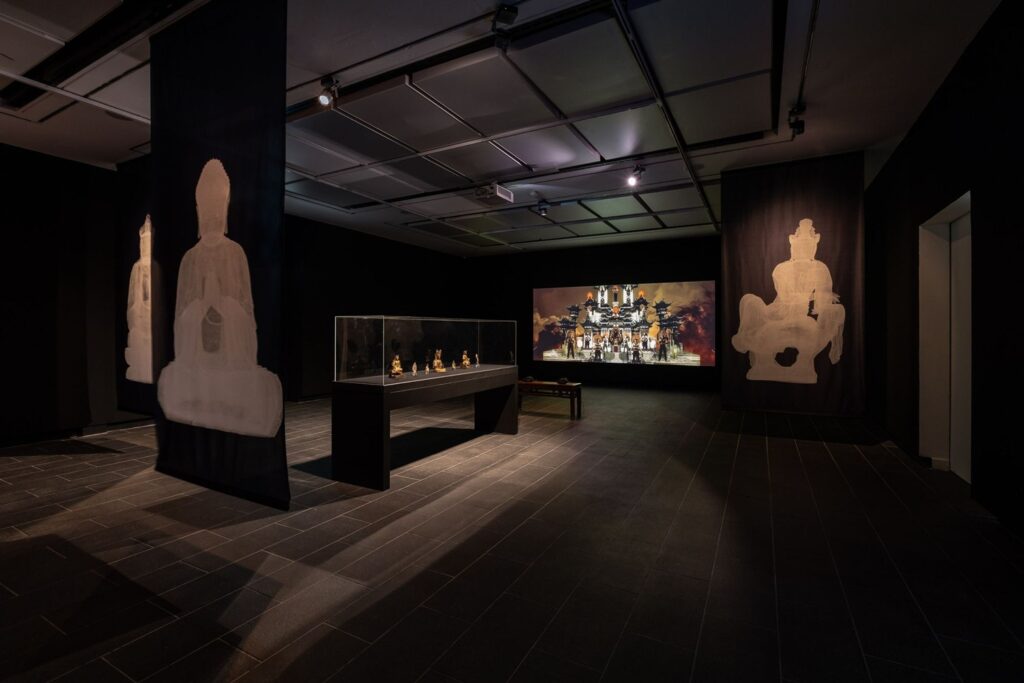
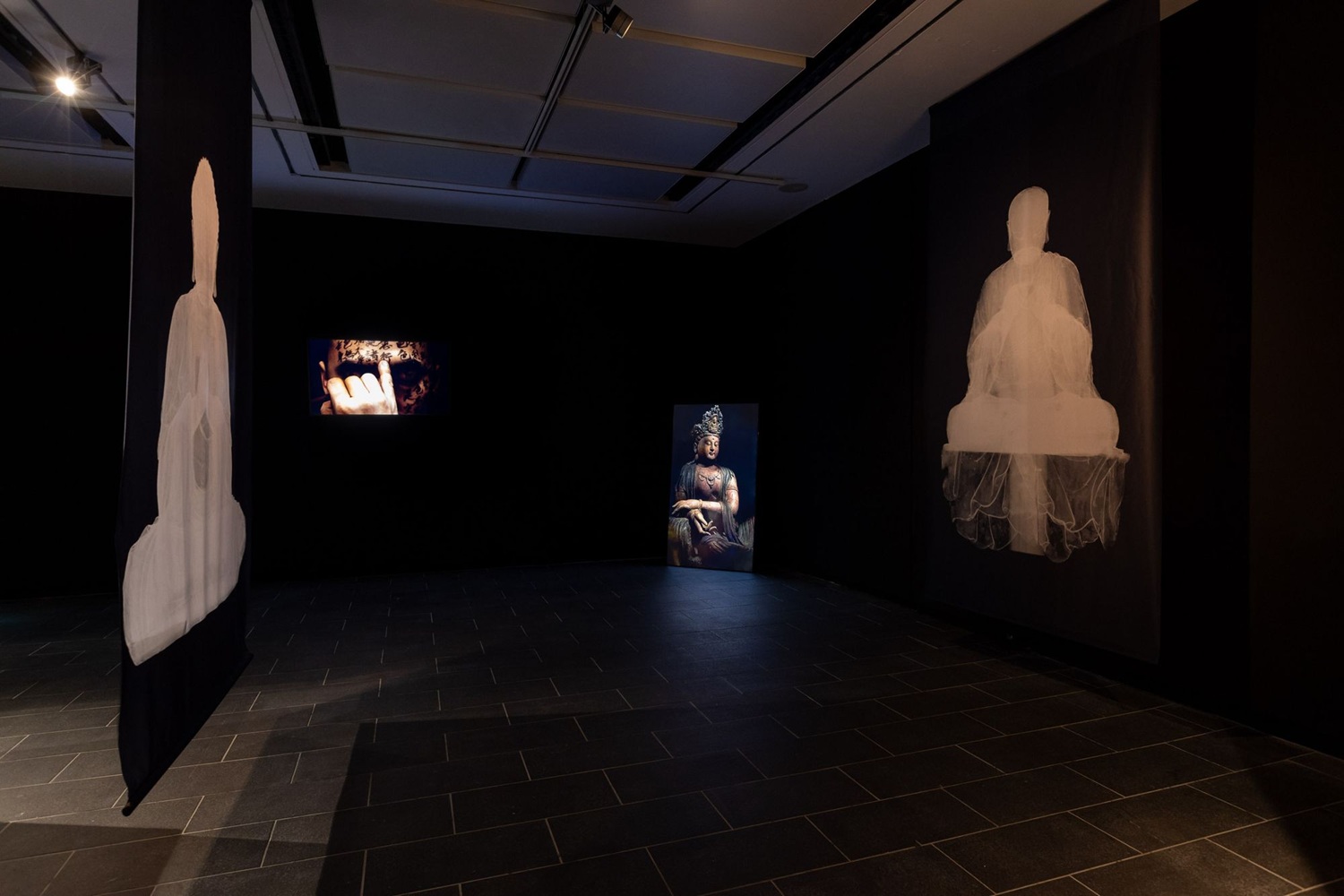
Absent from this show are the twenty large Buddha sculptures which were present at MAO. Assistant Curator Julia Jiang generously explains that the original sculptures would be impossible to transport, particularly given the difficulty of preserving wooden sculptures. For the seven small figurines on display, a vitrine had to be purposely built in order to store and maintain the pieces at just the right levels of lighting and humidity. The presence of the larger pieces, however, is not missed. esea contemporary, instead, supplants them with hanging sheets of tracing paper that show x-ray images (completed by Fondazione Centro di Conservazione e Restauro) of the original large wooden Buddhas. The result is a series of enlarged white prints that resonate against a navy background, reminiscent of the stunning white and Prussian blue contrast found in a cyanotype. The hanging Buddhas split up the room without imposing hard walls, meaning that at any given position in the room, you get a sense of solubility, where you can always see the full space, though sometimes distilled through a thin, spectral-like tapestry.
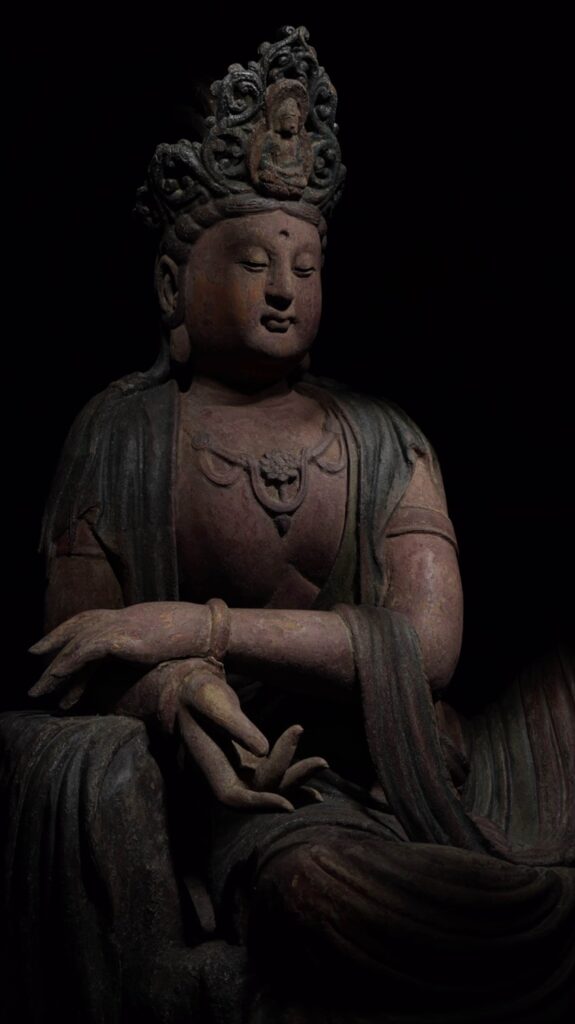
The rest of Shadow and Void: Buddha¹⁰ invites contemporary artists to engage with representations of the Buddha, as well as investigating their own relationships with Buddhism. In a striking, single channel video, artist Wu Chi-Tsung looks at a work shown in one of the tapestries – a Bodhisattva Guanyin from the Ming-Qing dynasty. In ‘Drawing Study – MAO Bodhisattva Guanyin, Ming-Qing Dynasty’ (2022), light gradually travels upwards from the base of the seated figure to its head, illuminating different aspects of the Buddha as it moves. From afar, you might think that the work is static. But spend a few moments in front of the screen and you’ll realise that Wu Chi-Tsung uses a torch as a brush in order to capture the silhouette of the sculpture. The video is only twenty-six seconds long, but I continually find myself returning to it as a touchpoint for the exhibition. At any moment, you can turn around and see the light fixate on a different spot. At one moment, contours of the figure’s draped robes are cast into focus. At another, if you’re lucky, you see the Buddha’s face and its short, curling crown. Time moves in a different way, something ineffable and shifting, totally different to the fixed vitrine figurines that carry a sense of fragility. Here, light acts as both a revelation and a veil, creating swings between playfulness and intimacy.
Other highlights include artist and animator Sun Xun’s film ‘Being is Negative (唯幻 / Illusione)’ (2023). Sun Xun skilfully blurs painting with animation in a series of shots, that in the artist’s words, ‘challenge conventional notions of spirituality’, drawing from Buddhist thought that suggests that all perceived reality is an illusion. A spinning red light circles rapidly around the screen to reveal itself as the lit end of a cigarette. A camera pans through a room of terracotta Buddhas in varying states of degradation. A series of banal objects appear on screen – a coke bottle, a pillow, a vase – on screen for half a second, before disappearing into ink that runs down a man’s legs, saturating his ankles with its thick pigment. In a particularly striking sequence, we witness a transformation of animals, changing from a tiger to a monkey, to a fish, a hawk, a crab, before finally morphing into a painting of a man with his hands clasped over his eyes. His expression is one of exhaustion.
Taking up the entire right-hand side wall is artist LuYang’s film ‘Moving Gods’ (2015), a work that is perhaps less persuasive. It’s difficult to look at the vitrine of figurines without being affected by the quick, flashing imagery that dances across the screen, speedily moving between symbols of sacredness to ‘fiery, multi-dimensional aureoles, charting neuroscience, biology, anime and cosmos’. Maybe this is the point, that we’re not meant to have a static viewing experience of the objects. ‘Moving Gods’ moves from landscapes that look like the reddish, volcanic terrain of Mars, to imitation temples that wouldn’t look out of place in a dream hallucination scene out of The White Lotus. But the result is jarring, and feels hyper-stylised; the high-speed visuals are reminiscent of a music video, relying on spectacle rather than the measured contemplation the rest of the exhibition demands.
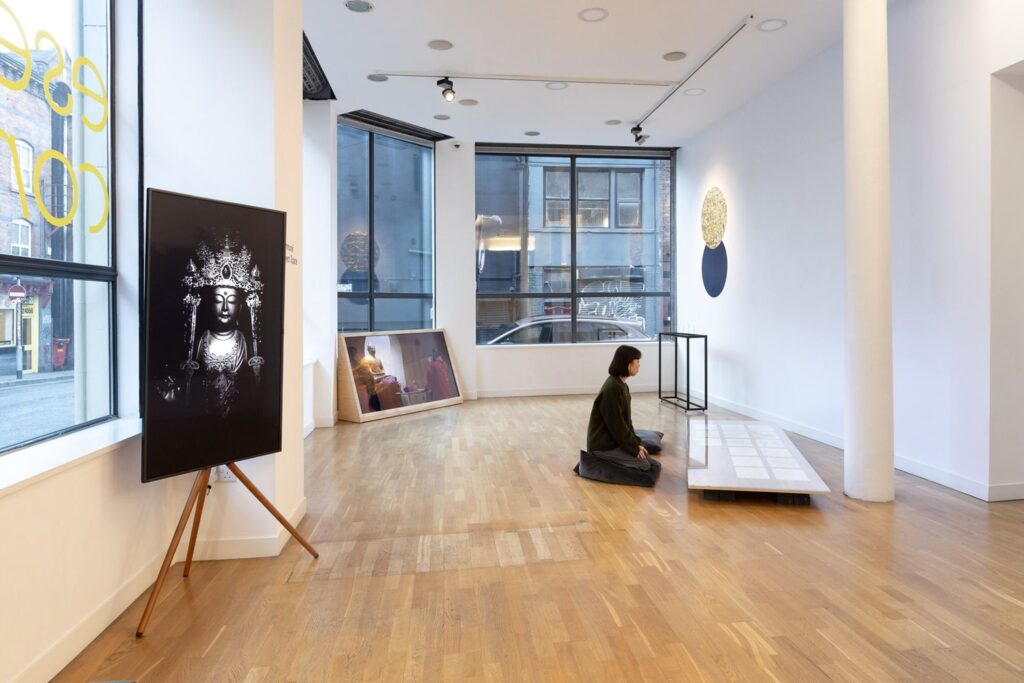
In the foyer, a long glass-laminated table bears drawings from Zheng Bo, an ecologically driven artist interested in ‘cultivat[ing] kinship with plants’. In ‘Drawing Life’ (2021), we’re given a series of plein-air sketches capturing Hong Kong’s dense plant habitats. The work was created during the pandemic as a meditative practice, where each piece is titled after Chinese solar terms, such as ‘Beginning of Spring’, ‘Rain Water’ or ‘Walking of Insects’. To look at the drawings up close, viewers can kneel on cushions on the floor, and peer at the drawings, at the hastily sketched branches and clusters of flowers that resemble exploding stars.
Next to this piece we find Sinta Tantra’s site-specific ‘Perfume’ (2023), an installation that stages a tray of burning incense beneath two overlapping circle-shaped murals – one in goldleaf and the other in deep blue. This is presented alongside Lee Mingwei’s ‘Spirit House’ (2022), a film that explores the exhibition of the same name at the Art Gallery of New South Wales from 2022. In the film, Mingwei describes how a rattan-wrapped stone was placed in the hands of a bronze Buddha each day. Visitors could take the stone if it ‘called’ to them, with the condition that they return it when its purpose on their journey was complete. I think of the The White Lotus again, of the season three opening scene in which a character prays to a Buddha sculpture for protection – before quickly retracting his prayer, exploding with profanities at the figure after it becomes clear his plea has not been granted. I wonder how many people returned the stone, whether it stood on someone’s mantlepiece, or beside their bed, or whether it became another transactional gesture, worthy only in its attendance as a souvenir, a mark of having engaged with a desirable experience.
Perhaps one of the main difficulties with the exhibition is its lack of context. For a show that asks where these works come from, I couldn’t see a wall text (although there is a gallery guide in a pocket book you might miss when entering the main gallery). Instead, there’s a small digital slideshow in the Main Gallery, but the text belongs to the original Turin exhibition, often describing works that are not on display in the Manchester venue. One slide, for example, describes how the lighting in the museum has shifted from ‘dim to stark’, reminding us of how the ritual context, once integral to these devotional objects, has been irrevocably lost. But the room we’re in is not stark – in the main gallery, the walls are black, closer to something like backstage setup, rather than the glaring arrangement the slideshow alludes to. We’re given a sense of the extended journey the Buddha figurines have travelled, from the objects’ original locations to private Italian collectors, then to MAO and finally to Manchester. It’s not a comfortable journey – think again of the Tianglongshan lootings – we’re reminded that these works have been removed from a devotional setting and shuttled into a display case.
A number of slides mention Chinese forgeries, explaining that two small sculptures in the room could come from the same source as many other examples of fakes that proliferated in the 1980s and 2000s. If you haven’t been on a tour, this information is confusing, even leading visitors to believe there are forged Buddhas in the room. One slide describes how to spot a forgery: ‘Organic statues are dynamic, in constant tension. Look at how static and poorly carved these two [fake] Buddhas are compared to our larger statue. They certainly do not exude any particular sense of divine.’ Again, we can’t see the figures being referenced on display, and I find myself pausing, unsure how I would conceive of the divine. I wonder, is kneeling down to peer at Zheng Bo’s drawings a way of engaging with the divine? To get on my knees and lean over, to place my hands against the glass table and trace the outlines of the undulating stalks rising up from the undergrowth of Hong Kong? Or watching the light travel up the clasped hands of Wu Chi-Tsung’s ‘Drawing Study’? This isn’t what the slide intends – it’s referencing the original Buddha figurines – but it does lead me to locate acts of devotion in the contemporary works.
While looking at the exhibition guide of the original MAO show, displayed on the reading table in esea contemporary’s foyer, I learn that the wooden Guanyin statue, linked to the Sui, Tang and pre-Tang dynasties, the subject of both one of the hanging tapestries and Wu Chi-Tsung’s video, belonged to Mario Prodan, a famous Italian collector of Chinese art during the first half of the twentieth century. After this death, the statue was sold and later acquired by MAO. The story of the sculpture’s acquisition raises questions including, what were the circumstances under which Prodan, a private collector, obtained the work? Perhaps Prodan acquired it, as many Western private collectors did, following the collapse of the Qing Dynasty, a time in which China entered a period of instability marked by the Chinese Civil War (1927-1949) as well as repeated invasions by Japan. China’s weakened central authority would have allowed for informal networks to thrive, facilitating the illegal or semi-legal passage of valuable cultural artefacts into private collections, particularly in the West. We don’t know how Proban got the Buddha artefact. The guide emphasises a committed effort to carbon date the piece and clarify its origins, but even in carbon-dating it I’m unsure if this reconciles how far removed the piece, now via a museum to a temporary gallery show, is from its original cultural context.
Above my desk, as I write this, I look up at a poem I haven’t read properly in years. It reads ‘buddleia not buddha chanting in bloom / buddleia not buddha buddling on my tomb,’ from Will Harris’ ‘Buddleia Not Buddha.’ Harris evokes the idea of how symbols are reduced to superficial language, made meaningless. It feels fitting. The figure of the Buddhist artefact has been so profoundly decontextualised in the West. I couldn’t even write this article without referencing The White Lotus – I’m part of the issue too. In some ways, Shadow and Void is an exhibition about hauntings. It’s a show haunted by a larger previous exhibition in Italy – where, everywhere you go in the Manchester gallery, you’re reminded that this show, is a fragment of that. Even some of the text belongs to the Italian show, and not the Manchester one. But’s it’s also a show that is haunted by the tension between the Buddha’s sacred origin, and its contemporary commodification as an object. I don’t think Shadow and Void: Buddha¹⁰ seeks to reconcile these things – we’re shown the Buddha figure and Buddhism in many different iterations, as we’re shown its displacement not just as a physical object, but a cultural signifier. To reflect this, the Buddha figure appears in several different guises: as film, x-ray and goldleaf, as handed down, stolen and hollowed out. We’re invited to confront all of these transitions, as we find that both as a physical object and an artistic concept, the Buddha figure does not remain in place.
Shadow and Void: Buddha¹⁰, esea contemporary, 18 January – 20 April 2025.
Chloe Elliott is a writer and poet based in York. She is currently completing her MPhil in History of Art at the University of Cambridge.
This review is supported by esea contemporary.
Published 24.03.2025 by Jazmine Linklater in Reviews
2,697 words


