Antony Pickthall, Head of Marketing and Communications at the Liverpool Biennial, gives his views on the North West’s leading contemporary art fair, The Manchester Contemporary, which took place in Manchester from 28 to 30 October 2011.
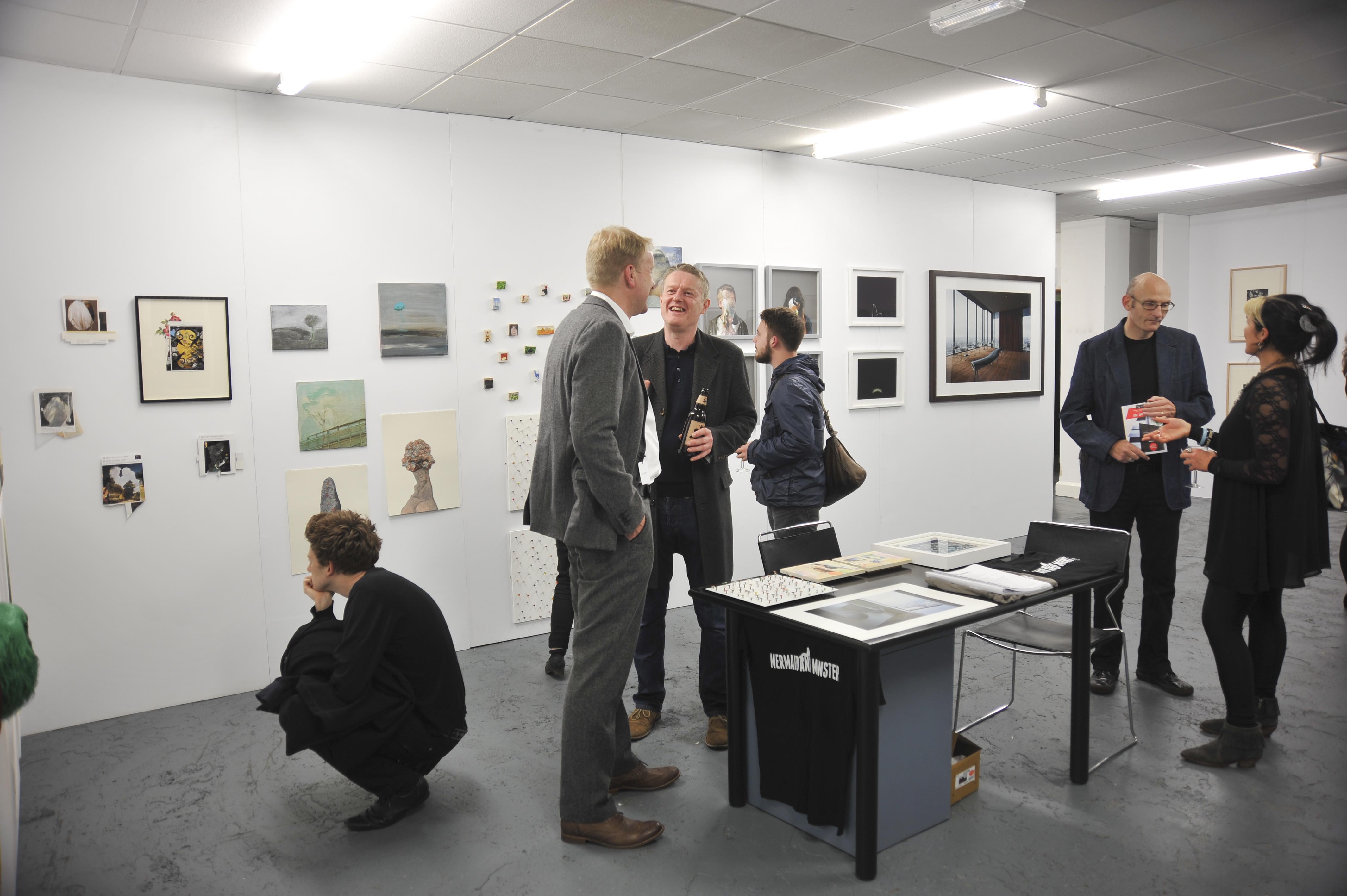
Opening of Manchester Contemporary, 2011
With the ballyhoo surrounding Frieze Art Fair focusing attention on London it is sometimes easy to forget that there has been an art fair in Manchester since 2009; one that presents a strong picture of commercial art galleries outside of London. The ten galleries in The Manchester Contemporary 2011 hail from Bristol, Cardiff, Gateshead, Liverpool, Manchester and Cardiff, as well as London and bring together the work of 37 artists working across diverse forms.
The artists on show reflect the established as well as the emerging, mixing painting, sculpture and digital art. As a snapshot, this year’s art fair underlines a return to painting and drawing and the strength and depth of younger artists working across the country.
Some of the local artists represented are clearly leading the development of the fair’s reputation: Iain Andrews’ painting is vibrant and strong, almost in your face with its thick layered paint ; Samantha Donnelly’s sculptures are subtly powering a commitment to ideas and Rachel Goodyear’s work is witty and confrontational.
Bristol’s WORKS| PROJECTS works with an impressive group of artists, including the highly sought after Richard Wilson and Richard Woods but work by David Mackintosh (also based in Manchester) and Edwina Ashton was especially exciting. Mackintosh has an attractive fundamental simplicity in his drawing, working with bold colour and line. Edwina Ashton’s sculptures were – it turned out – just the tip of her work’s unsettling iceberg. She makes performances and films that play with humour and the unexpected in satisfyingly surreal tributes to the extraordinary in the ordinary.
A new addition to the fair in 2011 is The Print Room. Here visitors could view and purchase a wide range of limited edition prints. Works for sale by artists from The Manchester Contemporary exhibitors were complemented by prints from a selection of other invited organisations. In addition, a series of information and project spaces included presentations from artist-led spaces, artists’ agencies and partners of The Manchester Contemporary.
There is no doubt there is considerable ambition at the heart of the three-day event but perhaps it needs to pull itself further from the orbit of the Buy Art Fair, which is not presenting critically engaged artists and appealing to a much broader market place.
It has significant partnership activity with the Contemporary Art Society and The Manchester Contemporary VIP programme was aimed at developing even stronger links to contemporary art collectors, offering them the chance to meet artists in their own studios and to develop their knowledge about what these artists aspire to achieve.
One of the ways it could do this is by developing a programme of new commissions, perhaps in partnership, in the manner of Frieze Art Fair. A series of new commissions could provide additional reason for audiences, critics and collectors to explore the work of some of the UK’s leading artists in the context of the North West and actively demonstrate why when artists are not only given the chance to stretch themselves but ably supported in the process, they can create the work that demands our attention.
Antony Pickthall is Head of Marketing and Communications at the Liverpool Biennial.
@antonpick
Published 02.12.2011 by Bryony Bond
570 words