Truman Capote once remarked that his friend Cecil Beaton was ‘a total self-creation’. This is certainly the stance taken in Harewood House’s collaborative exhibition with the National Portrait Gallery, Cecil Beaton: Staging Icons. Cecil Beaton is remembered as much for his personality as his multi-hyphenate artistic talents, thanks to his glittering social circle and waspish sense of humour. His output spanned Oscar-winning costume design for Audrey Hepburn in My Fair Lady, set design for the Metropolitan Opera and the Royal Ballet, and, most famously, photography of the twentieth century’s great characters. With some of these portraits on display for the first time, visitors are offered a comprehensive encounter with Beaton’s oeuvre, the work of a man who understood the power of performance, onstage and in life.
Staging Icons is divided into eight rooms, in a guided route which encompasses half of Harewood House’s ground floor. When visitors enter the first room, they encounter a wall printed with Beaton’s ‘Self-Portrait in Studio’, taken in 1933. He gazes back at visitors, with a knowing smile and affected pose, amongst a dishevelled set. The exhibition’s thesis statement, that Beaton’s self-presentation was its own form of performance, is made immediately clear.
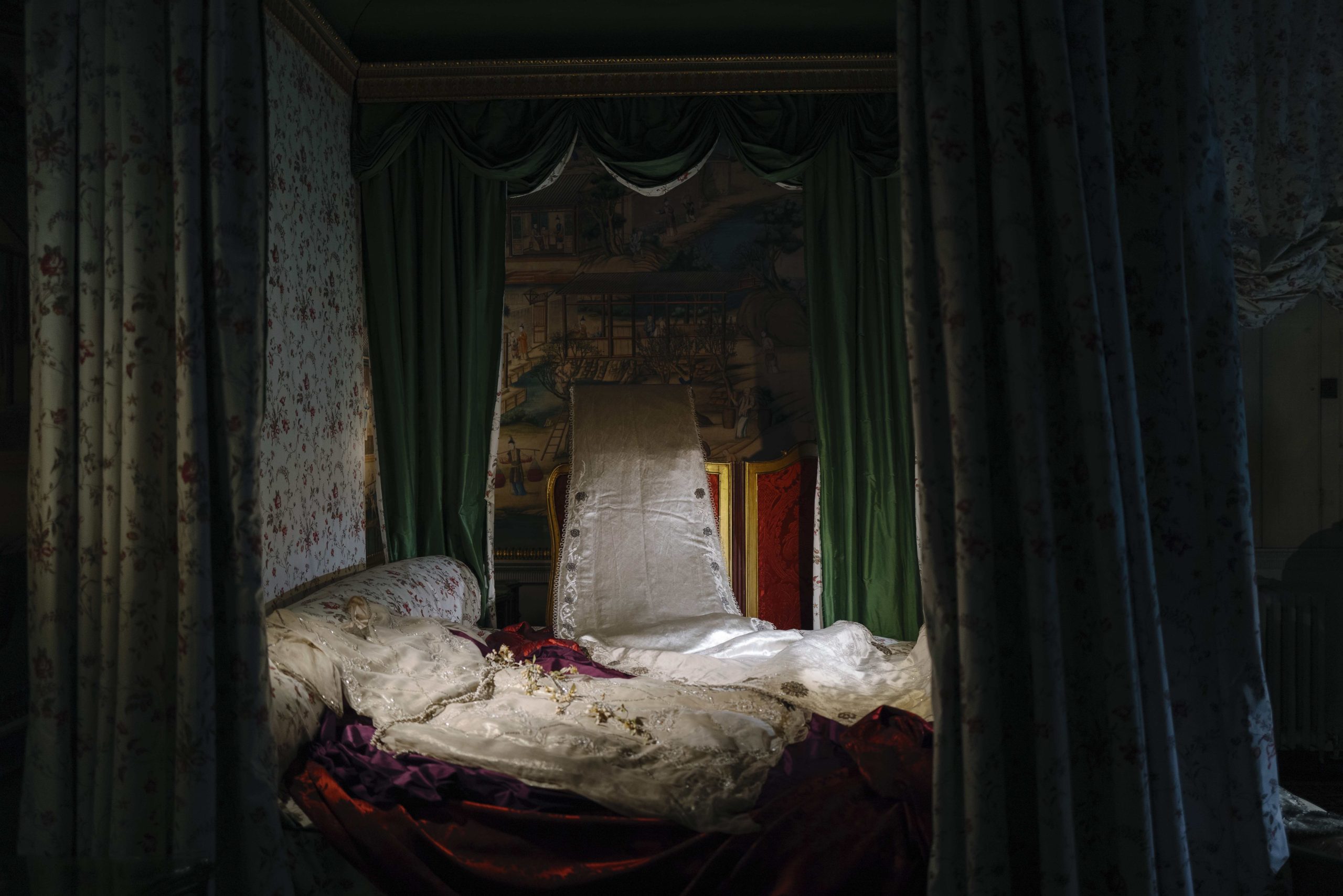
Much is made of Beaton’s passion for Britain’s aristocracy, with four of the exhibition’s rooms named ‘A Visit to Harewood’, ‘Beaton and the Harewoods’, ‘A Royal Occasion’ and ‘Staging Royalty’. One memorable display employs Harewood’s status as a royal household by reimagining Princess Mary’s bedroom as a theatrical set. Her wedding dress is laid on a four-poster bed, with her shoes and her mother’s hats whimsically mounted across the other furniture. This creative installation is a nod to Beaton’s 1971 fashion exhibition at the V&A, for which he visited Harewood House to borrow the royal garments.

The House’s architecture proves to be a most suitable setting for a look at Beaton’s career. With its Georgian, Neoclassical flourishes, and windows offering views of gardens designed by Capability Brown, it seems to remark upon the self-consciously constructed nature of aristocracy, something that Beaton embodied in both his portraiture and his life. Indeed, Beaton’s class background is emphasised repeatedly in the exhibition’s wall text, as multiple rooms reference that he was from an ‘ordinary’ and ‘suburban’ middle-class family. A contestable claim, as Beaton was the son of a wealthy merchant and attended Harrow before going on to St John’s College, Cambridge, where he made the social connections that allowed him candid access to the royal family. Nonetheless, this exhibition reads Beaton’s outsider status as stemming from his non- aristocratic origins.
Beaton’s impressive engagement across the performing arts is highlighted in Lord and Lady Harewood’s sitting room. One section, named ‘In Character’, presents photographs of Laurence Olivier, Vivien Leigh and Audrey Hepburn on the set of My Fair Lady; another, ‘Behind the Scenes’, features Beaton’s sessions with British dramaturgs of the 1960s – playwrights Alan Bennett and John Osborne, and director Jonathan Miller. Next door, this narrative continues in ‘World of Dance’, with elegant images of Rudolf Nureyev and Margot Fonteyn.
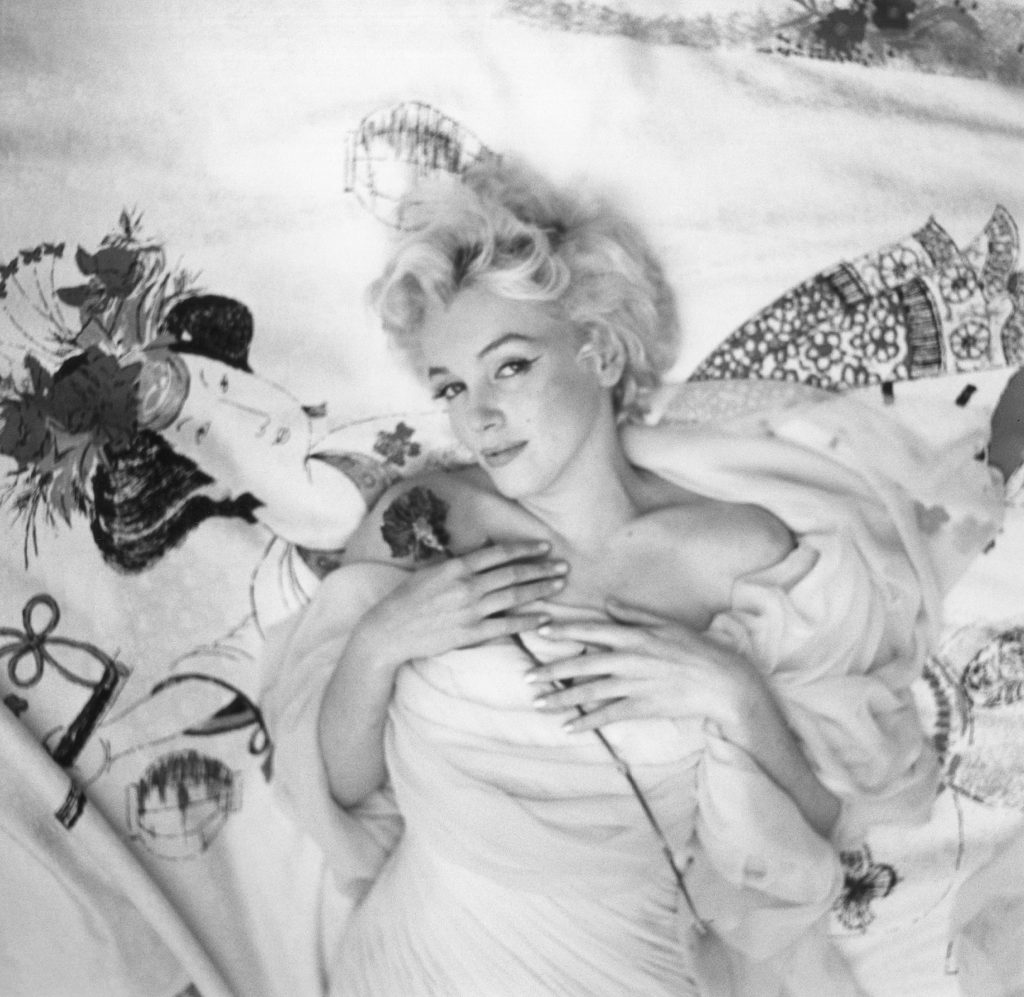
Many visitors will no doubt be drawn to Staging Icons to see the collaborations held in the final room of the exhibition, ‘Leading Lights’. Here are many of his most familiar works, of film stars such as Marilyn Monroe, Julie Andrews and Greta Garbo. Monroe’s portrait reveals the innocent side of her beauty, as she reclines in a hotel bed in a white dress, charmingly holding a carnation. This is accompanied by a description sharing Beaton’s flippant remark that her life ‘would all end in tears’. Next to Monroe is his photograph of fellow Hollywood legend Elizabeth Taylor, a more soft-focus look at a woman known for red-blooded excess. Off camera, Beaton sneered at her for her ‘vulgarity’ and ‘fat, coarse hands’. These comments are not quoted directly in the wall text, although there is some reflection on Beaton’s Book of Beauty (1930), a manifesto exploring his strict ethos on physical attractiveness. ‘Leading Lights’ ends the exhibition with an uneasy tension, between Beaton’s gift for portraiture, and the controlling, often discriminatory, instincts underscoring his aesthetic sensibilities.
Also on display in ‘Leading Lights’ is a 1941 image of music hall star Lily Elsie, which provides a cyclical note for the exhibition to end on. In ‘A Star-Struck Child’, the second room of Staging Icons, the wall text states that Beaton credited Elsie as the catalyst for his artistic career, after seeing a postcard of her by his mother’s bed at three years old. Visitors are reminded that, from childhood, Beaton indulged in his own form of diva worship. As his career progressed, he saw such encounters with his idols as a marker of success.
This illuminates an underlying theme which is apparent throughout, although less clearly articulated. Beaton was known to have had relationships with both men and women, but his outlook undeniably anticipates later gay male artists such as Warhol and Derek Jarman. His need to escape into fantasy, his obsession with eluding his own effeminate physicality and imposing his aesthetic desires onto others, may be read as a queer person seeking to bend the world to his will rather than attempt to conform to the heteronormative, bourgeois world he was born into. This can even be seen in his subversive habit of signing his name in vivid pink ink, a signature which appears across the promotional materials for the exhibition.
Beaton’s life was in many ways a triumph of queer self-fashioning, done in a spectacular style by a man who enjoyed immense privileges. Staging Icons is a fittingly extravagant look at Beaton. There are many pleasures to be had in appreciating his ability to capture famous faces in intimate, yet emblematic moments. If only this exhibition felt able to delve more deeply into its complex themes, and the (at times) cruel man it concerns, then it could look beyond Beaton’s ‘staging’ and into his inner world.
Amy Kitchingman is a writer, curator and cinephile based in Leeds
Cecil Beaton: Staging Iconsis on at Harewood House Trust, Harewood, from 13 June – 4 October 2026.
This review is supported by Harewood House Trust.
Published 29.07.2026 by Benjamin Barra in Reviews
1,086 words