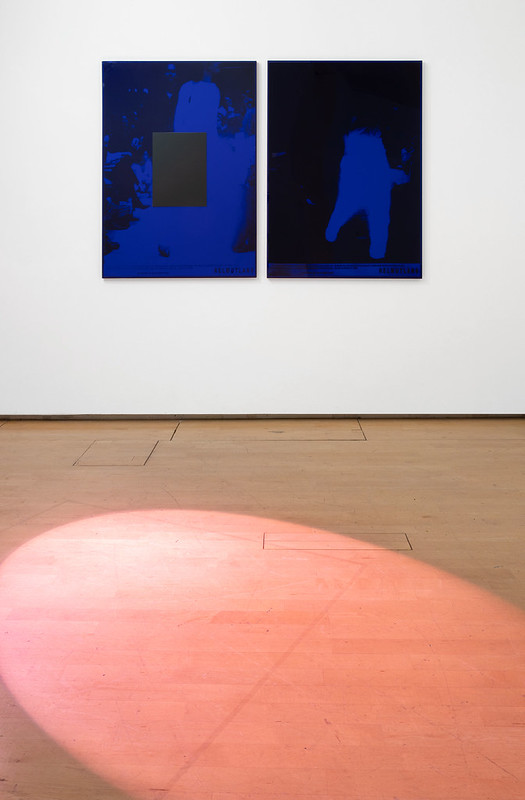
Bending my neck uncomfortably, I realise I’m standing just too close to the high-shine surfaces of Simeon Barclay’s ‘A Track with No Name’ (2018) to decipher its imagery. A diptych of high-contrast monochrome photographs under glossy, semi-opaque blue Perspex sheets, on the left I can make out a clear, skull-like head floating above a shadowy undergrowth tangle of limbs and faces. The right-hand image reads mostly black, my own face reflecting back unhelpfully as I lean towards it, gallery lights bouncing off the hard plastic, interrupting my reading. Just behind me, the floor space is lit by a hot pink spotlight, angled purposefully towards the centre of the room. To fully take in Barclay’s artwork, I will have to step into that illumination and put myself on show.
This is the conceit of Curtain Up, a group exhibition curated by Zoe Watson in the Lowry’s Andrew Law Galleries that includes works by Barclay, paintings by Denzil Forrester, Joy Labinjo and Ryan Mosley, collages from Abigail Reynolds and cyanotypes by Bridget Smith alongside three major new commissions from Ulla von Brandenburg and Manchester-based artists Chris Paul Daniels and Rowland Hill. The Lowry is a multipurpose arts venue whose three performance spaces contain 2,300 seats, and their programme is just as vast—the press release says the building hosts almost one million visitors each year. As a millennium regeneration project, the Lowry has by now hosted a quarter century of performances, and Curtain Up is billed as a homage to this history. It sets out to celebrate the communal delight of audiences in spaces such as theatres, clubs, fairgrounds, cinemas, community halls and art galleries, whilst gently probing the power dynamics inherent to spectating.
At tonight’s opening, there’s something magical happening: the crowd feels more warmly cohesive than many gallery openings, aware of ourselves as an integral component of the show. So, emboldened by the effects of the tart rhubarb fizz we received on arrival, I begin by stepping onstage, moving into that circle of pink light.
Barclay’s images fall into place as fashion posters, ‘Helmut Lang’ just visible along the bottom edge. These runway shots are taken from the perspective of the catwalk, explicitly messing with the positioning of subject and viewer, Barclay messing with visibility through layers of transparency and opacity. Is the opaque black rectangle overlaid on the lefthand image its true subject? Or am I, newly illuminated and more clearly reflected back beside it? From this position, light falling differently through the Perspex, the blue faces now read starkly as white. Who here interpellates whom, and as what? Viewers are plunged into an inaccessibly exclusive high fashion event, where all its participants, from models to viewers and photographers, are already spectator-performers, to question the very formation of identity through visibility. This racially coded, classed interaction opens the exhibition with a master stroke. Giddily, we all watch ourselves being looked at.
The first new commission here is the curiously titled ‘Spirits are Matter’ (2026) by Ulla von Brandenburg, a colossal curtain which cuts a corridor out of a larger gallery space, hanging wall to wall, ceiling to floor, in a bright geometric patchwork of reds, blues, dark purples, oranges and greens. The hand painting of these colours onto the cotton panels is evident in the varying patches of opacity, especially in the paler mint greens, turquoises and sandy browns. All the process and function of this item are on show: the parted doorway held with raw brown rope, totally functional, and unused curtain pole loops punctuating the top edge at regular intervals. The fabric’s slight transparency under institutional lighting makes the pressed seams visible from the front. This curtain documents the precise and arduous labour of its making: the meticulous joining of panels—some mere centimetres across—to accumulate a geometric pattern of curving arcs and intersecting lines at sharp angles.
Standing in front of it, I’m reminded of the circus. Its scale turns me into a small child looking upwards in anticipation. Its opening beckons, but passing into the big top I find myself backstage where, behind the scenes, even more of the artwork’s making is revealed. Raw patches of cotton, where paint hasn’t seeped all the way through, create a contrast of more organic, marbled colour work with the angular block pattern. Here are the starker seams, hanging threads, heavy duty brown heading tape.
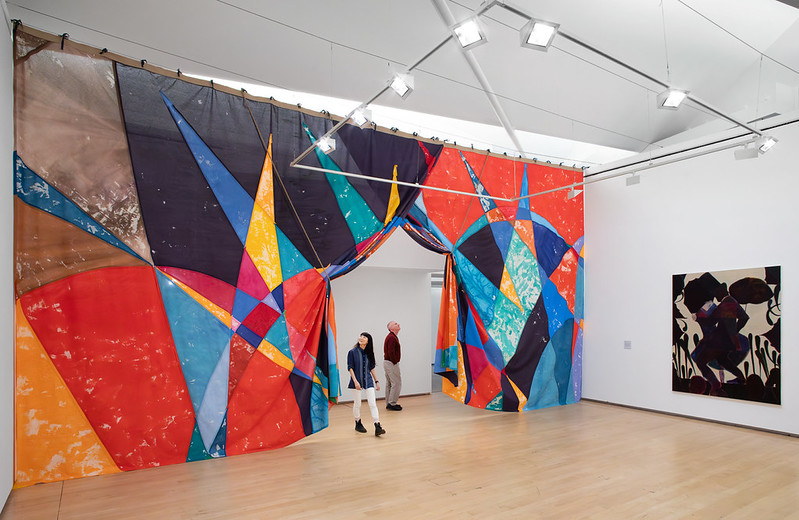
I’m not quite convinced by the reading, offered by the wall text, that this curtain challenges hierarchies of the theatre by allowing usually static observers to cross over into active participation merely by stepping through it. For one thing, we are already in an art gallery. Even if we hadn’t begun with Barclay’s reflective surfaces, the major difference between a traditional theatre audience and gallery audience is always the level of activity in our participation—our bodies moving through space, modulating our altering relationships to works in the room, moment by moment, is one of the foremost pleasures of physically navigating an exhibition. I’m also not sure this curtain is immediately legible as a theatre curtain, a far cry from the stereotypical plush red velvet we might first imagine, or the ruched drapery of Bridget Smith’s cyanotypes elsewhere in Curtain Up.
von Brandenburg’s title, ‘Spirits are Matter’, introduces one of the show’s more latent themes of religious, or pseudo religious, ritual, and their physicality—apt because the physicality of this thing, much more than the paratextual meanings on offer, creates the artwork’s delight. Nonetheless, introducing sprits to the room ushers metaphor into the curtain’s threshold, which is bolstered by assistant curator Grace Buckley’s accompanying text situating the work in early twentieth century spiritual practices. Citing a synaesthetic theory of emotional colour profiles developed by Annie Besant in 1905, Buckley’s suggestion that von Brandeburg’s palette reflects the various emotional states of an audience does intellectually augment the work, but I’m not sure how much it adds to my enjoyment of it, which persists wholly through its navigable material, visual qualities.
Buckley’s text places the exhibition more broadly within the concept of collective effervescence—wonderfully pertinent tonight as our amassed glee floats on rhubarb bubbles. Coined by sociologist Émile Durkheim in 1912, collective effervescence describes the communal affect that powers a crowd, especially in a religious context. But looking up at ‘Spirits are Matter’, I think of the twentieth century American pragmatist John Dewey, and his argument that our inherent capacity for spiritual, religious, supernatural feeling has been claimed by organised religion, effectively locking those of us who identify as nonreligious out of the possibility of such experiences. Perhaps I am incapable of enjoying von Brandenburg’s installation beyond its physicality by dint of my rationalist life training.
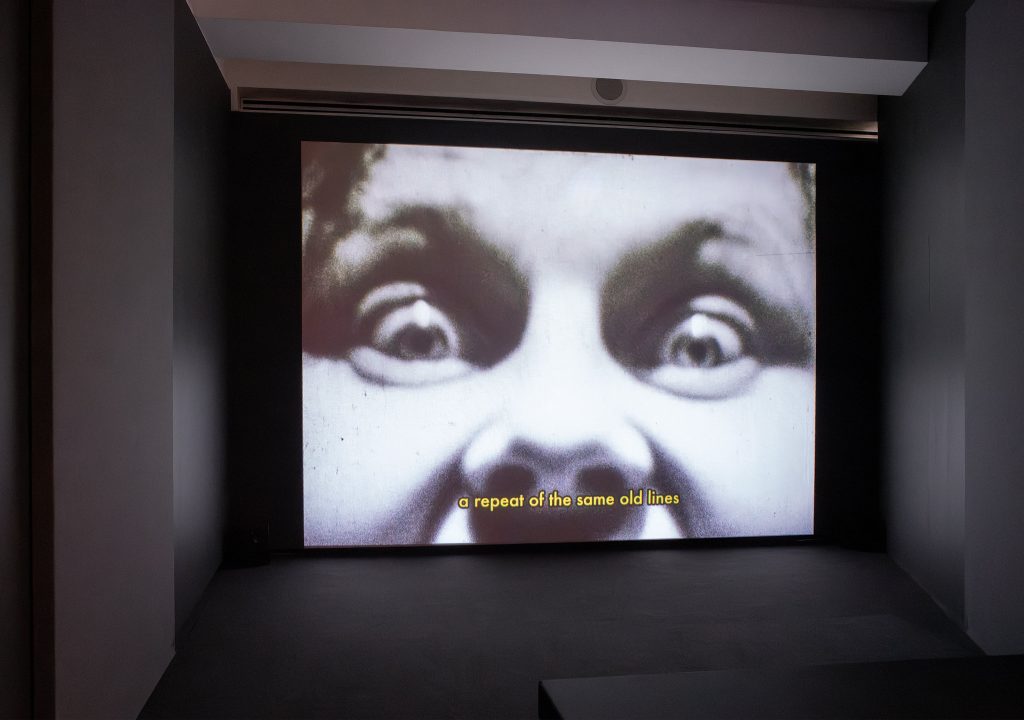
Crossing its threshold again, I detour into a darkened side room to watch Chris Paul Daniels’ new film, the second commission of the exhibition, ‘Give Yourself a Round of Applause’ (2026). Pieced together from performance related footage found in the North West Film Archive, its voiceover narrative is displayed in yellow subtitles, spoken by musician and producer AFRODEUTSCHE. The wall text prepares me to encounter an unreliable narrator, leaving me wondering what my role will be if my starting point is distrust. But the footage is irresistibly endearing. Here are community halls and amdram productions, kids’ theatre, cine societies, magic shows with sleight of hand and illusion, mask fabrication and dance shows. Everywhere, the home movie style feels intimate, increased by Daniels’ mention in his opening night speech of his parents’ meeting in an amdram group. Even with the most bizarre spectacles on screen—the literal belly laughing of two big-smiled top-hatted characters milling around on stage that turn out to be two decorated torsos rhythmically deep breathing, or a dog walking on hind legs for slightly too long before a glittering foil curtain—I feel close to what I’m watching, like it could be my family’s memories on screen.
The narrative, however, does its best to drive a wedge between the screen and me. Flitting between authoritative criticism, metacommentary on the film being screened, aphorism, skewed idiom and hyperbolic confession, there are many references to familiar stories: fairytales, biblical stories, fables and myths. Mephistopheles and Orpheus are both mentioned, two characters who journey to the underworld, suggesting that the surface isn’t all it seems. What, for example, does the sentence, ‘Shame is misremembered joy’ actually mean? Despite its illusion of narrative, this text is impossible to follow. I’m reminded of Noam Chomsky’s grammatically correct, semantically meaningless, sentence: ‘Colourless green ideas sleep furiously’. Poetic, frustrating, a misfired attempt at highbrow gloss over middlebrow imagery. The narrator’s unreliability turns back on itself, inducing trust in the film’s self-awareness, which seemingly comments on the simultaneous self-certainty and vacuousness of much contemporary art world posturing.
‘Give Yourself a Round of Applause’ is a frantic viewing experience. The frequency of change holds recognition just at bay, so that any illustrative moments offer calmer respite. When we hear, ‘all pay the full price no concessions’, and see hands exchanging cash for tickets, for example, or when we hear, ‘someone is stealing your voice’, over a ventriloquist and dummy. Short of deconstructing the mechanics of storytelling, as the wall text claims, I think Daniels, by repeatedly teasing us with the suggestion of them, ultimately refuses traditional narrative arcs. There is no hero’s journey here, but a cumulative atmosphere of performance that holds whimsy, joy and laughter alongside authority, denial and confessional self-pity, as the text evacuates itself: ‘I’m giving up on bad dramas and imaginary arguments’, it states, Janus faced and bamboozling.
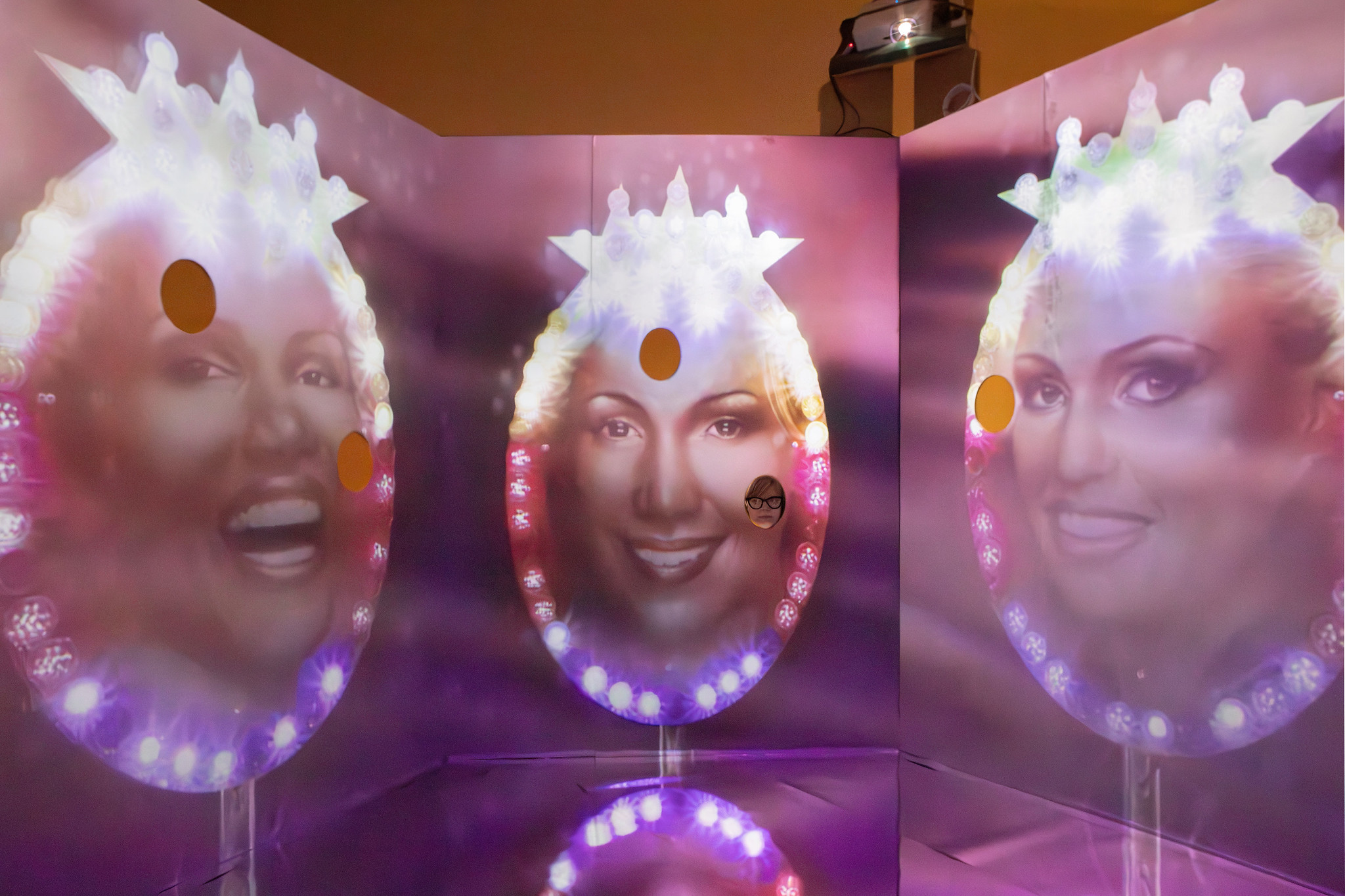
Eventually I head to the exhibition’s grand finale, Rowland Hill’s ‘Relic’ (2026), a ten-minute long video installation, the final new commission here. It seems I’m backstage again, now in the afterparty. At the centre of the packed room, where the volume of laughter matches the thumping soundtrack, is a standing hexagonal structure of bare MDF and pine frames topped with three projectors pointing inwards. People variously press themselves up and lean down to slot their faces into the cutout ovals spaced randomly around the walls; when someone moves away, I see flashes of blue moving through a hole. A surprise arc of light appears on the gallery wall behind, situating the structure at the centre of a mysterious planetary system.
Rushing forward to take their place, I discover the hole is marginally too high for me—craning my spine unnaturally augments the trippy feeling I get from the magical footage of colour changing plumes of smoke, pink to purple to blue, and enchanting sparkling lights. Luminous and transportive, hazy memories of funfairs drift over footage of spinning rides until I accidentally catch someone’s eye and we both burst out laughing. Preoccupied by awe, our own visibility took us both by surprise. I had forgotten I wasn’t safely ensconced in a traditional audience, all our eyes pointing in the same direction. Rather, I realise, I am part of the image for the people on that side of the hexagon, just as they are for me, their little floating faces so full of wonder, eyes rolling around in their heads to take in the display of projectors and everything they show.
We are just one form of portraiture here, mixed in with the strangely unrecognisable paintings of celebrities you see at fairgrounds—is that Bono? Robbie? Is that Halle Berry? Is that Tony Blair? Hill’s own self-portrait appears in the film at one point, larger than life and serene. But insofar as ‘Relic’ is a portrait, it is of Loughborough Fair, the place where all the footage—filmed by Paul Daly—comes from, which Hill has been documenting for over a decade. That she grew up just streets away from the site which has housed a travelling fair of some kind since 1221 is evident in the shots of red brick suburban house facades, punctuated by the reflection of multicoloured rides sweeping rhythmically across their windows. This distanced doubling is echoed in the funhouse mirrored floor, which returns everything as a warped, upside-down world at the centre of this spinning elsewhere fiction. Suddenly the mood becomes quite sinister, the soundtrack—designed by Stefan Smith—doomy, the footage splitting, doubling, growing darker until, greyscale, this young lad in triplicate commences endlessly walking towards us without ever getting anywhere. Eventually I realise he’s moving in the centre of a spinning ride with others, just like us, strapped in around him while he’s freestyling it, dancing a bit, just keeping himself upright so casually.
Loughborough Fair is quite literally a medieval relic, and the various strands of Curtain Up conjoin in Hill’s installation. Palpably generating collective effervescence, its dizzying effect does at times come close to the transcendental thrill we seek on fairground rides, those precious moments when we lose ourselves entirely. I think of Dewey again, wondering how close the hedonistic rush of the fairground could be to a supernatural experience of communion. Has Hill found, and recreated in this gallery, one of the true sites of secular religious experience? Or perhaps, by packaging it within the props of its own artifice and turning our gaze back on ourselves, she’s done something more interesting. Elated, queasy, we turn away from the spinning kaleidoscope, wobbling back toward solid ground.
As much as Curtain Up is a delightful, embodied, whimsical exhibition, it’s the various guises of its devotional fervour that stay with me. I think of the commitment of its three commissioned artists, meticulously piecing their huge new works together from smaller component parts, and how each differently activates the viewer’s positioning, from navigating the reliability of narration to physically becoming part of the artworks for other viewers. While these interrogations of collective aesthetic experience and the social formations of identity are welcome interventions in an art world so saturated by political posturing, it’s worth bearing in mind that art galleries are, in some sense, always performing. By performing performance itself, I’m not sure that Curtain Up succeeds entirely in creating the necessary conditions for collective effervescence amongst its viewers in and of itself. Which is to say that tonight, the Lowry has a captive audience willing to collectively perform and interrogate its own role, brought together for the opening with speeches and pink fizz. But I wonder how the exhibition will fare later, whether the show has the capacity to induce collective effervescence amongst disparate, art-viewing strangers, encountering unique works alone on a Tuesday morning.
I’m left wondering too about the engagements with class throughout the show, from the representation of upper-class wealth in Barclay’s work to the working-class environments of the fairground and community hall from Hill and Daniels. What happens to our performance of class identities when we’re subsumed into a collective? Is performance itself, and all the power dynamics inherent in its staging and viewing, offered here as a bridge across class divides? Not for want of institutions like Salford’s Lowry trying, both gallery and theatre audiences remain largely middle and upper class. As homage to a quarter century of those audiences in the building, Curtain Up offers a curious tribute, repeatedly collapsing the fourth wall and muddying the distinction between viewer and artwork without necessarily contributing any material change to the class stratification of audiences or the inherent power dynamics of viewing all kinds of art. Or perhaps the gallery’s performance here is an attempt to offer itself as the secular church that creates an equal community of its visitors. If not quite a religious experience, Curtin Up does indeed remind us that every audience is also a community, and that, short of epiphany, a self-reflexive gaze on our collectivity can illuminate our joy.
Curtain Up is at Lowry, Salford, 18 April – 21 June 2026
Jazmine Linklater is a writer based in Manchester, and is a Regional Editor for Corridor8. Her new poetry publication is Snagged on red thread (Monitor, 2025).
This review is supported by Lowry, Salford.
Published 10.05.2026 by Laura Harris in Reviews
2,722 words