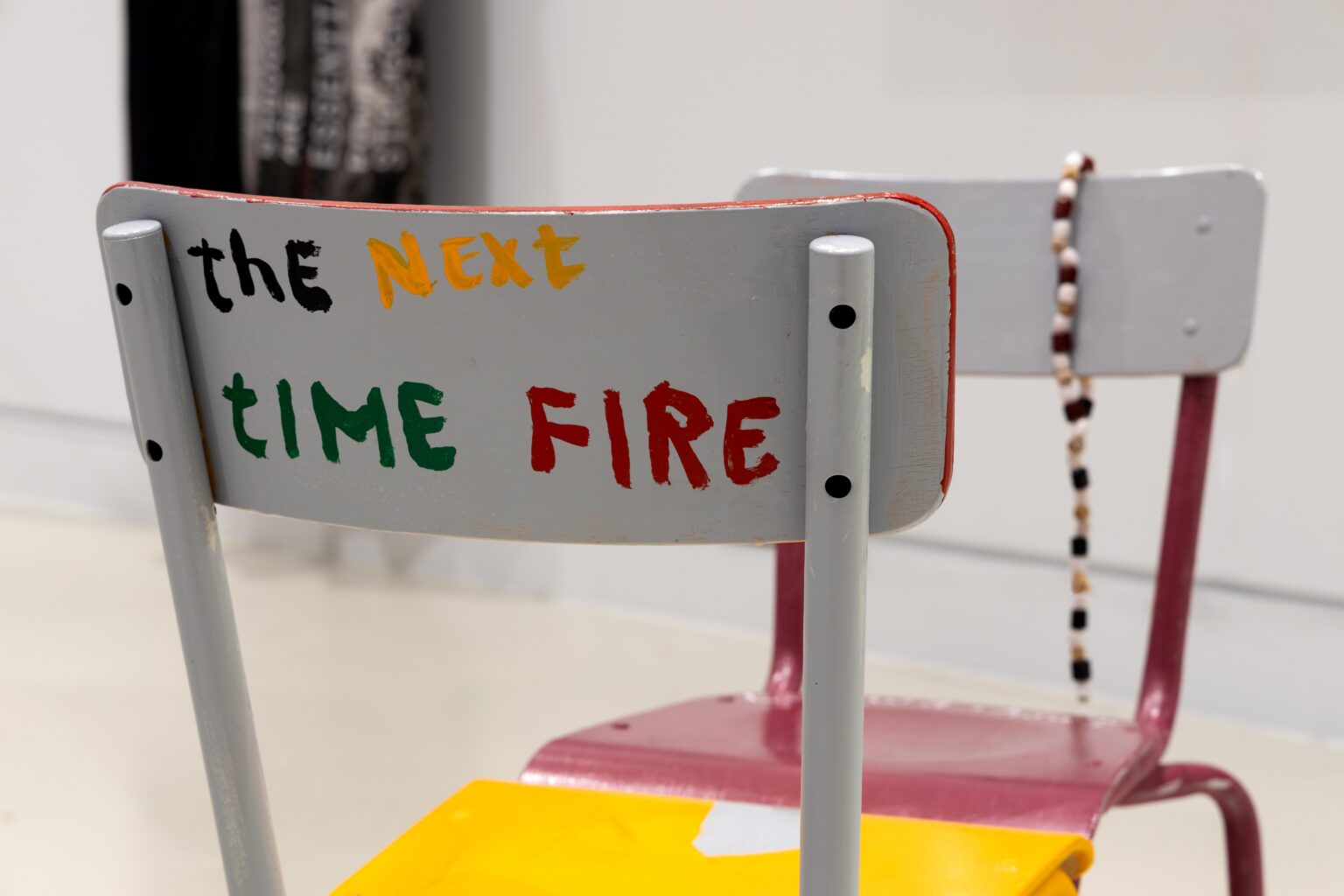
When I was commissioned to write this essay in response to Gavin Butt and Marianna Tsionki’s Mixed Up: Music and the Art School at Blenheim Walk Gallery, Leeds Arts University, I realised quite quickly that although this is a subject quite close to my heart (having played in bands in Leeds and having taught at two of the art schools in the city, as well as having written a review of Gavin’s recent book No Machos, No Popstars for Tribune magazine in 2022), I was just as interested in what a young art student in their early twenties might make of the exhibition. Talking to Gavin last year when he was invited by Leeds Beckett to give a lecture about the contribution of the Polytechnic to this scene in the late seventies and early eighties, he was insistent that this research was important in looking forward, that it should not be seen as a nostalgic salve, or as a weapon to beat the present day with – that there are urgent and necessary lessons in this research that resonate very powerfully with the current climate within both the art school and the wider culture. So I invited Olli Tipling, a very recent graduate of the Fine Art course at Leeds Beckett, to accompany me around the exhibition.
Olli’s art practice with Dani Sophia has revolved around their performance art group / band Pseudo Cunt, whose work reminds me of that being made by the art students shown in Mixed Up. Indeed, Olli knew the work of many of the bands depicted in the exhibition, in particular Frank Tovey’s Fad Gadget, but had not made the connection that many had studied on the same course as him forty years previously. We talked about how history has a way of repeating itself across decades (first time as tragedy, second as farce?), that perhaps there is something in the water, like the process of osmosis in art education where some of the same ideas become available or prescient in response to particular circumstances – which appears to support Butt’s assertion about the material’s continued relevance.
We also talked about the influences that the artists and musicians in the exhibition would have come into contact with at the Leeds art schools of the late seventies. Olli was particularly interested in the type-written statement by Andy Wood echoing a conversation with the then Fine Art Course Leader at Leeds Poly, Geoff Teasdale, who pointedly encouraged a very broad conception of what he termed ‘cultural production’ rather than Art. (The conversation can be seen in the documentary A Town Like New Orleans, available on Youtube.) Certainly, this stems from the Polytechnic’s attachment to Walter Benjamin’s ideas – the Fenton pub opposite the Poly became a de facto branch of Benjamin’s Frankfurt School, particularly around the relationship between art, politics and new technologies. It’s notable that the more conventionally ’northern’ Polytechnic, which had an unfortunate strain of macho posturing, also spawned a number of artists who were avowedly camp and queer before the fact, most famously Tovey and Marc Almond. Of course, the other external influence that hangs heavily over Mixed Up is the work of David Bowie.

In contrast, at the ‘proper’ University – remember university status was only conferred on Polytechnics in 1992 – the influence of Situationist ideas through the teaching of T.J. Clark and Terry Atkinson of Art & Language was felt in the post-68 sloganeering and deconstructed Lettrist funk of bands such as Gang of Four, Delta 5 and the Mekons. It’s worth pointing out here that the relationship between the two Fine Art courses was more complicated than is sometimes presented – many of the bands associated with a specific institution contained members who worked across both courses. In the case of Green Gartside from Scritti Politti, a resistance to some of the Poly’s macho posturing led to an engagement with the more theoretically minded Fine Art course at the University; other musicians / artists like John Hyatt had connections with both courses.
I talked to Olli about the present Fine Art course at Leeds Beckett as he was originally conflicted between studying music or art at degree level. He was put off studying music by the requirement to audition and demonstrate a knowledge of music theory and technique. No such demands were placed on studying Fine Art, other than a portfolio and interview. Many of the artists / musicians in the exhibition would not have faced this conundrum – music courses were, at the time, rarer and were taught at more traditional music colleges or conservatoires. The artists in Mixed Up revelled in their outsider status, their lack of technique and facility, regarding it as a political gesture (here again is the Benjaminite ‘author as producer’). Punk had razed the ground, and what flowered in the provincial post-punk landscape were the first blossoms of a DIY scene, a determination to work things out as you went along.
Again, I feel that there are really important lessons for art education now. These courses are in many ways the last refuges of the disavowal of mastery, control and specific ‘skills’ in a market-driven culture. They are still spaces for students to experiment (in the truest and most messy, least goal-oriented manner) and to engage at a deeper level with their own methods, strategies, preoccupations and concerns where these skills arrive as a constituent and implicit part of the students’ need to physically manifest their ideas. This, ironically, comes at a time when university courses attempt to win over potential students with a display of ‘professional’ resources, so that music courses in HE are kitted out like Abbey Road Studios, when most of the students already have a personal home studio on their laptop.

Certainly, the technological resources available to Fine Art students are, and always have been, an important part of their studies – again, ironically at a time when HE is in crisis and course budgets have been slashed. One of the main emphases in Mixed Up is a reimagination of John Darling’s sound-desk as it was installed in the Fine Art department at Leeds Poly. This is accompanied by a lovely self-deprecating introductory letter to the Fine Art students that sought to explain the use of this resource, stating it was explicitly for those students who wanted to soundtrack their own performance-based practices to make soundtracks for audio-visual work, not for wannabe pop stars looking for a cheap studio.
This emphasis on new technologies was something the new Fine Art course at Leeds Poly was predicated on – this coming from an engagement with Fluxus ideas of ‘intermedia’. The H-block building where the course was situated, and which appears in a number of photographs in the exhibition, had a ground-floor corridor that contained a photographic and TV studio, a gallery and a studio theatre. This was observed by American journalist Meryle Secrest in 1969 when she visited Leeds for Studio International to see what had become of the so-called ‘Leeds experiment’, the radical teaching of the Basic Course at Jacob Kramer College by such figures as Richard Hamilton and Harry Thubron. While there she identified new technologies as being embedded within the new Fine Art course at Leeds.
It was clear to me looking round Mixed Up that tutors like John Darling and Bill Mayson, who helped shoot and edit Sally Bairstow’s Glamorama, screened here in the exhibition, brought with them technical expertise from other attendant industries – such as sound engineering and broadcast film and television – onto the courses at Leeds Poly. In contrast, Olli talked about not being able to use the music studios at the new Leeds School of Arts building because he was not a music student. This form of real estate protectionism is rife within an art education system that talks constantly about multidisciplinary practice, but which often descends into internecine battles over resources. This seems ironic at a time when many of our students are deeply multidisciplinary in their practices, in part as a result of digitisation.

The emphasis on students being able to get their hands on the means of cultural production seems central to the exhibition and again feels very contemporary. New digital forms allow art students to create, distribute and exhibit their work, as well as to forge new communities of practice. This resonates very clearly with a reaction against the slick, attention-deficit inducing, written-by-committee pop music of streaming services by those independent artists who have sought to control their own expression as a kind of Gesamtkunstwerk, where image, visuals and music are part of the same multimedia means of expression. These artists seem to be directly indebted to the pioneering creativity of this post-punk period in Britain and there has recently been a resurgence in interest in this period by artists, academics and musicians – a discourse which Gavin Butt has consistently been central to.
Finally, when I asked Olli about the exhibition, they said it was ‘bitter-sweet’, that they felt both inspired and slightly sad that they realised that students on the same courses, separated by forty years, were thinking, feeling and reacting in very similar ways. I wondered whether this was dispiriting, but Olli was clear that they felt it was reassuring and that an understanding of historical practice could be exciting and liberating, opening up possibilities. Anyway, as Olli observed, when playing music, everyone knows that ‘everything is a remix’.
Olli and I also talked about the curation of the show. He felt strongly that although it had been carried out with real care and consideration, the white cube space of Blenheim Walk Gallery still felt, to him, like ‘a museum’, a place where things are ‘laid to rest’. Olli talked about wanting his practice, like the artists / musicians in Mixed Up, to dissolve hierarchies of skill, knowledge and talent between performer and audience, to attempt to bring art and real life closer together. We both felt that the exhibition, although very thoughtfully designed and curated, made the mostly ephemeral documentary material on display into something to be contemplated or appreciated as art. It’s true that it’s difficult to exhibit performance art and music, mediums which often deliberately attempted to evade commodification, but for both Olli and I there was a sense that the main artefacts associated with this scene, the music itself, were obscured by being available only through headphones, which visitors could choose to engage with (or not). The extended public programme for the exhibition includes sound studio workshops and a performance by artists connected to Leeds Arts University, but the only audible soundtrack in the space itself is that of the Glamorama film, a composite of Kraftwerk and a kitschy / camp sixties Barbarella type soundtrack, which for many new to this scene is perhaps not the most representative introduction to the work of these artists / musicians.

Olli picked up on the exhibition’s campy trash aesthetic and this also has strong echoes of today’s interest in plunderphonics and reappropriation. It was clear in the exhibition that the University of Leeds bands had a sense that their music was a form of extra-curricular activity informed by the political discourse of the seminar room, and that perhaps they skirted away from the truly radical assertion that their music was their art practice that was evidenced by those artists coming from Leeds Poly, who were wrestling with a post-sixties tradition that navigated Jeff Nuttall’s Bomb Culture through Albert Hunt’s experimental theatre to Fluxus and onto Dan Graham and David Bowie, Brain Eno et al.
What I find inspiring in this exhibition is the notion that there is still a space within Fine Art courses for a form of resistant dilettantism, an engaged amateurishness, that eschews simple ideas of facility, talent and technique in favour of a need to connect and communicate through any form possible. This exhibition traces how a kind of radical permission might be given, based not on Romantic ideas of artistic freedom, but through the filter of theory and history. Many of the works shown in this exhibition, and more widely within the pop culture at the time, are heavily indebted to a conscious engagement with a history of art. Courses like these at the Poly and University were the first to capitalise on the possibilities afforded students studying a theoretical, Marxist, modernist history of art and representation, not contained simply within the white walls of the gallery but echoing through the popular culture of the time. I’m reminded of the other figure whose work hangs quietly over this period, Kurt Schwitters, whose multidisciplinary, Dadaist work was rediscovered and re-evaluated in shows such as that at the Hayward Gallery in 1978.
Both Olli and I agreed that Mixed Up needed to convey more of the contradictory, messy dynamism, energy and vitality of this scene. This is to some extent implied in the artefacts presented, but the accompanying interpretive writing seeks to contextualise in a conventionally educative manner. This is not a call for designing the exhibition in a way that pastiches post-punk graphics, but Olli and I both felt that the exhibition felt slightly removed and academic. Many of the subsequent histories of punk and post-punk have deliberately highlighted the often contradictory and conflicted sense of memory, and have made use of unreliable narration through verbatim testimonies to escape the museological instinct to compartmentalise and systematise knowledge, to challenge notions of academic ‘truth’. Of course, it’s important to make the research coherent and accessible to an outside audience, to find new narratives and perspectives on this material, to use this research to hold onto a form of collective memory, and I would congratulate Gavin Butt and Marianna Tsionki that this did not feel like simply going over old ground. There were some great new discoveries and new perspectives in the material presented – but perhaps it could have communicated something more of the collective feeling that emanated so powerfully from the art schools in Leeds during that period.
Aidan Winterburn is a designer, writer and filmmaker who teaches Graphic Design at the Leeds School of Arts at Leeds Beckett University.
Mixed Up: Music and the Art School is on at Blenheim Walk Gallery, Leeds Arts University, from 14 February – 17 April 2025. In the gallery on 31 March, 5-7pm, there will a performance event inspired by Frank Tovey’s Berg – a work based on Anne Quin’s surrealist novel of the same name. The event is co-created with Leeds Arts University MA Fine Art students, artist Samra Mayanja, David Steans (Senior Lecturer, MA Fine Art, Leeds Arts University) and Marianna Tsionki (Associate Professor & University Curator, Leeds Arts University). Booking not required.
This review is supported by Leeds Arts University.
Published 26.03.2025 by Benjamin Barra in Reviews
2,539 words