
Abi Palmer is a disabled artist, writer and filmmaker. Her most recent work includes solo exhibition Slime Mother and book Slugs: A Manifesto (Makina Books), both of which explore the slug as a symbol of solidarity and resistance from intersectional marginalisation and scapegoating. Slime Mother will be exhibited at Site Gallery, Sheffield, from October 2025.
In the wake of Labour’s proposed cuts to Personal Independence Payment (PIP), a non-means-tested benefit that is supposed to contribute to the many additional costs of having a disability, Palmer reflects on a life spent in the welfare system. This piece has been supported by DASH to explore the impact of PIP cuts on disabled artists.
‘I want a life where my crip friends and family, collaborators, mentees and mentors get to do more than just barely survive. The cuts to PIP that the Labour government have proposed show a blatant disregard of what it costs to be disabled – not only the additional £1010 per month required by the average disabled household to achieve the same standard of living as a non-disabled household, as calculated by Scope, but the cost to our lives, our dignity. Despite seeing us as potential workhorses in a fictional land of jobs, they show a total lack of regard for our wisdom.’
The best thing I inherited from my grandmother was crip wisdom: tips on how to navigate the welfare state. I also inherited the genetic mutation that makes me disabled in the first place. I remember being eight years old, sitting on a sofa in a room that looked and smelled distinctly of not coping, and listening to a story about how Great Auntie D dragged her poorly body out of bed, put on her smartest clothes, and drove all the way to the job centre for her Disability Living Allowance (DLA) assessment. She couldn’t find a place to park and had to walk in uncomfortable shoes for longer than she’d anticipated. When she got to the assessment centre it was up a flight of stairs. She didn’t want to make a fuss or miss her appointment, so she hobbled, painfully, her arthritic knees in agony. When she got to the meeting, the assessor told her that they’d watched her journey from the car park, and she obviously didn’t have a disability. Afterwards, she couldn’t walk for days. She didn’t get the DLA.
The moral of the story was: don’t push through to impress your benefits assessor. Show them your worst day, not your best.
By eight years of age, I was already familiar with the concept of pushing through. I knew what it meant to have to fight through pain and expend too much energy to endure family events or sports days, only to collapse for weeks at the other end of it. I had started falling asleep at my school desk because of pushing through. That year I missed fifty-two days of school. My mum taught me to save up my energy like coins in a piggy bank, resting every third day so I could have enough capacity to spend on all the days in between.
I have always understood that the welfare state is there to trip you up, rather than help you. It seems odd that the government chooses not to understand how you can overspend your body’s capacity one day and pay the price another, that your body might run out of budget. Especially given the constant rhetoric from austerity-committed governments and mainstream press about disabled people ‘wasting’ financial resources. I learned that sometimes it’s better not to push through, to instead show your vulnerability and the greasy sheen of not coping, in order to be provided with the tools to cope better.
I have relied on PIP (Personal Independence Payment) or its predecessor, DLA, since I was eighteen years old. One of the most violent parts of relying on an increasingly hostile welfare state is realising that you become your own cop, the disability assessor in your own head. A common experience for disabled people with fluctuating conditions is to occasionally get a ‘good day’, where you have less pain or more energy. Despite the massive mobility scooter I trip over on my way to the bathroom, on days where I’m able to sit up straighter or can take another step unaided, it’s easy to feel like a fraud. The crashing reality of pushing through – that you will wake up tomorrow unable to stand or walk – is easy to forget when you’re not in immediate pain.

The hostility of the current PIP test works on multiple levels. It asks you to list all the hardest things about your existence and then seems to imply you’re lying from the outset. Instead of asking ‘what do you need to survive?’, it asks you what you can’t do, from an able-bodied perspective. It makes no attempt to understand your actual needs, or what disabled life actually looks like. It is easy to forget, or never to have known, all the things that able bodied people might be able to do on top of that one ‘good day’: to commute, reliably, to their nine-to-fives, and also to wash and dress and feed themselves; maybe even to socialise after work and on weekends. Maybe they don’t need days or weeks to recover from the strain of these tasks. When you are disabled and dependent on a state that doesn’t care about you, it’s easy for your world to shrink, even in your imagination.
That we have a Labour government who are increasing the attack on disabled peoples’ right to survive feels like a horror movie. I am old enough to have felt the possibilities of a better functioning welfare state: at eighteen years old under New Labour, I was entitled not just to DLA and social care budget, but to Independent Living Fund (ILF), which paid a support worker to take me to a sixth form college for one hour, twice a week, as well as accompany me on occasional ‘enrichment’ activities such as art gallery visits and poetry events. There were plenty of flaws in this system, rooted in inequality and neoliberal ideas of ‘living your full potential’, but having time and budget to tether me to community and culture allowed me to imagine a life for myself where my needs would be met.
It is hard to describe this to newly disabled or younger disabled people today. By the end of New Labour, ILF had been scrapped. Subsequent years of Tory austerity obliterated social care packages, as well as moving from DLA to PIP, in an open effort to make it harder to access any welfare at all. Meanwhile, a steady campaign of hate was launched in government and media, leading to a rise in disability-related hate crimes and resulting, by the end of Tory rule, in thousands of preventable deaths for disabled people during the (ongoing) Covid-19 pandemic.
Even before the most recent welfare cut announcements, accessing PIP has felt impossible and opaque. Assessments lean too heavily on diagnostic criteria at a time when a crumbling NHS can barely afford to assess you, let alone provide a diagnosis and treatment. There is a nine-month wait to be assessed for Access to Work support. The assessments are so complex, aggressive and unclear that it’s easy to miss what help is available for disabled people to access work. To obtain an electric mobility aid within the NHS, you need to live in a wheelchair accessible home, but only 9% of housing in the UK meets these standards. And if you do require a mobility aid, boarding a bus, train or plane will always come with a form of negotiation from an underpaid and exploited worker. Sometimes you have to beg to be permitted to board. Sometimes you simply won’t be.
At thirty-six years old, I have begun to feel like a crip elder. When a mentee asks for advice about navigating their disability in the workplace, or a friend collapses with long Covid, I take pride in my role – my list of suggestions, the twenty-minute voice note full of my own crip wisdom. For years the skills I’ve learned to survive as a chronically ill person felt like useless, private knowledge. Now I feel like the welcoming committee: come on in, let me show you around.
The first and hardest lesson about many kinds of chronic illness is that money might not be your biggest budgeting concern anymore – energy might be. If supposed extravagances such as taking a taxi or ordering a takeaway might prevent you from a two-week collapse, skipping paid work or going hungry, sometimes they are worth the cost. There are ways you can plan for this, but the economics of sickness are very different to those of being well. PIP is for far more than just these things, but the complicated calculations that disabled people constantly have to make are already hard enough. It’s horrifying that disabled people, fearing loss of jobs, lives and energy, will have no access to support.
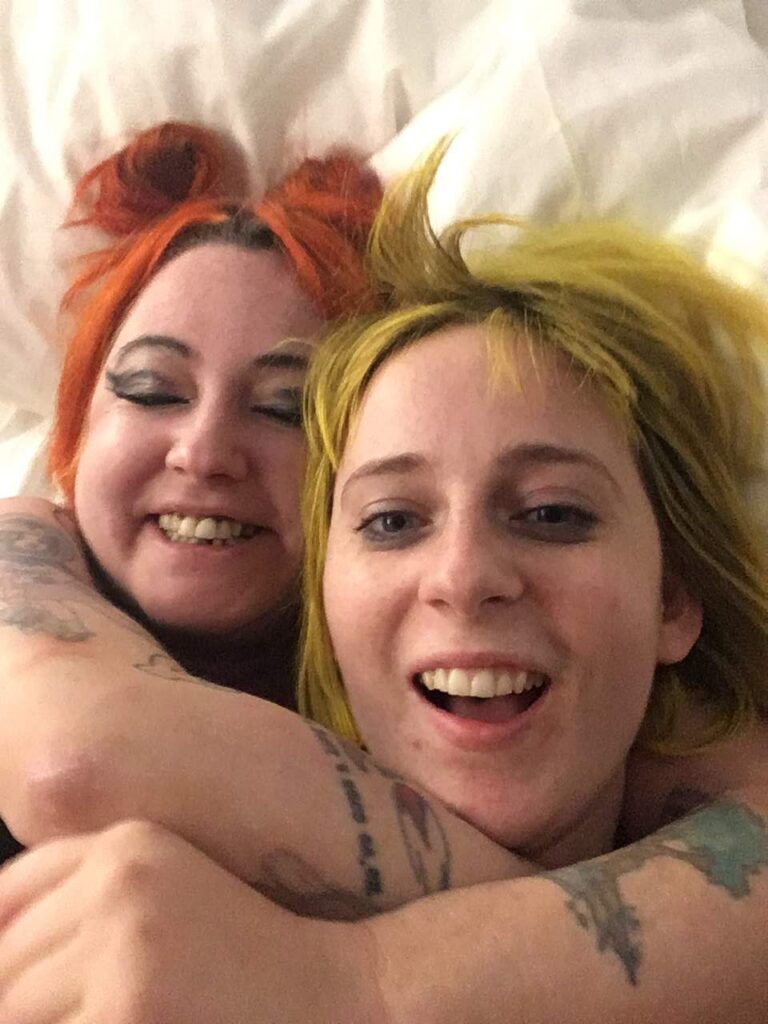
Over the past few years, members of my own community of disabled artists have begun dying. Last year, we lost my collaborator and friend Jackie Hagan, a Manchester-based artist and writer who had taught me how to lean into and celebrate the weirdness of my flesh, my sexy, strange alien parts; to take the grease and stains of a body I couldn’t reliably clean and cover them with glitter.
Before that, we lost Lizzy Rose, who taught me how to make and document art with my most vulnerable self, through cartoons, sketches and photographs from a string of hospital wards. Together with Alice Hattrick and Leah Clements, she also taught ways to ask for access needs to be factored into institutional negotiations, through the project Access Docs for Artists. We need paid time to rest, to work more slowly, to recover from the strain of having to perform labour in our broken bodies. Developing ways to communicate this has been an invaluable service to the creative community.
One of the hardest and most impossible griefs is how little time I got to have with these crip peers and elders. It is so hard to travel when you’re sick. As working freelance artists, we have little capacity to socialise as well as work, on top of hospital stays and medical side effects and general fluctuations of sickness. I pretty much only got to spend time in person with Jackie when an institution could pay us to collaborate. We lay in accessible hotel rooms, got drunk and posed with each other’s mobility aids, or wrapped ourselves in tinfoil and made photoshoots celebrating our strange disabled bodies. As Jackie got sicker and I could no longer safely travel due to the pandemic, our last few years of contact mainly consisted of videos of dogs on rollercoasters shared at 2am.
I never got to be in a room with Lizzy at all.
I want to cling closer to my crip community while I can, to share their wisdom while it’s still possible. I want to meet crip artists and elders, to ask ‘how are you doing this?’ and receive an answer that isn’t just: ‘I’m not, not really.’
I want a life where my crip friends and family, collaborators, mentees and mentors get to do more than just barely survive. The cuts to PIP that the Labour government have proposed show a blatant disregard of what it costs to be disabled – not only the additional £1010 per month required by the average disabled household to achieve the same standard of living as a non-disabled household, as calculated by Scope, but the cost to our lives, our dignity. Despite seeing us as potential workhorses in a fictional land of jobs, they show a total lack of regard for our wisdom.
Mia Mingus coined the idea of ‘access intimacy’ – ‘that elusive, hard to describe feeling when someone else “gets” your access needs… It could also be the way your body relaxes and opens up with someone when all your access needs are being met.’ I want to hold on to this intimacy with my sick and disabled friends. I want to hold them close, while I have them, to learn from them. In seeing and bearing witness to each other’s experiences of pain, our disabled dreams, we validate each other and understand that we deserve more than the bare minimum.

I will end on a different kind of image:
On March 26th, I joined the protests against the PIP cuts outside 10 Downing Street, on my mobility scooter. I had spent the days since the announcement in a state of panic, doing constant maths with my partner about how I might possibly afford to survive, let alone work, without extra support. I went to the protests accompanied by a friend who helped me navigate my access needs. I went to the protests in a howl of anger and rage.
When I got there, I found myself surrounded by more disabled people than I’d ever seen in one place. Since pavements and public transport generally segregate disabled people it’s rare to gather in such a crowd. I witnessed a wider diversity of bodies and mobility aids than I could even imagine. I ran into friends I never get to see. We chanted together, and as we rolled and marched and hobbled from Whitehall to Parliament, a band played, cheering us on. We took care of one another. I didn’t have to worry about scooting over a stranger’s toe, because everyone was looking out for each other. Despite our anger it felt celebratory, joyful to be surrounded by so many disabled bodies, so many forms of crip wisdom.
My body paid the price and I spent much of the next week in bed in a massive pain flare. Two of my friends sent me cash to buy a takeaway because I was struggling to eat. But I spent that week grateful for the access intimacy, the mutual aid of my community.
We deserve more, much more, than what the government is taking from us. We deserve a life in which disabled people get to spend more time sharing space together and not have to pay a price for it. We deserve a future where we get to meet, not just to work or to protest, but to share our whole selves, our crip wisdom. We deserve a life where we come together, not just to shout in pain and anger, but to move, in our beautiful, idiosyncratic strangeness, our disabled joy.
Published 21.05.2025 by Benjamin Barra in Features
2,540 words