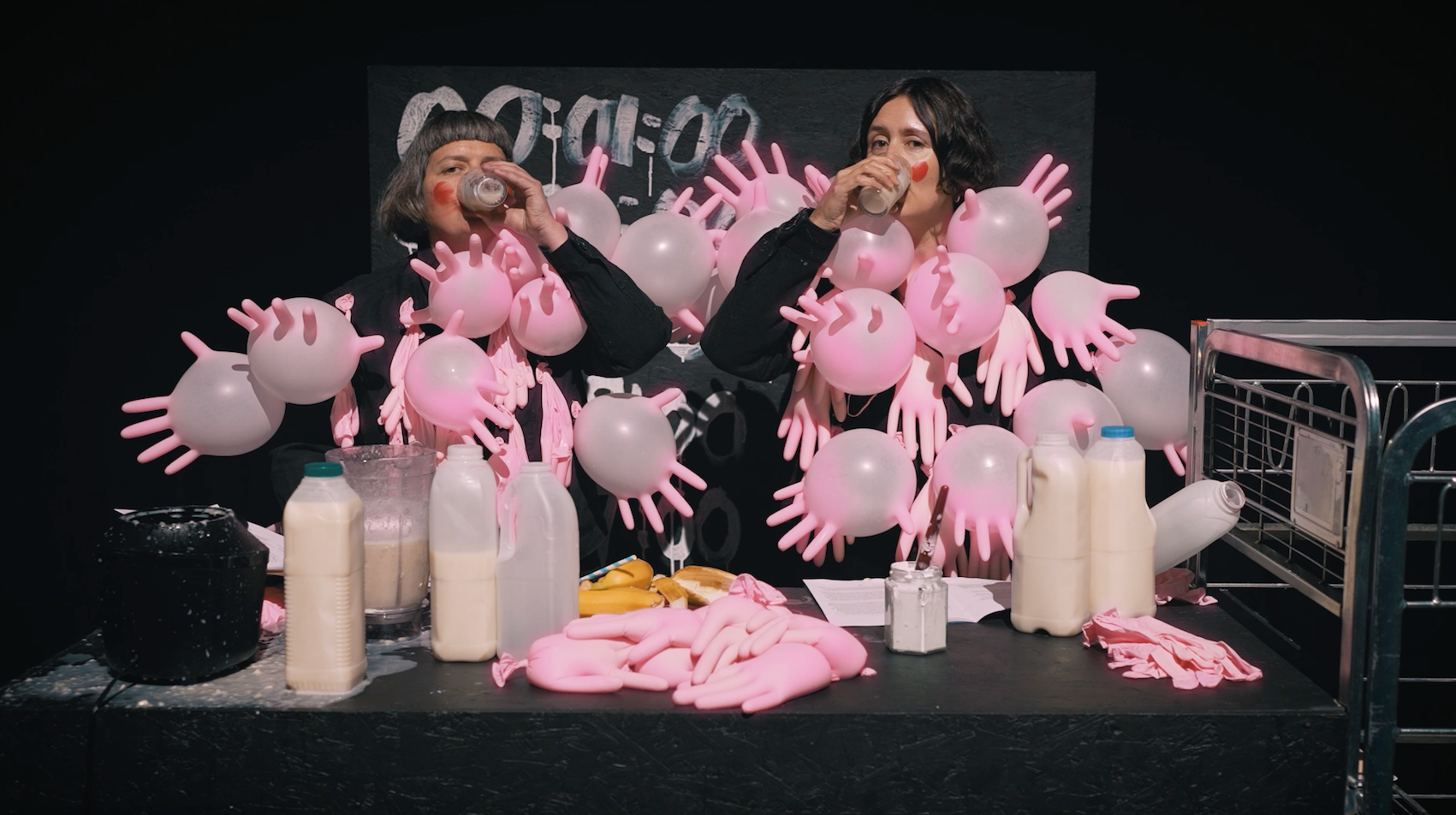
Conway and Young’s ‘Milk Report the Film’ (2025) centres on the two artists standing behind a milkshake bar reading from a paper report, whilst intermittently applying lipstick badly, downing glasses of milk, and manually blowing up pink surgical gloves (sometimes to the point of bursting), attaching them to themselves or filling them with milk. The keeping of time runs through the film, but what does the time spent feeding a baby represent – nutrition, nurturing, duty, loss, work? These are some of the associations explored in the film, along with how the act of tracking feeds produces data: ‘She’ll harvest her own data and make it pay’. When feeds are logged in an app, it analyses it and turns it into tailored advice and targeted advertisements.
As a young mother, the artist Yuko Edwards charted every time that she breastfed, first in a notebook and then making marks on canvas in ‘First Child (July-Aug)’ (2001) and ‘Second Child (Sept-Oct)’ (2006). For Edwards, documentation was an act of self-preservation. It was a way to know that she existed outside of her caring responsibilities, and it offered a place where she could focus both emotionally and intellectually and continue her work as an artist.
Edward’s practice mirrors that of countless artists who have grappled with the tensions of work/non-work in their experience of motherhood and sought to resolve them in their own practice. In ‘Post-Partum Document’ (1973-1979), Mary Kelly includes stained nappy liners as part of her documentation of motherhood, contrasting analytic observation with the emotional experience of the mother-child relationship. Mierle Laderman Ukeles sums up this tension in her ‘Manifesto for Maintenance Art’ (1969),
‘I am an artist. I am a woman. I am a wife. I am a mother. (Random order). I do a hell of a lot of washing, cleaning, cooking, renewing, supporting, preserving, etc. Also, (up to now separately) I ‘do’ Art. Now I will simply do these everyday things, and flush them up to consciousness, exhibit them, as Art.’
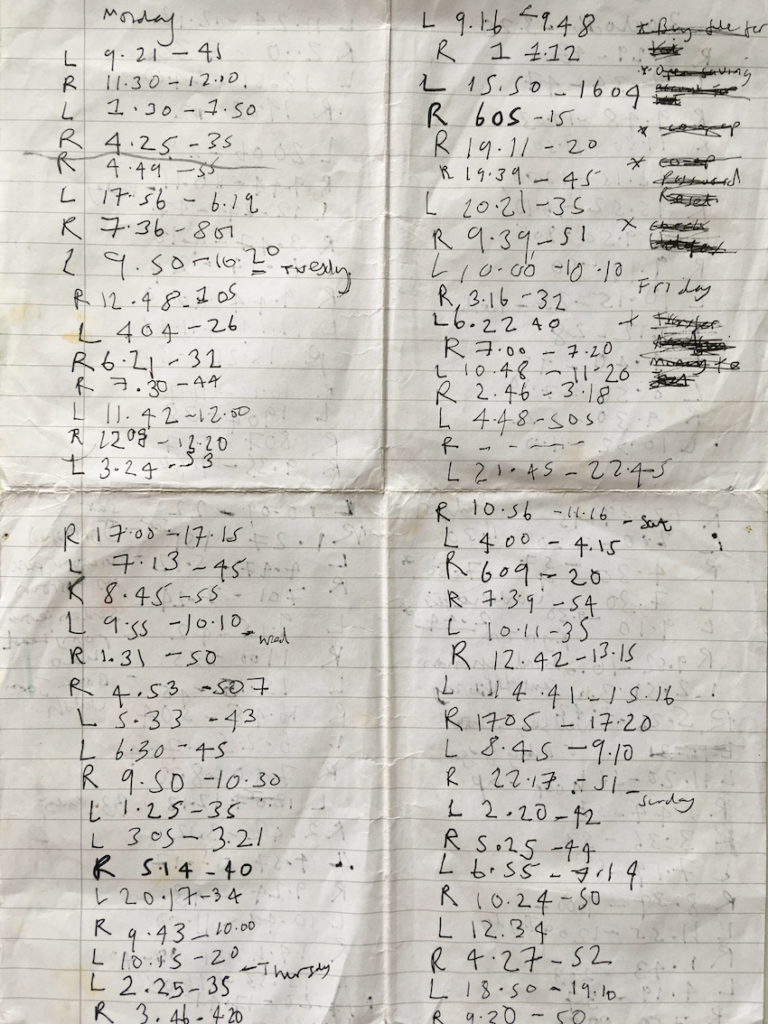
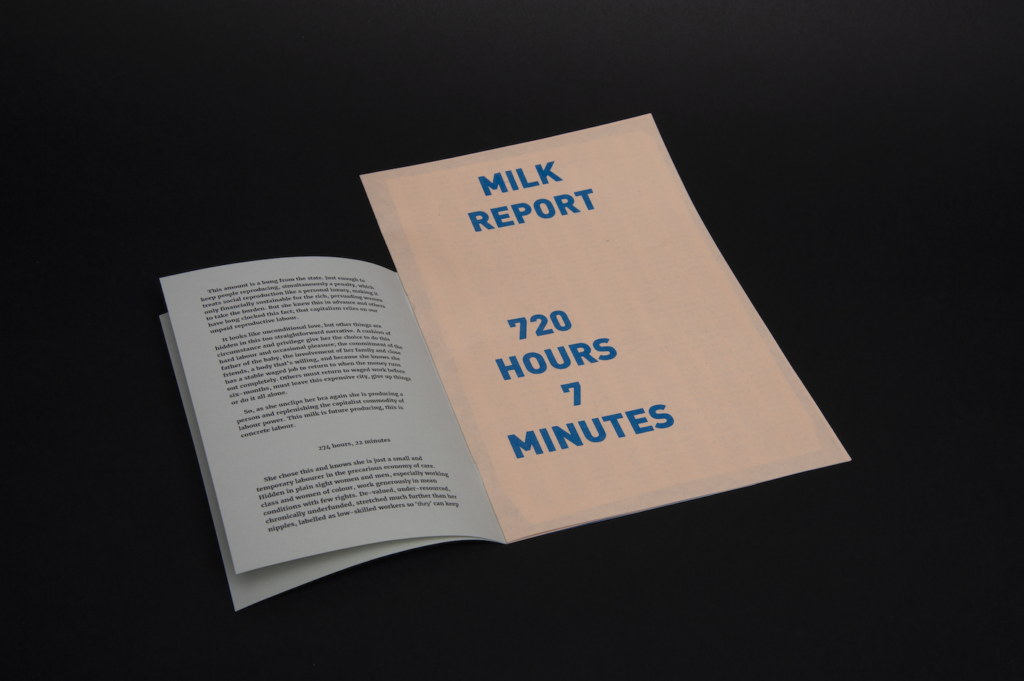
‘Milk Report the Film’ similarly conveys the emotional and physical struggle of breastfeeding. Every feed Young gave to her infant in their first six months was counted. A total of 2,232 feeds amounted to 720 hours and seven minutes of ‘labour-intensive work undertaken’. The artists equated this time with a wage of £5,916.95, which they sought to recuperate from the sale of 720 printed copies of ‘Milk Report’, priced at £8.21 each. In the film, Conway and Young’s reading aloud of the report is interrupted by hours and minutes numerically displayed on screen, manically whispered.
In this respect, ‘Milk Report the Film’ is part of a wider feminist tradition that seeks to render visible the effort and time involved in the work of care that is systematically unaccounted for and devalued in capitalist societies. Capitalist accounting of what societies produce includes only waged labour and production for markets. Using an iceberg analogy, feminist political economist J. K. Gibson-Graham explains that most of the world’s economy is submerged underwater and hidden from view, including the economies of women and minorities.[1]
In different ways, feminist scholars and activists have highlighted the potential of making visible invisible labour as a strategy to resist and challenge gender oppression. ‘Milk Report’ references the Wages for Housework Campaign of the 1970s, a movement that continues today through the work of the Global Women’s Strike. Feminist economist Marilyn Waring criticised the omission from national accounting systems, such as GDP, of critical yet unpaid labour conducted by women across the world and pioneered time-use surveys to record women’s unpaid labour.
In their work, Conway and Young entertain the idea of payment for reproductive labour whilst acknowledging its impossibility in the context of the pervasive and systemic devaluation of ‘women’s work’. As the artists clumsily paint drippy white numbers onto a blackboard behind them, adding up the minutes and hours spent feeding, they remind us that there is no capitalist system of accounting that will accurately and justly renumerate reproductive labour, or evidence its value to society: ‘This is a set up, so she clocks on again. Perhaps her resistance will manifest in the type of worker she produces? A lazy one, a slow one, one who takes more than they give’.
The profit imperative of the capitalist system is satisfied through the exploitation of workers: every worker is paid less than what their bosses receive off the backs of their labour. There would be no profit without labour exploitation. With their wage, the worker must reproduce their ability to work the next day and the day after. The workforce needs to be replenished generation after generation. This would be impossible without the unpaid and underpaid work of social reproduction undertaken in the main by women and racialised people.
It is the necessity of unpaid social reproductive work that lies at the very heart of women’s oppression as it intersects with racialised and class-based structures of subjugation. Gendered and racialised narratives, such as the idea that products of social reproductive labour are free gifts of human nature, maintain the monetary devaluation of care work. Such ideas support the view that care and nurture should be freely given as part of what it means to be a woman. As they stare ahead out of the screen, tired and obviously pissed off, Conway and Young evoke the tensions and discomfort of being trapped in ‘the narrative of nurture and nature’.
The person using their body to feed a baby is simultaneously scientific medical apparatus, a one-woman enterprise, exhausted, harvested, experiencing pleasure, working, unable to work, giving of unconditional love, a factory, a site of resistance, requiring of state intervention.
‘Milk Report the Film’ presents multiple and contradictory viewpoints on the act of breastfeeding. The person using their body to feed a baby is simultaneously scientific medical apparatus, a one-woman enterprise, exhausted, harvested, experiencing pleasure, working, unable to work, giving of unconditional love, a factory, a site of resistance, requiring of state intervention. These are the tensions and contradictions of capitalism that cannot be fully resolved within the prevailing socioeconomic system. By revisiting the question of work – care as work, care as taking away from a person’s ability to work, or paid work as necessary for social reproduction – the artists confront the central question of class; who is doing the work and under what conditions?
‘Milk Report’ is set in the context of late capitalism – an epoch characterised by the commodification and industrialisation of more and more parts of economy and society including housing and social care. In the UK, the number of homes for social rent has declined by a quarter over the last 40 years. Relentless cuts to social security, the closing down of public spaces and provisions such as libraries, children’s centres and youth clubs, and the defunding of third sector organisations since 2010, has meant that the private costs of social reproduction are the highest that they have been in three generations. The Report outlines this in stark terms:
‘The state pays her £148.68 a week, that’s £594.72 every four weeks, which only just covers her monthly rent… not including bills, taxes or food. In this city her expenses are more than her income. She would be financially insolvent if it weren’t for savings, small family gifts and a partner working long shifts when he isn’t caring for their baby.’
Women are frequently vilified for not breastfeeding, but many women simply cannot afford not to return to paid work at the first opportunity, making formula their only option. Numerous studies show that rates for initiating and continuing breastfeeding after six weeks are the lowest in areas with the greatest social deprivation.[2] And yet there is still labour involved in the preparation of formula milk, not to mention the need to earn a wage to pay for it. Walking into my local supermarket in 2023, I noticed that formula milk boxes were secured behind wire cages, and remembered reading that the item most shoplifted in Tower Hamlets was Calpol. In the age of austerity, desperate caregivers do what they need to.
Ironically (or to be more accurate, systematically) many of the women forced by circumstance to return to work only a short time after giving birth have the lowest paid jobs, often doing care work or on zero-hours contracts. Care is the most feminised and racialised sector in the UK economy. It is also the sector with the lowest gender wage gap. People performing this allegedly unskilled, yet essential, work are paid equally poorly regardless of gender.
In another twist, picked up on by Conway and Young (‘There is a black market for bodybuilders who want to buy women’s milk. It’s that good. Paid up to $10 a day’), women in the UK have been selling their milk to support the rising costs of reproduction. In 2021, the Redditch based company NeoKare Nutrition began selling pasteurised breastmilk for £45 per 300ml,[3] with providers typically paid around £3 per 100ml. Women’s oppression under capitalism supports the devaluation of reproductive labour and commodifies and valorises breastmilk – the product of that labour – at the point of sale, transferring wealth to corporations via exploitation and extraction.
The crisis of care in an age of austerity means that mother artists in the UK today face challenges of a different order compared with those of the previous generation. Withdrawal of the welfare state, cuts to arts funding, low pay and zero hours contracts along with rising costs of living have made things tougher. The need to make art as an act of self-preservation is increasingly difficult to realise for the mother artist.
‘Milk Report’ explores the contemporary politics of care through the case of breastfeeding by situating the latter within the framing of work – as work and in relation to (paid) work – and brings to the fore contradictions and tensions that are in the cultural and social understandings of care, the biological imperatives of care giving and receiving, and the exploitation working people in the interest of profit and wealth for a few that is at the core of capitalism, that are viscerally experienced.
By the end of the film, the artists have manufactured milk-filled gloves, which Conway piles into Young’s arms. There are too many for her to hold – something’s got to give.
Susan Newman is a Professor of Economics at the Open University and co-curator of the online exhibition This is Essential Work.
‘Milk Report the Film’ by Conway and Young will be premiered as part of Scarborough Film Festival on 23 March at Woodend Gallery, coinciding with Nurture, an exhibition of work by artists who are mothers curated by Crescent Arts, including the Feeding Chair.
The film was commissioned by In Certain Places as part of Feed, a collaborative art project exploring infant feeding and public space. It was funded by Arts Council England and the University of Central Lancashire.
[1] Gibson-Graham, J. K. A Postcapitalist Politics (University of Minnesota Press, 2006).
[2] For example: A. B. Peregrino et al, ‘Breastfeeding practices in the United Kingdom: Is the neighbourhood context important?’ Matern Child Nutr, 14 (4), October 2018; L Hunt et al, ‘Adapting breastfeeding support in areas of socio-economic deprivation: a case study approach’, International Journal of Equity Health, 20: 83 (2021).
[3] In January 2023 there was a recall of NeoKare products: https://humanmilkfoundation.org/neokare-product-recall/
Featured content


Published 20.03.2025 by Lara Eggleton
1,933 words