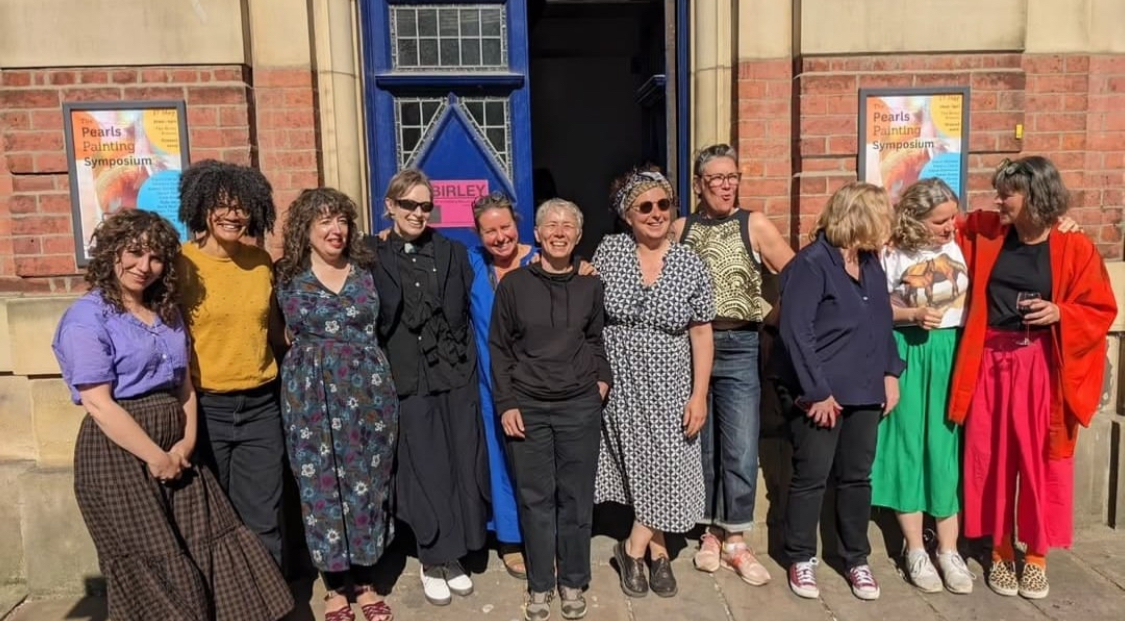
At the Pearls Painting Symposium which took place at the Birley Studios in Preston on 17 may 2025, the self-taught artist Lela Harris gave a giddy, dizzying talk about how her career and profile had recently sky rocketed. Harris talked about the Folio Society commissions that have seen her illustrate books by Alice Walker and James Baldwin, a permanent exhibition at the Judges Lodgings Museum bringing to light Black histories in Lancaster, and a residency at Harewood House in Yorkshire. All these opportunities have helped Harris develop her practice in portraiture: transforming what the essayist Saidiya Hartman refers to as the ‘scraps of the archive’ into fuller, richer histories of Black social lives.
Despite Harris’s recent successes, there’s still an underlying sense of how access to resources and infrastructure shapes an artist’s practice, sometimes in tense relation with their desires and ambitions. At a recent solo show at Assembly Arts, Lost & Found, Harris exhibited a series of paintings in ink, made up of smaller rectangular panels, which imagine a childhood photo album that never was. The construction of the paintings from smaller panels suggests the fractured state of uncertain memories, as well as the gap between imagination and reality as Harris turned to the scraps of her own personal archive. However, Harris admitted that there was also a practical reason for working in this way: it was possible to fit work on one panel into the limited time in the week, negotiated around her day job, and to make space for this in the small room in her house that is her studio. How might Harris’s work develop were she not restricted by these parameters of time and space? Similarly, artist Hannah Wooll talks about the collages she began to make inside the pages of old books as a new mother without a studio space to work in – artworks like ‘Field Trip’ (2017, acrylic and acrylic ink on book page), which shows five purple figures eerily looking out from an outcrop of rocky gemstones, could be filed away on a bookshelf.These ideas about how art can transform the material experiences of our everyday lives, breaking the confines of the quotidian and the practical, but also about the resources and the structures that either support or limit the realisation of an artist’s vision, came up repeatedly throughout The Pearls Symposium.
Since May 2024 the Birley Studios in Preston has been the site of the developing project called The Pearls & The Oyster, which seeks to help artists achieve their ambitions by providing the resources that community affords. Established by artist and studio member Jayne Simpson, The Pearls has provided a platform for women painters in the North of England to share their work and connect with each other. Having hosted an exhibition in the Birley Studios’ gallery space in October 2024 and now two painting symposiums, in May 2024 and 2025, Simpson hopes that outcomes from these events will constellate to form a thriving community, offering friendship and mentorship as well as nurturing artistic development.
The second instalment of The Pearls Painting Symposium – supported in part by a crowdfunder – coincided with a busy, fiercely sunny day in Preston. In the Birley Studios there was a convivial buzz, which suggested that Simpson’s efforts are paying off. The venue was packed to the rafters (free tickets sold out) with a crowd of mostly, though not exclusively, women artists, who all share an interest in painting as an expansive and expanded practice. Although The Pearls is advertised as a network for the North, people travelled from all over (including the Outer Hebrides) to take part in the conversation, indicating a hunger for this kind of initiative.
During the day, ten women artists took the floor: Roberta Cialfi, Ingrid Christie, Alison Critchlow, Sarah Grant, Lela Harris, Kate Jacob, Ruth Murray, Helen Thomas, Matilda Wainwright and Hannah Wooll. As organiser and host, Simpson set some simple parameters, giving each of the artists time to talk about their work and a projector for showing photographs and videos. Most of the artists opted for a solo mini talk, although a Birley Studio neighbours Roberta Cialfi and Sarah Grant began the day with a fascinating dialogue titled ‘Conversation in Paint’. Cialfi and Grant charted convergences and divergences between their practices as colourists. Their sensitivity to each other’s work, and the ability to offer insight that might otherwise seem out of reach, was testament to the value of shared spaces and the mutual inspiration they can engender. In this vein, Matilda Wainwright used her talk to attest to the vitality of the artist-led gallery space she has opened in Cheshire, the FG Gallery, which has seen her expand her practice as a curator and gallerist, as well as a painter.
The other artists found a variety of ways of opening-up the inner workings of their practices in their talks. Ingrid Christie, for example, offered a biography, which told the story of her development as an artist. Early in her talk, Christie showed a felt-tip drawing she’d made at five years old of a vast woodland, with a girl observing some frogspawn at the very centre. This detailed attention to the natural world was also evident in her account of how she had found her home and muse in Morecambe Bay in the later stages of her career: an ‘environment of monumental shifts’, as she described it, which has become the subject of her surreal photographs, films, and the abstract egg-tempera landscapes she paints of mercurial skies and rock formations.
Taking a different approach, Alison Critchlow decided to begin not in the past but from within the ‘maelstrom’ of creative energy, with the canvas she had just left drying in her studio. Critchlow showed us close-up images of the energetic, fizzing and dynamic marks that form the language of painting in her large abstract canvases – ‘like the parts of a sentence or a musical score’, as she described them. Taking inspiration from the Romanian-born artist and member of the New York School of painters Hedda Sterne (1910-2011), Critchlow has been working on a series of ‘Swarm’ paintings since 2023, which map the chaotic, calligraphic swarming of imagined hordes of insects. In her talk, Critchlow confessed that ‘sometimes a painting is a bit ahead of you’ and reflected on how she knows when a new Swarm painting is on the horizon because splashes of orange and red (the signature of the Swarm paintings) will find their way onto other canvases.
The focus of the symposium was not the glossy, high polish of ‘artspeak’, but an authentic glimpse of what process feels like. By communicating this feeling, the assembled crowd might catch a spark of inspiration from each other. One of the questions that was repeated across the day asked what happens in the space between an artist’s observation of the world and the thing they create in response to that observation. The audience of artists wanted to know, for example, how Ruth Murray moved between the elaborately staged scenes created for her models, and the largescale, surreal and unsettling psychological portraits she paints, or how Helen Thomas transforms the minutely observed patches of weeds growing in the gaps of a pavement into her hyper-realistic, absorbing studies of neglected plant life.
In her talk, Thomas quoted the painter Bridget Riley in a piece published in the London Review of Books. Reflecting on the role of drawing in her practice, Riley writes:
For me, drawing is an inquiry, a way of finding out – the first thing that I discover is that I do not know […] What it amounts to is that while drawing I am watching and simultaneously recording myself looking, discovering things that on the one hand are staring me in the face and on the other I have not yet really seen. It is this effort ‘to clarify’ that makes drawing particularly useful and it is in this way that I assimilate experience and find new ground.
Engaging with the process of artmaking leads to an assimilation (or a translation) of experience that would otherwise not be possible. As Sarah Grant put it, ‘How to find a painting through paint rather than having a beautiful image to paint’. For Riley, as for Sarah Grant, artmaking doesn’t necessarily begin with some grand philosophical question, but with a felt response to the voluptuous, sensorial and affective detail of the world. In contemplating, to take Helen Thomas as an example, the unknown plants growing between the cracks in the tarmac, the artist may arrive at a revelation about the world, but she can’t know this until she has engaged in that process of thinking through making.
There is also a certain amount of vulnerability involved in trusting the process. At the symposium it also became clear how valuable it is for an artist to have the support of a community to explore uncertainties about new directions in their work and practice. This came to the fore in a talk by Kate Jacob, an artist who originally trained in embroidery and textiles at Manchester School of Art but now works as an abstract painter. Jacob spoke about feeling stuck and admitted to long periods of not working when she was trying to find a way back to her studio practice. She showed us the collages she has been making as part of this process, in which she re-uses and re-invents scraps and off-cuts from earlier studies and sketches, combining them with other bits of recycling and detritus like paper plates and packaging to form layered and unruly assemblages. These fragments are held together with temporary attachments improvised from whatever is lying around: tape, thread and paper clips.
They share some of the qualities and colour palette of Jacob’s abstract paintings, but they mischievously deconstruct those compositions to form bright assemblages and suggestive, humorous characters. Jacob describes how these works ‘grew and morphed and multiplied’. Many of the individual pieces, as she describes them, reach out to each other kinetically when pinned to the studio wall, making the white space around them resonate and radiate differently. They have an agency all their own, and require, even demand, that their maker relinquish some control over the process.
The status of these pieces is still unresolved. Jacob admitted that never having trained as a painter, she has always felt that she needed to prove herself; now she is grappling with the sense that the collages are of lesser value than her paintings. There was, however, a palpable sense of excitement about the collages in the room, and an understanding that this might be the moment of breakthrough. Jacob was encouraged to keep playing at the edges of uncertainty, allowing herself the freedom to experiment; as she said, these new works challenge her sense of what a painting might be.
To some extent a day of artist’s talks might sound like a typical format for an institutional ‘symposium’ or ‘conference’ but the atmosphere – and it’s not just an effect of the sunshine – was different. Throughout the day, paintings gradually appeared in the interconnected rooms of the Birley Studios, mounted on the walls of the gallery space or propped up below the projection screen. Some of the artists had travelled with small, portable canvases, while others (who are based in studios at the Birley) ducked behind the scenes to find something relevant as this impromptu exhibition grew.
Between talks it was possible to revel in the thick, impasto-shaggy fur of a portrait of the fictional dog ‘Lassie’ (oil on board, 2025) by Sarah Grant; to lose yourself in the direct, searching gaze of Lela Harris’s subject in the monochrome portrait of an anonymous woman in ‘Mother Tongue’ (charcoal on paper, 2024); or to feel a sense of time and place upended in the greening, glasshouse-light of Roberta Cialfi’s fictitious still life of a potted plant, ‘Sfuggente’ (oil on cotton laid on board, 2025). As people milled about in the space surrounding these artworks, friends caught up and new connections were made, there were offers of studio and residency spaces and talk of exhibition opportunities and potential collaborations. The day felt improvised and generative, both in its ability to connect artists with the kinds of practical support (space and time) that makes their work possible, and to inspire the feeling of creative energy that leads to an exploration of the world through form, colour, materials and process. Under the guidance, care and vision of Jayne Simpson, The Pearls only seems to be growing in vibrancy and momentum. The invitation is open, so I would encourage you not to miss what happens next.
The Pearls Painting Symposium, 17 May 2025, The Birley Studios, Preston.
Francesca Brooks is a poet and writer based in Manchester.
This article is supported by The Sport and Culture Fund Lancashire and SpaceHive.
Published 03.07.2025 by Jazmine Linklater in Reviews
2,142 words


