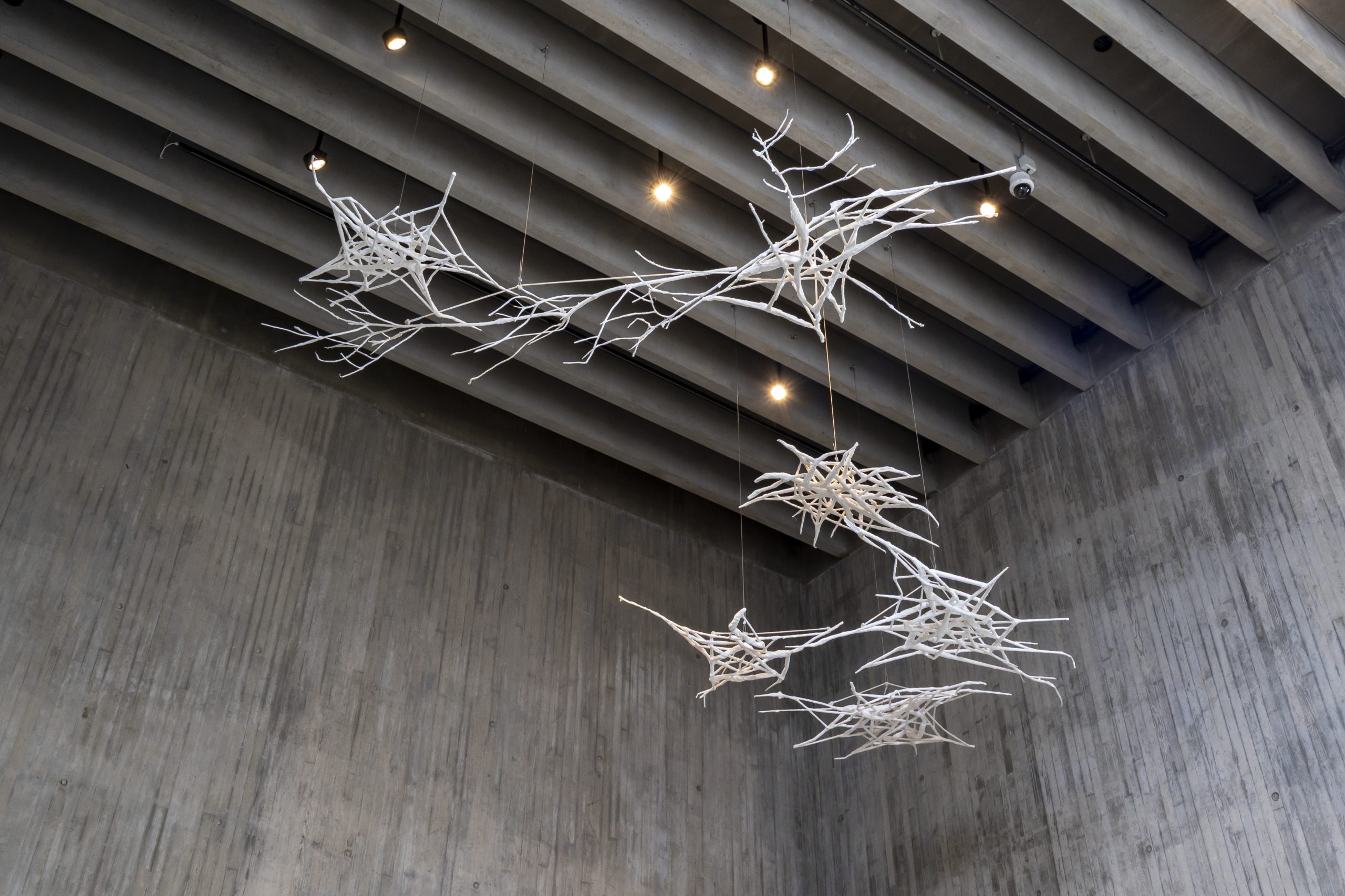
On entering What Grows in Between at The New Art Gallery Walsall, it is difficult not to look upwards. Suspended high above the gallery floor, Hannah Rollason’s white plaster forms ‘Rhizomatic’ (2026), stretch across the building’s vast, tall concrete ceiling like interconnected root systems, fungal networks or constellations suspended in mid-air. Their delicate, branching structures refuse a singular point of origin, immediately establishing the exhibition’s central proposition that growth is rarely an individual or solo act. Rather, growth emerges through relationships, interdependence and the spaces between people, places, migratory journeys and histories.
Presented as the third iteration of Assembly, an annual commissioning programme delivered through a partnership between Multistory and The New Art Gallery Walsall, What Grows in Between brings together newly commissioned works by Rollason, alongside Dan Booth and Abraham Babajide Cole. Between them, the three artists’ work across painting, sculpture, installation and photography. Each approach uncertainty not as something to be overcome, but as a condition through which care, memory and belonging might be renegotiated. The exhibition traces the fragile networks through which identities are continually formed, through mitigations of gender norms, journeys in migration and heritage, and ecological systems in the production of knowledge.
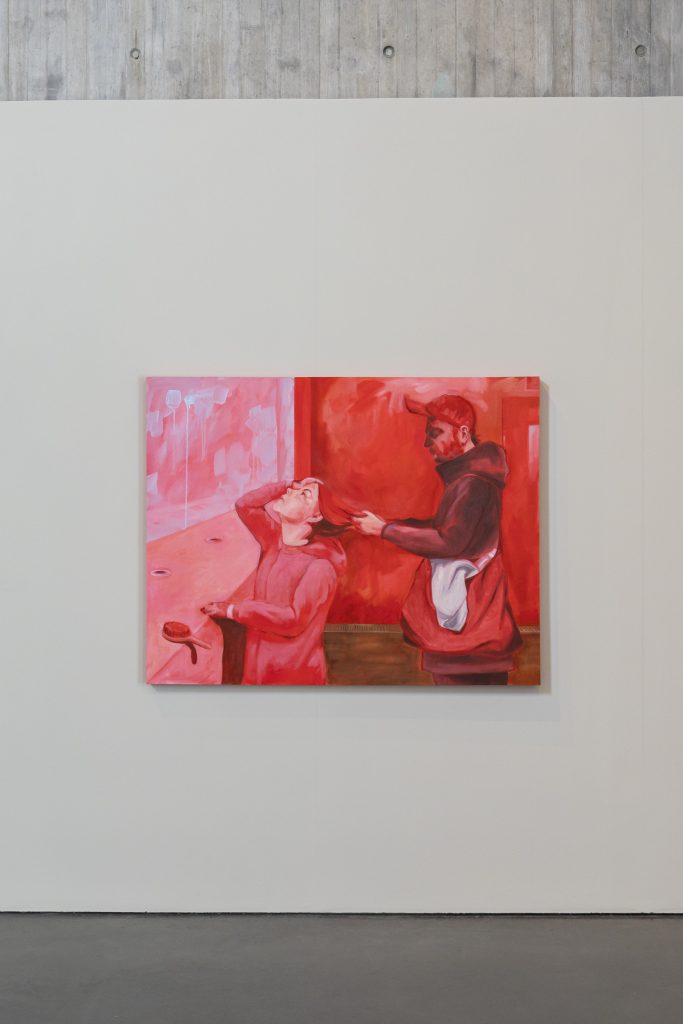
The exhibition’s title, What Grows in Between, reveals itself as a curatorial theme. ’Between’ becomes an active site: between parent and child; home and migration; ecology and urbanisation; individual and collective knowledge. Rather than existing as three individual practices sharing a gallery space, Booth, Cole and Rollason’s artworks begin to form intertwined conversations across the space, producing distinctive resonances through their different material languages. Booth’s paintings are perhaps the most immediately familiar to me; figurative paintings reflecting the body in motion, yet, that familiarity is disrupted. Exploring fatherhood, public leisure spaces and everyday acts of paternal care, whilst simultaneously questioning inherited expectations of masculinity. Booth’s paintings draw on lived experience and art historical references to reimagine conventional and accepted narratives surrounding tenderness and emotional vulnerability. In ‘Plaiting of the Hair’ (2026), the simple gesture of a father tending to his daughter’s hair becomes a quiet comment on the paternal role in familial structures. Historically, images of domestic care have overwhelmingly centred maternal labour; instead Booth locates care within fatherhood, without announcing it as exceptional. His paintings resist spectacle through an emotional force that lies in the interpretation of ordinariness and the everyday.
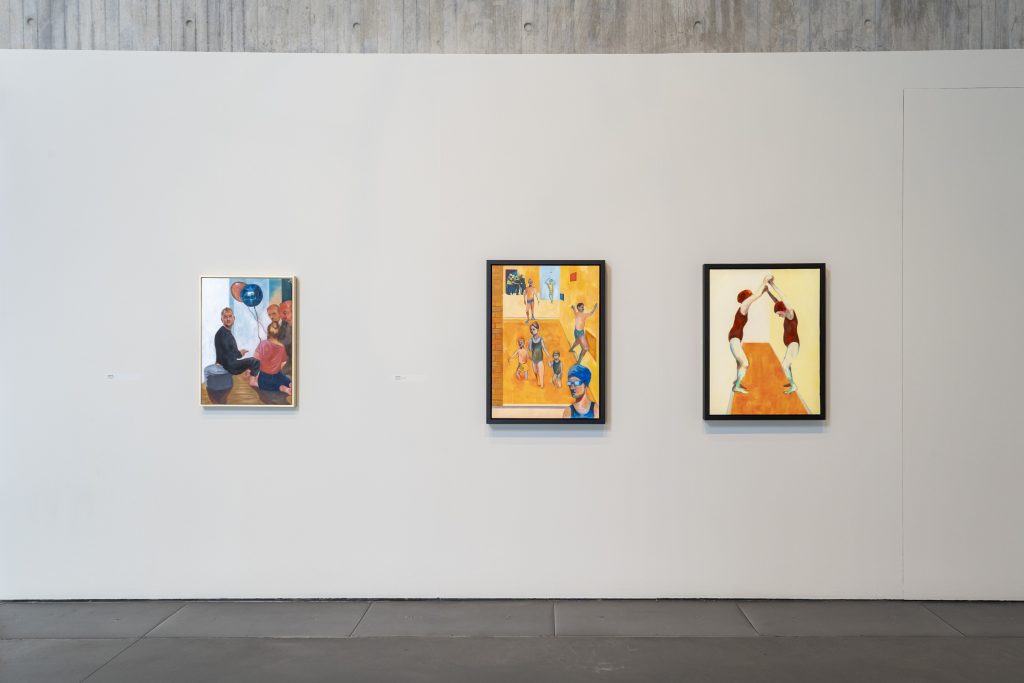
Across Booth’s wider installation of paintings, negotiation between intimacy and precarity continues. Swimming baths depicting collages of privatised security staff, changing rooms illustrating paternal care, and town centres that host Coral betting shops appear not merely as architectural settings but as civic infrastructures where communities are formed. The exhibition interpretation notes the artist’s concern with the gradual erosion of public spaces that once fostered social connection, that reads as fluent language between the working classes. Booth’s figures often occupy environments that appear simultaneously lived-in and neglected, hinting to the small, forgotten towns of the Black Country. The artist emphasises this tension, becoming particularly communicable through his refusal of nostalgia: a deliberate rejection of the myth that the past was simpler, safer or better—a time that, in reality, never truly existed. Rather than romanticising disappearing civic institutions, his paintings recognise their continued importance precisely through the characters in the paintings. The swimming baths are a key focal setting, presented not as a utopian space; here, they are worn down, underfunded, a commentary on bureaucratic systems and the way they become publicly inaccessible. Yet these spaces continue to facilitate encounters between strangers, families and different generations, communicating that belonging often emerges through these ordinary rituals rather than in extraordinary moments.
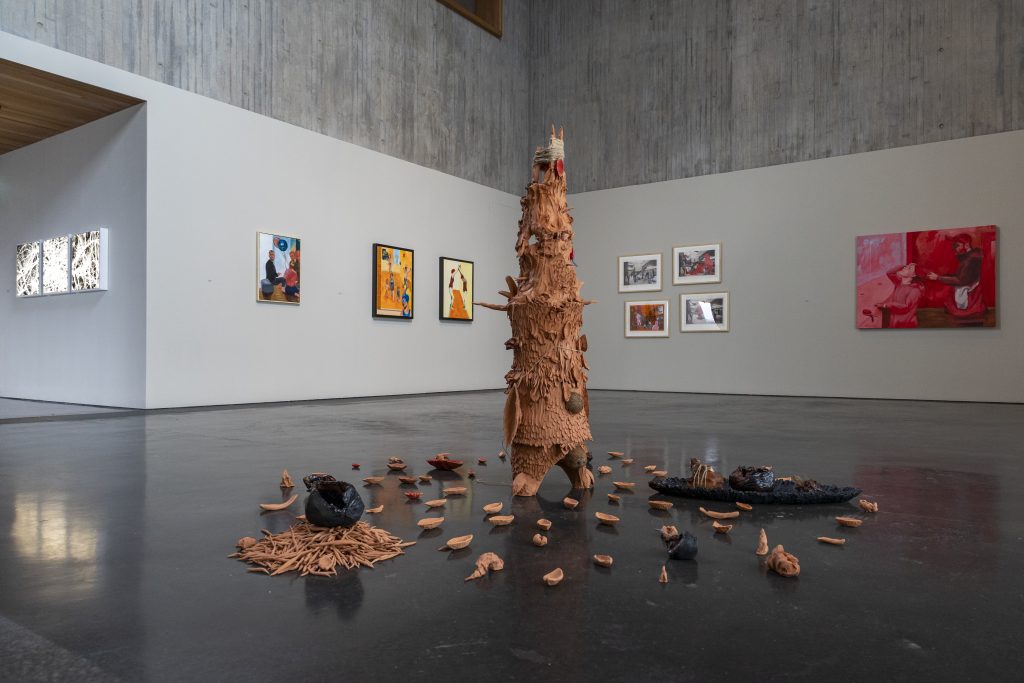
If Booth’s paintings explore care through the social body, Cole’s sculptural installation ‘Elsewhere Has Entered the Body’ (2026), shifts attention towards the body as a vessel of migration, memory and transformation. His terracotta sculpture sits centrally in the room, rising from the gallery floor like an archaeological fragment, excavated from the past and still in the process of becoming. Clay appears repeatedly: fractured vessels scatter across the floor; charred organic forms occupy dark ceramic boats; cowrie shells hang delicately within hollowed cavities, while vivid red thread binds broken surfaces together. The cowrie shell has long held cultural and economic significance in African, South Asian and East Asian cultures, being used worldwide as shell money, between 3,000 years ago and the early 20th century when it was banned by colonial administrations. The visual language of Cole’s work that joins the cowrie shell and ceramic boats together, further adds to the strong layered narratives of journey and migration.
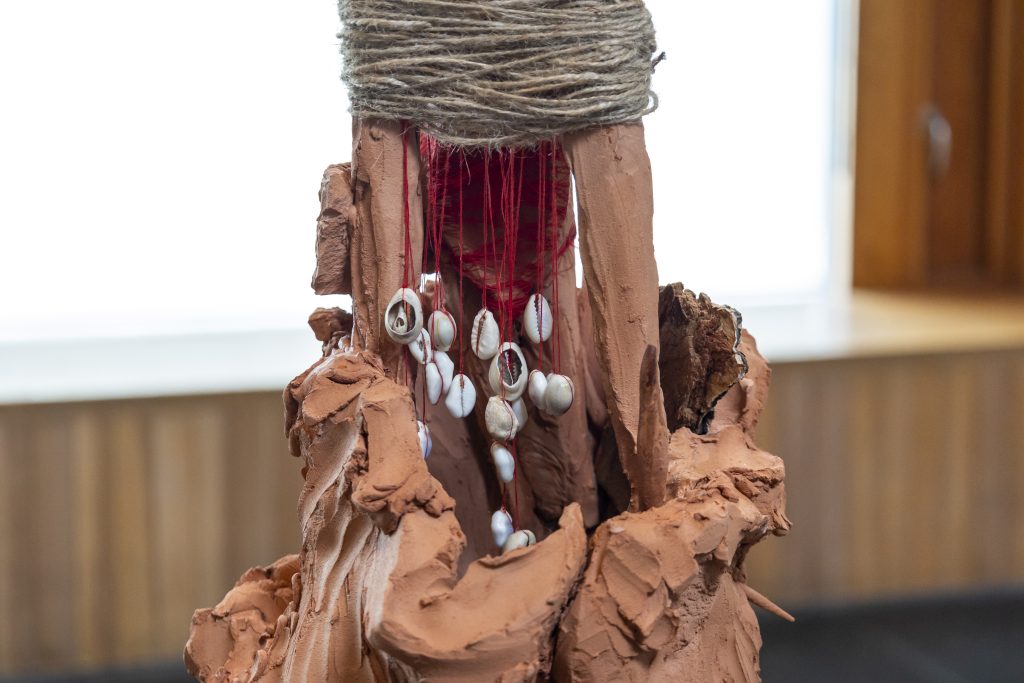
Cole’s materials resist permanence. Clay dries, cracks and records touch. Charcoal retains the memory of fire. Beeswax softens with the heat of touch. Rather than concealing these transformations, the work centres them, allowing material change to become inseparable from lived experience. Drawing on Yoruba (an indigenous West African ethnolinguistic group of over 50 million individuals) understanding of selfhood beyond the physical body, the artwork connects personal memory with collective histories through fragmentation and material experimentation.
What is particularly striking is the installation’s refusal to offer a singular reading. The scattered ceramic forms evoke seeds, bones and boats while simultaneously resembling ritual offerings. The sculpture appears protective yet vulnerable; architectural yet bodily. Rather than functioning symbolically in a fixed western understanding of meaning, these materials remain open, continually oscillating between journeying histories and possible futures. This openness extends to the installation’s spatial choreography too, where visitors navigate carefully around dispersed ceramic fragments, becoming acutely aware of their own movement through the work. We must tread carefully here, mindful that the scattered fragments of art across the gallery floor serve as a reminder of the careful navigation necessary for documenting important histories of migration. The artwork asks for slowness, where viewing becomes an embodied act, rather than simply a visual one. The viewer’s body in motion becomes integral to the work, invoking memories of journeys across land and water; what does it mean to travel safely?
Materiality within Cole’s practice therefore operates not as a presented web of artworks, but as embodied knowledge. The physical substances of ‘Elsewhere Has Entered the Body’ quietly suggest that migration itself might be understood not solely through geography but through materials and their transformation.
Rollason’s suspended plaster sculptures, photographic works, prints and illuminated light boxes are scattered throughout the exhibition reinforcing the proposition of interconnectedness in her work. High-contrast images of tangled woodland ‘Nexus’ (2026), become almost abstract fields of intertwined lines, where the foreground and background become increasingly layered and indistinguishable from each other. Nearby, other photographs ‘Within this framework’ (2026), document urban development, sitting in quiet tension with the artist’s dense ecological networks suspended above, suggesting competing systems of extraction, expansion and habitation. Drawing on the educational concept of the rhizome, Rollason proposes decentralised models of learning that resist hierarchical structures. Her photographic works and suspended sculptures appear simultaneously fragile and expansive. Their branching forms echo fungal mycelium, root systems and neural networks without directly replicating any of them.
What interests the artist is not simply ecology itself, but the ways in which ecological thinking might reshape how knowledge is organised. The exhibition interpretation positions her practice as ‘a critique of hierarchical structures that reduce living systems into commodified representations, instead proposing more interconnected forms of learning and civic participation.’ There is an interesting resonance here with contemporary discussions surrounding more-than-human perspectives, where ecological systems challenge anthropocentric, human understandings of agency, refusing the idea that humans are the masters of nature; yet Rollason avoids didactic environmental messaging. Instead, ecology functions for the artist as a method. Networks of materials and images become metaphors for collaboration; the rhizome becomes a model for education; interconnected growth becomes a way of imagining alternative civic futures.
It is within these quieter resonances that What Grows in Between becomes most reflective of the wider societal intricacies of Walsall and the Black Country. As someone who was born, raised, and resides in Walsall, each artist’s practice has enabled me to reflect on the dynamic lives of others in my locale; considering their importance to the Black Country’s histories. The exhibition doesn’t need to insist on obvious thematic parallels between the artists. Instead, relationships gradually accumulate through careful repeated encounters with material. Booth’s changing rooms become places of emotional vulnerability. Cole’s clay vessels become repositories of journey and memory. Rollason’s suspended rhizomes become speculative infrastructures for collective learning. Individually, each practice addresses different concerns. Together, they begin to ask a broader question: what conditions allow people, communities and ideas to grow?
The exhibition therefore subtly directs attention towards process. The Assembly programme, which What Grows in Between is part of, invites experimentation and dialogue as forms of artistic infrastructure, with both a programme of mentoring, and the commissioning of new work by each participating artist being an integral aspect of the process; an acknowledgment that the growth that frequently occurs within relationships remains largely invisible to audiences.
There is perhaps a broader civic significance here, too. Having grown up in Walsall, I have a long and fond relationship with The New Art Gallery Walsall, not simply as a gallery but as one of the town’s few genuinely public civic spaces: somewhere people can spend time without expectation, encounter unfamiliar ideas, and imagine alternative futures in a town that has lost many of its civic services. NAGW (as it is commonly abbreviated) is a provocation of a disappearing public future, embedding civic space as an integral part of society whilst bolstering the traces of the broader civic ecology being diminished around it: libraries, youth and adult education centres, and Walsall Leather Museum. In its first location on Lichfield Street, in a building shared with the Central Library, The New Art Gallery Walsall as it now stands, was dreamt up in the 1990s, forged from the belief that “the people of Walsall deserve the very best”, a line I learn from speaking with Deborah Robinson (Head of Exhibitions & Collections), that was the belief of the gallery’s past Director, Peter Jenkinson. The gallery, as seen today, opened at the turn of the Millennium and symbolised a monumental marker in Walsall’s history; one that remembered its community and was remembered by its community. This context inevitably shapes how I experience What Grows in Between and my inseparable relationship with Walsall. The exhibition sustains attention to care, belonging and collective infrastructure, and is inseparable from the gallery that hosts it.
Rather than offering certainty during uncertain times, What Grows in Between proposes something quieter and more affecting. Growth, these artists suggest, rarely happens in isolation. It occurs through fragile ecologies of care, through inherited and navigated histories, through overlooked public spaces, through materials carrying memory, and through conversations unfolding between artists whose practices initially appear very different. In a time increasingly characterised by precarity—social, societal, humanitarian, ecological, economical, and political—the exhibition offers resistance while asking us to pay close attention to the relationships that surround us: between bodies and landscapes, between parents and children, between communities and institutions, between roots that spread beneath the surface long before visible growth begins. Perhaps this is what grows in between.
What Grows in Between: Assembly 2026, The New Art Gallery Walsall, Walsall, 10 July – 11 October 2026.
Larissa Shaw is an artist, writer and educator from Walsall. She is currently completing a PhD researching the European witch trials and their lasting legacies on UK endometriosis healthcare.
This review is supported by Multistory and The New Art Gallery Walsall.
Published 01.09.2026 by Kevin Hunt in Review
1,978 words