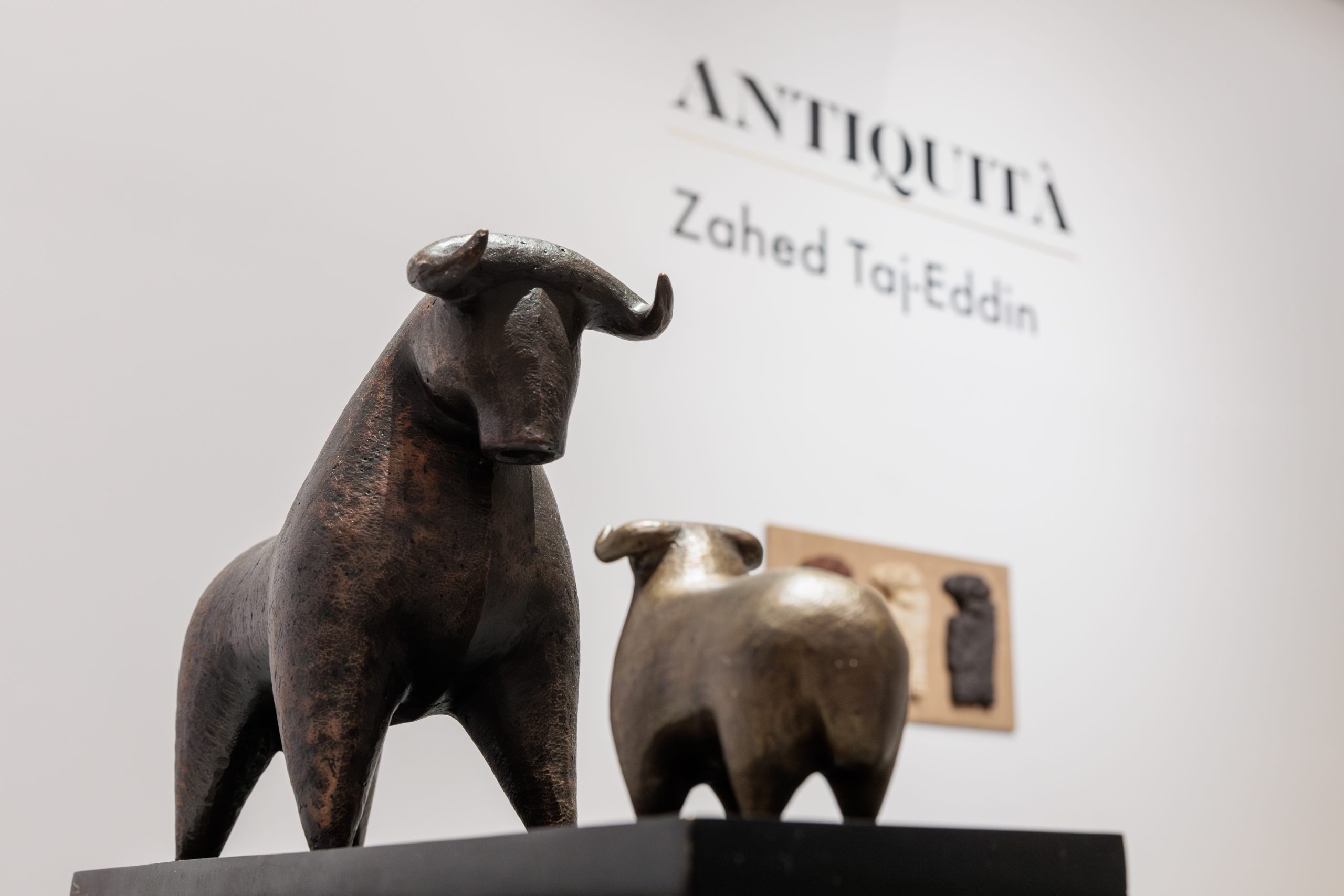
This was my first visit to The Atkinson and it took a moment to orientate myself. I was surprised to find that the main body of the building is a theatre, with its wings housing a museum and an art gallery. This turns out to be a relevant arrangement for the story that unfolds in Zahed Taj-Eddin: ANTIQUITA, an exhibition of work by a sculptor and archaeologist working at the intersection of contemporary fine art and traditional craftsmanship, from a Syrian and British perspective – Taj-Eddin was born in Aleppo and has lived and worked in London since 1989.
The entrance to ANTIQUITA is through another gallery, currently showing works by female artists from The Atkinson’s collection. This sets the scene for an archaeological encounter, for something newly brought to the surface, perhaps previously lost or hidden. The doors between all of the exhibition spaces are open, allowing me to catch a peek of works by father-and-son metalworkers Brian and George Fell, as well as an education space as I’m passing. This through-flow makes a subtle connection between the themes in the gallery’s art-wing reinforcing ANTIQUITA’s positioning between fine art and craft-based practices, art history and contemporary art, as well as other academic dualities.
Taj-Eddin’s exhibition feels consciously dressed, almost nostalgically, as a museum exhibit. Many of the sculptures’ plinths support airtight acrylic boxes, as if taking their styling from vitrines in The Atkinson’s historical wing. Any confusion over the age of these artefacts is quickly pierced by the audio loop from a film I can’t yet see, the artist talking about process and making. His words sound contemporary. There’s an incongruous banner on the wall, less pristine than the rest of the exhibit. It looks tired, perhaps itself excavated from a previous museum display. It makes me think about the ways in which objects from ancient civilisations are collected and presented, as outsider stories, simple narratives glossing over complex layers of scientific research and interpretations. Taj-Eddin’s works stand in contrast to this colonial perspective. ANTIQUITA feels more like a pun, an in-joke. A subtle museum take-over.
Three information panels introduce the exhibition. Two describe Taj-Eddin’s work with a brief biography, as is typical. A third, sets the tone for a personal encounter with his work. Here Taj-Eddin has written his own fable, a story in which a sprightly goat triumphs over the bull(y). Despite the museum styling, Taj-Eddin’s fable shifts my feeling receptors away from dead, stuffy things. This is not an archaeology, art or craft exhibition or even a gallery. Instead, reading this tale, I step into an imaginary, mythological world on the brink of creation, and paradoxically already in existence.
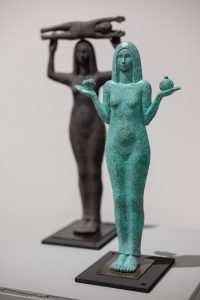
Traditionally crafted in ceramic, bronze and Egyptian faience, a variety of animal forms – bulls, sheep, horses and a goat – are presented to us by Taj-Eddin, along with human figures, as evidence for this world’s existence. Taj-Eddin was born in Aleppo, Syria, one of the world’s oldest continuously inhabited cities. By making these ancient-looking forms and consolidating them in fire, he is continuing traditions of making that date back to 7000 BCE when clay containers were first fired and transformed into ceramics and 3300 BCE when an alloy of copper and arsenic formed the first bronze objects in the region. Despite this lineage, the world Taj-Eddin has conjured feels precarious, temporary, a relentless, alchemical effort to sustain a cultural tradition through colonialism, authoritarian rule and civil war in Syria. Not all works are transformed from fragile ceramic into durable bronze, suggesting that future visitors may only get to see half the story.
The works presented are categorised across three themes ‘Mythologies’, ‘Allegory and Animals’ and ‘Eternal Females’. Although I wasn’t always aware which category of work I was looking at, the distinction made between myth and allegory, whilst subtle, seems important. Myth is a symbolic narrative passed down over generations. Allegory is a narrative or visual work representing abstract moral or political truths. Taj-Eddin has lived under political constraint and has been displaced. His sculptures draw from political allegory in Arabic literature dating back to the 18th century where the bull’s role is to dominate, the sheep’s to obey and the goat’s to refuse. But Taj-Eddin’s sculptures offer a much more complex and hopeful view. The sheep that confronts the bull in ‘Dialogue’ (2013) is not docile and the fact that it is a bronze edition suggests there are more sheep waiting in the wings ready to step up. In the ceramic stoneware sculpture ‘Moment of Victory’ (2013), the goat similarly does more than refuse to move from its precarious position on top of the bull, rather it stands proud and victorious.
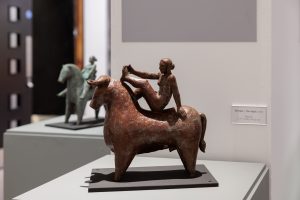
Taj-Eddin uses the titles of his sculptures not only to emphasise but also to extend political perspectives beyond the ‘Allegory and Animals’ theme. A classically styled, ceramic stoneware sculpture depicting a draped female, in ‘Mythologies’ for example, is seen differently when you read the label, ‘Stop the Bombs’ (2013), her arms re-discovered, raised in a futile gesture of self protection. By dividing the exhibition thematically and allowing works to cross borders, tendencies towards categorisation are reinforced. I notice stylistic differences. There are sculptures more closely resembling ancient artefacts, such as ‘Stop the Bombs’. There are simple animal forms cast in smooth bronze like ‘The Herd’ (2013) and sculptures that look similar to this but with slightly rougher surfaces crafted in ceramic stoneware such as ‘By the Horns’ (2018) which depicts an outstretched figure, acrobatically vaulting on a bull. Then there are sculptures with unusual surface treatments such as ‘The Music’ (2014), where the tooling of horizontal grooves is tantalisingly touchable, as if this ceramic stoneware is asking to be washed by time, softened by generations of feeling. This scattering of stylistic differences across the narrative categories jar a little, as if things aren’t quite what, or where they should be, as if displaced.
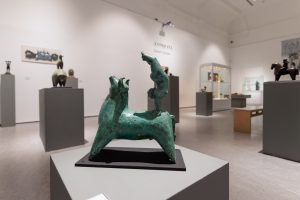
The overarching theme in ANTIQUITA is the way we continue to hold such categories as essential ways of observing the world. Epistemic practices that keep ourselves forever at a distance as the observer. This dichotomy is referenced in the staging of the exhibition’s ‘Sculpting with Clay with Zahed Taj-Eddin’ (video by Keith Craig, 2026), itself primarily concerned with the artist’s dual-role as artist and craftsman. Projected, it stretches across a wall, between plinths supporting the dual motifs of ‘The Alchemist’ (2015), a bronze sculpture depicting a man on a horse, foregrounded to the right and other sculptures ‘The Mother of Knowledge’ (2025) and ‘Isis’ (2025), in bronze and ceramic stoneware, set further back and to the left. This triptych of sculptures all depict figures with hands, lifting outwards and upwards in equal measure, looking like horns of a bull, or the scales of justice. They seem to represent opposites, an idea repeated throughout the exhibition, between myth and allegory, bull and sheep, man and woman, good and bad, life and death.
Watching the film, I’m interested to hear Taj-Eddin talk about the differences between artist and craftsman and the distinction between fine art and craft. How working with the foundry to cast his hand-made clay sculptures into bronze elevates his ceramic craft to fine art, increasing both the material value and longevity of his forms. He describes beautifully the alchemical process of ‘letting go’, into the foundry fire the evidence of his own hand, melting away his moral ownership, which is now shared with the foundry, bound in a new creation. In this bronze-casting process Taj-Eddin identifies only temporarily as a craftsman, in the making of the original ceramic sculptures where he considers himself both artist and craftsman, at the same time.
I am similarly neither consistently bull, nor the sheep that gather around or confront it. I guess I am both. And also the fabled sprightly goat, that we see only once in ‘Moment of Victory’ (2013) but is ever present in the role I play, actively moving from side to side and holding a critical position as I go around the exhibition. Take ‘Gaza’ (2024) for example, a bronze watermelon wedge (a defiant symbol of Palestinian identity) acts as a seesaw for a sheep and bull. The watermelon is off balance and the bull stands elevated above the sheep. I can’t quite settle on an interpretation of the relationship between the two animals. Is the sheep about to leap up and send the bull crashing down, or is its act of holding ground merely maintaining the bull’s dark shadow? The truth perhaps lies somewhere in and between these two positions.
Physically the bull remains the central character in ANTIQUITA. A brief glance at the catalogue reveals that more than one third of the works feature a bull. In ‘Animal Presences’ (2008) archetypal psychologist, James Hillman, suggests that the bull symbolises the sheer force of our imagination, that impenetrable gust of undifferentiated excitement that comes to us charging in like a bull. In the founding mythologies of Ancient Egypt the baby bull slides into the world from mother Isis and announces itself as ‘the bull of confusion’. Taj-Eddin’s craft is in taming this bull through processes of sculpture, scholarship and archaeology.
Bull is everywhere in this exhibition and I say that in these most generous, alchemical terms. Taj-Eddin’s studio output is a testament to the necessity of imagination for personal, cultural and human survival, in the face of the overwhelming forces of dictatorship. Bull dominates in the mix of materials, processes and languages that seep across the exhibition’s thematic boundaries and yet is tempered by repetition.
Human figures are variously found riding a bull, ‘The Alchemist’, ‘Coexistence’ (2025), ‘Europa – The Myth’ (2014) to name just a few. These same figures are also found to be holding each other. A man holds a woman in ‘Support’ (2020) and a woman holds a man in ‘Woman of Gaza’ (2024). A golden sheep confronts a towering bull in ‘Dialogue’ (2013) whilst three sheep create a tower on the back of a bull in ‘Victory’ (2025). A lively goat stands on the back of a bull in ‘Moment of Victory’. Bulls circle the lid of a vessel in ‘Seige/Worship’ (2012) and in a separate but possibly related work ‘Going in Circles’ (2021) sheep surround the vessel’s interior. In ‘Confrontation’ (2026) sheep gather to face a single bull on a plate that could easily be rotated, the tables turned, forcing a herd of sheep to flee as we see in ‘The Sheep go to Lampedusa’ (2015).
There is at times an uneasy dose of humour in these scenarios. I initially smile at the watermelon see-saw before I read the title, ‘Gaza’ (2024). This sometimes idiomatic, sometimes dislocating, always layered symbolism requires a participation that seems intentional. The necessary unveiling of the work perhaps speaks more to the artist’s archaeological approach than do the more obvious aspects of the work, such as the ancient forms, materials and processes the artist is engaged in.
Understanding that these works talk about and originate in a condition of conflict and/or suppression also offers a way into the deeper, more psychological level ANTIQUITA operates in. Taj-Eddin’s ‘Adam and Eve’ (2023) and ‘Departure’ (2024) have each lost their limbs. We are accustomed to seeing classical sculptures damaged in this way, however, these are contemporary fine art sculptures. Given the references to modern conflicts throughout the exhibition, they rather depict human victims of war.
But, look again, and there are hints at something else going on as well. ‘Departure’ for example, is a gold-coloured ceramic sculpture depicting two figures (male and female?) bonded back to back, supported by a horse and displayed in ‘Eternal Female’. I don’t notice at first their missing arms, but when I do, their conjoined human torso’s supported by two pairs of legs suggest to me a return to and incorporation of feminine (wild) wisdom. Whilst the two heads seem to have everything covered, looking in both directions, an un-harnessed horse takes them somewhere neither figure has any control over.
What this story might mean to the artist, to me, and to you, will most likely be different because of our lived experiences. The artefacts of ANTIQUITA and the evidence of Taj-Eddin’s alchemical work, asks us to acknowledge these different experiences, to question and to consider not only other perspectives of the contemporary world but imagine a world of alternative outcomes that seem unlikely, if not impossible to us in the present moment – like a goat or sheep, triumphant over a bull. Accepting that our creative agency comes on the back of a bull, may also help us accept the less obvious aspects of our bullishness, our sheepishly, ‘why bother’ and stuck-in-the-mud’ mindsets. I left the exhibition with a good dollop of fertile hope and many questions about where it might be put to best use.
Zahed Taj-Eddin: ANTIQUITA, The Atkinson Southport, 13 June – 10 October 2026
Elaine Fisher is an artist and writer based in Liverpool
This review is supported by The Atkinson
Published 23.07.2026 by Natalie Hughes in Reviews
2,224 words