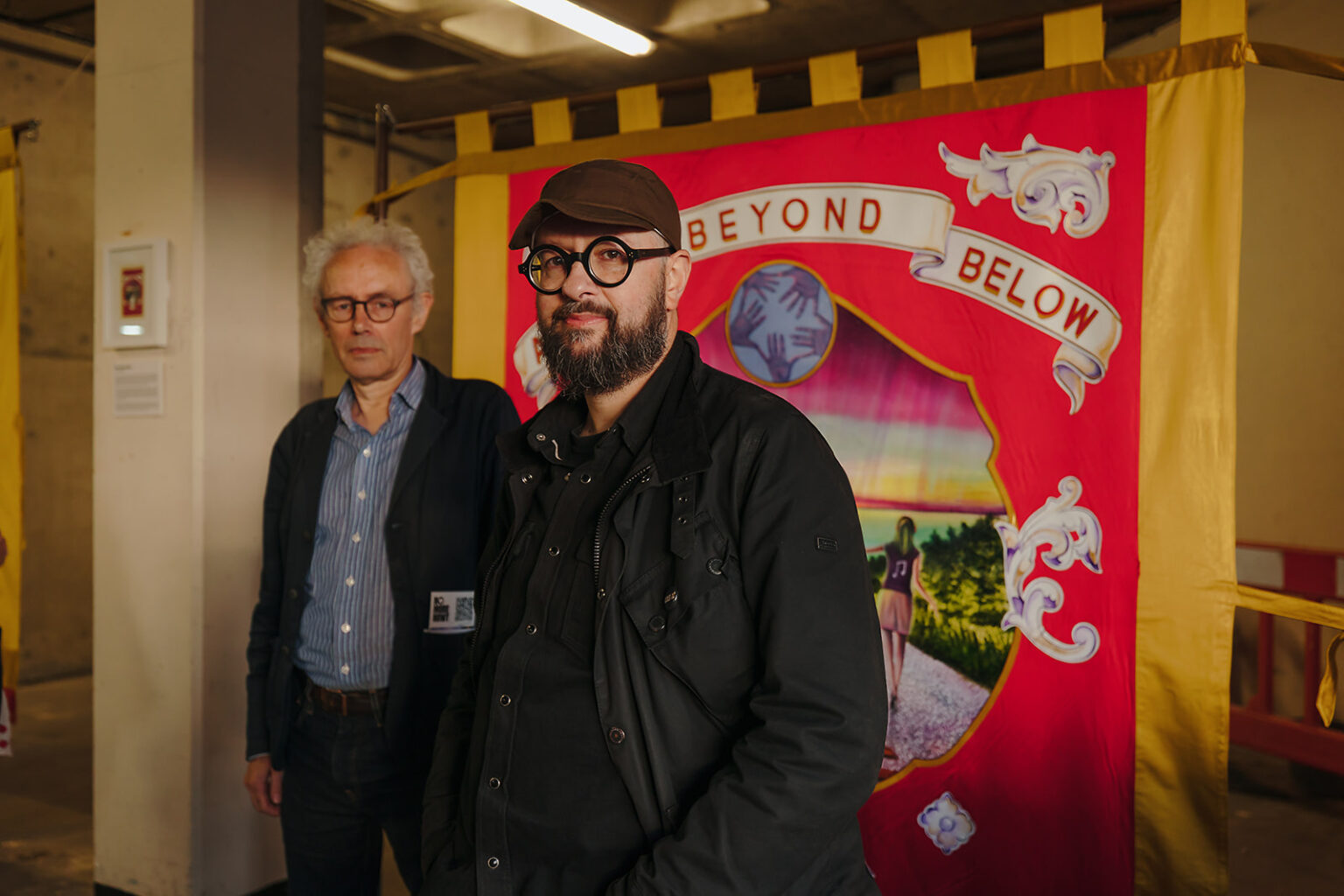
Celtic mythology describes certain places as having a ‘thin veil’ between worlds, separating the mundane everyday from the otherworld – that parallel dimension of ancestral spirits and supernatural energies. Artist Dale Holmes lives in Todmorden, the West Yorkshire town where three dramatic Pennine valleys converge, encircled by windswept moors studded with weathered gritstone outcrops. Todmorden has been one of the top UFO sighting hotspots in the UK since a series of strange happenings in the area in the 1980s, sealing its reputation as a place where the veil is perpetually thin.
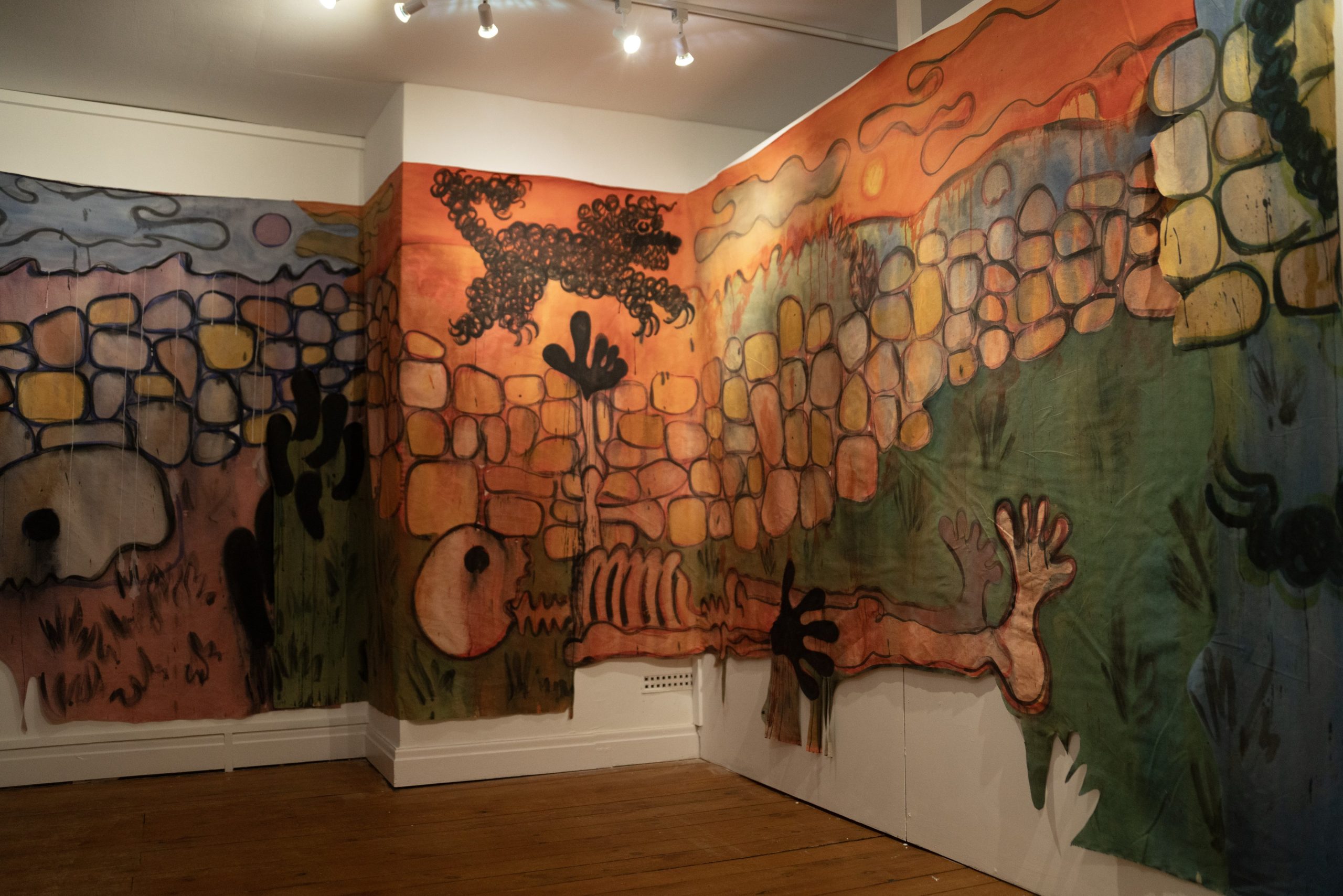
Holmes channels this otherworldly atmosphere in Beenderman & Gytrash, his current solo exhibition at South Square Centre in Thornton, Bradford. The show presents a series of fantastical large-scale acrylic works depicting supernatural encounters across Haworth Moor, featuring the skeletal Beenderman, an archaic folkloric figure whose name literally means ‘Bone-man’, alongside Gytrash, the ghostly black dog of Yorkshire legend that famously appears in Charlotte Brontë’s Jane Eyre. There’s a particular resonance to viewing these works in Thornton, as the painted landscapes depict the very moorland that surrounds the gallery, where, according to local folklore, Beenderman and Gytrash stalk the hills and drystone walls.
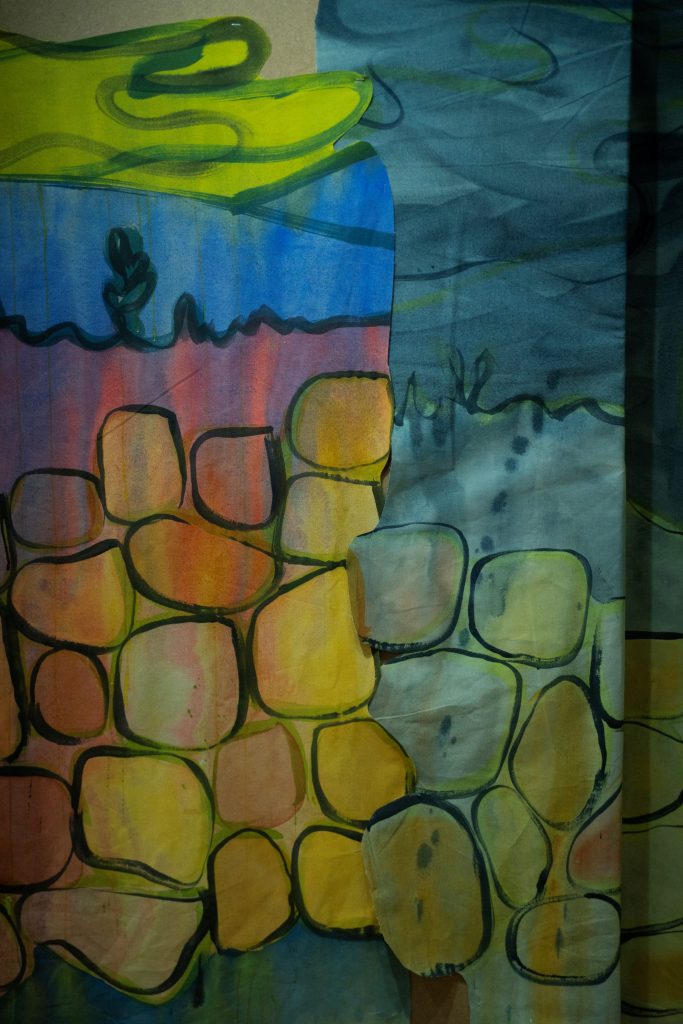
The tale of the two pals is laid out floor to ceiling in the gallery space on expansive pieces of calico, wrapped around corners and cleverly lining up to complete the image of Gytrash across two walls near the entrance. Holmes has cut boldly into the calico around shapes at the bottom of the canvas, revealing glimpses of white wall beneath, while sections of his painted drystone walls are freed from their backing, creating flapping tabs that project into real space. This fearless approach to material transforms the gallery into an immersive moorland environment – the work pulls you into each corner of the room, and you find yourself following it around as if tramping the hills outside. Holmes also has an excellent way of capturing dusk turning to night through a palette of solar orange and lavender hues, colours that Beenderman seems to absorb into his bones, allowing him to blend in with the twilight landscape. Against this moody backdrop, Gytrash emerges in stark contrast, rendered in scrawled black marks, howling defiantly against a luminous yellow moon.
The exhibition extends outdoors through a narrow passageway where Holmes’ abstract works hanging from both walls create a deliberate moment of spatial compression before the courtyard opens up. The garden space hosts Welcome to Corpse Road Coffin End Tennis Club (2022), a series of acrylic paintings on unframed canvas that present a dog’s eye view of various figures’ feet and ankles alongside Holmes’ recurring motif of Yorkshire dry stone walls. These works function as hybrid objects – paintings that behave sculpturally, positioned to interact directly with the garden’s architecture and plantings. In them, we see horizontal bodies that appear to be being transported along the ‘corpse road’, a route used by remote communities to transport the dead to burial sites. Alongside these are the odd pair of hoofed legs that suggest not just human corpses but supernatural entities using these ancient pathways, reinforcing Holmes’ vision of folklore as a living, hybrid system where the boundaries between human and non-human remain fluid.
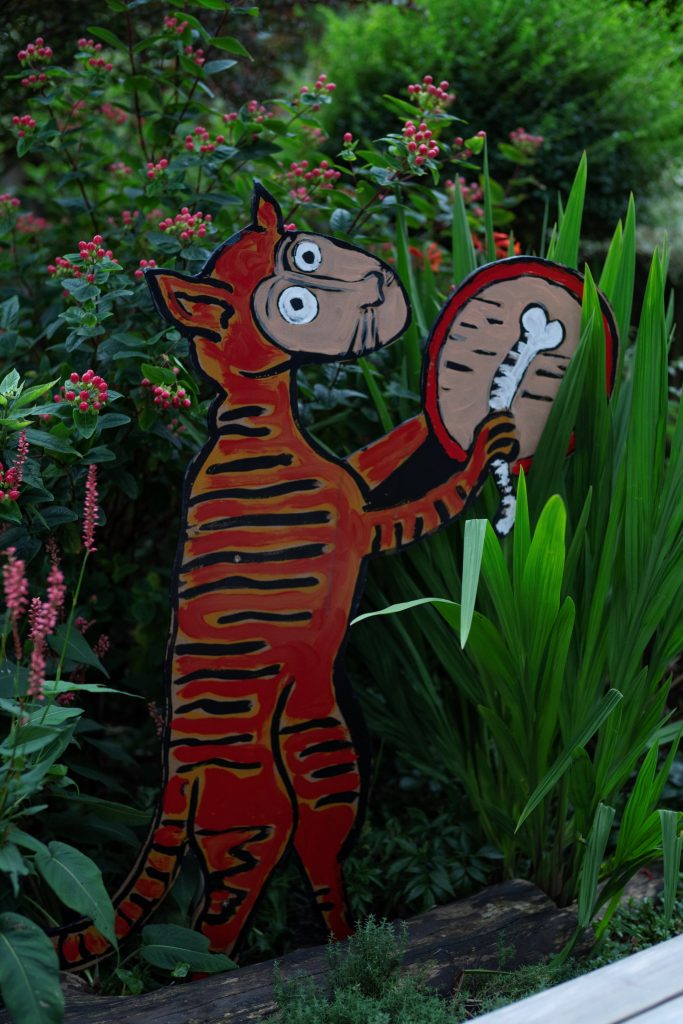
Painted dummy boards depicting a dog orchestra playing bone instruments emerge from amongst plants. These flat, painted figures create an uncanny dialogue with the three-dimensional garden around them, while more dummy boards show pairs of feet protruding from the soil to create an unsettling inversion – are these figures emerging from or disappearing into the earth? The ambiguity feels deliberate, suggesting the permeable boundary between burial and resurrection, between the living landscape and its spectral inhabitants. Holmes’ fictional ‘tennis club’ seems to propose alternative social structures where ancient ritual and contemporary leisure become indistinguishable. The artist has consistently created these paradoxical sporting institutions – including his earlier Ratcatcher’s School for Good Dogs Tennis Club (2022) and Broken Hand Tennis Club (2021) – that function as social spaces for the excluded and supernatural. Here, the ‘club facilities’ include corpse roads as courts, bone instruments as equipment, and burial grounds as playing fields.
In the exhibition text, Holmes mentions that Beenderman was traditionally ‘seen in bad weather and at the darkest times of night’, but that recent developments in technical walking gear have rendered him somewhat redundant. Where once a skeletal figure stalking moorland paths in harsh weather might have genuinely terrified unprepared travellers, today’s hikers are equipped with GORE-TEX jackets, head torches, and GPS devices. This added context gives further access to the humour in the work – the pair busying themselves on the moors, Beenderman exploring a hole in the wall while Gytrash runs off with his bony leg like any mischievous pet.
Holmes transforms ancient terrors into endearing companions, questioning where folklore sits in sanitised modern times. As we embrace the countryside through weekend hiking and heritage tourism, we remain oblivious to the ancient forces that once made these landscapes unsettling. In neglecting these old fears, we’ve stripped them of their power – yet Holmes suggests that Beenderman and Gytrash haven’t disappeared entirely, merely adapted to find new ways to occupy themselves in a world that no longer believes in them.
Hanna Dhaimish is a curator and writer based in Otley.
Dale Holmes: Beenderman & Gytrash is on at South Square Centre, Thornton, 1 Aug – 5 Oct 2025. There is an artist talk with Dale Holmes on Friday 12th September, 6-8pm.
Published 08.09.2025 by Benjamin Barra in Reviews
933 words