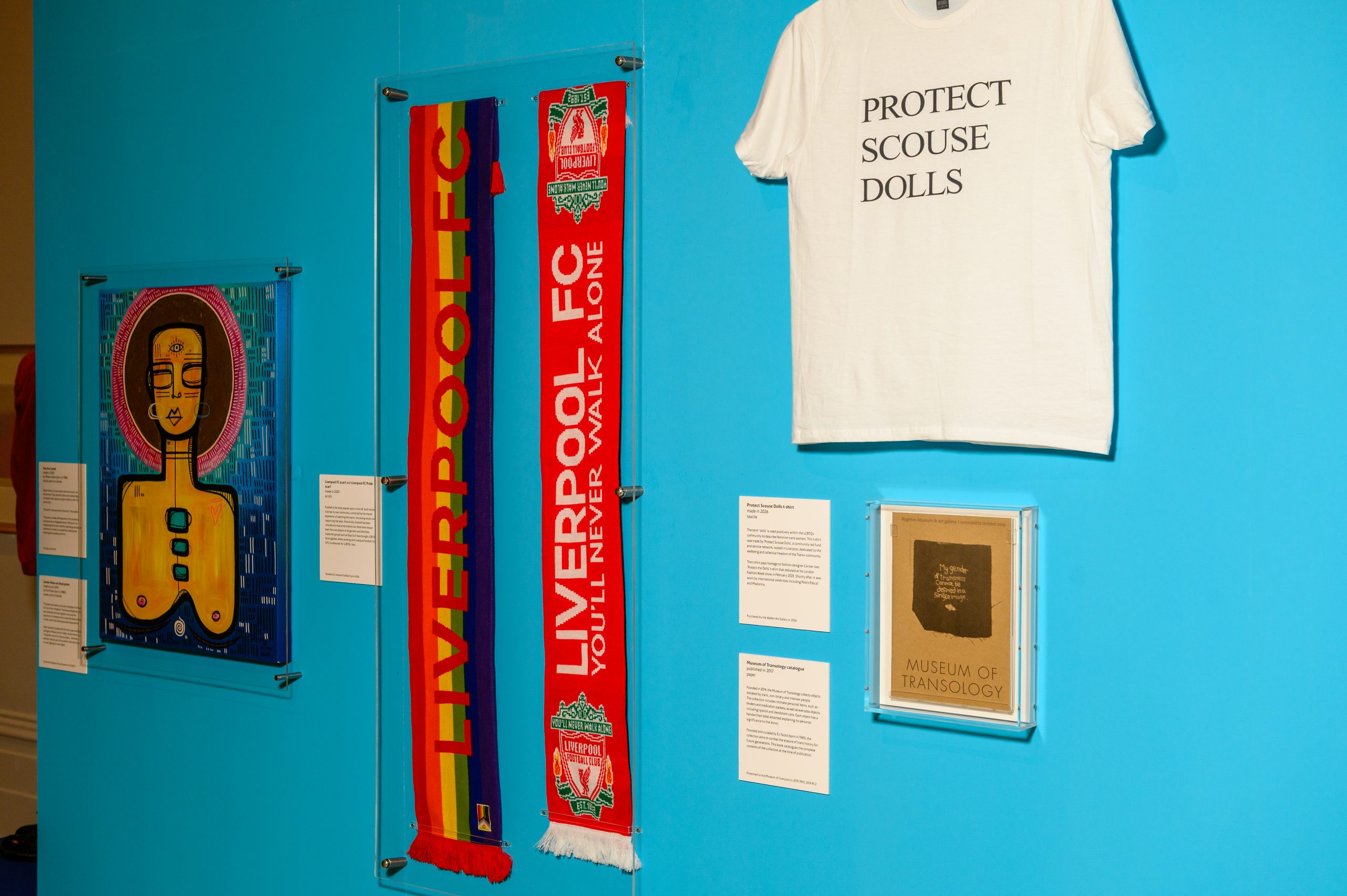
This review has been written by Review Collective (RC), a group of creatives based in the North West who meet monthly, online or in person, to write and share critical responses to art and culture. RC is a project by Artist-led St Helens, an artist-run studio in St Helens, on the outskirts of Liverpool City Region.
We were invited to review the Gender Stories exhibition at the Walker Art Gallery not long after the local elections in St Helens brought in a Reform-led council. One of the first things this council announced was that they would not be supporting Pride. As a result, local libraries across the town were told to remove their Pride themed displays. St Helens is a part of the Liverpool City Region and as queer representation was being suppressed throughout its borough, Liverpool’s Walker Art Gallery was preparing to launch Gender Stories, an exhibition exploring ideas about gender (what is it? how does it affect us?) and the histories of these ideas.
It is in this context that we visited the exhibition. Feeling anxious, unsafe and mistrusting of public institutions’ abilities to advocate – and hold space for – LGBTQ+ voices. Congregating in the foyer of the Walker Art Gallery, we shared stories of grassroots organisation as a means of creating sanctuary for marginalised individuals, and whether institutions like the Walker Art Gallery can facilitate feelings of belonging and togetherness. We hoped that the exhibition would initiate conversations among audience members about the social process of marginalisation, and would do so in a way that boldly embraced the complexities of gender.
The exhibition is located on the first floor in the venue’s temporary exhibitions space, which comprises a small room that we both enter and exit through. In this a printed wall text tells us that Gender Stories has been a collaborative effort between Bristol Museums, National Museums Liverpool, and Brighton & Hove Museums. Another display informs us that the font chosen for the exhibition’s interpretation is gender neutral. Towering colourful plastic structures in the centre of the room are decorated with quotes (such as ‘Gender belongs to everyone. It is something personal for each one of us.’) from participants of the community workshops, which form part of the show.
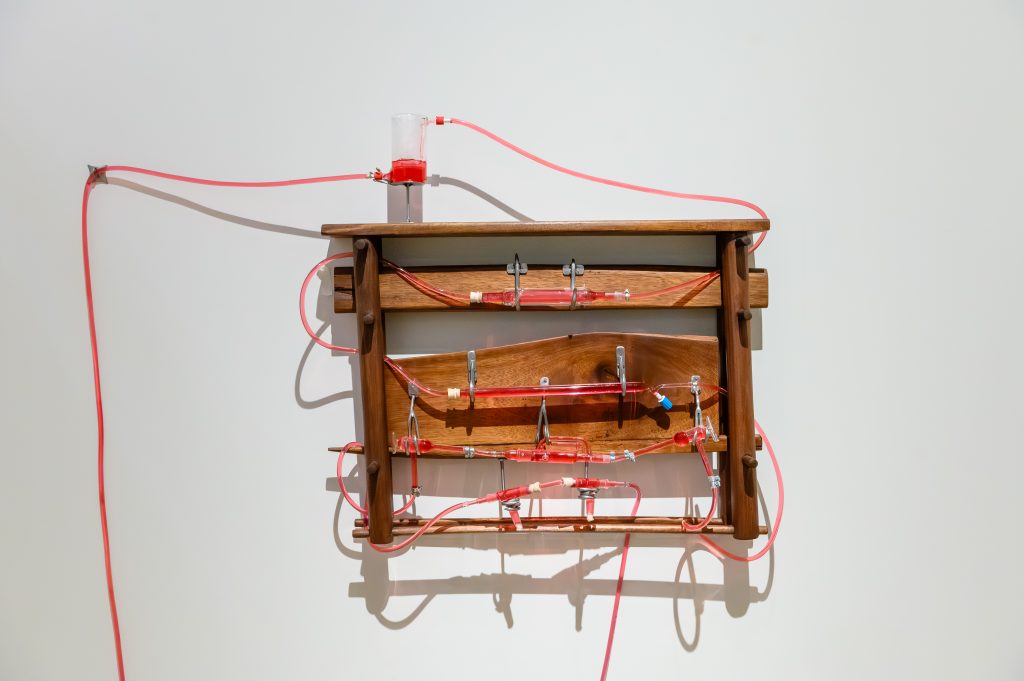
Entering the main exhibition space we are immediately drawn to Charli Kleeman’s ‘What If You Regret It – Fig. 3: Gun Rack’ (2025). Located just past the entrance doors, and fixed to the wall, this artwork comprises of a wooden frame(similar to a bed headboard) which acts as a supporting structure for a loop of plastic tubing circulating a red blood-like liquid. Here, there is symbiotic interplay between the organic and the synthetic. As a liquid, the fake blood becomes a double entendre for fluidity, and represents the choice to biohack our body using HRT (hormone replacement therapy) – gels, skin patches, pills and pessaries taken to adjust an individual’s chemical makeup to better serve their needs.
Regulated avenues of gender affirming care and HRT acquisition for trans and gender nonconforming individuals can be inaccessible, with high costs, restrictive prescribing guidelines and years-long waiting lists preventing the administration of life saving care. In trans culture, biohacking is often synonymous with peer assisted affirmative care. DIY HRT is one component of this: finding unregulated routes to obtaining HRT, following crowdsourced guidelines that are in perpetual flux, through processes of trial and error.
One member of the Review Collective draws a comparison between Kleeman’s ‘Gun Rack’ and the short speculative fiction story by Torrey Peters, ‘Infect Your Friends and Loved Ones’ (originally self published in 2016, reissued in ‘Stag Dance’ (2025)). A purposefully divisive text, ‘Infect Your Friends’ theorises the fallout of a world infected by a bio-terror virus that stops humanity from being able to produce sex hormones. In response, a black market springs up, synthesised hormones (of various qualities and efficacies) are circulated, and everyone must decide which hormones they will or can take. Gender, for everyone, is an active decision, inexorably tied to survival. Nuanced, expansive narratives seen in Peters’ writing and Kleeman’s work are interrogative and future-orientated. The choice to place ‘Gun Rack’ at the start of the exhibition, insists on complicating any easy story of the past, present and future of gender.
Moving through the space, we reach an open-plan shed-like structure, which serves as the exhibition’s central reading room. Here, books and zines on the exhibition’s theme are available to read and short films play onscreen. The films belong to The Walker’s series ‘What Artists Wear’ (2026 -) and play out loud in the gallery space. Several adjacent artworks provide us examples of those ways that gender might be exhibited in our clothes, presentation and social groups. In particular, Hassan Hajjaj’s ‘Gang of Kesh, part 2’ (2000), which challenges Western perceptions of Islamic womanhood and North African gender roles. In this image we see five women, each wearing a niqab and an abaya are pictured with their motorbikes. Their clothes are made from bold, contemporary fabrics – blue polka dots on white, leopard skin print, Gucci motifs – which contradict perceptions that this type of traditional dress is oppressive. The women hold themselves confidently, their eyes gaze fixed in authoritative and imposing stares. The photograph is framed with tins of motor vehicle paint, the choice to use this male-gendered material (vehicle repair is presumed to be the preserve of men) reinforces the women’s position as agentic subjects with the freedom to choose the lives they want.
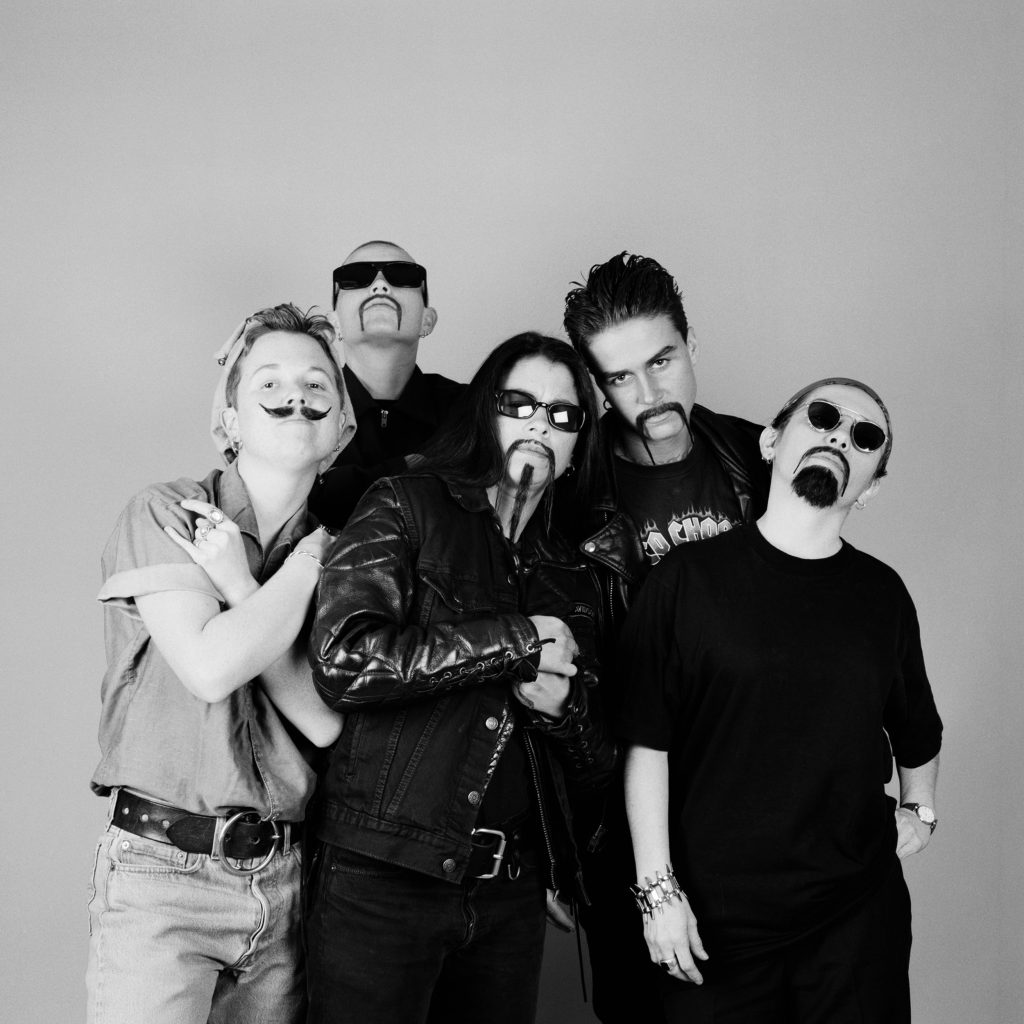
Throughout the exhibition, there are places where artworks mirror each other, their curation subtly alluding to differences and similarities. Catherine Opie’s ‘The Gang’ (1990) is another photographic group portrait, this time, the figures’ over-the-top faux moustaches and bravado stances capture playful poses that resemble photo booth snaps taken at fancy dress parties. Opie’s photograph is taken from within her own queer community and its accompanying text describes the work as a playful subversion of gender, featuring members of the Daddy/Boy lesbian subculture. This might also allude to,, the idea of class as intersecting with gendered presentation. Historically, ‘butch’ has not just been a marker of masculine expression, but is an intrinsically working-class identity, often considered a gender in and of itself.
We hear more intersectional stories from those who took part in the community workshops via recordings featured in audio stations around the gallery. Three benches in the gallery space provide places where visitors can press a button to choose which clip they’d like to hear, listening via a small handheld speaker held to the ear. Accounts range from a woman talking about how her gender transition didn’t align with ‘being trapped in the wrong body’, to another woman who relays how her twin sons admonished her negative views towards men, forcing her to change her behaviour.
Ree Bradley ‘The Mind is a Group Muscle’ (2025) is a 12 minute short film accompanied by a series of A4 drawings displayed in a grid along the wall. Tucked into the corner of the gallery space, the film shows close ups of faces (Bradley also a participant) as their owners experience a body-based therapy session. What we see is a collective raw, unfiltered form of expression. The drawings created in the session we’re watching unfold, are child-like and seem to mimic that turbulent vulnerability of trying to figure, or feel, something out, The images feature scratchy or scribbled crayon markings recording abstract forms and phrases such as ‘ALL ARE CONDUITS’. It is a glimpse into something that feels private and at odds with the public setting of its display , particularly as the film plays aloud and fills the reverberant open space with a crescendo of deep moans.
We found the exhibition to be nuanced and inclusive. It is devoid of assumptions, gender essentialism, pathologisation, medicalisation, or anything that makes us grit our teeth. We didn’t notice a single artwork featuring genitalia, a common trope for feminist art of the 1960s – 1980s and therefore not out of the question to expect. The exhibition is subtle in what it’s trying to say, which at times leaves our group feeling unnerved. We are so used to gender being a topic up for debate, that we are tensed waiting to see something we disagree with. Regardless of the exhibition’s theme, the toilets in The Walker Art Gallery are neatly gendered, and there is no feeling that we are safe from being misgendered anywhere at any time. The exhibition’s theme raises questions around the challenges for institutions to be radical, particularly in times of crisis.
Our desire for an equitable future for all genders leaves us hoping that Gender Stories catalyses important conversations that we can have with each other, our loved ones, and ourselves. Leaving via the room we entered through, a display along one wall invites visitors to tie a ribbon to a statement they most agree with, such as ‘I’ve heard a new perspective here today’ or ‘I feel hopeful about the future of gender’. There are only a couple of ribbons left in the trays for us to attach, which we think is a positive sign.
This review was written by Review Collective members Cath Garvey, Joe Hughes, Phoebe Verity, Kristian Lawrence, and organised by Gee Collins, for Corridor8. Review Collective is a project by Artist-led St Helens (@artistledsthelens) that wants to hear more about culture from the people that have to get three buses to get there because the train was cancelled. We meet monthly, usually online, and use Hyfon, an ad-free online messageboard, to share reviews between meetings. If you’re interested in joining Review Collective, email us: studiosinsthelens@gmail.com for next meeting dates.
Gender Stories is on at The Walker Art Gallery until 31st August
This review is supported by National Museums Liverpool
Published 18.08.2026 by Natalie Hughes in Reviews
1,670 words