It’s rare to enter a gallery and make a beeline for the wall text, but something in George Shaw’s spiky capitalised handwriting commands the eye, summoning me past all of the paintings, sketches and video works I thought I’d come here to look at. Twenty minutes pass and I’m still rooted to the spot, glued to his exuberant coming-of-age tale, a perfect snapshot of late 1980s Sheffield but also that feeling of being nineteen and seeing all the possibilities of the world fly toward you as you stare out of the window of a train. In Small Returns, George Shaw pushes that feeling to the fore.
Shaw’s new exhibition at Yorkshire Artspace marks almost forty years since he first arrived in the city to study fine art at Sheffield Polytechnic’s Psalter Lane campus. Bringing together works from the last twenty-five years alongside early student projects and three brand new paintings, Small Returns doesn’t just revisit the painter’s older works, it goes through his memories with a fine-toothed comb, starting with the autobiographical essay inked on the gallery walls. Titled Small Returns: Art, Ambition and Awful Pies, it tells the story of Shaw’s youth and artistic awakening, introducing the themes of exile, return and loss that have come to define his practice ever since.
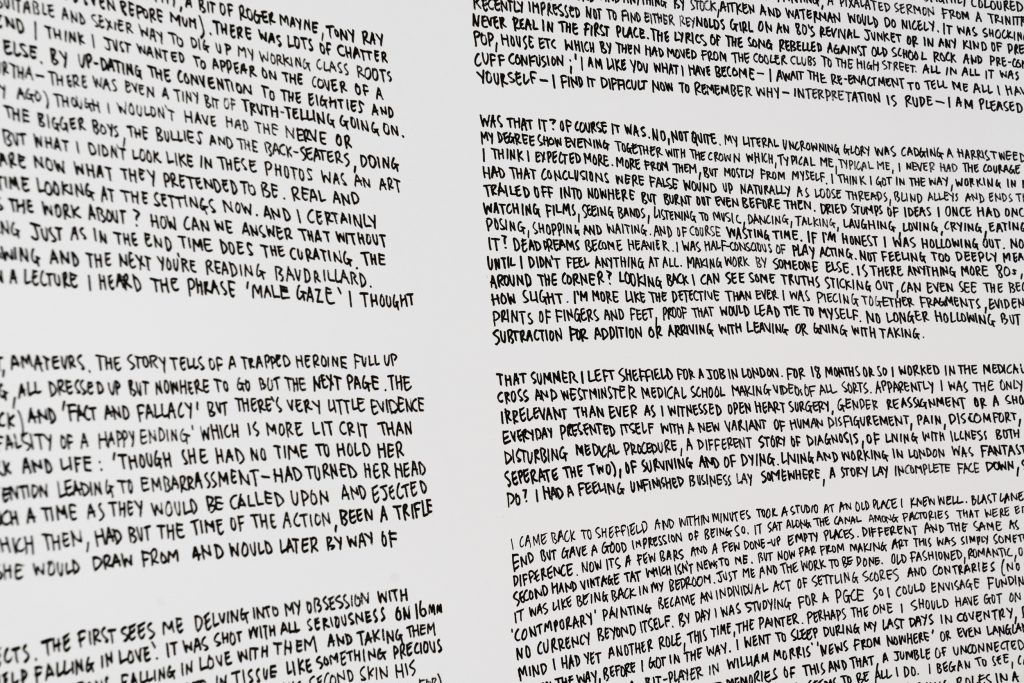
Back in 1986, exile for Shaw simply meant getting out of Coventry. A romantic yet naïve figure, he describes coming to Sheffield still wet behind the ears, weighed down by a portfolio and an infatuation with Northern identity mostly informed by kitchen sink dramas and the covers of Smiths records. He soon gets into the swing of things, writing texts, attending warehouse parties, and eating his first ever curry. ‘That summer was a kind of heaven,’ he reflects, ‘temporary as all heavens are, but it lies sweetly and uncorrupted within me.’ Clearly, this was the time of his life – he had finally been reborn as ‘an artist in a garret in a film of my own making’.
Hosting this exhibition in Sheffield packs an extra punch, now that Psalter Lane has been relegated to collective memory. For alumni, it’s a bit of a lost Atlantis, an enclave of creativity and experimentation right up until its demolition in 2010. The kind of place where a light bulb could break in the lift and everyone would assume it was an installation. But surely, we all have our own equivalents: places we left long ago yet still revisit again and again in our minds.
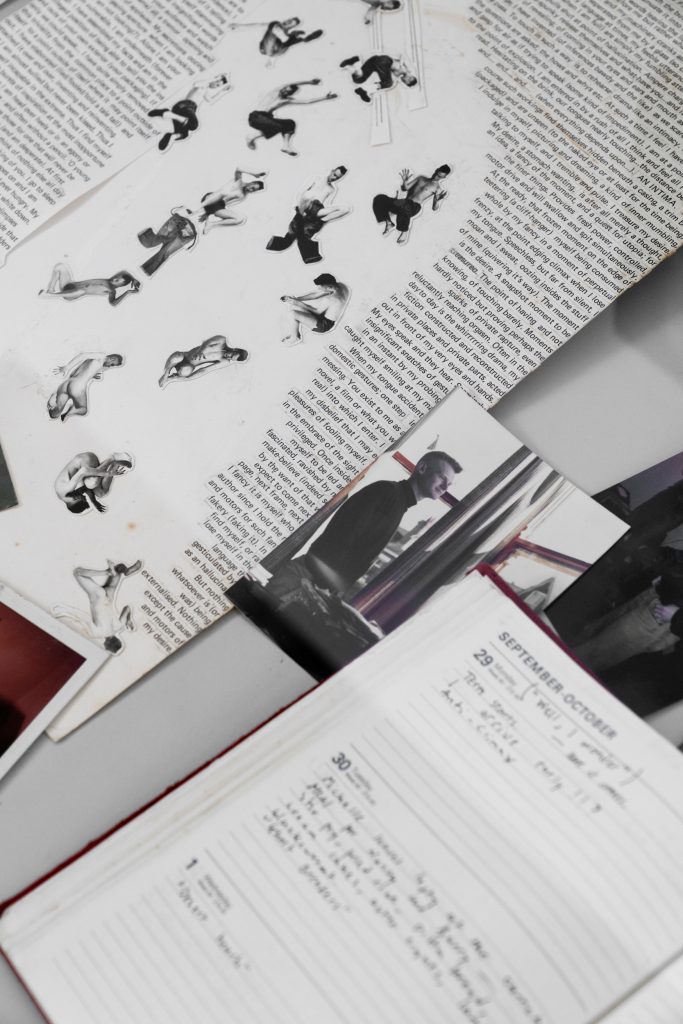
Another of these places for Shaw turned out to be Coventry after all. How could Shaw ever have guessed that the paintings he is best known for, and which earned him a Turner Prize nomination in 2011, would focus on Tile Hill, the Midlands estate he left behind all those years ago? This first room of the exhibition sets out to piece together that particular George Shaw, the one shaped by his estate. As well as self-portraits, there’s a museum-worthy vitrine filled with Shaw’s NUS cards, Polaroids, and letters his Dad wrote him while he was at art college, along with diary entries and other little keepsakes referenced in the wall essay.
It’s strange that of all the works and souvenirs on display, it’s the two video pieces ‘Stutter’ and ‘Once Upon a Time’ (both 1989) that feel the most like relics. Made at 23, when Shaw was truly finding himself as an artist, no doubt becoming the person his younger self longed to be, they bring together elements like glitchy slogans, a bare-chested Shaw, art theory and disposable pop songs. Shaw describes ‘Once Upon a Time’ as ‘a pixelated sermon from a Trinitron pulpit’. He might mock his younger affectations, but there’s a charm to witnessing someone so devoted to making art communicating his vision fiercely and energetically to camera.
Made more recently, a short film by Jared Schiller titled ‘The Tribe’ (2018) follows Shaw and his brother and sister returning to the family home for a catch-up with their mum, Eilish, the year before she died. Armed with a mountain of biscuits, they compare notes about childhood, from accidentally suffocating their pet tortoise to ‘the notch where Dad’s chair used to bang on the door’. Their gales of laughter don’t mask an underlying anxiety about the grim march of time, the knowledge that they won’t be able to gather in this house forever. But when she’s asked by her daughter if she misses Donegal, Eilish isn’t sentimental about her own homeland – home is here and now, surrounded by her children, sipping tea out of a ‘Queen of Awesomeness’ mug. ‘Oh, we are having fun,’ she murmurs.
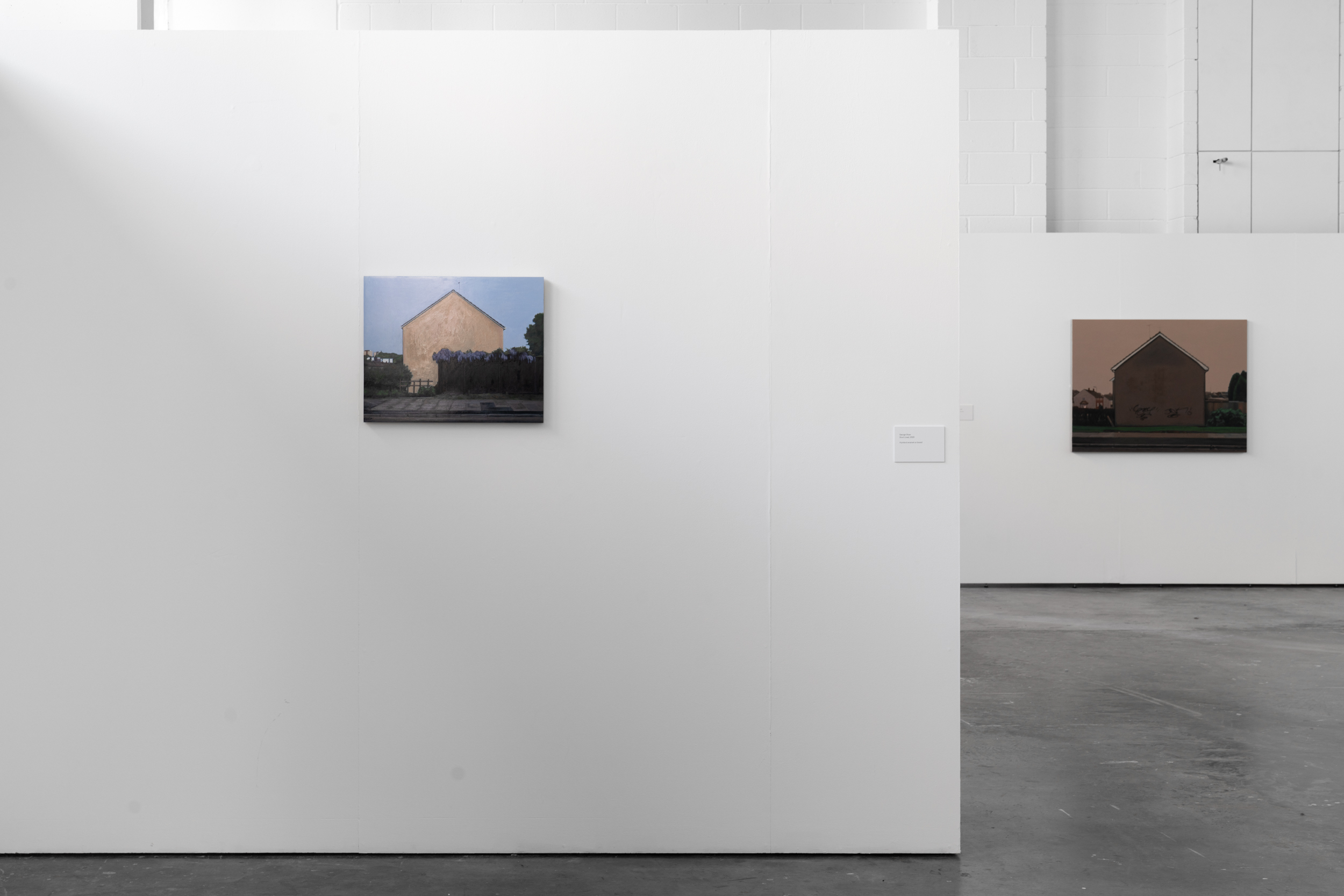
The family’s eagerness to pin down scenes from their past might be the same impulse which drives Shaw as a painter to so faithfully recreate Tile Hill. Entering the second room of the exhibition, the place comes sharply into focus. These are exactly the desolate landscapes Shaw is known for, showing a man-made suburban wilderness where buildings glare back at us and humans are only visible by the traces they leave. The paintings document the same streets glimpsed out of Shaw’s mum’s living room in ‘The Tribe’, but now they feel bare and unloved.
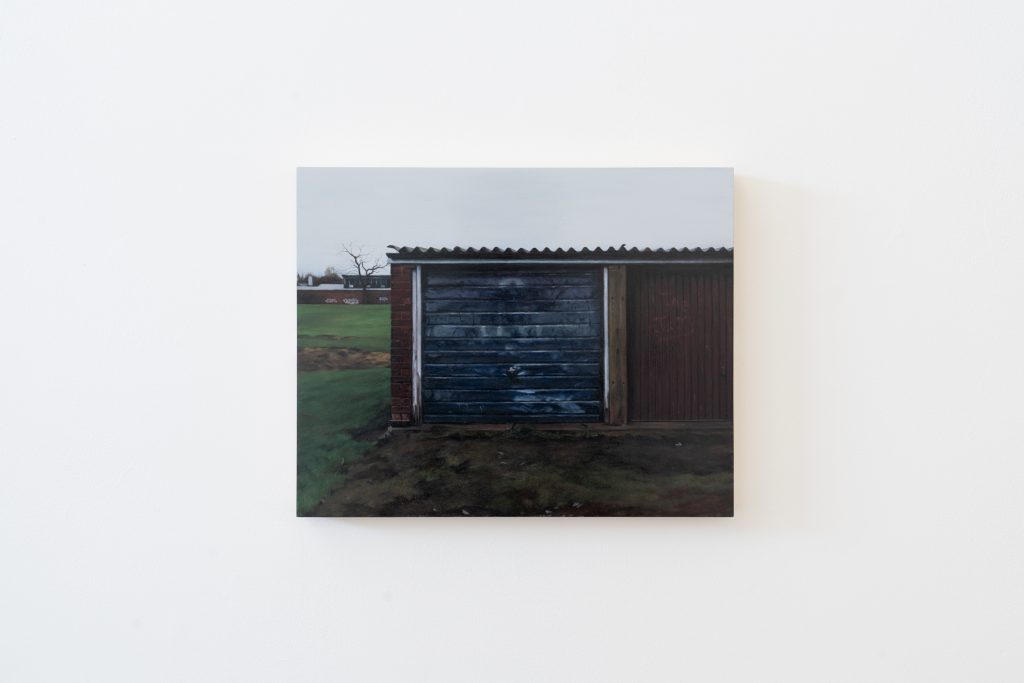
Small Returns makes no secret of the artist’s attachment to the past. But his paintings don’t skim over nostalgia’s dark side, the other ways that fixating on an idealised (or imagined) past can play out. His sealed-off garages in ‘Nostalgia’ and ‘ACAB’ (both 2025-2026) or the fence draped ominously in tarpaulin in ‘The Passing Wind’ (2023-2024) show his former home as somewhere guarded, territorial, suspicious. This is no place for casual visitors – a point made quite firmly by the ‘FUCK OFF’ road sign of ‘The Sublime’ (2022).
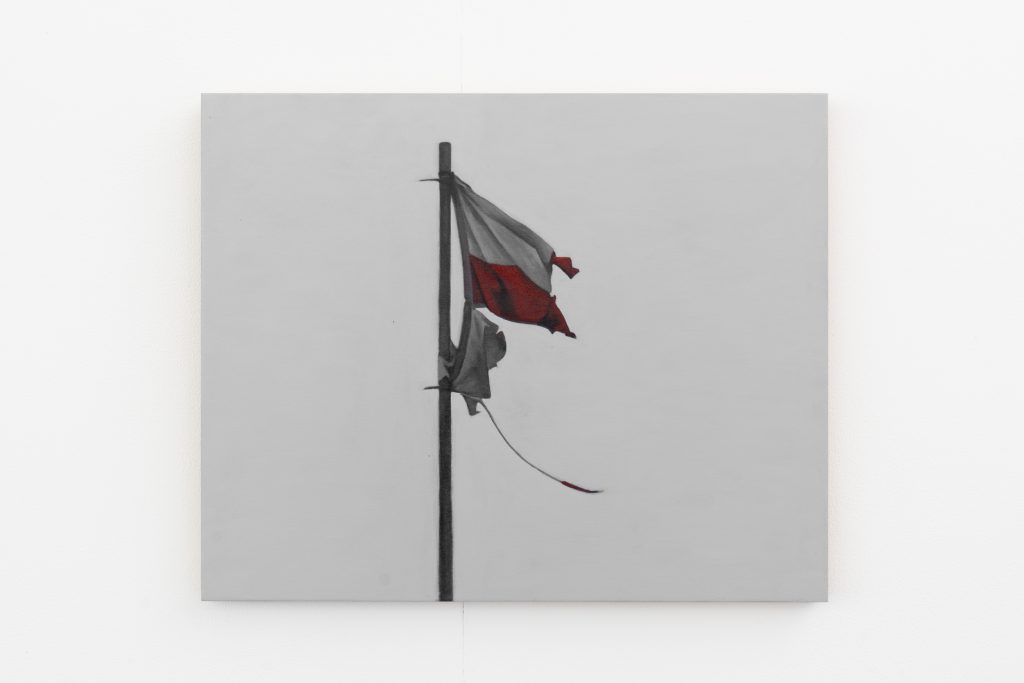
In ‘Half English 4’ (2019-2020), Shaw paints a tired, torn England flag billowing pointlessly in the wind, a supposed display of national pride that reads more like defeat. Just like all the wonky red crosses appearing in bus stops across the country last summer, the people responsible for these angry little interventions go unseen, furtively etching the landscape with warnings. England flags are a motif that Shaw observes repeatedly in his old neighbourhood, and they hint at a sense of alienation far beyond the romantic outsiderhood felt by a lonely teenage Smiths fan.
And yet, these paintings are still romantic, because they are the backdrop for Shaw’s youthful daydreams. They embody his desire to flee. His choice of Humbrol enamel paint, more commonly used for sprucing up Airfix models, adds an otherworldly sheen to these otherwise ordinary suburban landscapes. That lustre makes Tile Hill appear like it would in a dream, viewed in the mind’s eye rather than from the ground. Such misty-eyed escapism lurks in sketches like ‘Carnival’ (2023) too, in which a crater-like iridescent puddle takes up most of the frame, reflecting back all the trees but somehow not the graffiti or concrete.
Several works explore the tense co-existence between nature and urban development. The Tile Hill estate is bordered by woodland, and in some of Shaw’s paintings it feels like the trees want to claw back their space. In ‘Lent’ (2023), they tower above a row of terraced houses, their boughs splayed dramatically against the sky. But in his woodland scenes, they don’t fare so well – in ‘I Woz Ere No 5’ (2011) someone has left the tree stumps charred and blackened, while in ‘Native Land (Altered)’ (2022-23), a respectable old oak finds itself daubed in lime green graffiti.
Unspoilt it isn’t. But Shaw allows the possibility of retreat, for small moments of escape just a short walk from home. ‘Painter on the Road 3’ (2020) comes from a body of work first inspired by country rambles with his dad. The Shaw of this portrait isn’t a child or a youth, but a broad-shouldered man in a sensible coat, walking steadily with a sense of calm, no longer captive to his environment. There’s a timeless pastoral quality to this image, a coming up for air; the painter breaking out of the neatly gridded, mapped out neighbourhood, and just seeing where the path takes him.
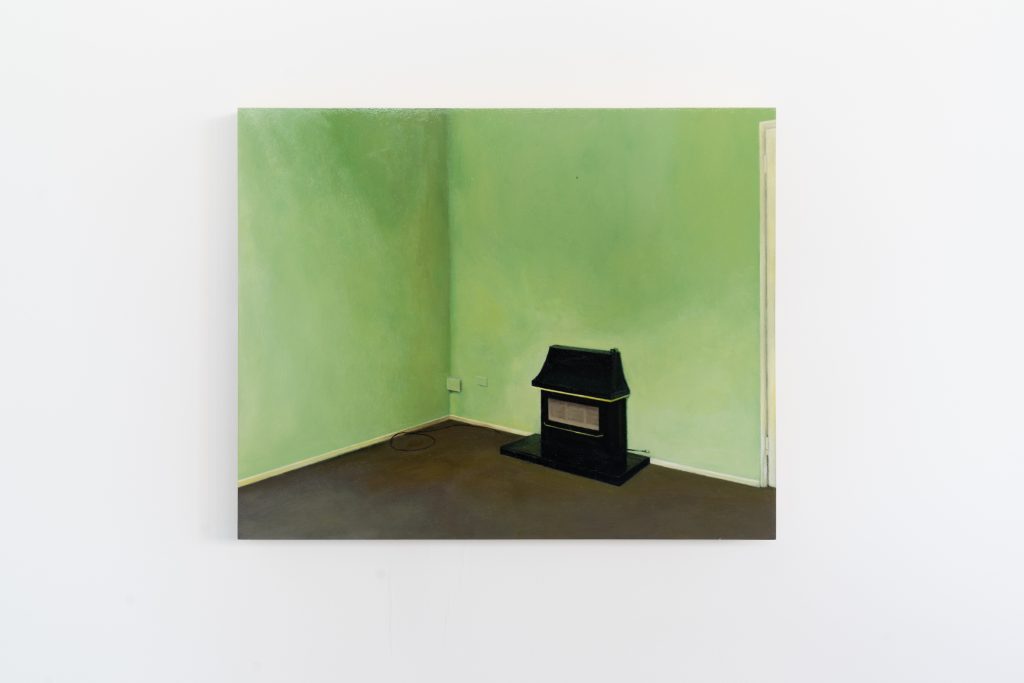
Many of George Shaw’s paintings of the outdoors share a haunted quality, but when he steps into the domestic sphere that sense of loss is even more pronounced. ‘Thereafter IV’ (2022) shows a room empty except for a gas fire, the walls a wan olive shade which might once have looked vibrant but now suggests only hospital corridors. I find myself thinking back to Eilish in her living room with its holy water font, her son’s paintings, her husband’s well-thumbed books. Could this be the same room? Only Shaw and his siblings, with their knowledge of every crack of the wall, every creaking floorboard, could say for certain; to the outsider, the room’s stories are all off-limits.
Towards the end of his wall essay, Shaw describes the futility of trying to return to a place you once knew – even his pilgrimage back to Sheffield for this show has taught him as much. He found that the pubs smelt of bleach, the booksellers had given way to baristas, and any internal narratives he sustained about the city had become superseded by other people’s everyday lives. His memories lagged behind the city’s reality, even as he found his past still super-imposed onto Sheffield’s present. But he puts on a brave face. ‘I’m glad to see the back of it,’ he concedes, ‘much as I cling to the other stuff.’
Maybe if Small Returns had stuck purely to paintings, you would take George Shaw for quite a remote figure, someone who surveys suburban streets with a pathological exactitude, rendering lawns and fences and ‘Keep Out’ signs in razor-sharp perpendicular lines. But here, he has managed to fill the space with people, laughter, warmth and connection, drawing parallels between the bookish adolescent he was and the artist he has become. The fifty-something man joking with his mum about memory foam is the same painter immortalising his neighbourhood in Humbrol, the same lad with a quiff and black polo neck staring up at us from beneath the glass.
In a few short weeks, all these paintings will be taken down, the television cables unplugged and the writing scrubbed from the walls – but like the exhibition warned us all along, places always find a way to move on, even when we ourselves can’t.
Orla Foster is a writer based in Sheffield.
George Shaw: Small Returns is on at Persistence Works, Yorkshire Artspace, Sheffield, 14 Mar — 25 Apr 2026, open Thursday to Saturday, 12-5pm.
This piece is supported by Yorkshire Artspace.
Published 08.04.2026 by Benjamin Barra in Reviews
1,804 words