Unquiet Landscapes, a collaboration between Yorkshire Artspace and Contemporary British Painting, brings together thirty-eight artists in response to Christopher Neve’s 1990 book that lends the exhibition its title. Neve wrote about post-war painters – Nash, Sutherland, Minton – who turned to landscape after experiencing the trauma of war, seeking something stable in a world that had revealed itself as anything but. Guest curator Joanna Whittle, herself a painter, describes this show not as an addendum to Neve’s text but as ‘papers slipped between the pages’ – a conversation across decades about what landscape painting can hold when the world feels impossible.
Whittle offers a thought in her curatorial essay that hangs over the exhibition: ‘Perhaps it is this numbness that drapes itself upon painters trying to discern their role in the interpretation of war today… what is happening beyond screens and layers of images and words which seem more to anesthetise us than to provide us with insight.’ The strongest works here break through that numbness using material specificity and emotional directness. Others gesture at contemporary unease but struggle to find their ground. The exhibition gathers artists responding to ideas of landscape, loss and belonging, though many of the responses come from an arguably narrow demographic vantage point.
For Neve’s subjects, it was the trauma of war that marked a ‘before and after.’ Today, that division point might be the COVID-19 pandemic, as it was for Georgia Peskett, for whom lockdown became the catalyst for an ‘internalised view’ – the world seen through glass, paperweights becoming portals in ‘Forever and Ever I’ (2023). Barbara Howey’s work from the same period captures something urgent. Her Norfolk marsh paintings, created during lockdown with decisive mark making, slashes of earthly greens against a yellow background, were born from what she describes emotionally as ‘grief and love’ – a need to respond to landscape ‘rapidly being actively destroyed by human stupidity and greed.’

Some of the works introduce an environmental unease that feels both distant and immediate. Paula MacArthur’s paintings of a Galena crystal (lead ore, both useful and toxic) become a metaphor for something ominous hurtling towards us. Julian Perry’s diseased trees are both atmospheric and elegiac, their surfaces built up with careful attention to decay. Iain Andrews, an art therapist working with teenagers, channels that experience into canvases with extraordinary texture and burning colour. The paint application appears almost sculptural, with colours that seduce even as the subject unsettles. George Shaw has made 400 paintings of the same Coventry square mile, calling himself ‘a landscape painter, not a landscape thinker.’ During his National Gallery residency, Shaw began relating trees to crucifixion imagery, his suburban corner of England pulled through centuries of European painting tradition.
Two artists reflect on being in a state of transience. Natalie Dowse depicts a familiar road in ‘Road 10 (going home)’ (2012). I have witnessed a similar view countless times – the journey to my mum’s house, the journey to a funeral, a job interview. It speaks a million stories, and it means nothing and everything. Dowse riffs on solitude and comfort ‘in the notion of return and belonging.’ Her use of perspective pulls you into the never-ending journey stretched out in front of you. Sarah Grant also takes you along on ‘Commute I’ (2023) and ‘Commute II’ (2023), two oil on board pieces depicting her Manchester to Preston summer evening commute. Bordering on abstract, the scenes truly pass by in a haze, perfectly capturing the life-affirming nature of an evening train ride in the right light.
Anita Lloyd picks up this thread of ‘passing through’. Her small painting lingers in one of those in-between walkways near a station – a place you might drift through a hundred times without ever forming an attachment to it. The familiarity is real, but the connection isn’t, echoing Christopher Neve’s sense that landscapes are often ‘a sum of their parts’ that we can’t quite piece back together. Nicholas Middleton’s ‘Cruciform Building with Raised Barrier and Rubble’(2014), based on a photograph taken in East Berlin years before the painting’s creation, captures a similar sense of arrested passage. Mandy Payne meets this territory from a different angle, turning her attention to the built environment itself. Her longstanding engagement with Park Hill and other brutalist estates reflects another kind of transience: not the movement of people through space, but the quiet erasure of the communities who once defined it.

Several artists use landscape as a container for personal trauma and loss. Susan Absolon, caring for parents with Parkinson’s disease (her mother with Parkinson’s dementia), depicts a ‘previously shared reality’ fragmenting. In ‘Turn to Stone’ (deliberately undated), an imposing black shape blocks a glowing sunset – a gap in memory taking over joyful recollections. Self-taught painter Al Daw’s ‘mental maps’ navigate grief after a friend’s death and traumatic legal situation. ‘Ghosts that don’t quite become people’ populate landscapes where distant sunsets stay out of reach behind immediate obstacles – what he called society’s ‘morose feeling’ made visible. Paul Newman’s psychological landscapes, created while recovering from an operation and struggling with anxiety, extend this vocabulary. These are landscapes where pain doesn’t exist in the background but structures the view entirely.
Highlights of this exhibition include Conor Rogers’ ‘Greenlands’ (2025), a dimensionally flat scene painted onto 608 king-sized cigarette rolling papers. Rogers depicts the proverbial ‘heartbreak hotel’ where his father resided after the breakup of his marriage, accompanied by a poem full of humour and longing: An unfathomable navigation, / Suddenly opened up, / Like the parted sea, / Moses was ere 2k7. The material choice matters. Those 608 rizlas represent labour – each one placed, painted – but also fragility. Hard subject matter rendered in the most delicate material. Council estates too often appear in galleries as spectacle for middle-class artists to document and aestheticize. Rogers sidesteps this entirely. This is his childhood, his landscape. The rizlas’ fragility becomes a formal argument: this matters, even if it could tear.
Graham Crowley and Richard Bartle both engage with landscape as archaeological site, where the past doesn’t simply vanish but leaves material traces. Crowley’s ‘Orford Ness, Study 1’ (2019) depicts the former atomic weapons testing site, now a nature reserve. He paints on pegboard, and those regular holes become what he calls ‘historical interference.’ The grid disrupts the pastoral scene, reminding you that nature is erasing military history even as the atomic testing buildings remain. Bartle takes a different approach to unearthing history. His paintings depict objects he’s dredged from Lincolnshire mud with the help of a metal detector, disinterred and arranged like specimens. The buried metal undergoes what he describes as ‘alchemical transformation through oxidation’, creating intricate surfaces of rust and patina. He recreates these textures through layered paint, building up colour until the ancient forms emerge.

Questions of continuity and inheritance surface in works that look back in order to move forward. James Quin draws on fragments of art history, lifting figures and gestures from Giotto and Bruegel and reworking them until the original scenes feel unsettled rather than quoted. Judith Tucker performs a similar shift through architecture. ‘Platform’ (2008) turns diving board into monument and viewing platform, structures that hover between leisure and ceremony. Simon Tupper’s London City (2024) pushes this tension further. Influenced by Lowry, his cityscapes are instantly recognisable yet faintly off-key, streets and buildings that feel remembered rather than observed.
Several artists push landscape towards abstraction. Amanda Ansell’s Suffolk-Essex riverscapes capture water in motion. A fantastic, vivid green winds through the canvas, twisting shapes that feel like pure natural form. Jan Valik creates ghostly territories where paint operates as atmosphere. Thomas D Fowler, working in Thailand, translates humidity through a process of masking and removal. Simon Carter’s Essex marsh paintings build from quick drawings made during regular walks. Back in the studio, he examines and dissects these observations, overlaying them until the landscape becomes an accumulation of encounters rather than a single view. Linda Ingham’s delicate handling and restrained palette in ‘Precipice vi, Pylon 1’ (2024) encourages close looking at a fragile-feeling scene of a tree against grey clouds, a reminder that not all responses to place announce themselves loudly.
Neve wrote about F.L. Griggs, who responded to industrialisation and war by retreating into fantasy, creating etchings of a past England that no longer existed. Whittle notes that contemporary artists in this exhibition ‘turn their backs too; but in a way that only exposes this loss rather than conceals it.’ Emma Bennett is drawn directly to the chapter on Griggs in Neve’s book, particularly Neve’s words on Griggs’s ability to return to subjects repeatedly, ‘finding his way deeper and darker into the plate both literally and metaphorically, lingering and hesitating, sometimes for years.’ Two thirds of Griggs’s etchings depicted places that did not exist. Bennett’s work operates similarly, combining interior and landscape images to ‘create interim landscapes you can travel to anywhere.’ Her abandoned surrealist scenes contrast soft flowers against moody wood and a painted landscape scene, something rumbling away in the background, a storm approaching. Whittle observes that Bennett isn’t sentimental or emotional when speaking about her work – ‘but I am,’ the curator admits. Angelina May Davis creates what she calls ‘pantomimic England.’ In ‘Book Church’ (2022), she places a church on a book cover, instantly recognisable as a symbol of village life but sealed shut. The gesture says clearly: this place might not exist. It adds another dimension of impossibility, a romanticised version of England that has been lost.

Another highlight is Narbi Price’s anonymous floral tributes. These are devastating emblems of passive experiences of loss, where you might see the roadside memorial but never know the story behind it. In ‘Untitled Flowers Study 1’(2022), Price strips away identifying landscapes, leaving tributes floating against raw canvas. The contrast is stark and gut-wrenching. We all pass these makeshift shrines and bear witnesses to someone else’s grief. The paintings capture those strange, inadequate encounters.
Three sculptural works operate as markers of transformation. Maud Haya-Baviera’s ‘The Danger Is Coming’ (2025) combines steel, ceramic, bronze and copper into a composite warning sign. A flat copper plate, washed with thin blue colour, bears an etched image that suggests a winged creature – abstract but distinctly alive. Bronze elements resembling palm fronds or feathers rise nearby. The disparate materials don’t quite cohere into a single form, which seems intentional. Christopher Jarratt’s ‘Handle With Care’(2024) is GPS-mapped to where he found the raw material (timber), stark white against black plinth. Chantal Powell’s bitumen covered structures in ‘The Twelfth Hour’ (2022) act as gate-like hieroglyphs, blackened surfaces that look pulled from fire. Powell draws on alchemical symbolism and Jungian psychology to create what she calls portals between worlds.
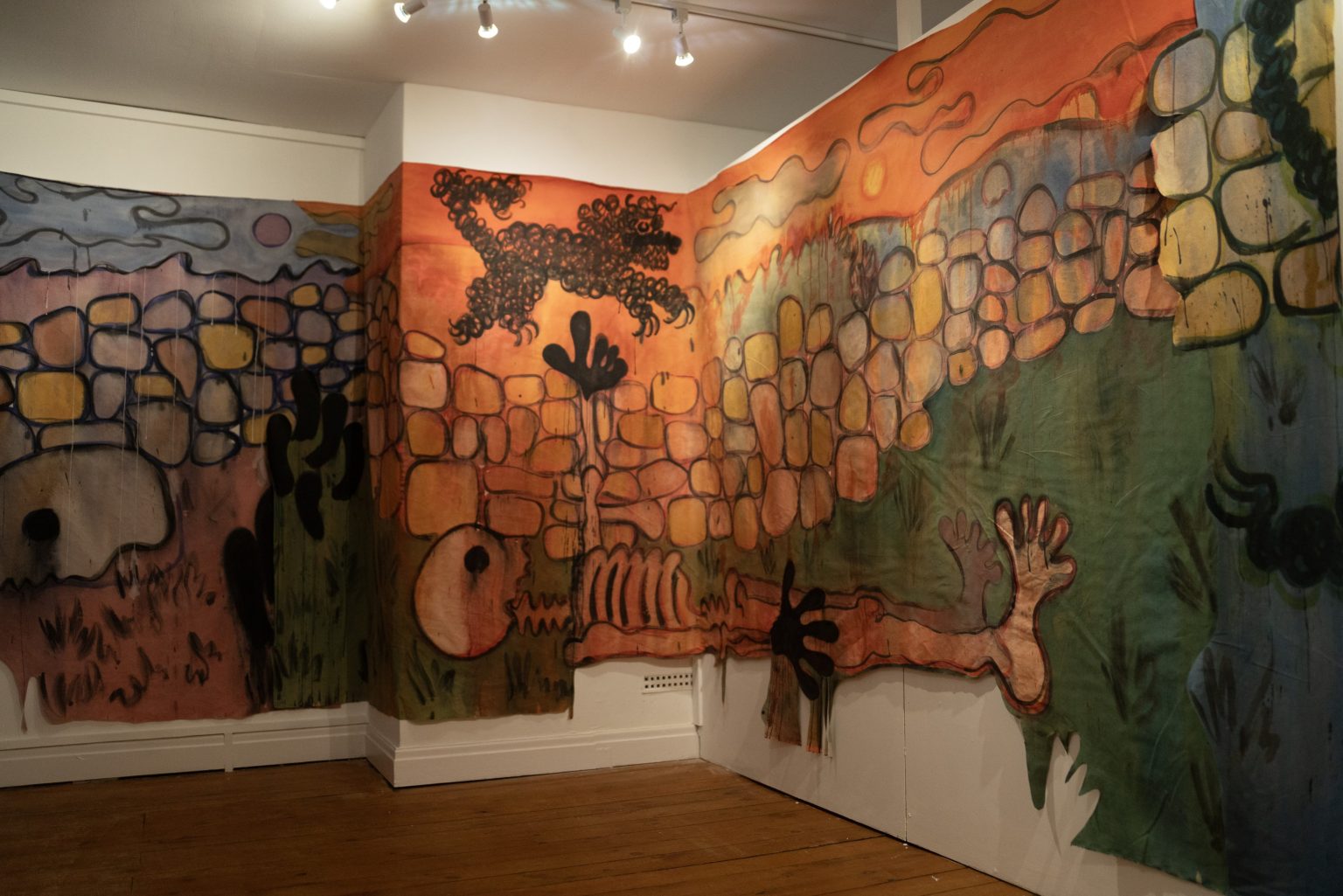
Lisa Ivory’s work deserves to be encountered on its own terms. Her paintings unfold within a shadowland that feels half-remembered, hovering between rural myth and urban wasteland. A Wildman stalks these scenes, sometimes joined by a skeletal figure of death, not as shock devices but as persistent presences. They interrupt the landscape in the way old beliefs linger beneath contemporary life. Ivory’s paintings suggest a version of England that persists beneath progress and redevelopment – not lost exactly, but submerged.

Ideas of extraction and erasure surface repeatedly across the exhibition, particularly in works that treat landscape as something excavated rather than observed. David Ainley’s engagement with mining sites carries a charged stillness: expanses of whiteness register both absence and the threat of sudden force. Victoria Lucas approaches this history through subtraction. By cutting coalfields from a nineteenth-century geological map and replacing them with coal dust in ‘Untitled (Coal)’ (2024), she turns the document inside out. Jonathan Alibone similarly treats the surface as something to be worked through in ‘Untitled (Substrata, Exposed)’ (2017). His layered constructions feel archaeological, as if meaning might be uncovered by digging down. David Orme’s ‘Monuments to What?’ (2025) operates through gathering and reassembly. Across these works, landscape becomes a record of removal.
The works in Unquiet Landscapes suggest an England that is familiar but unsettled. Roads, housing estates, city streets and fragments of countryside appear not as fixed places, but as sites shaped by memory and erosion. What feels ‘lost’ here is not a single landscape, but a shared certainty about what these places mean and who they belong to. Whittle asks whether painters today can break through numbness to offer insight rather than anaesthesia. Many of the strongest works do so through specificity: Rizla papers placed one by one, floral tributes reduced to their quiet essentials, train window views accumulated across seasons. These gestures are attentive and sincere, and they give the exhibition its emotional weight.
At the same time, attention is never neutral. The exhibition is shaped largely by a particular range of lived experiences, which inevitably frame the version of England that comes into view. Other ways of inhabiting landscape formed through migration and postcolonial histories, or contemporary working-class life spoken from within rather than at a distance, register more as absences than oversights. The unease explored here is deeply genuine and often moving, but it is not exhaustive. If Unquiet Landscapes succeeds in sitting with uncertainty, it also leaves open the possibility that other, equally unquiet landscapes might yet widen the conversation.
Hanna Dhaimish is a curator and writer based in Otley.
Unquiet Landscapes is on at Persistence Works, Yorkshire Artspace, 5 December 2025 – 24 January 2026, open Thursday to Saturday, 12-5pm.
This review is supported by Yorkshire Artspace.
Published 07.01.2026 by Benjamin Barra in Reviews
2,290 words