
In light of St Helen’s council’s latest regeneration plans, the question that artists Claire Weetman and Gee Collins, aka Artist-Led St Helens, are asking, is: What do local artists need? This major redevelopment of the town centre over the next five years expects to change St Helens dramatically, improving housing and transport links. The fact that the council has commissioned two local artists, staunch advocates for their community, to do this work, is a coup. All too often ‘regeneration’ comes at the expense of artists. In St Helens, local Councillor Anthony Burns is promising “inclusive growth”, which is “culturally centred”. But what does that mean?
That “inclusive growth” will see the only existing artist studio space in St Helens demolished. Platform, an artist-led space situated in St Mary’s Market, a central and sprawling indoor shopping centre, has been home to twenty studio members over the past thirteen years. At present, Platform is at capacity, with six artists calling the space home and a long waiting list to join. This is one of the reasons Weetman and Collins have been advocating for more studio space to be made available since 2019.
Last year, Weetman and Collins responded to an open call out from St Helens Council that asked: What are the needs of creatives based in St Helens (specifically around studio space and resources)? To tackle this question, they proposed a participatory action research model, building on their experience of running Platform Studios (co-founded by Weetman with other local artists in 2012) and advocated for the inclusion of studio space within the town centre regeneration plan. Collins perceives the council as having positioned them as the voice “representing the art community”, but believes the response to regeneration must be collaborative. Therefore, their research has included working with 99 local creative individuals and organisations including The World of Glass, Cafe Laziz, Buzz Hub St Helens CDP, The Book Stop, STAT magazine, Corridor8, St Helens College and University Centre St Helens. The outcome is two beautiful short films[1],[2], three reports (publicly available from late August 2025) about artist’s studios, equipment and resources, and a ‘toolkit’ document to support artist development. It’s called How to Build a Village: Artist-Led St Helens, and it’s both thoughtful and thorough.

The Findings
For readers unfamiliar with the town (and I was largely, until starting a job at a St Helens based NPO three years ago), let’s set the scene:
A former mining town, and famous for glassmaking amongst other heavy industry, St Helens boomed during the Industrial Revolution. Part of the Liverpool City Region, and with a population of around 117,000, the town is probably best known for its successful Rugby League team the Saints, the World of Glass museum, and Jaume Plensa’s Dream – a huge, 66 foot public artwork visible from the motorway. Or you might have heard of local legends Rick Astley and Johnny Vegas?
St Helens scores high on national deprivation statistics, perhaps due to an increasingly elderly population, than typically found across the North West. According to the 2021 census, 22% of people in St Helens identified as disabled, and the town also had the region’s joint highest proportion of people (aged five years and over) providing up to 19 hours of weekly unpaid care.
These statistics are important because they intersect with the real lived experience of many artists in St Helens, who told Weetman and Collins that one of their primary needs is studio space close to home.
Another key strand of the participatory action research model was to work with the artists in the town to see what a shared studio space could look like, based at Street and a Half, leased to Artist-Led St Helens by Kindred and managed by Make. In St Helens, Kindred’s remit is to bring buildings back into community use (something Make have a lot of experience with in Liverpool’s North Docks, Birkenhead and Huyton), and Street and a Half promises to be a space for creatives “to test out new ideas and encourage a creative community to flourish”.
I met with Weetman, Collins and some of the artists that have supported their research in the Street and a Half space to chat. The tension between gentrification and grassroots arts activity is palpable as we discuss the varying needs and wants of the council versus the community, and I’m reminded of the ever-changing spaces’ former occupants: it’s the space where I started my role with arts organisation Heart of Glass, and before that, was an independent called Mash Café.
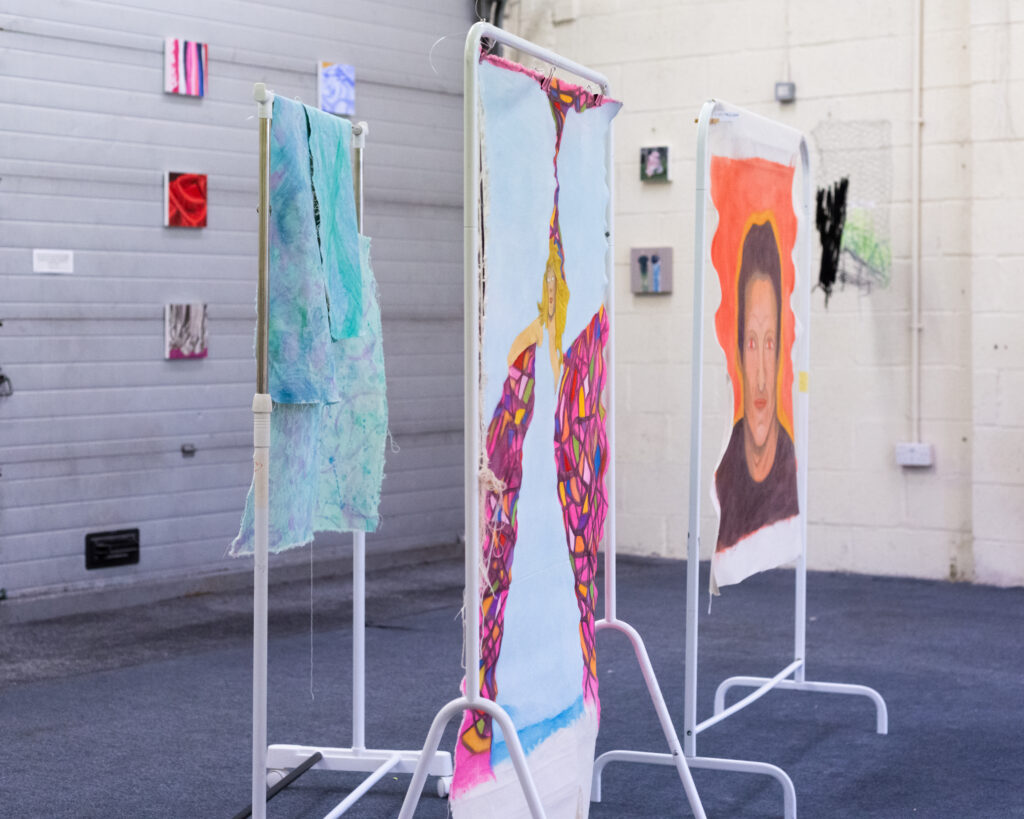
Street and a Half has proved to be a less than perfect venue; issues with the lease meant that access to the building was limited, and so during the three months they hoped to run an accessible studio as an R&D pilot project, artists could only access the space a day a week. This significantly impacted the scope of Artist-Led’s research, meaning the space was used mainly for events and workshops. As if on cue, an artist enters Street and a Half as we chat: he’s setting up for an event later that evening, a very necessary peer support group for artists working on their unfinished creative projects.
The space has seen forty days of activity (five events and twenty workshops) in total, including: three days of research and consultation, a BA Fine Art Painting student residency, Reverse Realities painting workshop with artist Jasmine Lockett, KLASS a pop-up design shop by BA Graphic Design students from St Helens College, and Expressions of Tomorrow exhibition by Level 3 Art and Design students at St Helens College. One day a week, artists and freelancers used Street and a Half as a co-working space. But they could have done much more, given the permission. It’s clear from our chat that St Helens is really lacking in not only arts spaces, but places that feel multicultural, queer or politicised. A sentiment that is borne out in the data collected by Artist-Led St Helens. Plus, as well as thinking about visual artists, the team’s next event programme will pay close attention to the needs of musicians and performers – artists for whom rehearsal space is precarious or lacking in St Helens too.
Street and a Half stretches the length of the street: “a live feasibility study to establish the demand, and potential, for space in which creative and social businesses can gather and grow” (Kindred Press Release, 2024). The new space is designed to support and nurture social businesses and start-ups “from recycling fashion projects to cake-making businesses looking to employ local people” as well as artists, designers and makers looking for studio space. It’s a broad remit, and risks forgetting about the artists and the space they so sorely need.
Space to separate artistic work from care work, and other life responsibilities (which many of us who work remotely can relate to). Space to create: artists need room for their projects, and it was noted that being cramped in a bedroom or on the kitchen table can and will have an impact (or even creative limits) on artistic practice, for example, forcing the individual to create smaller or perhaps digital work. Space contributes to a sense of professionalism too – from hosting clients to student gallery visits, artists deserve to take up space. The space at SnA feels like a great starting point, but it’s not guaranteed.
A lot of space is also needed for storing and sharing equipment (details of the equipment artists are asking for were shared with the council as part of Artist-Led St Helens work). Sharing spaces and resources in turn helps foster a sense of community – another thing that artists found lacking in the town at present.
From the report: “Attendees valued the sense of community, support, and connection the events fostered. They appreciated the opportunity to collaborate, share knowledge, and build networks in an environment that felt welcoming, friendly, and useful for their creative direction. Overall, the events were experienced as catalysts for personal growth, community-building, and positive energy.”
Right now, a lack of studio space poses a direct threat to any sort of artist community even existing in St Helens. If it’s not available in the town, artists can and will move elsewhere, and the possibility of creative community will be lost. It feels like a civic responsibility.
“As a disabled person I feel like the studios at SnA are a hub of inclusivity and neurodiversity, and it’s a friendly non-judgemental place” Writer Joseph Hughes tells me. “It’s part of why I’ve changed in the past year or so from wanting to move out of St Helens at the earliest opportunity to wanting to stay here.”
What does Affordable mean?
Many people stay in St Helens because of care responsibilities and generational poverty. Collins returned after completing their university course in London because for them, St Helens is “imperfect, but important”. They love the affordability of living here, and don’t want to be in London “chasing someone else’s idea of success, trying to reinvent themselves or be cool.”
So affordability is key to a sustainable model of artist studio in St Helens. But affordability is complex and Artist-Led St Helens note they “wish to fully understand what ‘affordable’ means to practising artists in St Helens at various career stages.” Affordability is a sliding scale – most artists earn less than minimum wage. The last large scale report of artist income reported artists earn £2.60 per hour, whereas minimum wage is £9.50 (STRUCTURALLY F*CKED, 2023). Affordability means to be both sustainable, and value for money.
Weetman and Collins found that artists in St Helens typically expect to pay less than £100/month – “We believe the initial creation of a low-cost (under £100 per person) shared studio space, with a sliding scale approach to pricing and a shared hardship fund, would promote St Helens as a cultural town and strengthen the creative community.”
Right now, “there’s a sense of artists “passing through St Helens on their way to be creative” Joseph muses, as we confront the idea of internalised class prejudice. “They’ll be back” Collins playfully retorts. They admit that they see part of their role to bring artists to St Helens, and Joseph adds: “before this, I wanted to get the first train out… the fight to stay isn’t one I have to do by myself now”.

“St Helens Artists Need a Shared Financial Model”.
Liverpool based artist Josh Coates recently received funding to visit New York to research Community Land Trusts, and has been sharing his learning with Artist-Led St Helens, as they ponder how to move forwards. “Radical use” (in this case referring to a non-hierarchical artist-run space) “has to be filtered through business / capitalism” he shares. “We want radical land ownership (community ownership and redistribution of land to address historical injustices and promote social and economic equality)… whilst selling keyrings” (a reference to a recent pop up in the Street and a Half space). Places like Wiese in Hamburg have managed this – an artists studio propped up by income from a café and nursery on site, however, there aren’t many examples of places like this being run by working-class artists. Josh has asked around, and can’t find a single one in the UK.
We discuss the pros and cons of CLTs (community Land Trusts) versus CICs (Community Interest Companies) , their various rights and rules over property ownership and the financial implications that may bring. There’s always squatting.
So the real question is – will St Helens Council listen?
“With the town’s regeneration already taking place, this is the perfect time for St Helens to create a space for artists to work in the town. If artists can’t locate affordable space within St Helens, they will take their creativity elsewhere” – How to Build a Village, 2025.
The report is clear: champion the ideas of St Helens’ community of artists and collaborate with them on the town’s regeneration. The changing population in the town is creating more diverse, multicultural communities, and there’s an exciting opportunity to centre artist voices in its future. This sentiment is echoed in a Guardian’s 2015 report on creative ways artists can improve communities (2015): “this movement isn’t about positioning artists as special outsiders who parachute in with easy fixes, but as neighbours who are one part of a whole set of things a community can do to be healthy.”
Building a village for and with artists will be a collaborative process with the “swishy blazer people” (as Collins refers to the council et al), which means interfacing with bureaucracy; perhaps a small price to pay to allow space to create genuine, bold change in the community.
Artist-Led St Helens delivered this research, commissioned by St Helens Council Arts Service, with funding from the UK Government through the UK Shared Prosperity Fund and Arts Council England in partnership with St Helens Borough Council, Kindred LCR CIC, St Helens College, and St Helens Borough creative practitioners.
Sinéad Nunes is a writer based in Liverpool
This report has been supported by Artist-Led St Helens
Published 13.08.2025 by Natalie Hughes in Explorations
2,240 words