The life of an oyster is marked by a process of constant filtration. They draw in saltwater, trapping and digesting nutrients while expelling anything surplus. Absorbing calcium carbonate from the water through a layer of soft tissue (known as the mantle), which they then deposit in strong composite crystal formations that become their outer shells. The WWF (World Wide Fund for Nature) calls these bivalve molluscs ‘quiet climate heroes’ for the way that they buffer the shoreline from erosion, and for their role in filtering seawater for the benefit of other living things too. Allowing sunlight to penetrate the seabed and removing pollutants such as excess nitrogen, while absorbing carbon into their shells. In A Shell Stood for Zero–at artist-run g39 in Cardiff–Kelsey Cruz-Martin explores her own kinship with oysters as a metaphor for the role of the artist in being alert and adaptive to their environment: listening, making, remaking.
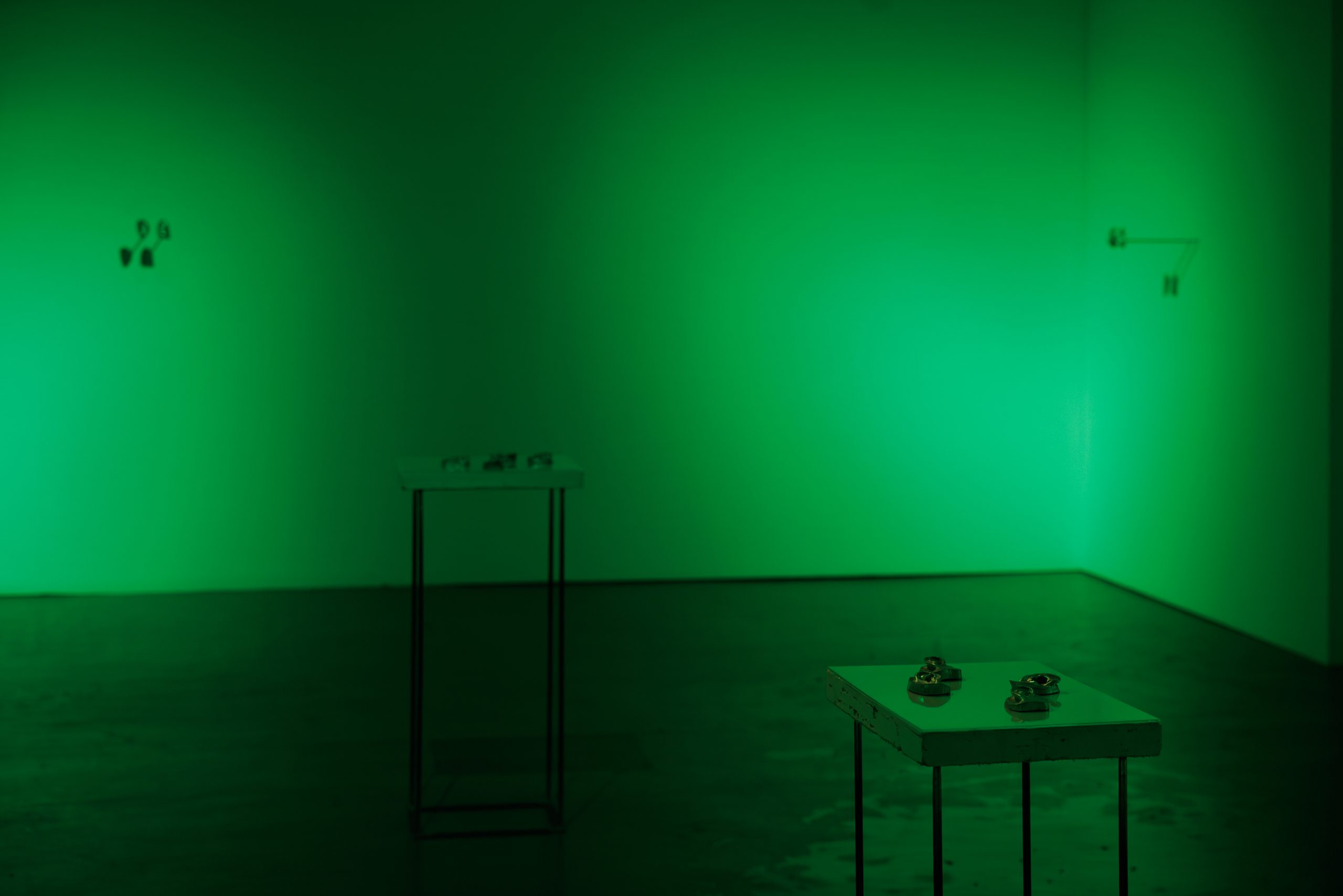
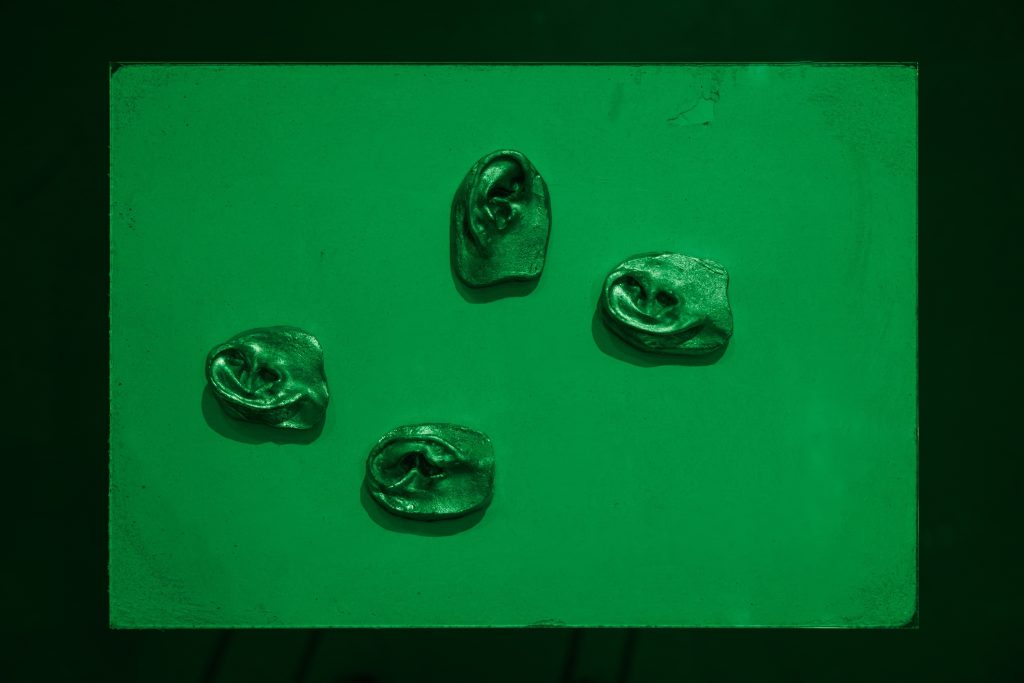
Cruz-Martin’s solo exhibition–developed during a year-long period of making as the 2025 Freelands Studio Fellow at Cardiff Metropolitan University–is held in an artificial haze of fluorescent green. Spotlights lend pockets of sparse, specific, visual focus that I use to pick my route through the gallery. Light in the centre is shed on a number of disembodied cast ears, which lie on stony-looking blocks atop a couple of waist-height steel-legged plinths. They are somehow reminiscent of the third century Sicilian martyr St. Agatha, often depicted throughout art history as holding a platter of her own severed breasts, which were amputated upon denying the advances of a male admirer. Cruz-Martin’s aluminium extremities (they are casts of her own ears) are hardened and metallic, though the give of imprinted skin is still discernible. Listen up, they say. Pay attention. Their title: ‘Soft Openings / World Receivers’ (2026), suggesting that these are the central means by which we should understand the show.
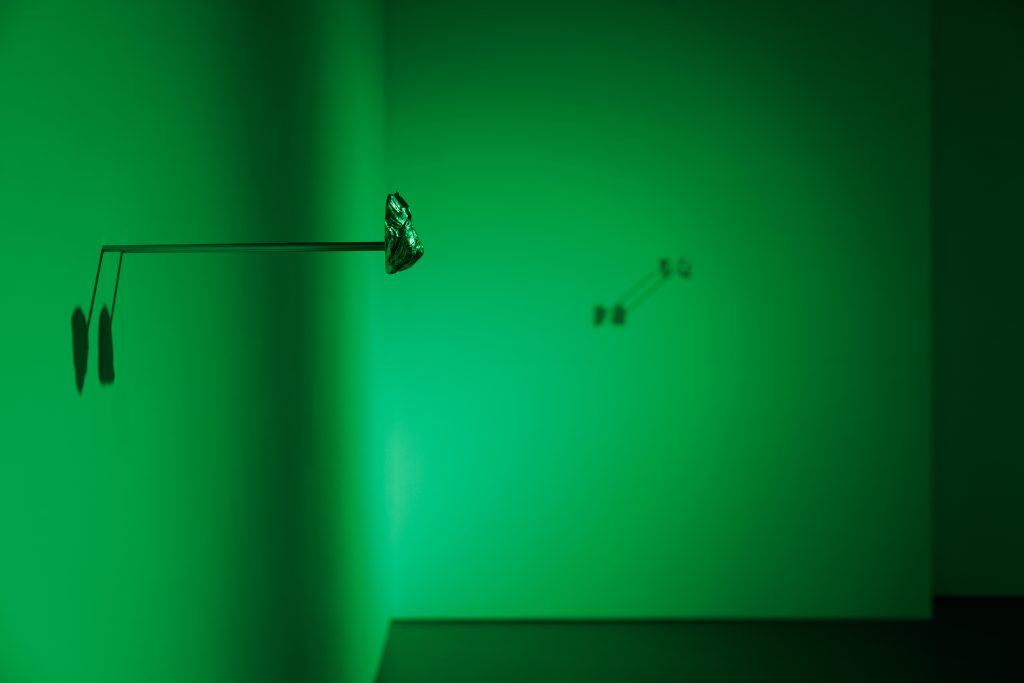
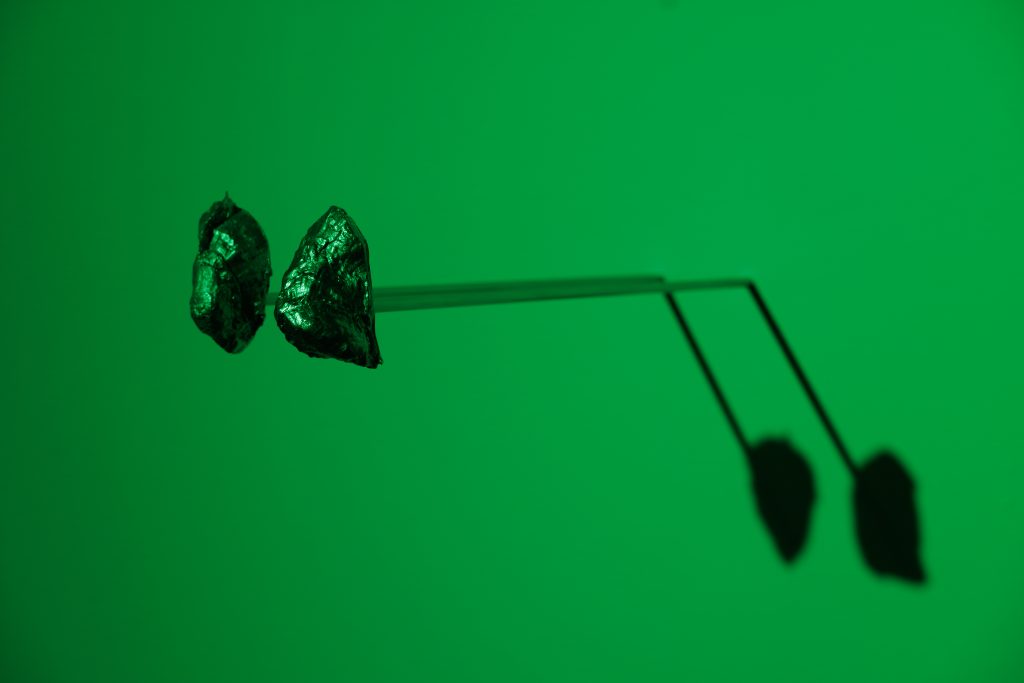
Around the edges of the room, following the pools of green light, are four pairs of cast oyster shells: ‘My Shell Mechanical’ (2026), themselves remarkably earlike. Each pair presses out a foot or so from the wall on meticulously crafted, horizontal stainless-steel rods. They are alert, meeting me at eye/ear level. Set up like this, they suggest bionic appendages. Also cast in silvery aluminium, they are the result of several complicated stages of phase changes (as is the laborious process of casting) where matter undergoes transformations from solid to liquid and back again, often under extreme conditions of heat in order to be dipped, melted, fired and poured. The casts bear the traces of their making, echoing the life cycle of oysters whose shells grow in multiple layers, concentric growth rings making visible their incremental development. All of the casts are different, though the pairs of starter shells they are moulded from are the same. Each are doubles–two halves of a whole–but they are also non-identical reproductions of a now absent original, complete with imperfections from the processes by which they have come into being.
On a low block nearby lies a stack of posters in fluorescent green. I rifle through, laying them out over the gallery floor to find that each contains a scanned image of 2 halves of Cruz-Martin’s cast oyster shells in different configurations; touching, side by side, overlapping, at a slight remove. Electronically compressed, the visual transformation caused by the light of the scanner picks out the pearlescent texture of the cast shells: smoother on the concave inside, more jagged on the outside. They appear like topographies or puddles or apertures, openings onto ultrasound scans that feel at once fleshy, grounded and abstracted. Amounting to yet another transformation undergone by the shells. On the back of the poster is a mobile number to call–07366710996–which will remain active beyond the run of the exhibition. It takes you to a pre-recording of an audio work, ‘Digital Twin’ (2026) (made with the support of Cruz-Martin’s long-time collaborator Rod Brakes), at which point I realise that perhaps I have experienced the exhibition backwards. Should I have started here, with a phone call, and worked my way inwards, instead of outwards? I take the opportunity to call the number and am greeted by a voice, sometimes accompanied by a soundtrack which, like the images on the posters, are processed, compressed, synthesised; this audio carries the sonic quirks of a lo-fi recording, metallic and distanced.
Retracing my steps, looking again at cast oysters and cast ears while listening to the track that ranges in subject matter from describing the volatility of materials and physical processes, to engagement with digital interfaces and the mutability of the self. The audio functions to collapse space by speaking as if from a disembodied afar but in close relation to the physical objects before us, like an audio guide stripped of its tone of objective authority in favour of internalised rumination. ‘I’ve been thinking about how so much of the world enters us / through these soft openings’ says the voice (Cruz-Martin’s own) sibilant and crackly; here she is, entering me. The use of sound becomes complicated when it meets the physics of the space, a gallery within a gallery in an open plan converted warehouse, with little sound proofing. Cruz-Martin’s words assume that I would be listening ‘arm held in a hairpin position’ with my phone posited shell-like to my ear, but the quiet of her spoken words, and the architecture that surrounds me, mean that I reach for my hands-free, in-ear, noise cancelling headphones instead. Her words nonetheless struggle to assert themselves over a sound work from the concurrent exhibition just meters away that implicates itself bullishly throughout the building, requiring that I work harder–oyster-like–to home in on the sounds that I need for this moment and block out those that feel surplus.
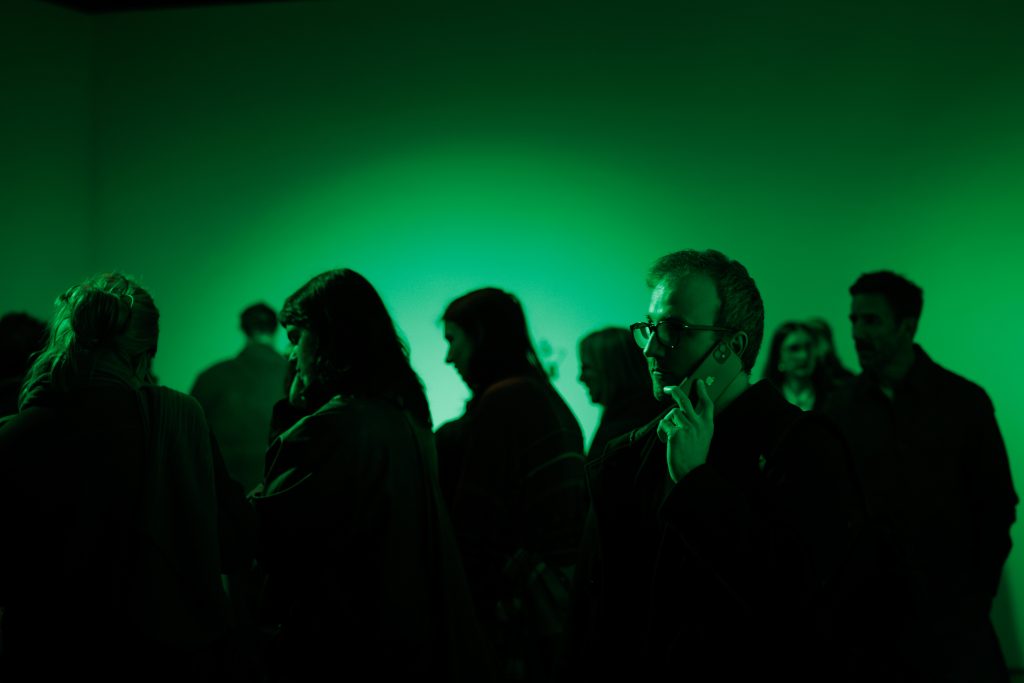
A Shell Stood for Zero builds towards rendering you acutely aware of the conditions of your body in a state of heightened viewing and listening: the foreign bodies nestled in my ears, their filtering of sound, my dissipated visual attention in the dim green light. The artist’s spoken words–often muffled and breaking up–are replete with repetitions and near-repetitions: ‘not exactly the same / but not exactly different’. They allude to ways in which the objects on show are rendered physical: ‘metal enters through the centre / fills outwards’. In which the terminology of craft processes mirror emotional human states: ‘the burnout leaves a cavity of hollow channels’, and which in turn are likened to our experiences of the world, attached to electronic devices: ‘this reel is real’. This text is made from cut-up words and ideas Cruz-Martin has absorbed, like an oyster, or an ear, from elsewhere. Reconfigured fragments of other subjectivities–writing by novelist Clarice Lispector, conversations with artist-writer Samra Mayanja, music by rapper billy woods–are determined by an ambiguous feminist citational practice. This is an active resistance to myths of originality and individuality in favour of collective attunement. In Cruz-Martin’s harvesting from that which already exists, she teases out kinships between the processes of writing, casting, editing and feeling, and the life of the oyster. Drawing attention to the hybrid bodily ways in which we absorb, process and retransmit our digital, physical and emotional environments. Making something from something else.
Kelsey Cruz-Martin: A Shell Stood for Zero, g39, Cardiff, 28 March – 25 April 2026.
Lizzie Lloyd is a Bristol-based art writer and researcher. She co-runs WITTA, a project exploring relationships between art and writing.
This review is supported by Cardiff Metropolitan University through the Freelands Studio Fellowship Programme.
Published 22.04.2026 by Kevin Hunt in Review
1,294 words