Lately, I’ve been thinking about liminal spaces. Not just because they’re currently flooding pop culture conversations, but because being suspended in transition with no discernible end is similar to living with chronic illness. You’re never quite ‘well’ but facing fluctuating degrees of ‘ill’. It is, too, a consequence of living through climate crisis. As I write, relief of escaping the latest heatwave sits alongside dread for the next, and the feeling that this is just the beginning. We need new ways of thinking and communicating to take action on the climate crisis, whilst navigating this zone of uncertainty and vulnerability.
I wonder if liminal theory can help us here. Anthropologist Victor Turner coined the term liminoid to distinguish between necessary liminal spaces or structures, and those that are opted into as a means of rest, leisure, or regeneration. Turner asserts that these latter spaces make way for creative experimentation and unstructured play, personal reflection, the elimination of social hierarchies, and comradeship through shared vulnerability.
What happens if we elect to stay with the liminoid for a little while, sitting with the slippery in-between-ness? And what might this mean for our understanding of the climate crisis? It’s this question I was confronted with when joining In-Situ for a weekend residential to kick off the ‘Leadership Collective’ of their Climate Lab Pendle programme.
Operating out of Pendle, In-Situ works grounded in its local communities, connecting art, people and place in a socially engaged, collaborative practice that aspires to promote action. In-Situ’s artists-in-residence work across a variety of artistic disciplines, each to engage people in everyday and systemic issues. Dana Olarescu, for example, has been working in Nelson to devise a Food Strategy for the town, connecting food producers, growers and groups around shared aims. Dana’s work will continue as she contributes to Climate Lab Pendle.
Radical in their approach to organisational structure and operations (for example, on Climate Lab, In-Situ will work to the seasons and only deliver programming in Spring and Summer), they aim to disrupt ‘business as usual’, coordinating programmes that sit locally but stretch outwards to consider structural and societal implications. Key to this is their ‘fluid structures’ model – wherein all paid staff receive a flat wage and have equal decision-making power. As Anna Taylor, In-Situ’s Internal Development and Reflective Practice lead, tells me, the Leadership Collective of Climate Lab Pendle is very much an experiment to see how these fluid structures can be extended further than the core staff team.
Climate Lab Pendle is a natural progression of existing programmes and critical relationships that have formed over time. The idea came when Pendle Council approached In-Situ to develop a creative climate campaign around behaviour change as part of celebrations for the borough’s fiftieth anniversary in 2024. Anna explains that what they proposed back was a series of conversational events highlighting that centered listening, not telling. What emerged was the importance of reflection, being transparent about a lack of answers, and making space for the unknown, providing a possibility to truly ‘go deeper’. In this way, the programme uses climate change as a way into discussing what is commonly referred to as a polycrisis: the distinct way in which numerous global crises, be they ecological, political or humanitarian, intersect and interact with each other.
Working with Tom Deacon, a facilitator in climate engagement and leadership work, the two devised the major formats of the programme, centred on a ‘don’t tell, listen’ approach to community education that meets people where they’re at and enables the creation of collaborative dialogue. This includes the use of Climate Fresks. The Climate Fresk is an interactive, collaborative card game developed by French lecturer Cédric Ringenbach, as a means of making the complex, scientific findings of the IPCC (Intergovernmental Panel on Climate Change) more accessible to the public by sorting them into cause and effect and encouraging reflection on emotions leading to collective action.
With fellow collaborators Building Bridges, a community development charity in Nelson, working to support adult education, social interactions and community cohesion and The People Speak, an art collective known for their hugely popular format of ‘Talkaoke’, a talk-show style facilitated discussion, In-Situ devised and delivered ‘Inside Out Pendle’ in April 2025, which served as a launch for the Climate Lab programme. In January this year, In-Situ were awarded funding from the National Lottery’s ‘Reaching Communities’ strand, enabling them to fund further work on Climate Lab until 2029. Sitting within In-Situ’s previous collaborative work, this funded programme enables the continuation of – in Anna’s words – an ‘ecosystem’ of collaborative relationships.
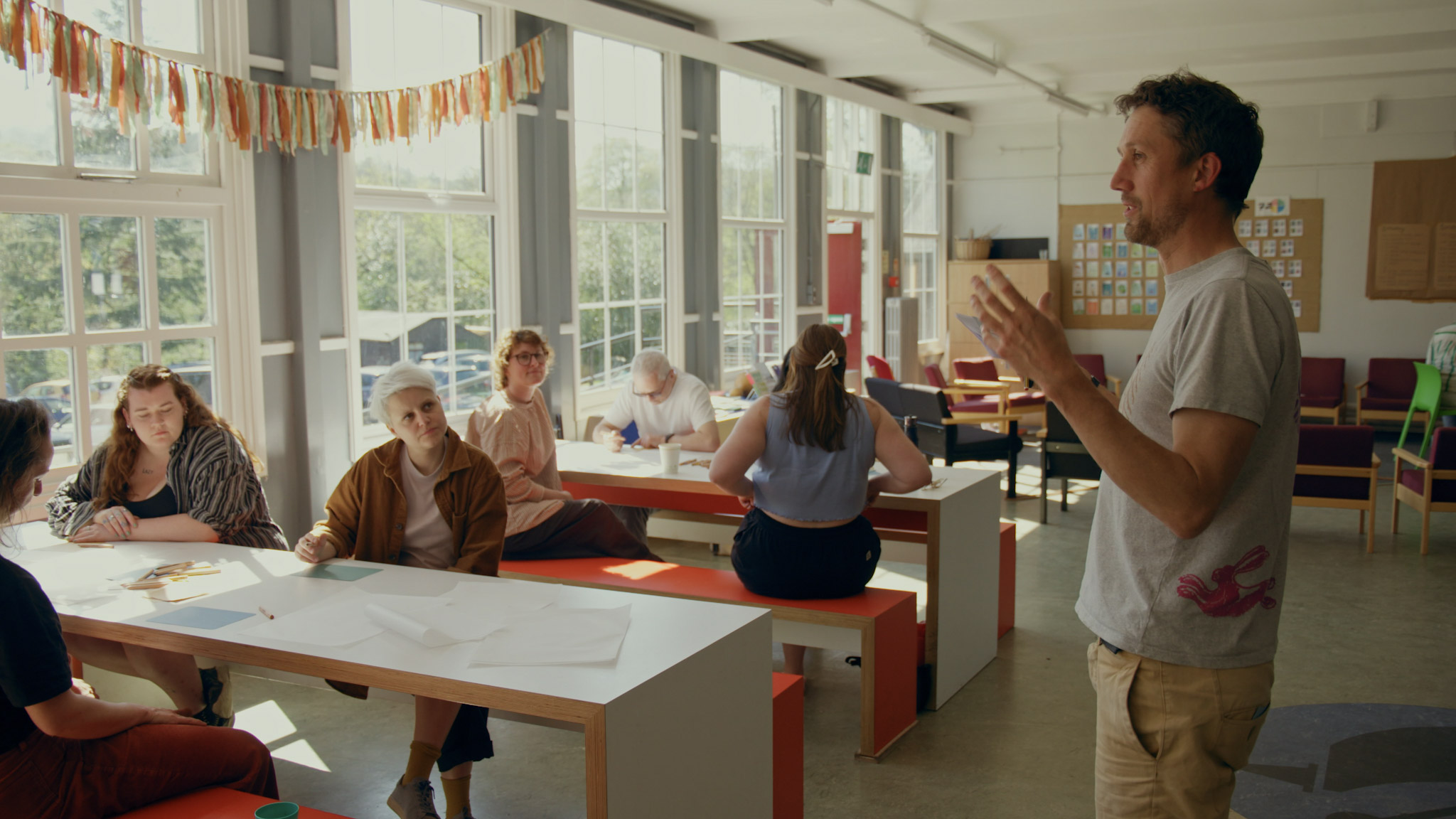
In total, nineteen people are taking part in this residential, comprising In-Situ staff, Board members, representatives of partner organisations, artist/collaborators-in-residence, community volunteers, and invited guests like me. Most of these attendees will form the Climate Lab Leadership Collective: a smaller, focused group whose role (whilst currently undefined and will become clearer through collective discussion) will, hopefully, be to provide vital touchpoints between the programme and community participants – bringing together different groups to think speculatively about the potential of shared futures, and translate this to transformative action. Anna explains to me that many in the group, specifically In-Situ staff and trustees, artists-in-residence and collaborative organisations, have worked together before and have longstanding relationships through shared work (most significantly on the recent This is Nelson 4-year Town Deal programme). Conversely, others in the group are meeting each other formally for the first or second time.
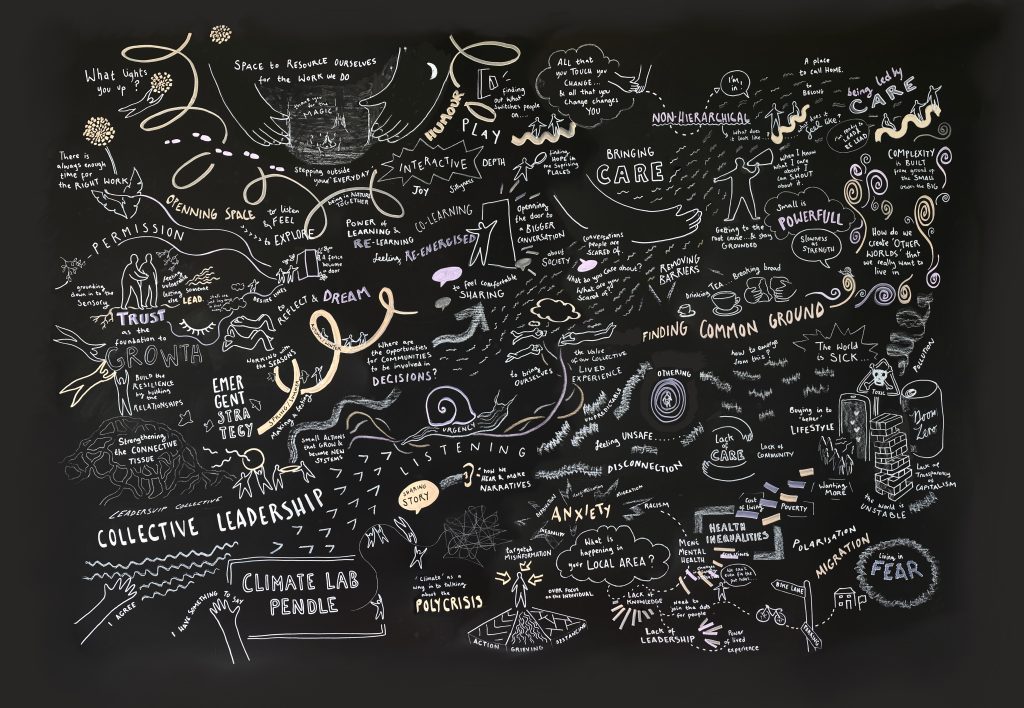
Graham as filmmaker, Temujen as visual note-taker, and I, as writer, have been invited to attend the retreat to document the group’s thoughts, feelings and ideas, but also to participate as much as feels appropriate. Within this process, I’ve reflected on my role as a writer quite significantly: why did In-Situ want a writer to be with them for the unfolding of initial conversations? Fundamentally, I think it’s because writing is a way to process, understand and communicate. As Joan Didion wisely said, ‘I write entirely to find out what I’m thinking’. Being given the opportunity to write my way through this experience has given me a renewed understanding of it, particularly in ensuring that my reflections are of and within the group, not about them. That said, the writing process has taken significantly longer than I’d have liked – owing to my own health, and the declining health of the world around us. Between the residential and me sitting down to write this, there have been two heatwaves. This makes me ponder the tension between slowness as necessity and the urgency and frustration we feel in climate grief.
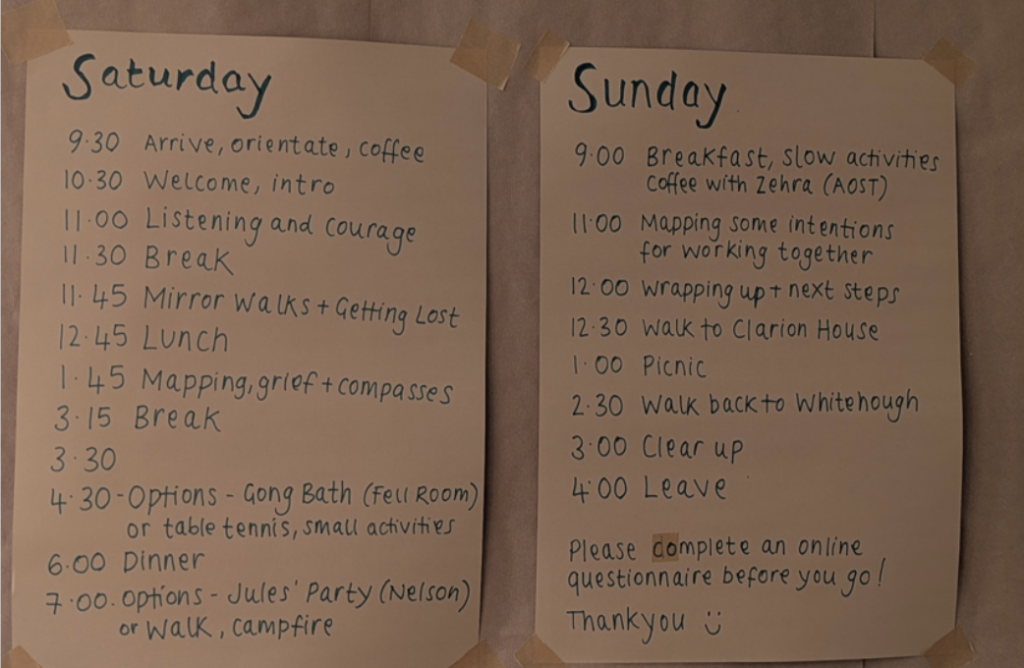
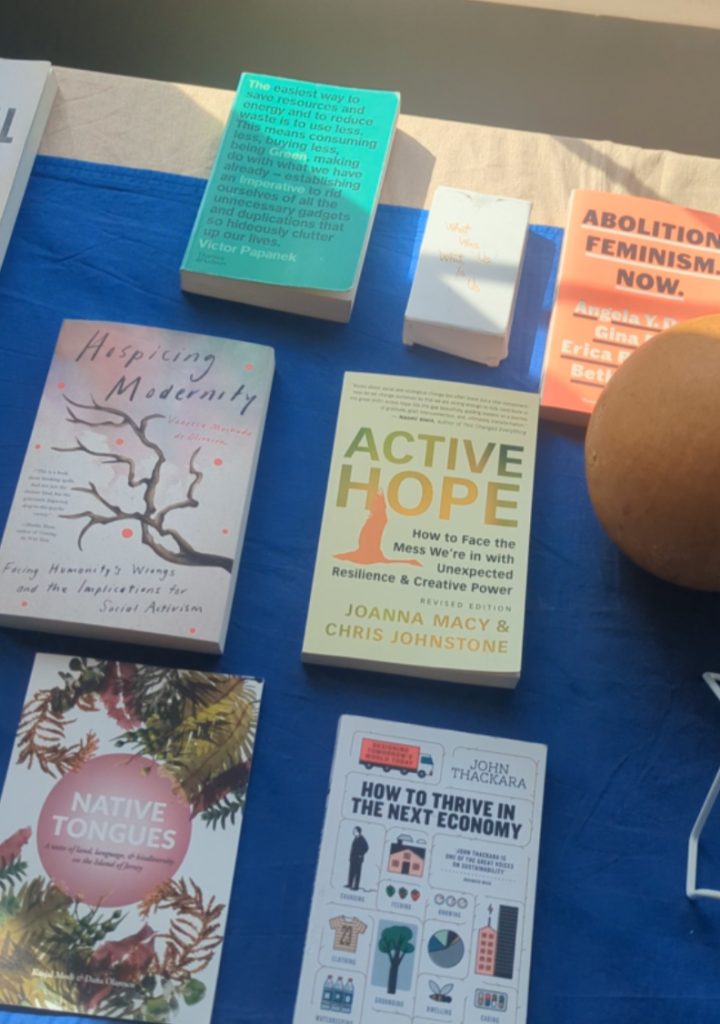
We begin the day’s proceedings sitting in a circle, with a reading by Anna from adrienne maree brown’s Emergent Strategy (2017), which draws on Afrofuturist methods and the work of writers like Octavia E Butler, to posit that change is constant, and social and activist groups can best achieve their goals when they work with this nature, not against it. This text sits amid a whole host of oft-referenced touchpoints, presented to us at the residential. Others include Active Hope by Chris Johnstone and Joanna Macy (2012), which offers practical frameworks for resisting passivity and challenging denial, and The Fantasy and Necessity of Solidarity by Sarah Schulman (2025), which rejects saviourism and charity to demonstrate how solidarity necessarily includes self-criticism, the ability to fail, and working alongside those who share our goal, regardless of total agreement. These readings seem key to the work of In-Situ, who centre their practice around methods that meet people where they are at, and honour rest, contemplation, and embracing change. Climate Lab Pendle demonstrates itself as a testing-ground approach to newer, experimental ways of working, with hopes for community engagement that are sensitively attuned to bridging the gap between theory and embodied practice, scientific knowledge and lived experiences.
We move to discussing the practical elements of how the collective will work together throughout the course of the programme, such as meeting at least twice a year and having an initial workshop on principles and values based goals. Here, a series of questions about the programme is raised. Is ‘Climate Lab Pendle’ the right name? Is ‘Leadership Collective’ the right name? How can In-Situas the administrative organisation behind this project de-centre themselves? This latter question reaffirms In-Situ’s commitment to being facilitators, makers and holders of space, without being the sole holder of power or decision-making influence.
Our attention turns to prompt cards that were placed on seats around the circle before we sat down. The cards offer phrases, lifted from Emergent Strategy, that invite reflection, such as ‘the large is a reflection of the small’, prompting discussion of collective action, people power and perspective. By encouraging individual reflection and collective sharing, the residential becomes a ‘negotiated experience’, as Tom describes early on. The phrase emphasises each participant’s agency in shaping the collective and engaging in the gathering in ways that feel most accessible or desirable.
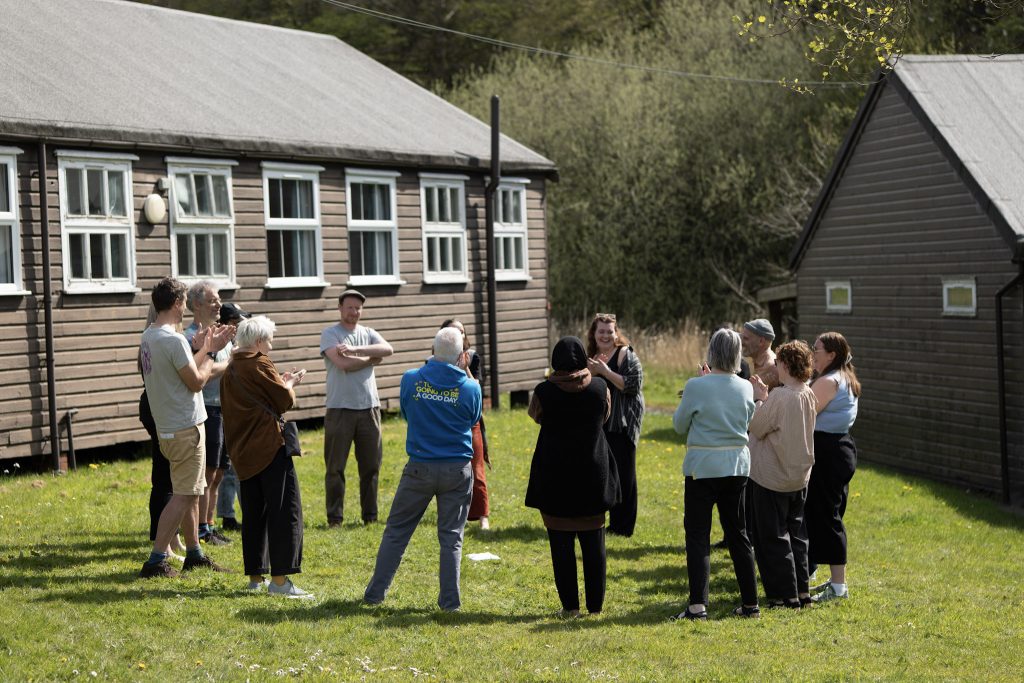
As our sessions move outdoors, something curious happens. I begin to think about the activities I’m engaging in as an embodiment of how we had been thinking of and discussing topics such as relationship building, climate activism and solidarity. An activity facilitated by Tom and Dana invites us, in pairs, to metaphorically ‘get lost’. We are actively encouraged to both ignore or creatively think of ways around conventional boundary markers, i.e. gates or ‘no trespassing’ signs, and to follow instinct – to read the land for desire lines, to tap into the senses guiding us. In placing human-made barriers secondary to our relationship with the world around us, ordinary worries became inconsequential. It doesn’t matter whether we technically left designated premises and entered private land; what mattered was unrestricted, free exploration and curiosity and opportunities to build a deeper kinship with the fields of the site and beyond.
I can’t ignore the significance this could have to climate activism on a larger scale, i.e. the necessity of transcending borders – which are human made and serve to divide, or demarcate ownership on varying scales, from nation state to private landowner. What felt playful, exciting and even a little dangerous, presents as a revolutionary act of land justice. These experiences are also necessarily liminal: uncertainty becomes the dominating sentiment, but in a framing of opportunity, not inhibition. Consequently, our bonds become stronger through the sharing of this uncertainty, and trust, as Farrah reflects, becomes ‘the foundation of growth’.
We rely on this trust further in our next activity, facilitated by Tom and exploring our personal climate consciousnesses through mapping our motivations to act. As a group we discover how responsive negative feelings can, with distance and perspective, become proactive motivations to engage with the reality of injustice. In turn, the shift encourages us as a group to discuss how we can use this renewed vision to act on the intersecting crises facing our local communities. Members of the group raise their concerns around division and hostility, e.g. for racialised communities, the Cost-of-Living Crisis, health and social inequalities, loneliness and isolation, and misinformation or a lack of clarity from local governing bodies.
Together, we discuss how we might wish to engage proactively and healthily in a way that recognises and validates climate grief, but does not allow the grief to swallow us into inertia. Such discussion brings up points such as burnout avoidance, caring for the land as caring for each other and oneself, and the necessity of active – rather than passive – hope, another teaching of Macy’s, defined as ‘waking up to the beauty of life on whose behalf we can act’. It is insightful to understand the points raised by members of the group who are local to Pendle and Nelson, in order to understand how understandings of the polycrisis manifest locally, on the ground.
A commonly identified issue is a lack of transparency in local decision-making, as well as inequalities and the pervasive rise of far-right rhetoric. The group astutely makes clear that they feel these issues are deeply interconnected, and as a result of this lack of transparency and disinformation, it’s felt that residents don’t have the necessary knowledge or tools to ‘join the dots’ of how these issues are connected and, therefore, understand their agency to create change at a local level. An identified way forward for the group is the unpicking of narratives that mislead and dissuade from action, and it is exciting to see the group’s passion in making this a prominent theme to look forward to.
While I’m unable to stay for the entirety of day two and leave at midday, the activities I have taken part in within this brief time have been unlike most other spaces I have encountered. Dare I say it, they have felt more radical than a lot of community organising spaces I’ve been within. Ever since the residential, I’ve been pondering why that is. I’m reminded of the oft-referenced quote of Angela Davis, that radical ‘simply means grasping at the root’. As the group share what they’ve learned and what they want to do next, with reflections ranging from accessibility to vulnerability, empathy to finding ‘routes into conversation with people’, I realise that the space feels so transformative because of this liminoid quality it seems to possess. A slippery in-between-ness away from the everyday, where there is freedom to experience, ponder, generate and then return to our lives with a sharpened vision and a new community of people to achieve that vision with. Central to this is the slowness baked into In-Situ’s ways of working – from consciousness of burnout and how to avoid it, to leading with care and access, to working seasonally and within the rhythms of nature.
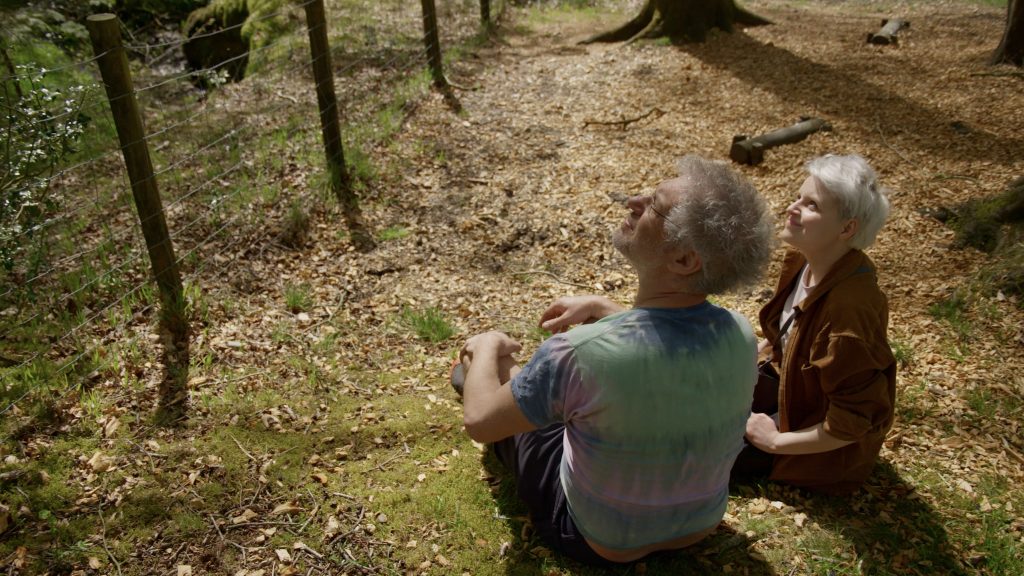
Together, we reflect on the core outcomes of the weekend: to have built familiarity in relationships across the collective, to understand what matters to each other personally and within their community and area, and to think about the specific role they may bring to the collective. In embracing the necessity of not rushing this process, I get the sense that this is all that was required – to have a space to sit with each other and see what might happen. To find the conversation that only these people in this room can have.
Looking to next steps, the group reflects on their hopes for Climate Lab. For Holly Noonan, Community Development Officer for Building Bridges, the hope is to find different ways of engaging with communities across Pendle, making accessible the causes and effects of the climate crisis and creatively finding ways people might want to learn about or respond to it – rather than ‘preaching to the converted’. Similarly, collective member Damien, who began volunteering with Building Bridges in 2021, tells me that, like Holly, he wants to reach people ‘on the other side of the hill’ (i.e., Pendle’s surrounding towns and villages). To him, the climate crisis is ‘here, it’s local’, and so not being engaged would be ‘putting blinkers on’.
Aaminah Kausar, the youngest member of the collective at twenty-two, is currently a shadow member of In-Situ’s Board, having recently completed a 2 year traineeship at In-Situ and is interested in engaging young people in conversations around climate. Like Holly, she recognises the risks of assuming that audiences are tapped into conversations around climate already. As we speak of social media and the attention economy, she recognises that many of her peers are hurtling towards an apathy crisis. She hopes that tapping into existing youth networks and conversations around youth culture – such as the Unlocking Nelson exhibition she has co-devised – will enable her to approach conversations around climate with her contemporaries, using Climate Lab’s ‘listen, don’t tell’ methodology to find common ground from which to devise new understandings.
Of course, these hopes are not without challenges – such as that of funder expectations. Several within the group, including Zoya Bhatti (In-Situ’s Engagement & Participation Lead) and Farrah Imtiaz (community volunteer and Programme Lead at Burnley FC), identify anxieties around project-led funding cycles that favour quantifiable results at the expense of sustainable community engagement. Nonetheless, whilst In-Situ does have funding for this work, it’s important to them to embrace the interdisciplinary, collaborative nature from which the project began.
Practically, these conversations have paved the way for the group’s next gatherings, namely a facilitated session on values-based goals with Jed Picksley, and the collective’s presence at this year’s Pendle Festival of Culture. The latter included Temujen’s live drawings on windows and interactive prompts for conversations around climate, power, information and hope, The People Speak’s signature Talkaoke, and a satirical participatory performance in parts, spanning the whole day. This combined into a chance for discussion and ‘joining the dots’ – that is, working out where local issues fit together and how collective action might be uncovered.
The very nature of a liminoid space is that its occupants enter the space voluntarily, and transiently. The point is not to remain suspended in uncertainty nor to use a lack of way forward as a shroud of avoidance. The point is to draw on each other, oneself and our surroundings to work through a way forward in community with each other. It’s a generative practice that demands vulnerability and trust. It’s easy for uncertainty to feel vague or evasive – subterfuge, even. Holding one’s hands up and admitting, ‘I don’t know’, can feel like a great place to stop, but it is a far greater place to begin.
My earnest thanks to all attendees of the residential, without whom this article could not have been written:
Aaminah Kausar, In-Situ Board
Angela Moran, In-Situ Board
Anna Taylor, In-Situ
Dana Olǎrescu, Artist-in-Residence
Damien Entwistle, Community Volunteer
Farrah Imtiaz, Community Volunteer
Graham Kay, filmmaker
Holly Noonan, Building Bridges Pendle
Margot Przymierska The People Speak
Michael Powell, In-Situ
Mikey Weinkove, The People Speak
Nazia Sultana, Community Volunteer
Paul Hartley, In-Situ
Temujen Gunawardena, Illustrator
Tom Deacon, Catalista
Vivien Carradice, Community Volunteer
Zehra Aziz,The Art of Small Talk
Zoya Bhatti, In-Situ
Climate Lab Pendle is a space for connecting, learning and acting together. We are developing radical local responses to the intersecting crises of climate, inequality, hate and misinformation through a four-year creative, collectively-led programme funded by Reaching Communities.
Amie Kirby is a writer, researcher, producer, and archivist based in Salford.
This exploration is supported by In-Situ.
Published 30.07.2026 by Jazmine Linklater in Explorations
3,147 words

