Since launching in September 2019, BLANK_ has serviced Leeds-based artists and designers by providing an important space where smaller-scale projects, including work in progress, can meet their public. It does this in ways that are free from the higher-stakes publicity, audience engagement strategies and footfall expectations that occupy the region’s major art institutions. In that, it’s exactly the kind of experimental space that any creative community requires. Leeds needs more of them. In addition to the exhibition space, BLANK_ encompasses an occasional publication and a residency award, won by Levi Hanes, Chloe Stead, Ella Philipson, KP Culver and Ruth Parker to date. This has broadened the conversation out beyond the gallery walls: the traces of Culver’s 2021 residency, in the form of a text written collaboratively with students, are still visible on the exterior of the building opposite.
Located within the School of Creative Arts on University Centre Leeds’s Quarry Hill campus, the gallery currently occupies a geographically pivotal site between the commercial city centre proper and the creative communities along and around Mabgate to the north and east. With the ongoing redevelopment of this area however, the School is on the move to a new building along Mabgate, and so the current exhibition by Mia Mai Symonds will be the last in the present location. It is hoped that the new building will afford a similar space, but at the time of writing nothing is confirmed and BLANK_ will shortly be on hiatus, although the publications and online presence will continue.
Like the strongest projects I have seen here, Symonds’ A Life of its Own, guest curated by Farah Dailami, Assistant Curator at The Hepworth Wakefield, presents mainly sculptural works and is sensitive both to the architectural quirks of BLANK_’s foyer space and to its walls of glass and concrete. On entering, an apparently demure scene greets the viewer, though this initial misapprehension is soon overturned. The overall effect is an arrangement of small-scale works displayed on plinths and walls and united by a palette of muted tones – off-white and pale green, through greys to the near-black of charred timber – and a shared preoccupation with materials: mortar, clay, metal, wood. Dailami’s introduction to the accompanying booklet suggests that the exhibition acts as an invitation to visitors ‘to acknowledge and negotiate their own relationship with objects’.
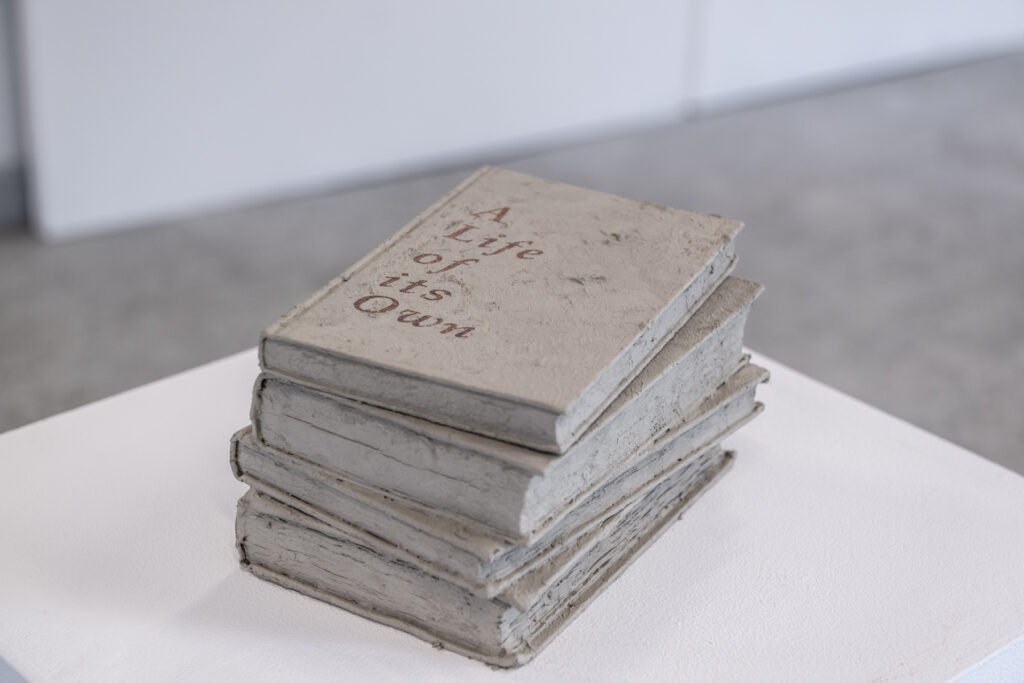
Three works on plinths of varying heights are arranged centrally. On the first of these, four small linen-bound hardback books are stacked on top of each other, united as one by a skin of unfired clay that smothers and encases them. On the cover of the book facing us are the words ‘A Life of its Own’, created in negative to allow the book’s faded red binding to show through. This gives both work (2025) and exhibition their title. On the second plinth, the upturned base of a white ceramic vase with a pale blue and green floral pattern is embedded in a block of mortar. ‘Folly’ (2025) is a work in two parts: a suspicion that the unseen portion of the vase is broken is confirmed by the nearby presence of a half dozen small fragments, each one embedded in a pancake of mortar, mounted together on the adjacent wall. The third plinth, much lower this time, holds ‘the little stones are singing’ (2025), an assortment of carefully arranged timber offcuts, charred and blackened, upon which balance several silver-metal nuggets. A flattened sheaf of dried paper pulp is partly tucked beneath the ensemble. Over by the far window on a fourth plinth facing Leeds Playhouse sits ‘Unfurl’ (2025), a three-dimensional drawing in earthenware recalling the classical outline of a lipped vessel. Inside its bulbous central void a nascent organic form is growing and unfurling, like the new frond of a fern.
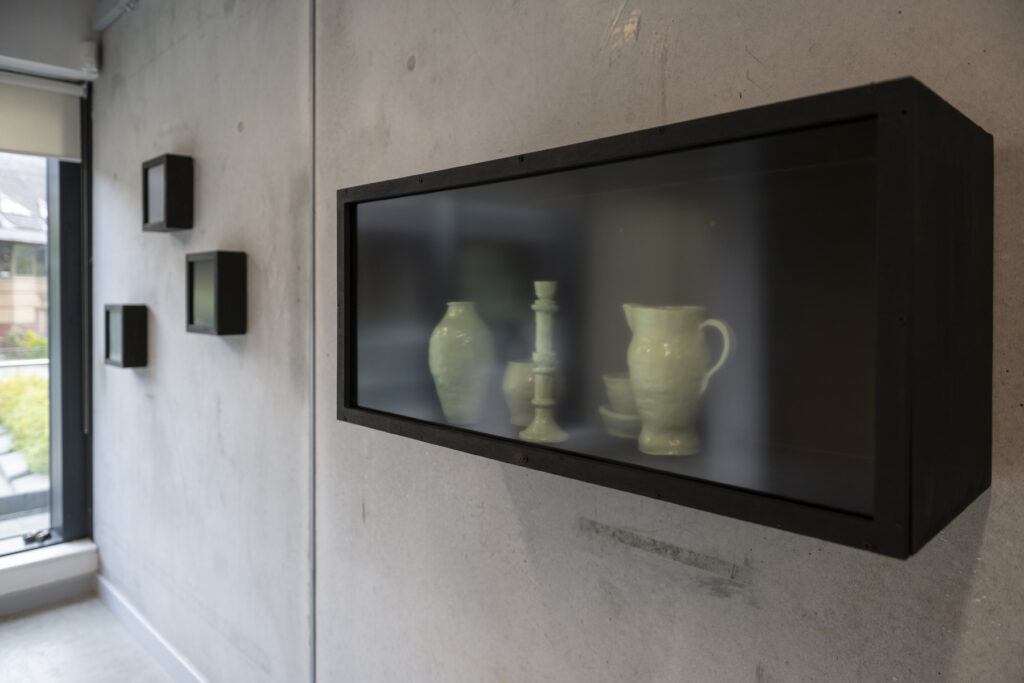
Accompanying these plinth-based works are others mounted on the walls. Three take the form of upturned bouquets of flowers cast in jesmonite and metal powder (bronze and brass). Three small vitrines with charred wooden frames and frosted glass hold dried roses. Another, much larger vitrine, again wall-mounted, references museological displays while resembling the three-dimensional recreation of a painted still life, recalling particularly the mature work of Giorgio Morandi. Held in a charred timber frame and behind more frosted glass, within it are arranged five functional ceramic shapes – four vessels and a candlestick. Their pale jade colouring nods to the sublime achievements of Chinese celadon ware, an association quickly refuted by the appealing wonkiness of their evidently hand-built forms. On another wall, a series of five small, framed photographic prints turn out to be created by placing ceramic vessels from the artist’s collection directly onto a flatbed scanner. In the resulting images, light from the scanning process bleeds around the edge of each object and begins to escape up its sides, leaving a ghostly impression that hints at three-dimensionality while drawing attention to the makers’ marks on each object’s base.
How are we to approach these disarmingly quirky works? Somewhat introspective in character, they do not shout, cry, plead or implore a response, yet are quietly compelling, rewarding time invested in slower looking that allows their many complexities to emerge. Issues of encasement begin to make themselves known. Objects are covered or embedded in mortar and clay; timber is sealed by charring; objects are fixed behind frosted glass; bouquets are dried and recast in metal. These are all methods of preservation, suggesting relations of care – or of containment, suggesting something potentially more sinister (the vast shelter preventing further leaks of radioactivity from the site of the 1986 Chernobyl nuclear disaster is known as the ‘New Safe Confinement’). Such processes of preservation have occupied cultures for centuries, as ways to mitigate the passing of time and the inexorable march of microbes.
Symonds has been exploring such techniques for some time. In 2023, the artist was commissioned to create a permanent outdoor work for Sunny Bank Mills, a historic site of textile production in Farsley, west Leeds. The resulting work ‘Remember Rana Plaza’ commemorated the tenth anniversary of the 2013 disaster in Savar, Bangladesh during which the collapse of a building housing multiple garment factories killed over 1100 workers and injured another 2500. The work, now installed on Weaver’s Lawn outside the Mills, is a roughly human-scale tower of cast concrete in which are embedded and preserved brightly coloured fabrics, proxies for the bodies entombed when the building collapsed due to structural failure and criminal neglect. Materials cannot help but carry for us socio-cultural associations, which are often also gendered, including in the histories of sculpture. The majority of the Rana Plaza disaster victims were women, the traditional workforce of the textile industry.
Symonds plays knowingly with these issues, using a range of processes to freeze objects in time so that they may re-emerge, transmuted, as sculpture. As the Italian painter and sculptor Umberto Boccioni wrote in 1914 in Pittura Scultura Futuriste, ‘Reality is not to be found in the object, but in the transfiguration of the object as it becomes identified with the subject’. A Life of its Own is less a presentation of individuated artworks and more a musing on questions of materiality, value and care as they relate to objects and subjectivities. The exhibition thus stages a three-way back and forth between the real object as it exists or existed in the world, complete with any functionality it served before its institution as art, the art-object as it is present within the exhibition, and the conceptual memory-object embodied with all the significance that objects have carried, since objects existed, loaded onto them by human subjects. In the exhibition booklet, Symonds states, ‘I have looked to objects to help me mourn, to make sense of things, to find a sense of order among the chaos’.
The complex negotiation of this territory, the interplay of materiality and subjectivity in contemporary art, is addressed by Griselda Pollock in her 2023 essay ‘On Medium and Memory’. Revisiting the formalism that American modernist art critic Clement Greenberg championed in his assessment of 1960s abstract expressionist painting, Pollock notes:
Contemporary artists have not rejected modernist tendencies outright. Yet many feel bound, ethically as much as aesthetically, to make art with critical intent (not content per se) and to open art to our wounded and fascinating, dangerous and unruly, violent, and existentially menaced world.

Symonds opens our experiences of the work to such considerations. Clues to their emergence from the artist’s situatedness come in several forms. Firstly, there is an unusual honesty to the way that materials are addressed through the exhibition labels. For example, the three bouquets hanging upside down are cast, their labels insist, not from solid bronze or brass alone, but from jesmonite finished with metal powder. Symonds thus deliberately reveals some of the constraints of her work’s making, prompting thinking on the practicalities – the affordability of materials and specialist processes – that confront most artists yet largely remain unspoken in the circuits of display. Also of significance are her choices of title. Is that of the exhibition, A Life of its Own, an autobiographical reference? Who or what is the ‘it’ in question? Is the title a reference to Virginia Woolf’s celebrated but contentious novel of 1929, ‘A Room of One’s Own’? In it, the author infamously wrote, ‘A woman must have money and a room of her own if she is to write fiction’. What must the artist have if she is to make sculpture in the here and now?
A more explicit literary reference comes in the form of the title of the work ‘the little stones are singing’, a line from ‘I Don’t Want to Be Demure or Respectable’ (2014) by the late American poet Mary Oliver. In it, the author ruminates on the desire for autonomy and unbridled freedoms, proposing a sensuous openness to the world so acute that even stones and rivers become animate and attain human characteristics. Oliver’s poetry is a major touchstone for Symonds, whose work is a committed plea for the agency of material objects. Her activities as a collector of ceramics stem from an interest in their potential to connect her haptically with the hands of those who made them and to tell the human stories of their making.
Oliver concludes her poem with the lines ‘Listen to me or not, it hardly matters / I’m not trying to be wise, that would be foolish / I’m just chattering’. A Life of its Own reveals Symonds as a conceptually and materially informed artist, reader and collector negotiating (chattering across) a complex territory in ways that promise riches to come. Dailami’s curation is largely elegant, although for a relatively small space there are perhaps too many works, leading some to feel compromised in too-close proximity to others. Overall, this is a strong and engaging show that rewards time invested. Far from demure, Symonds’ sculptures make small monuments of everyday objects and materials. They are diminutive in scale only.
Dr Kerry Harker is a curator and researcher based in Leeds.
Mia Mai Symonds: A Life of its Own is on at BLANK_, School of Creative Arts, University Centre Leeds, from July 10 to August 22 2025.
This review is supported by BLANK_.
Published 01.08.2025 by Benjamin Barra in Reviews
1,901 words