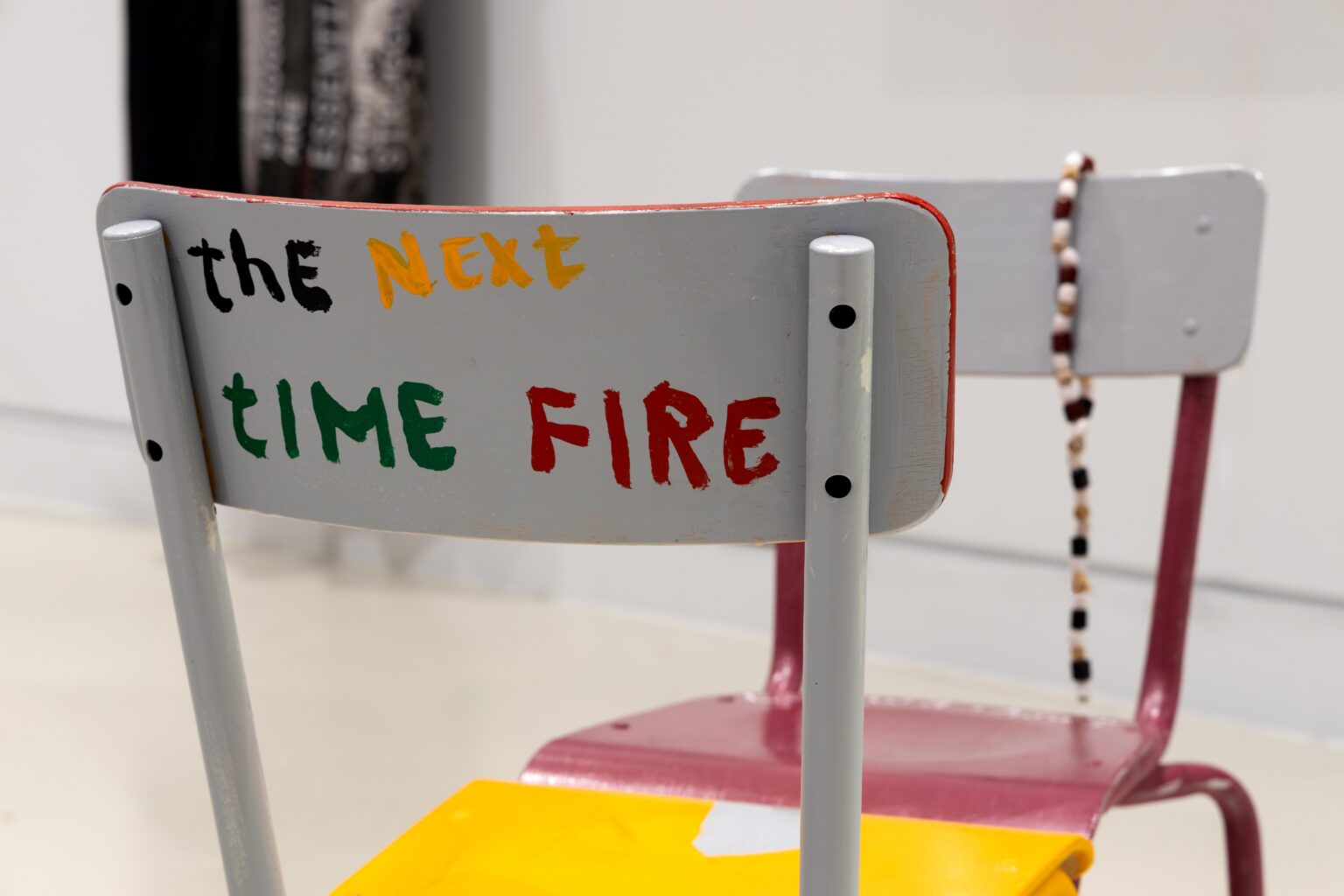
In her exhibition Still. Stray. Stowaway. at Blenheim Walk Gallery, Leeds Arts University, Paula Chambers brings together works that are reminiscent of an evacuation – an evacuation procedure that has somehow been stilled. Suitcases, vintage projector stands and tripods, hand-crocheted doilies, glass ball paperweights, accumulated over the years, found on streets or at flea markets in Europe and here in the UK, are repurposed and recycled. Emptied from their original meanings, since they no longer point to their original owner, they are transformed into a series of sculptural assemblages.
On the left as I enter the gallery space, a suitcase awaits. This isn’t any ordinary travelling case. It is covered in an array of pink and grey stones, mimicking pebbledash, the rough, textured finish made with small pebbles or stones mixed in with cement and sand that was a popular protective covering for the outside of houses in the 1960s. Whilst pebbledash is usually associated with a grey, dull colour, here it contains bright and bold fluorescent pinks. The suitcase serves as an introduction to the themes of the exhibition, invoking at the same time a sense of fixedness and the possibility of escape.
Titled ‘Feminist Escape Route Attempt no. 7’ (2021), the suitcase belongs to a larger series of works made during lockdowns and the imposed domesticity of Covid-19. These feminist escape routes began with a fifty-meter rope hung outside Chamber’s window. The rope now hangs in the space as part of ‘Feminist Escape Route Attempt No. 2’ (2020), also incorporating crocheted yarn and rolling pins. Further along, a bright pink typewriter churns out a pile of A4 sheets, equally pink. On these are typed the phrase ‘To Whom it May Concern’. This work, titled ‘Feminist Escape Route: Attempt no. 6’ (2021), is evocative of futile attempts to communicate with faceless institutional structures with little hope of reply.

Further along, jutting from the gallery wall, is ‘Jump’ (2024), which consists of a thin elastic band pulled taut over a digital print of a pink flower. Positioned like this, it is reminiscent of the young girls’ jumping game, played with a rubber band stretched between legs. As Chambers notes during the artist talk, this elastic band was found online – a spare piece intended to be inserted into women’s underwear. Having escaped from a knicker factory, here it provides an interplay between female sexuality and the innocence of the young girls’ jumping game.
Chambers’ work is an interesting take on the notion of the readymade with a feminist twist. The choice of colour, notably the pink hues that abound in this exhibition, is one of the means by which this is attempted. During the artist talk between Paula Chambers, Marianna Tsionki, the curator at Leeds Arts University, and Alexandra Kokoli, invited academic and lecturer, the discussion begins with the colour pink. Does the colour pink have an agenda? Who does it belong to today, and since when did we attach so much gendered meaning to it? According to artist and writer Kaye Blegvad in The Pink Book (2019), the word ‘pink’ has a somewhat roundabout origin. It was initially associated with the name of a flower, the carnation, and its jagged or serrated petals. ‘The word pink was first used in English as a verb meaning to perforate or to pierce. Thus, the pinking shear, a scissor that makes a jagged, zigzag cut.’ During the discussion, I wonder whether perhaps the jagged edges of this history may have been too easily bent into shape to serve the artist’s purposes.
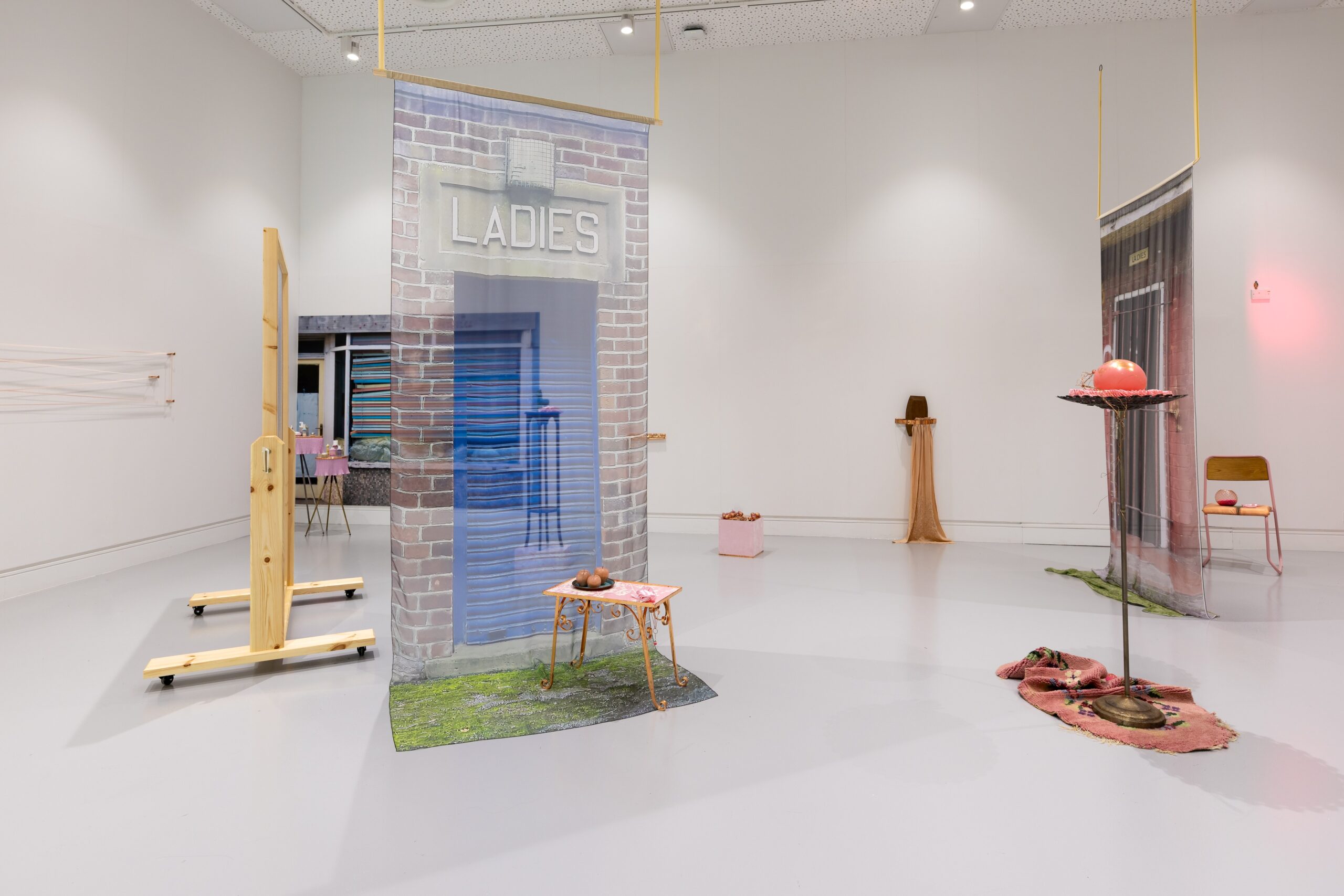
Things get interesting in the middle of the gallery, with the digitally printed chiffon panels that read ‘LADIES’. The title of the work, ‘Inconvenient Bodies’ (2023), points to the constructed and contested notion of gendered public toilets. Elsewhere are three small copper ‘ladies’, recognisable as the icon designating women’s toilets. Their placement is characteristic of Chambers’ methods of display: removed from their context, they are dotted around the gallery, utilising less obvious exhibition spaces – for example, sitting above plug sockets.
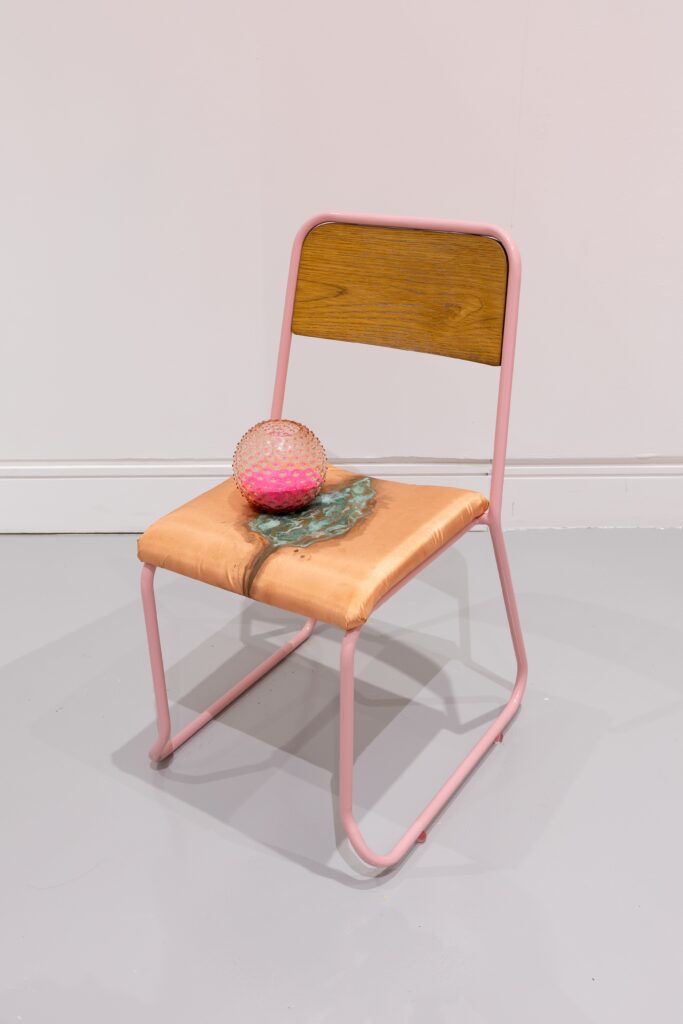
Copper is present in many of the works in the exhibition. Following a question about her choice of this particular material during the artist talk, Chambers explains that it is susceptible to transformation: when left exposed to outdoor elements, or even when urinated on, it becomes oxidised, taking on a distinct patinated green colour. In ‘Balancing Act (Chairwoman)’ (2025), a powder-coated chair frame supports an oxidised copper fabric on which a glass vase sits. It is this work that appears to show a way of moving beyond a pink-imbued sixties nostalgia to a more abstracted, ‘jagged’ notion of feminism – a feminism that doesn’t seek to beautify.
‘Pulling Teeth’ (2024) creates an instinctive bodily reaction to the violent act of its title, though on closer inspection the work falls just short of delivering. A delicate folded sheet of copper holds a ball of artificial silk thread, whilst a loose string holding a delicate glass bead has found its way downward and out of the frame. Overall, it comes across as aesthetically pleasing rather than menacing.
In the artist talk, Chambers’ often describes the works as being ‘feral’. It feels contradictory, then, that these same objects are handled with pink satin gloves when activated by performers during an opening-night performance. And in the space of the University gallery, they often appear neatly assembled in order to appease. The curatorial decision to eschew plinths is intentional, as are other decisions to embed assemblages on the walls or use projector stands to display objects. However, whilst the idea of the feral that Chambers wishes to engage with may be evident in the copper ladies that have been positioned inconspicuously above plug sockets, for example, too many of the works appear tamed by the gallery setting.
Other, wilder elements are introduced within a feminist context: a pair of animal antlers in ‘Feminist Escape Route: Attempt No. 12’ (2022) is tightly imbricated in a pink saturated gown. It is unclear how the antlers have come to be part of the assemblage, or where the rest of the animal might have escaped to. I am unsure how the colour pink fares with the artist’s intention of the works being feral – especially in ‘Last Bus Home’ (2024), where one feels rather the cosiness and security of the domestic in the way the glass paperweight sits comfortably on the decorated projector stand.

In the exhibition catalogue, the writings abound with references to feminist theory and feminist art. For me, however, the exhibition speaks more about our contemporary notions of a society in flux. The way the objects, sourced from flea markets in Europe in particular, are stalled and stilled in the gallery context recalls recent restrictions on the movement of people and goods marked by Brexit here in the UK. If these connections were made more evident, it might make more sense of the title.
Still, Stray, Stowaway speaks of transience, escapism and the fugitive. The work appears, however, to perform only fleeting encounters with academic ideas of feminist studies, whilst not always successfully navigating the disjunctions that can occur when placing these ‘feral’ objects in a public context. The overall insistence on pink as a colour through which to read ‘feminism’ feels overworn, whilst other exciting opportunities with materials, like the patinated green of the urinated-on copper sheets, are not highlighted enough.
Stella Baraklianou is an artist and writer based in Leeds.
Paula Chambers: Still. Stray. Stowaway. is on at Blenheim Walk Gallery, Leeds Arts University, 23 May – 27 September 2025.
This review is supported by Leeds Arts University.
Published 18.07.2025 by Benjamin Barra in Reviews
1,274 words