
Tomorrow I want to go home.
14 years, 6 months has taken its toll on me .
To start with it was all very scary, new, strange and weird. But now I am used to ‘doing time’. I am an experienced ‘con’ and know the drill, the hierarchy, what the nods, winks and look the other way mean. I don’t want to know all this, but I do. I’ve become integrated in a system I never thought I’d belong to.
This excerpt is taken from ‘Sentences’ (2023), a new artwork by Katrina Palmer, made with people who live or work within the justice system. Included in FACT’s current exhibition, On the other side, these fragmented conversations bind together an exhibition that presents the voices of incarcerated people in open dialogue with gallery visitors. Produced by FACT’s Learning team, in collaboration with Liverpool John Moores University, the exhibition is an invitation for the public to engage with their multi-year research project ‘Resolution‘.
Can collaborative art-making be used as a tool to change societal perceptions of our justice system, and influence policy making? This is the big question underpinning ‘Resolution’, which has brought together artists and researchers with incarcerated people and prison staff. The words excerpted above are those of someone with lived experience of the justice system, rather than the academics and artists involved in the project. This was a deliberate choice to upend traditional hierarchies of knowledge, and repatriate control over personal narratives. At no point are the ‘Resolution’ participant experiences made tokenistic, or packaged to prove a point or uphold the opinion of a third party.
On walking into FACT, I am immediately met by a wall of one-way mirrors reflecting visitors milling around the foyer. The work is ‘Close Watch’ (2022) by Pilvi Takala. Once behind these mirrors they appear as glass and are found to be concealing a multi-channel video installation. Two screens play films presenting a series of discussions and role playing exercises in which a group of security guards examine the impact of the power conferred upon them. Observing how the guards have the authority to eject ‘misbehavers’ provokes questions about the nature of disruption: who gets to define disturbance, and who or what does the expulsion serve?
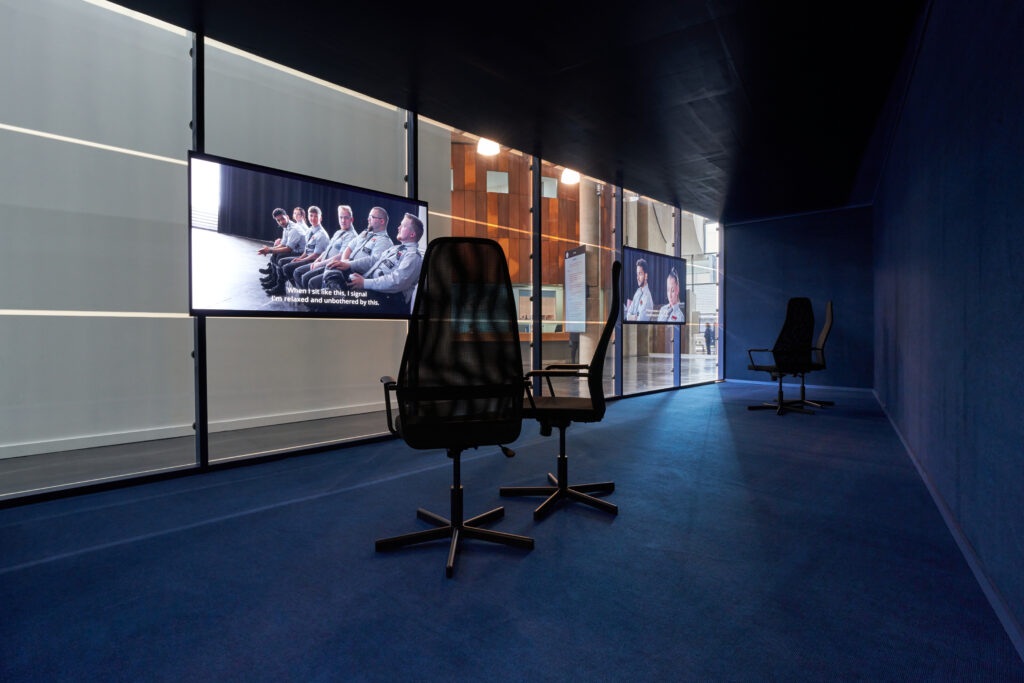
I watch these films, whilst simultaneously observing those on the other side of the mirrored wall. This voyeuristic element provides the audience a security role by proxy. This is important. Not only does it provide a context for Takala’s films, but it also allows the audience to embody a sense of the uneven power dynamics On the other side is in direct conversation with. Takala’s work grounds an experience of systems of control within the everyday. Shopping at a mall and seeing security guards is something we all know.
‘Close Watch’ also provides an insight into the considerations artists and producers scaffold collaborative art making with. In FACT’s foyer is a screen – like an oversized mobile phone – displaying excerpts of WhatsApp conversations between Takala, her producer, and a project collaborator. I read how her security guard colleagues are made aware that they are participating in an artwork, and learn of Takala’s commitment to paying people for their time. This attention to transparency and commitment to avoiding extractive dynamics provide a window into the careful, slow relationship- and trust-building that this type of work necessitates. These themes, the rules that direct quotidian activities and the ethics of collaborative art making, frame the exhibition as a whole.
In Gallery One, I encounter ‘A Machine To Unmake You’ (‘M2UY’) (2019-2024) by Melanie Crean. Developed over a period of four years with communities of incarcerated army veterans, this project explores concepts of rehabilitation: what is required to re-join civilian life, and how return can be facilitated. The title of the piece takes its name from the ideal ‘machine’ or social apparatus devised by the collaborating veterans to assist their transition from soldier to civilian. On display are a series of films and images made as part of the ‘M2UY’ creative workshops. The details of the actual machine are best articulated in a panel discussion featuring Crean, hosted on FACT’s website.
The work is shown in a large chamber created by multi-channel video projections on floor-to-ceiling screens. One screen shows a group of men with their backs turned to us. They are stood on chairs in a row that simultaneously extends left and dissolves from the right each time a new chair is passed along. This exercise represents a clock of sorts. It draws our attention to the subjective experience of time: prison-time is different to free-time. Opposite, we watch an owl swooping to take bait from an outstretched hand protected by a leather gauntlet. Both owl and hand are contained within a prison yard. A third screen shows a man with his back turned, his hands raised to his eyes forming a view finder through which he can focus his gaze past a fence. Fragmenting this image are excerpts of texts taken from the workshops facilitated by Crean. One reads: ‘Crossing the threshold and stepping into the unknown.’ Taken together, these words and images are disorienting.
Leaving this chamber, I’m funnelled down a corridor, at the bottom of which is a recording compiled from many different personal stories: of childhood memories; of reasons for joining the army; of trauma experienced in the theatre of war. This is an invitation to imaginatively speculate, together with the incarcerated men, about how things could be different. Here, the curatorial choice to platform the men’s lived experience of processes of incarceration, without analysis from a third person (artist, researcher, academic), allows the audience to feel part of an ongoing conversation.
Looping back to where I started: ‘Sentences’ is a collection of texts by people who live or work within the justice system, written during workshops facilitated by Katrina Palmer. Exploring the alternative freedoms afforded by a blank page, ‘Sentences’ allows the imagined to be discussed openly. Printed on single-sided yellow paper and bound in a manilla cover to mimic the way information was kept on prisoners before digitisation, copies of this document sit alongside a ‘dead magpie’ (made from paper) in a wall-mounted glass-fronted display case by FACT’s café. The magpie is a bird, a thief, and alone in its sorrow. Its inclusion as a paper corpse provides a metaphorical weight to this small, unassuming display.
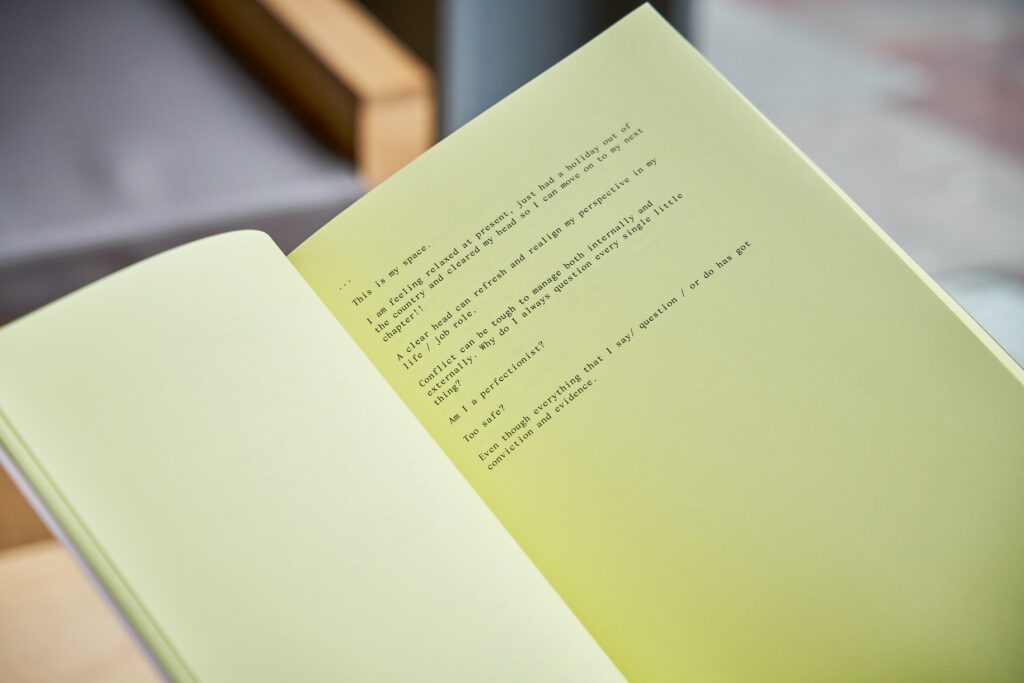
Ending the exhibition with people’s notes, bound and filed away discreetly, is a nod to how our society deals with deviation from its rules and values. On the other side is not a polemic. Instead, it asks us to engage with aspects of our social architecture that too easily go unseen, and consider if they are operating in the best way possible. What could be different? Melanie Crean’s ‘M2UY’ makes one suggestion: the distribution of ‘accountability [for the veteran] to community and kinship units to defend the defender’ (Melanie Crean, 2023). In her work, Crean speaks to the current lack of care and support for those leaving the forces, and goes some way to explain why the UK prison population contains such a high number of veterans.*
Presenting socially engaged art projects in a gallery context is never straightforward. Often, exhibitions like On the other side are activated by a participatory event with the artists and collaborators. Events such as these provide context through active engagement. For obvious reasons this cannot happen at On the other side. As such, avoiding turning the research of ‘Resolution’ into a spectacle was perhaps one of the biggest curatorial challenges for this show. By steering clear of making overtly political statements, On the other side successfully circumvents a polarising spectacle by focusing on process and dialogue. It platforms collaborative art making as a tool that can change perception by creating an alternative space to speculate together.
On the other side is on at FACT, 1 March – 2 June 2024.
Natalie Hughes is a writer and producer based in Liverpool.
This review is supported by FACT.
*There are no official figures, but estimates range between 3%-10%
Published 27.03.2024 by Laura Harris in Reviews
1,385 words