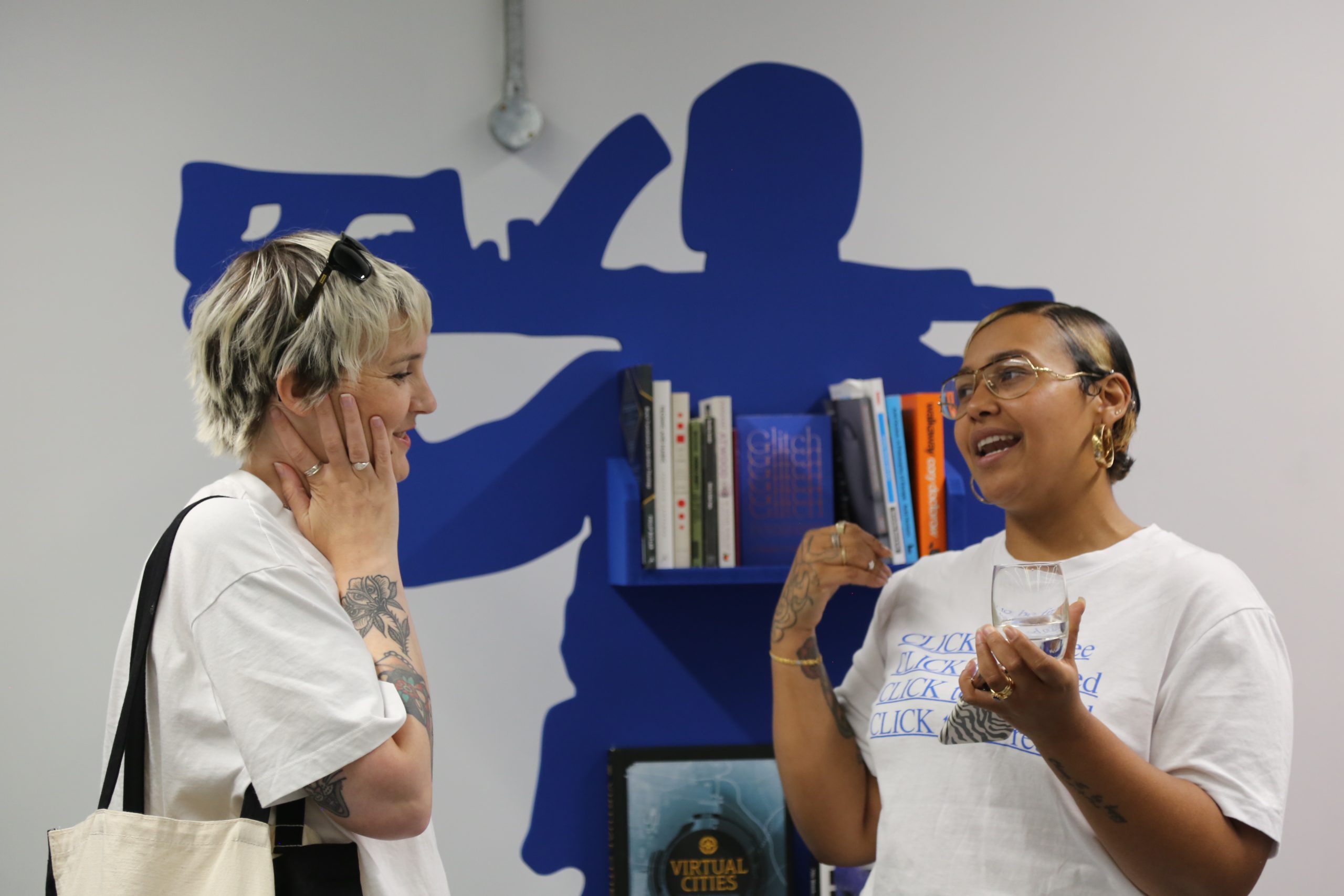
Ursula K. Le Guin’s The Carrier Bag Theory of Fiction has become a sacred text in the digital art world. The essay proposes a shift in storytelling: seeing language and narrative not as weapons of domination, but as cultural vessels. How might that alter the limits of our imaginations, our reality, and our roles? Artists working critically with world-building and belonging often cite it as foundational to creating interactive artworks, or explorable environments using game engines like Unity, Unreal, or Godot. Few embody Le Guin’s suggestion as fully as Jazmin Morris, a Creative Computing Artist and Educator based in West Yorkshire.
I spoke to her during the final week of Sandbox. This sprawling solo project includes a physical and digital exhibition, public events, participatory workshops and resources for navigating digital worlds or creating your own. Morris produced the work during a residency with Abandon Normal Devices (AND) and School of Digital Arts (SODA), Manchester Metropolitan University, as part of their Commons commissioning strand. Although the show has closed in Manchester, it feels like just the beginning of a project which could grow and grow. So we met to chat about it on Gather (a virtual space for remote workforces), inside the digital realm of Sandbox. Whilst exploring we discussed community, access and representation and how Jazmin’s approach hacks big tech whilst resisting digital perfection.
Lesley Taker: The show centres on ‘worlding’, a term often used by Donna Haraway to describe the notion of making worlds together, and you began with the question: ‘What kinds of worlds are needed at this time of ecological crises?’ Talk me through how the physical elements of the project explore that…
Jazmin Morris: Sandbox looks at game worlds – both digital and tabletop – but also ‘worlding’ more broadly, from sci-fi, literary, political, and digital art perspectives. Not all world-building has to be an interactive game, but gameplay shapes the space and informs the aesthetic of my own works in the show.
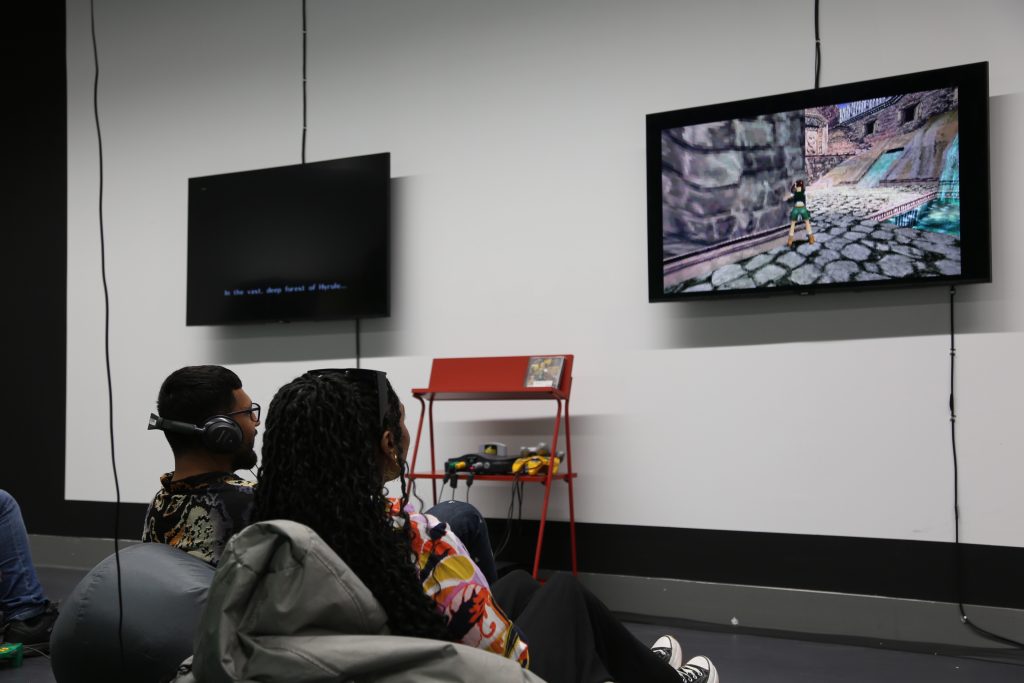
We created a gaming cave featuring a Nintendo 64 and PlayStation 3 equipped with both classics and more critical titles. Some offer rich, playful worlds, like the garage-soundtracked Buck Bumble or the coming-of-age tale Spyro. Others are problematic or entirely uncritical, such as Medal of Honour, which overlooks the power of perspective and role-playing history. These visual digital worlds sit alongside tabletop games, such as artist David Blandy’s The World After (2019), exploring climate disaster from a non-human viewpoint. Then, a sort of mixture of the two, there are text-based games such as Anna Antopy’s Queers in Love at the End of the World (2013), a tiny hypertext game with a big effect. The diverse resources available allow people to interact on their terms; to approach Sandbox as a “third space” to play, read, think, or be.
LT: In tech and digital art, we obviously use ‘sandbox’ to mean open-world play or a safe place to experiment, but for others, it evokes nostalgic, hands-on free play. It’s a very apt title for the way you create shared spaces in your practice and different types of engagement.
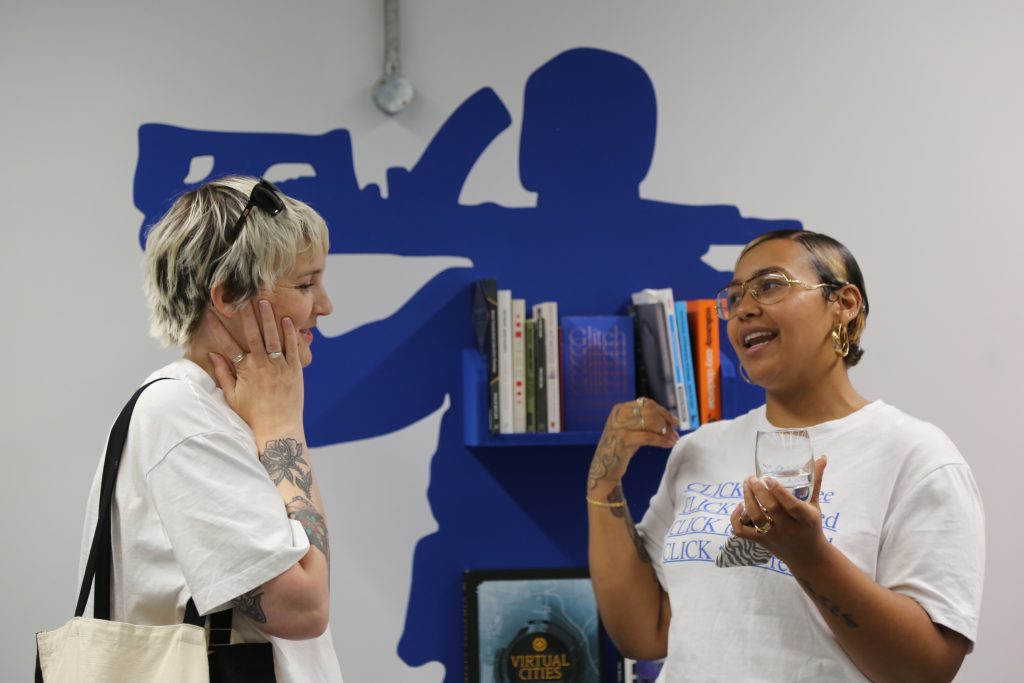
JM: The core message of Sandbox is: What can I do with what’s right in front of me? I’m not interested in tech fetishism or perfection. My focus is on community, education, and criticality; building an open ecosystem for co-creation. The physical gallery also responds to the lack of such spaces, especially for a Black woman in gaming. Leeds, Manchester, and Liverpool have big scenes, but haven’t always felt welcoming. I wanted to create something based on curiosity and openness, not on gaming skill or tech expertise. I wanted to create a space where visitors connected across backgrounds— and it’s worked, people have even returned on a daily basis to play in the gaming cave alongside critical discussions.
LT: Central to your work are exactly those stories we tell: rewriting, revisiting and rebuilding come up again and again. How do Sandbox’s resources, and crucially your own works use digital tools to reimagine?
JM: The events sharpened that focus. In my opening conversation with Michelle Collier, we discussed sci-fi’s power: how world-destroying can also be world-building (inspired by Octavia Butler) and resisting colonial logics in play and art spaces. The talk in Gather was more practical: how to create immersive worlds digitally, start writing your own, or critique existing ones, using any medium. I love a DIY, ‘folk computing‘ approach, and am inspired by artists like Porpentine Charity Heartscape, who use Twine, Bitsy, and Google Docs, to tell urgent stories. I think of it as a parasitic relationship with big tech: using platforms to amplify silenced voices, learning enough to use them critically, and then moving on.
My works are intentionally janky in their aesthetic. I’m not trying to master Blender or Unity; I want to tell the story and get out. A collaboration with Chris Tegho riffs on Google’s Dinosaur T-Rex Game that appears when your internet drops. We liked that it happens only when something breaks (linking to Legacy Russell’s Glitch Feminism). It’s most accessible to those with unreliable internet, who are the least considered by big tech. The mangoes and figs scattered throughout the world are pieces of our history. They push against technology’s Eurocentric approach, countering the ‘idyllic’ Western landscapes of early games and Windows desktops.
My work The Block (2025), digitally recreates two estate buildings as a response to how the mainstream media ignores working class existence. Or how, as in GTA (Grand Theft Auto), they’re used negatively, one-dimensionally. My rendering focuses on the creativity and resistance of these spaces, referencing Pirate Radio and novice aesthetics. Mad Esmond and Crazy Titch in a Nintendo Castle (2025), a lo-fi recreation of part of Peach’s Castle in Super Mario 64, replaces the anticipated royal paintings with images of grime artist Carl Dobson and my stepfather, both institutionalised Black men. The portraits become portals into their lives, and my creative world, positioning us in a space of power which resists any form of diversity.
LT: Your practice revolves around this idea of how we exist, play, and learn together, acknowledging the bad and working towards the good. This multifaceted, growing project is the perfect environment to invite others into your practice. What has that collaborative approach looked like during the residency?
JM: The whole exhibition exists in collaboration: it’s a living archive exploring different ways of existing together and storytelling. I think it’s important for me to have a strong voice and claim space as a working-class, Black female artist authoring a solo show, but I wanted Sandbox to be inclusive and open, to feel like my process. Bringing in more perspectives reveals alternative approaches to telling and sharing stories, rethinking digital creativity and empowerment.
I’ve also been working with Rekindle, an alternative school for working-class young people in Manchester. Facilitation has always been part of my practice, from starting Tech Yard at UAL, to running lectures and workshops across Europe. Hosting workshops in Sandbox means participants are surrounded by my literature, aesthetics, and games; stepping directly into my approach to worlding and storytelling. We exchange references and build new ones together. Sandbox becomes a classroom of sorts (although I hate the connotations), rooted in digital art, world-building literature and gaming.
LT: Talking more about being together in space – we’re meeting in Gather right now. Why was it important to you to build an online space as well as an IRL one and why did you choose this platform?
JM: Using Gather is an example of folk computing: offices use it for dry stuff, but we could bend it toward performances and games. Because of the Pokémon-esque, 8-bit aesthetics, it’s always going to be cuter than Zoom, but I wanted to see if we could playfully reclaim it a bit from corporate tech. Having the digital version of the gallery was vital. If I’m going to talk about cyberspace and the evolving culture of online, I should be present there. I don’t love to differentiate between IRL and URL; it’s still human interaction.
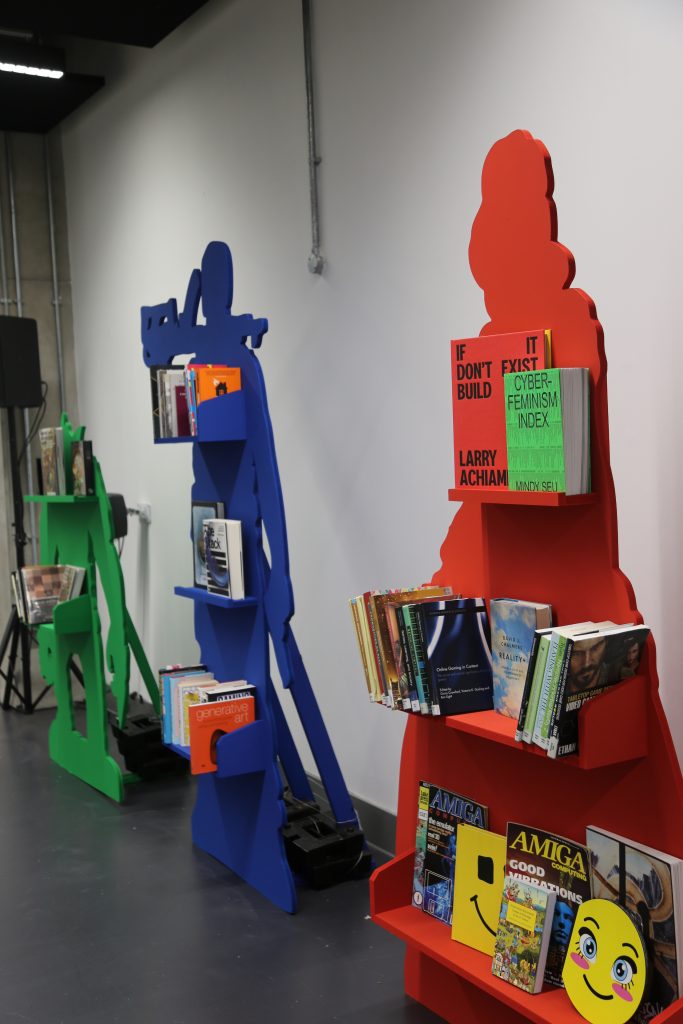
I’ve been researching simulation theory and putting Sandbox online plays with that real/virtual divide. Digital spaces have their barriers (expensive devices, reliable internet, leisure time) but they can reach more people and be used to overcome physical restrictions. For example, Sandbox’s resource archive was partly inspired by The Uncensored Library in Minecraft, which hosts texts banned for political reasons. I wanted to maintain that cyclical connection between physical and digital.
LT: The residency’s scope was pretty ambitious. The brief was to ask artists to work with AND and SODA in ‘rethinking commissioning models and digital platforms’. What experiments will you carry forward from this time? And what brought you the most joy?
JM: I love that Sandbox is so rich and full. I’ve been thinking about the colonial roots of “less is more” in Western modernism. To some curators, it might seem maximal, but I’m actively resisting the pressure to “refine” that I’ve felt since art school. I want to honour art organisations like Idle Women and AND, who’ve shown me different things can be art: my library, my work table, my collections, my community.
Sandbox comes alive when activated and there’s a performative side to my practice in those moments, so the events brought me a lot of joy. Nerding out about my book and game archives, borrowing from SODA’s library, and generally, the process of curating the project was nostalgic and soothing. It’s also my first large-scale project where I didn’t lose myself. I worked with realistic timelines and strong support from the production team. I think it’s important to talk about how hard it is to approach projects that way, because if it can encourage younger artists to protect their mental health earlier in their practice, good.
I’ve already applied for funding for Sandbox 2.0: to take it to more cities, show more games (including my own), run more events and keep it evolving in a slow, steady way. It isn’t just a one-off…
Lesley Taker is a Liverpool-based freelance curator, arts producer and writer specialising in digital art and art & technology, particularly gaming. Her play-centered practice focuses on how technology reshapes contemporary art, particularly around fluid identities, shifting truths, and unstable narratives.
Jazmin Morris is a Creative Computing Artist and Educator based in Leeds. Her practice and pedagogy consider the historical trajectories of modern technology and critically speculate on the landscape of human-computer interaction. Using free and open-source tools, Jazmin crafts participatory digital works that challenge power dynamics and hierarchies within cyberspace, with a particular emphasis on the processes of simulating culture and identity.
Sandbox was on at Modal Gallery in the School of Digital Arts, Mon 28th Jul — Thu 14th Aug 2025
This interview was supported by Abandon Normal Devices
Published 01.09.2025 by Natalie Hughes in Interviews
1,879 words