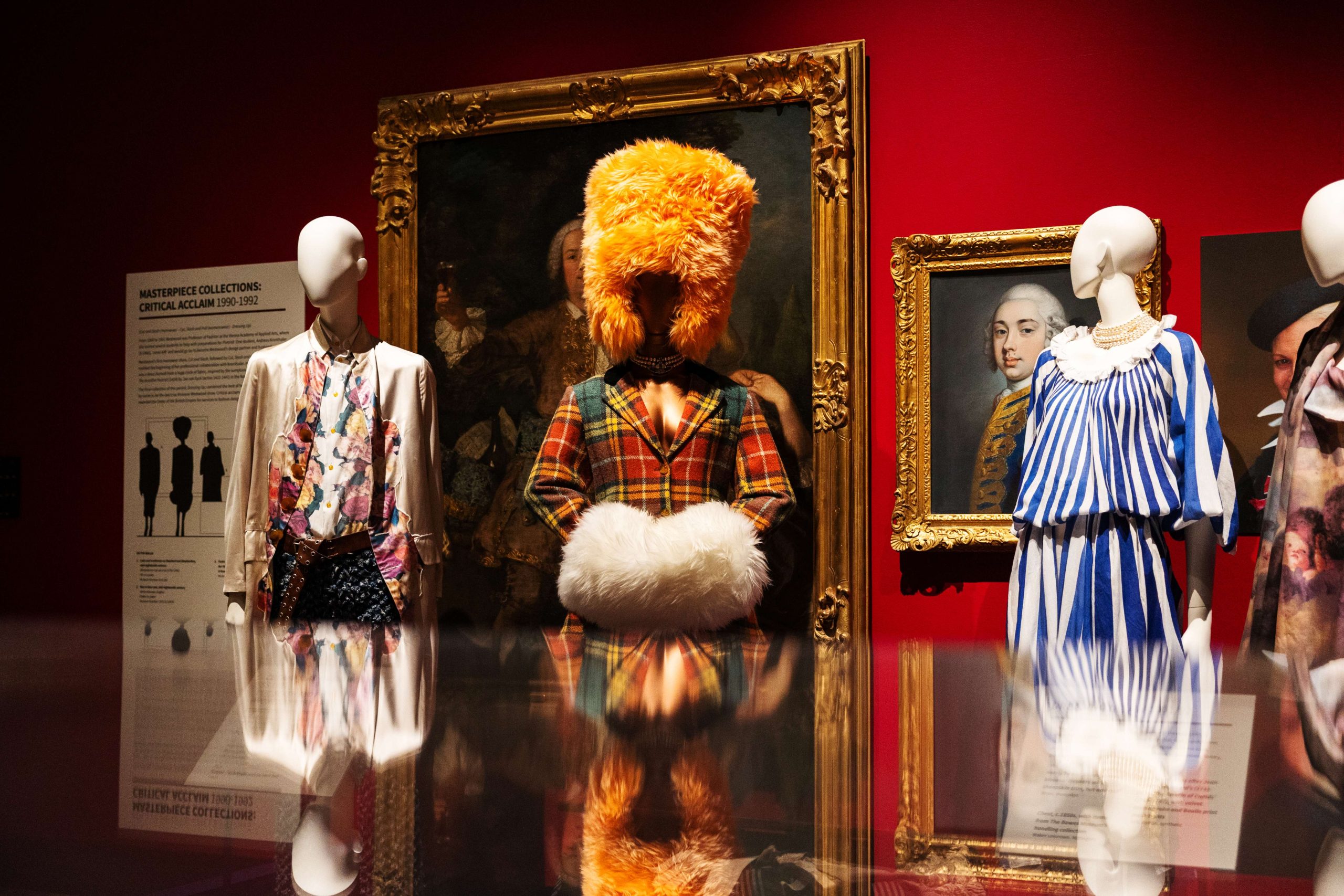
A huge collection of garments and accessories by fashion icon Vivienne Westwood are on display in Vivienne Westwood: Rebel – Storyteller – Visionary at The Bowes Museum in County Durham. The exhibition raises a few questions and reveals many contradictions, as Westwood – and fashion generally – often does with me. I love clothes, I love dressmaking, I love DIY cultures and scenes like punk, and I like the way that fashion connects very deeply with people in ways that contemporary art often can’t. But for me, fashion is hard to love: a form of liquid modernity that pushes us to chase trends and change styles, forever unsatisfied, fuelling – even embodying – capitalism, piling up waste and polluting the environment. And yet! We all need clothes; we all want to express ourselves through the garments we wear.
Vivienne Westwood was one of those pioneers whose work, at times, transcended and directly addressed some of the problematic aspects of fashion. You could say she was an artist. Her ideas are complicated and the objects she made were beautiful, and her practice was absolutely full of contradiction. A desire to be new and better and the same as everyone else while being totally individual is a weird and impossible race that cannot be won, except by those with vast amounts of money and dedication. You might as well drop out or go completely your own way. The Westwood here on display at the Bowes is a role model for the latter, but is set within a context of opulence, collection and the authority of the museum. There’s a lot going on.
When I think of Westwood, I see hand-made punk gear, tube skirts, cobbled together in squalid studios occupied by snarling vagabonds. I’m drawn to the artist of the early years, the association with the punk scene of the Kings Road in London, with Jordan, the Sex Pistols et al, and also to alt fashion clubbers Leigh Bowery or Pam Hogg, constructing wearable art for those wanting to shock and disgust polite society and get into the coolest clubs. We get a glimpse of that scene with some of her SEX and World’s End creations displayed in cabinets of the Fashion and Textile Gallery, adjacent to the main show. I dwelled here for some time, taking in the proto-New Romantic ‘Pirate Collection’ pieces and raggedy glam wear, admiring the sloping padded shoulders and slightly rude boob-level pockets on a green sateen top. These clothes were truly experimental: there’s a hat/mask inspired by the Elephant Man, which I doubt was worn by many but shows Westwood actively engaging with the cultural language of extremes.
Conversely, the main portion of Rebel – Storyteller – Visionary shows Vivienne Westwood the master. It begins at the point where Westwood itself became the brand – when she left World’s End and Malcolm McLaren behind and revealed her new orb logo, brazenly stolen from Harris Tweed, which is so familiar today – and walks the visitor through her progress as a maker of quality and sophistication. The display of her work as a practice spanning forty-odd years speaks to the relationship to time and space that fashion has, through the cut and style of garments, the couture, the tailoring, construction and choice of fabrics. And of course, it speaks to her interest in Art History. All in relation to this mighty bonkers palace of romance and beautifully crafted and expensive objects, The Bowes Museum.
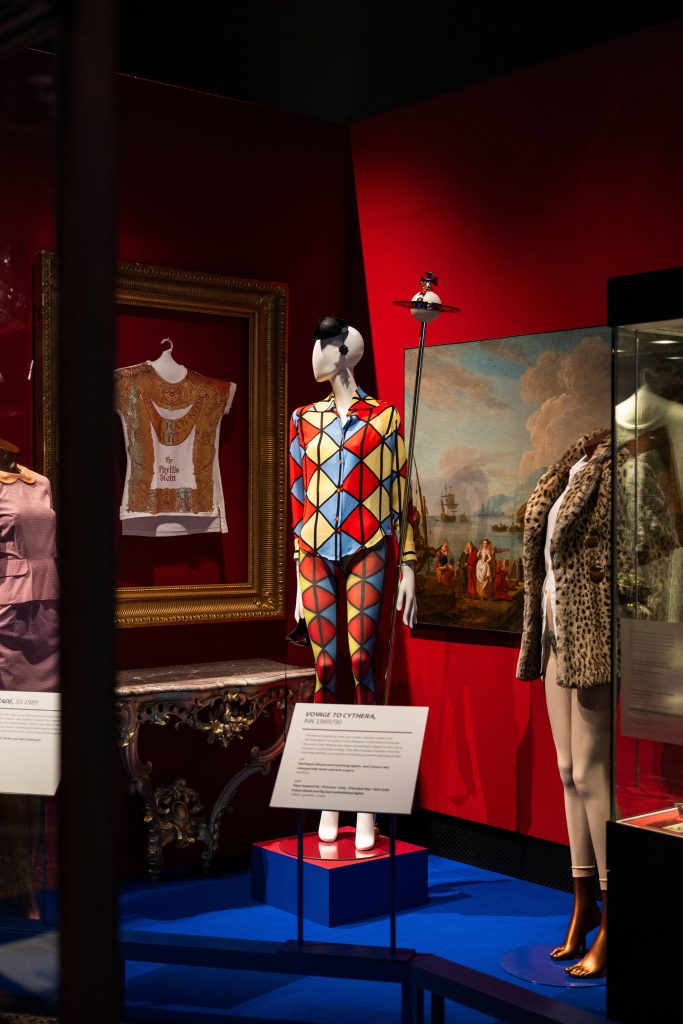
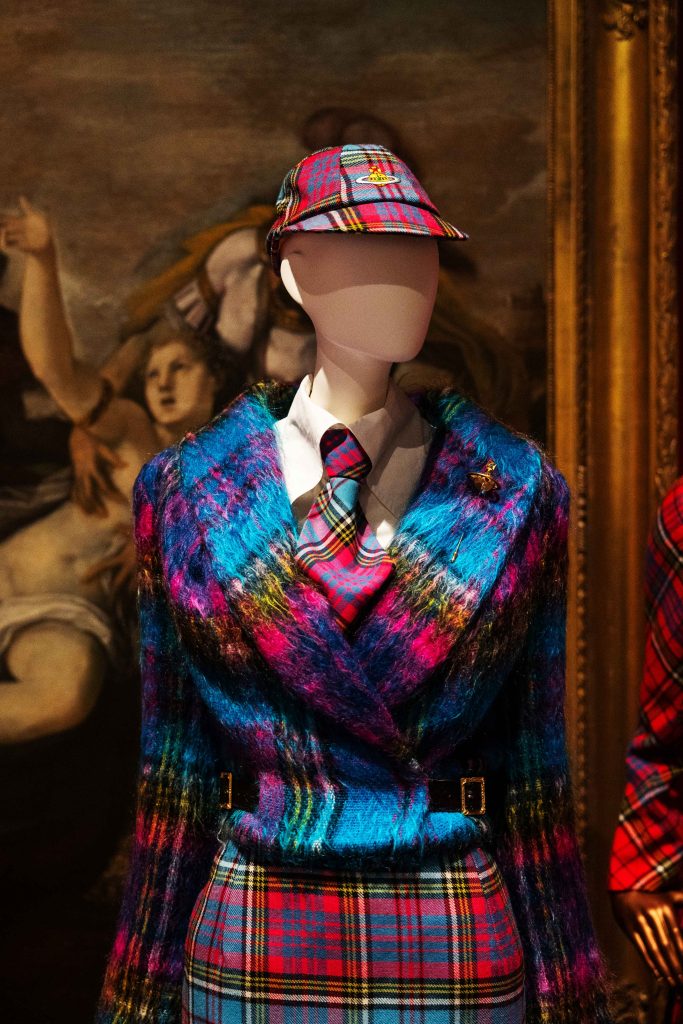
There’s a quasi or faux intellectualism in Westwood’s later work that sometimes ruffles me. It looks like she discovered Art History as a style and sort of sewed it in. Don’t get me wrong, I love the story telling and the exploration of themes. There are collections from the 80s based on Greek Paganism, HG Wells’ The Time Machine and the commedia dell’arte that are theatrical and fun, and while they sail close to the wind, almost venturing into costume, they are always wearable. (Oh, how I wish I could wear some of these things!) No, it’s the eccentric Britishness that piques: the use of Scottish tartan to symbolise rebellion sold to rich English fashionistas; the tailoring of the public-school uniform, of the hunt. Yuk. Yes, she makes it sexy, but in places it is just English and twee. It doesn’t do what the earlier stuff does, or maybe it’s just targeted at someone else (not me). Even her activism and manifestos and calls to embrace ‘culture’ seem a little stylised. Westwood herself was outspokenly conservative on such matters. She looked back to the romantic, the baroque, with zeal.
On the big screen is a looped video of old catwalk shows, and it’s fun to see the early New Romantic gear, the models bouncing around in their puffy rags, and later dressed like aristocrats dizzy on champagne – exuberant, extravagant young things with no cares. There’s Naomi Campbell falling over, remember that? Shepherdesses and pastoral playthings parade in a weird street style of folded and layered pyjamas, lolloping like tipsy Andy Pandies. It looks great but, yeah, I wonder how this cultural engagement actually challenged the status quo. Perhaps coming from a contemporary art angle I’m missing how it might have meaningfully altered the world of fashion.
Moving on, the museum itself becomes integrated into the show. In the 90s, Westwood was inspired by paintings from the Wallace Collection in London that are similar to many of those to be found in the Bowes. Baroque images of cupids and bare breasted maidens enjoying arcadian pleasures were printed onto corsets and scarves, their forms and colour schemes mixing in with elements of punk aesthetic such as hand written slogans or studs. Objects from the Bowes collection have been displayed with and around the garments, which is a great touch. There is an eighteenth-century dressing up box brimming with items from the handling collection which acts like a prompt. I don’t think we can touch them, but there is an opportunity for that later in the Fashion and Textiles Gallery. It looks amazing having the clothes in a context which I think Westwood would have appreciated, and demonstrates the connections and ideas, as quasi or faux as they seem to me. It still looks cool. This is excellent storytelling from the curator and brings the show to life.
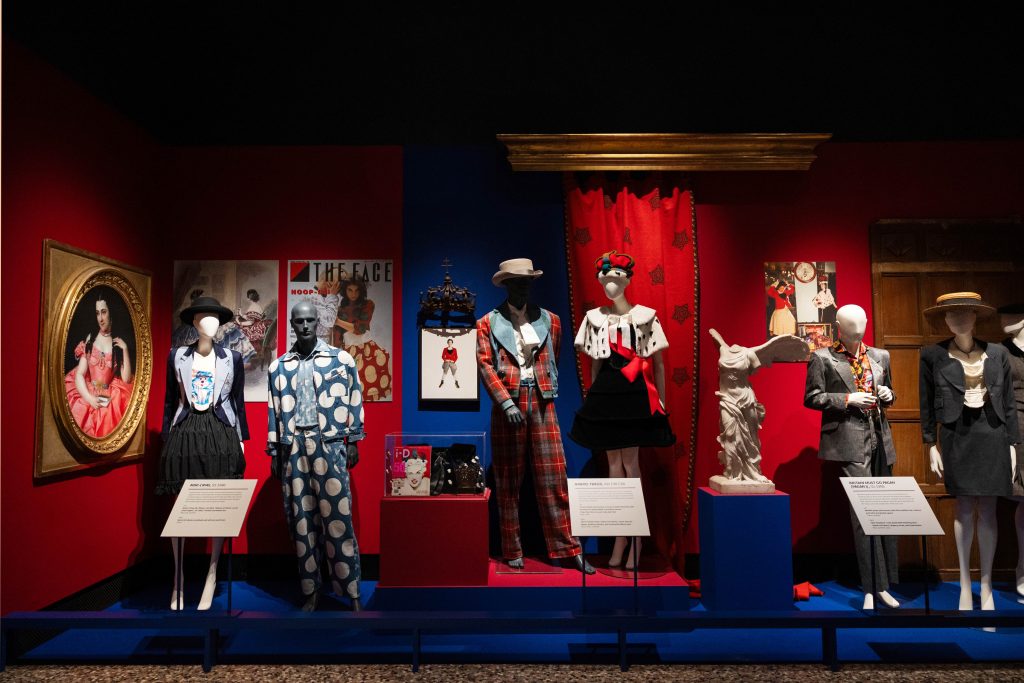
The exhibition gives us some insight into how clothes are designed and made, which is an important strategy to fight the negative effects of fast fashion. Back in the Fashion and Textiles Gallery, there are elements of a project from Northumbria University Fashion students that shows some of Westwood’s key garments digitally deconstructed on TV screens, revealing their pattern pieces. Their complexity adds a layer of admiration for the crafting of the clothes. The highlight of the show, for me, is the ‘MAKE YOUR OWN VIVIENNE WESTWOOD SEX JUMPER’ pattern published in DAZED magazine in 2018, alongside the jumper itself from 1970. It is a rare moment of sharing from the fashion world, and perhaps indicative of something that made Westwood a bit different from the rest.
Vivienne Westwood: Rebel – Storyteller – Visionary shows us some fabulous outfits that make me want to invest some care and time into my own wardrobe. Despite all my conflicting feelings, or maybe because of them, the exhibition made me think more carefully about what I wear. Every day we make a choice about who we want to be, how we want to feel, which parts of ourselves we want to show to the world, and the garments we style ourselves with are a huge part of this. Westwood’s designs do the things that fashion does, but they also inspire me to experiment with the form of my everyday life. I might turn my tartan travel rugs into bondage jackets, have a go at knitting my own SEX jumper, or create a whole outfit that expresses the ideas I usually reserve for my art practice.
Lesley Guy is an artist and writer based in Newcastle upon Tyne. She is Regional Editor for Northumberland, County Durham, Tyne and Wear at Corridor8.
Vivienne Westwood: Rebel – Storyteller – Visionary is at the Bowes Museum, County Durham, until 6 September 2026.
This review is supported by the Bowes Museum.
Published 24.07.2026 by Benjamin Barra
1,443 words