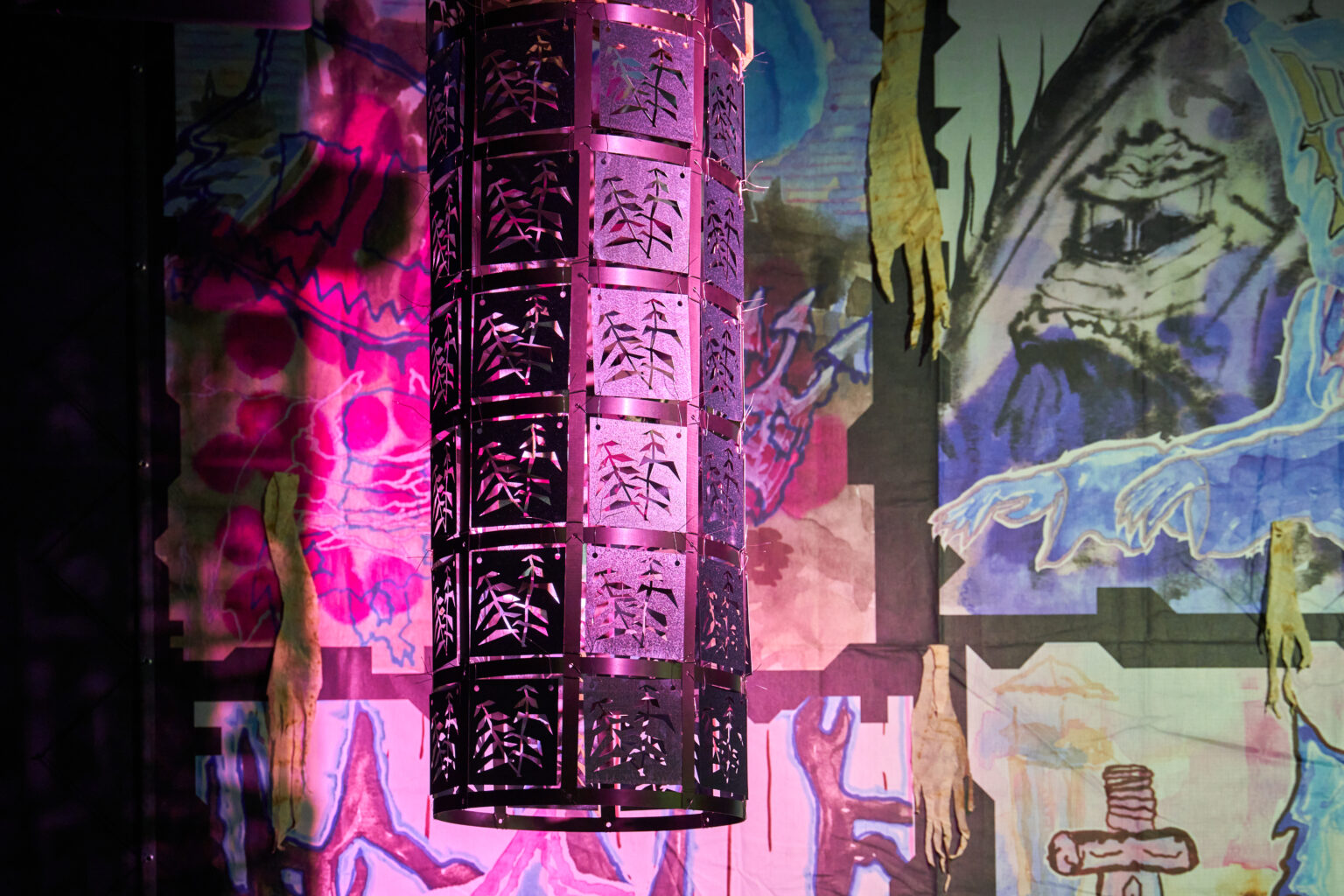
‘This point of desire which the nostalgic seeks is in fact the absence that is the very generating mechanism of desire. [The] realization of re-union imagined by the nostalgic is a narrative utopia that works only by virtue of its partiality, its lack of fixity and closure: nostalgia is the desire for desire.’ – Susan Stewart, On Longing, 2007
There is a tendency of longing that is present through A Gathering, Newcastle University’s 2025 postgraduate exhibition. A lot of the work displaying that tendency made me incredibly uncomfortable because at its most severe, the languages of colonial martial chauvinism, back to the land traditionalism and biological essentialism are deployed without political critique. Unfortunately, those artists’ languages also recontextualise the work of some others in the show, highlighting that the road from an uncritical personal nostalgia to blood and soil nationalism is not all that tortuous. In writing this review I’ve tried to thread the needle of including this context, without specifically naming those artists or their work. I don’t think it’s appropriate to single people out in a student exhibition, but while the far right is using those same languages of longing to justify violence against the vulnerable it is also dishonest to ignore.
Instead I wish to write about the work of four artists in A Gathering who have forged lines of escape from the seductive pull of inward reflection. The work that I find most interesting in the exhibition engages with the tendency of longing, but produces its own desires which it, in turn, explores.

On one of the university building’s upper floors, Nancy Daykin’s installation uses a very light and elegant touch to build a layered meditation on water. In a dark room, simple forms made from simple parts are stacked, slung, or balanced to suggest both protection from and the collection of water. Ropes, tarps, and ballast are loosely interconnected in a manner both of casual demonstration and the speed of necessity, but never the labouring of reenactment.
Under the cover of one tarp a poem plays out on an obscured projection while read by a synthesised voice. The line ‘Collecting is not so much a process of having but of becoming’ stays with me as a manifesto for the work as a whole. Later the voice reads, ‘The process of mapping the object of our desires means they are constantly in view. Coming towards us down the street in the structure of a stranger’. Between these two fragments, longing is set out as an unstable advance through the unknowable. The casually hung tarps evoke camping trips and blanket forts, but what it gives is not the paternal security of leisure and childhood but strategies for navigating trauma. This last point is driven home when leaving the room the audience finds a donation link on the rear of the door for Water is Life Gaza. This is a point within A Gathering where the ongoing genocide, its latest escalation concurrent with this cohort’s two year MFA, is acknowledged as its context beyond the university walls. The personal contextualised by the material.
On the same floor, Kitty McKay’s ‘There is something where there should be nothing; there is nothing where there should be something’ (2025) fills its room with orphaned architecture and civic alienation. Reclaimed public benches, documented graffiti, reclaimed paving slabs set with glitter, and a video conversation with the workers who are laying new pavement in North Tyneside.
McKay’s work is evidently concerned with connections that arise between, in spite of, and even due to, the striation of urban space. The public bench is heavy duty infrastructure designed to survive in out of sight spaces, and in such spaces it can form quasi-commons where meetings can occur outside of the structures of work and exchange. The half dozen phones positioned on it play different video loops of the same pedestrian underpass graffiti which reads ‘here today’. Again the edge space becomes a site of less-policed connection, the phrase on the wall waiting for a stranger to add the completing ‘gone tomorrow’ or the council contractor to complete the joke by erasing the graffiti entirely.
On a projection screen plays ‘Flawed space I: a case for contact – over networking – via Times Square Red, Times Square Blue’ (2025), its name adapted from science fiction author Samuel R Delany’s 1999 part-memoir on cruising in Times Square in the 1960s and the area’s subsequent redevelopment. The film shows paving in the process of being laid, while off camera the artist speaks with the workers installing it. They discuss the technical aspects of the job and their mutual acquaintances in McKay’s birthplace Liverpool. On the other side of the projection pavement slabs similar to those in the video have been laid by the artist themselves, set in place with red casting wax mixed with glitter. Together the two works bring to mind the May 1968 slogan ‘Sous les pavés, la plage’ (‘beneath the pavement, the beach’), as well as Delany’s 1984 novel Stars in My Pocket Like Grains of Sand that concerns the exploration of race, class, and sexuality by the last member of dead society.
There is a risk here that class signifiers of skilled manual labour and the run-down edges of urban space, while perhaps unusual in the galleries of a Russell Group university, become spectacle1. In such a context, there’s a risk that the nuance of the story told through documentation and found objects is drowned out by the action of bringing the exterior into this gallery, where it might function like an exhibit at a museum, or zoo.

However, within the densely filled room is a subtle, easy to overlook artwork in the form of a bus window engraved with ten plus years of scratches by bus users and then the artist. ‘Public space archive (with keys), c.2015-ongoing’, (2025), is a beautiful piece in its own right, sgraffito lines across high strength glass that appear to map out layers of historical, hypothetical, and psychological architecture. Within the context of the room as a whole, it’s this piece that enacts a tactic for which the others function as research, while it recontextualises them in the process. This work does not just document the capacity for connection hidden in urban space, but creates something new via an initiated connection between former bus users and McKay’s inscribed city. The living urban space as a collaboration between strangers against power, where the artist is not an anthropologist, but an agent.
In a large high ceiling space in the basement the works of PhD researchers Liang Zhou and Melissa Burntown intermingle, with no visible information providing context, titles, or respective authorship by the two individual artists. What is initially striking is how each artist’s work, while different, harmonizes with the other. Zhou’s fragmentary language is made from stones and bound beach detritus, beautifully inked woodcuts and hung canvas. Almost everything feels like it has either been cropped from something larger, or has spilled out over its borders and the remainder washed away to leave voids. The work points back to the manicula of medieval Europe and fifth-century Chinese shan shui but these references are dismembered to a granular level from which a new assemblage is made.
At the rear of the same space Burntown has hung a row of three rough intaglio prints on what reads as an improvised drying rack. On each, figures evocative of sketches for a commedia dell’arte performance, dissolve into cords, frill, and their own mid-tumble bodies. In front of the prints sits a trestle table strewn with more prints that suggest choreography scores, diagrams for the packing of paintings, and various props made from paper, fabric, and woven sticks. Amongst all the parts are multiple copies of a script where heavily redacted conversations between artists on the material conditions of labour destabilises into abstraction. Elsewhere in the space a looping line, like a dropped microphone cord, is marked in salt on the concrete floor, while on a wall lines of steel plot a branching flow diagram that ends in frilled fungi modelled from paper pulp.

Both Burntown and Zhou’s work pull from existing languages of carnival, marginalia, and the history of art. After a little time in the space each artist’s language begins to differentiate itself, but they continue to converse and compliment one another. Each builds their work from grains of material, and while handling these with obvious care the artists are not precious regarding the difference between the historical and their own exploration beyond it. All the work shown has a highly refreshing light touch. It feels as if in the space of leaving the gallery and returning the works could easily be disassembled and reposed in a new configuration, with a new voice.
It’s the dynamic lightness of Zhou and Burntown’s work that suggests an escape from the ‘desire for desire’ of longing. The negative qualities of nostalgia are invariably part of a clutching (gathering?) action, even while as Stewart says in the quote that opens this essay, what it grabs at is an absence. The nostalgic’s insistence on this thing that must be returned to, demanding impossible levels of fidelity, with brute force deployed against the inevitable frustration. The exits from this mire that A Gathering presents are invariably those with the lightest hand. Rather than entrenching, the most exciting work in this show disperses itself, pulling pieces of futures and past, fact and fiction, affects and politics. In doing so the lightweight pieces of work in the show avoid being bogged down in fidelity of image or gravitas of materials. Not the gathering up of childhood blankets, but the scattering of improvised game pieces.
Uma Breakdown is an artist, writer and award-winning game designer interested in animals, horror, and play.
A Gathering was on show at the Hatton Gallery and Newcastle University Campus, Newcastle, 9 August 2025 – 30 August 2025.
1. The heavy decline in the number of people from working class backgrounds within the arts is now well documented. In the 2022 paper ‘Social Mobility and ‘Openness’ in Creative Occupations since the 1970s’ by Brook et al the number of those from working class background working in the arts is shown to have shrunk by half over a fifty year period. More recently, the Sutton Trust’s 2024 report ‘A Class Act’ presents data that those under thirty-five from working class backgrounds are four times less likely to be working in the creative industries than their middle class peers. Looking at art education, the same report found that at Russell Group institutions such as Newcastle, 37% of students on creative courses are from upper-middle-class origins, while only 11% are from working class backgrounds.
Published 15.09.2025 by Lesley Guy
1,695 words