Absence at Liverpool’s Stable Gallery is a photography exhibition, produced in partnership with Open Eye Gallery. It brings together work by seven visual sociologists, alongside photographs selected from an open call across Liverpool City Region. Place is an important organising principle in the exhibition which presents photographic work made in Bosnia and Herzegovina, Iran, Palestine, Chicago, Berlin, Singapore and Liverpool. Each location suggests different ways to explore the complex social relations of what’s no longer here; the disappeared, buried, displaced. Curators Laura Harris and Maike Pötschulat, both sociologists, focused on “the ways in which absence is lived, felt and practised to show what materialises in the gaps and voids that are left by an absence.” This approach positions absence as an active presence rather than a passive vacancy.
This is my first visit to the Stable Gallery. I’m struck by the resonance between the work on show and its location, Liverpool Register Office. Births, marriages and deaths are recorded here, legal requirements that generate official documents, proof of the relations between people and place. Photographs operate in a similar way, as certificates of presence. Questions of documentation and evidence come to the fore in the room exploring absence and conflict. Paweł Starzec’s photographs revisit sites from the Bosnian War, Setareh Kazemi’s photojournalistic work explores life in rural Iran, and Manal Massalha’s series documents the lives of Palestinians in the Occupied Territories.
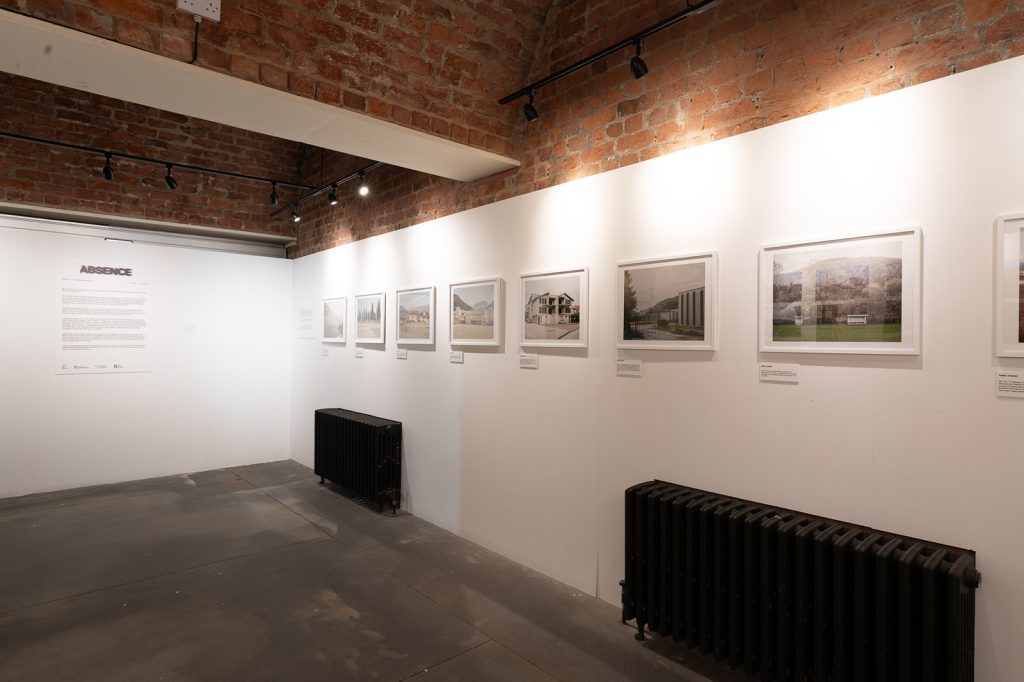
Starzec’s photographs present innocuous landscapes, public buildings and infrastructure. Empty of people, the scenes are highly crafted and shaped by a timeless pastel aesthetic that shifts from seductive to increasingly unsettling. The stillness in the photographs generates an eerie feeling in the viewer. A feeling that starts to make sense as we read the brief texts that accompany each photograph. These are redacted quotations from court documents, and they speak plainly of ethnic cleansing, detention, mass graves – atrocities of the Bosnian War. Starzec’s focus on the role of public buildings and infrastructure as makeshift places of terror is particularly striking and highlights how ubiquitous such transformations and returns are in war zones.
Massalha’s photographs of herding village life in Palestine’s Occupied West Bank region also address absence, along with systematic erasure. Her work is located on the wall opposite Starzec’s. Unframed and immediate, the images cluster together, a crowd of vivid prints, mostly portraits, clamouring for attention. The photographs offer frank portraits of a Palestinian herding community asserting their presence in the face of ongoing settler and state violence. The accompanying text offers fragments of testimony focussed on violence, restrictions to water supplies and grazing land. Massalha frames this as a process of ‘absenting’ – removing the viability of life from a people and their lands.
On the far wall, Kazemi offers combinations of image/text printed on paper and pinned lightly in place. The work feels ephemeral, delicate, her subjects self-effacing. A photojournalist operating in remote areas that can be highly conservative and patriarchal, she’s often the only woman photographer on the ground. Kazemi recalls being sought out by other women and girls wanting to be photographed. They didn’t ask for copies of the photographs. They simply wanted to be acknowledged in some way as being present. Kazemi’s observation alerts us to the absence of women and girls from spaces and places of decision making and authority.
Two further rooms contain carefully curated pairings. The first features Kyler Zeleny’s ‘Found Polaroids’ project (2011-ongoing) and David Schalliol’s documentation project ‘Isolated Building Studies’, (2006-ongoing). The second, Terence Heng’s photographs from his documentation of Bukit Brown, a Chinese diaspora cemetery in Singapore (2012-2014), and Gesche Würfel’s research project, ‘The Absence and Presence of the Berlin Wall’ (published 2025). These combinations suggest different explorations of absence as an agent or active presence.
Zeleny holds a collection of 6000 Polaroids and Schalliol has photographed over 700 isolated buildings. The commonality here is context and its erasure or absence. Historically, family photographs were singular objects. No negatives, network or metadata, context was social; familial relations that disappeared over time. It’s a process captured in Annie Ernaux’s memoir The Years (2018), where she recalls family passing old photographs around, their surfaces smudged, obscured by handling. A sense of connection stemming more from ritual than recognition. For Zeleny, letting go of context and inviting new connections was a way to reinvigorate the Found Polaroids. He invited writers of flash fiction to connect with and respond to individual photographs, and the absence of context becomes a creative spur rather than personal details lost beyond recovery.
Schalliol’s portraits of isolated buildings are part of an ongoing project that’s rooted in a social research practice. This collection of photographs, newly published in conjunction with the exhibition, are a way to document neo-liberal economic transformation of neighbourhoods in Chicago. Schalliol’s lonely buildings, photographed with the care of a portrait maker, seem part sentinel and part indicator species, a visual signal of urban processes such as the hollowing out of racialised and working-class neighbourhoods, and the escalation of gentrification.
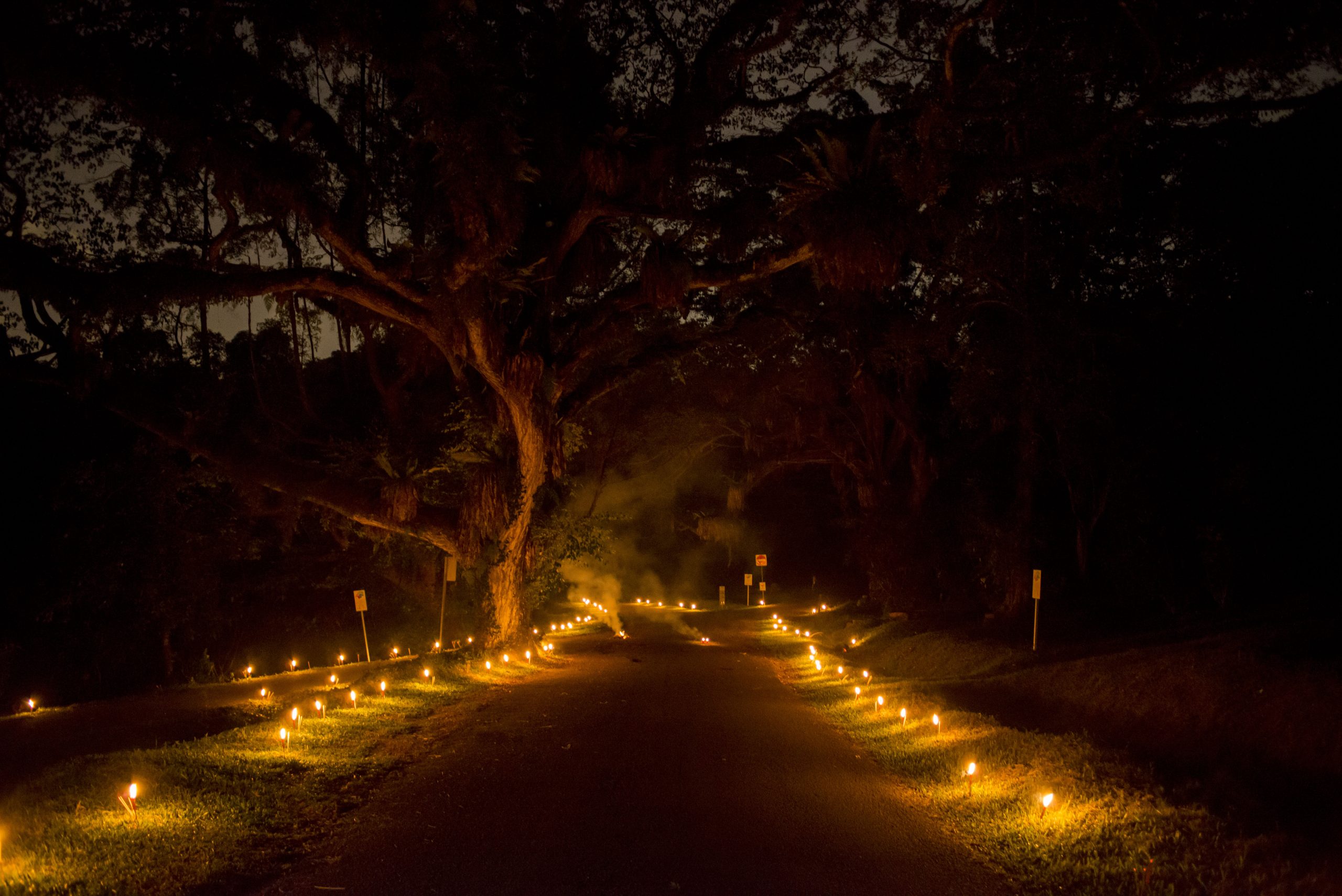
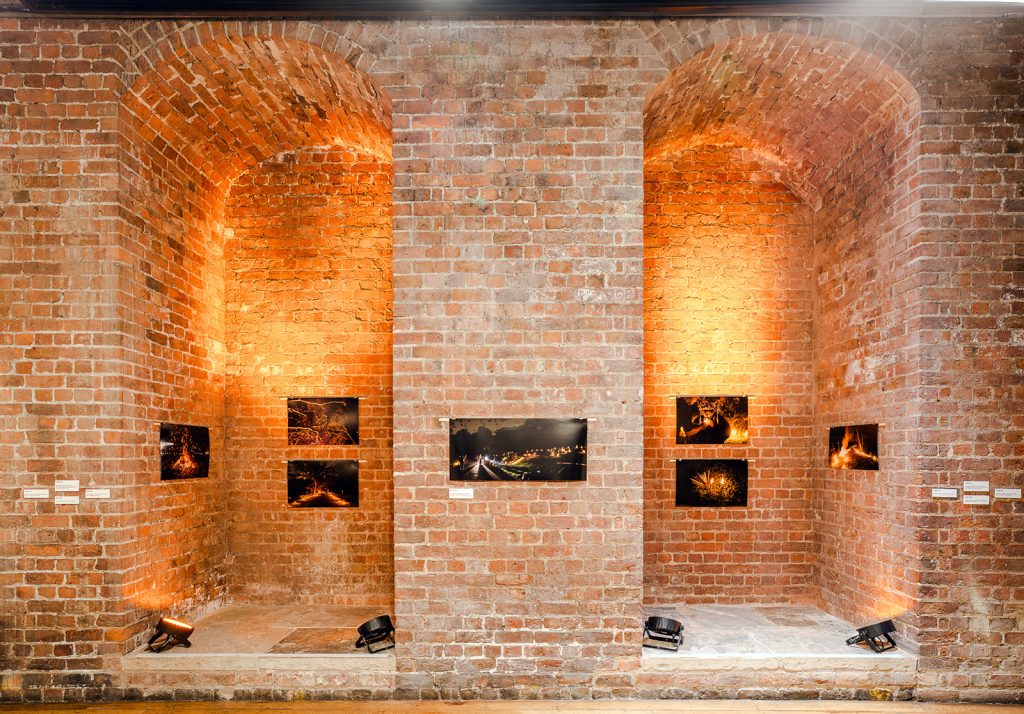
Heng and Würfel’s works are situated in a darker side-room, their photographs suspended in brick alcoves. Here, the works explore and enact rituals, ceremonies and pilgrimage. Heng spent years documenting Bukit Brown Cemetery during a period when thousands of graves were being exhumed to make way for an eight-lane highway. Bukit Brown presented opportunities to engage and record emergent deathscapes. Heng’s research centres around recording the rituals enacted by people during the Hungry Ghost Festival. Here, embodiment and performance become a way of giving presence to those who are absent. Heng’s photographs feel experimental. They’re often dark, nighttime shots of scenes lit by sparks and candles. It’s worth spending time with these photographs; they feel like attempts to record the ephemeral. A moment when presence is conjured through ritual and participation.
Würfel’s Berlin Wall project in some ways returns us to themes present in Starzec’s work on war, memory and infrastructure. In researching the absence of the Berlin Wall, a physical line of separation between East and West, Würfel drew on archive documents and conducted interviews to explore the history of the wall, which ‘fell’ in 1989. She cycled the length of the wall, stopping to document the site every 2.8 kilometres, a nod to the twenty-eight years the wall stood. The resulting composite photographs feel energised by slips and shifts. The layering process suggests multiplicity, a complex present and competing perspectives on unification.
Selected work from the Open Call across the Liverpool City Region is displayed in a corridor linking the exhibition rooms. Spot lit on the wall are photographs by Daniel Frost, Alishah Iqbal, Paradise Made, Dan Murphy and Claire Weetman (all selected by the curators). Close by, a further selection of digital images run in a sequence on a large screen. The Open Call asked for images of what has been lost, displaced or erased from the built and natural environments of the region, and what visible traces have been left behind and generated hundreds of submitted responses. Standing before the screen, watching the carousel of images felt like a kind of remote psychogeography. It was interesting to see so many Liverpool based photographers given a presence in the gallery.
An exhibition of photography that explores absence/presence touches on debates as old as the medium, its relation to the moment and passing time. The curatorial focus on social relations, materiality and absence offers a thoughtful way to approach the work of individual artists. It’s a framework that prompts connections between very different bodies of work. I was particularly struck by the idea of absenting, the occlusion of histories, genders, populations. Other aspects of the exhibition raised questions about the tentative, slippery nature of presence as layered, refracted; something that emerges in social/material practices and rituals.
Absence, Stable Gallery, St Georges Hall, Liverpool, Monday to Saturday, 9.30am to 5pm, 6th June – 11 July.
A special issue of TILT covering Absence is available from Open Eye Gallery (£5).
Kelly Loughlin is a curator based in West Yorkshire. With a background in adult education, she has worked with learners in the Open University and the prison system. Sight impaired since childhood, Kelly is a founder and director of a contemporary art space, 9a Project Space CIC, Todmorden.
This review is supported by Liverpool John Moores University.
Absence was produced in partnership with Open Eye Gallery.
Published 29.06.2026 by Natalie Hughes in Reviews
1,446 words