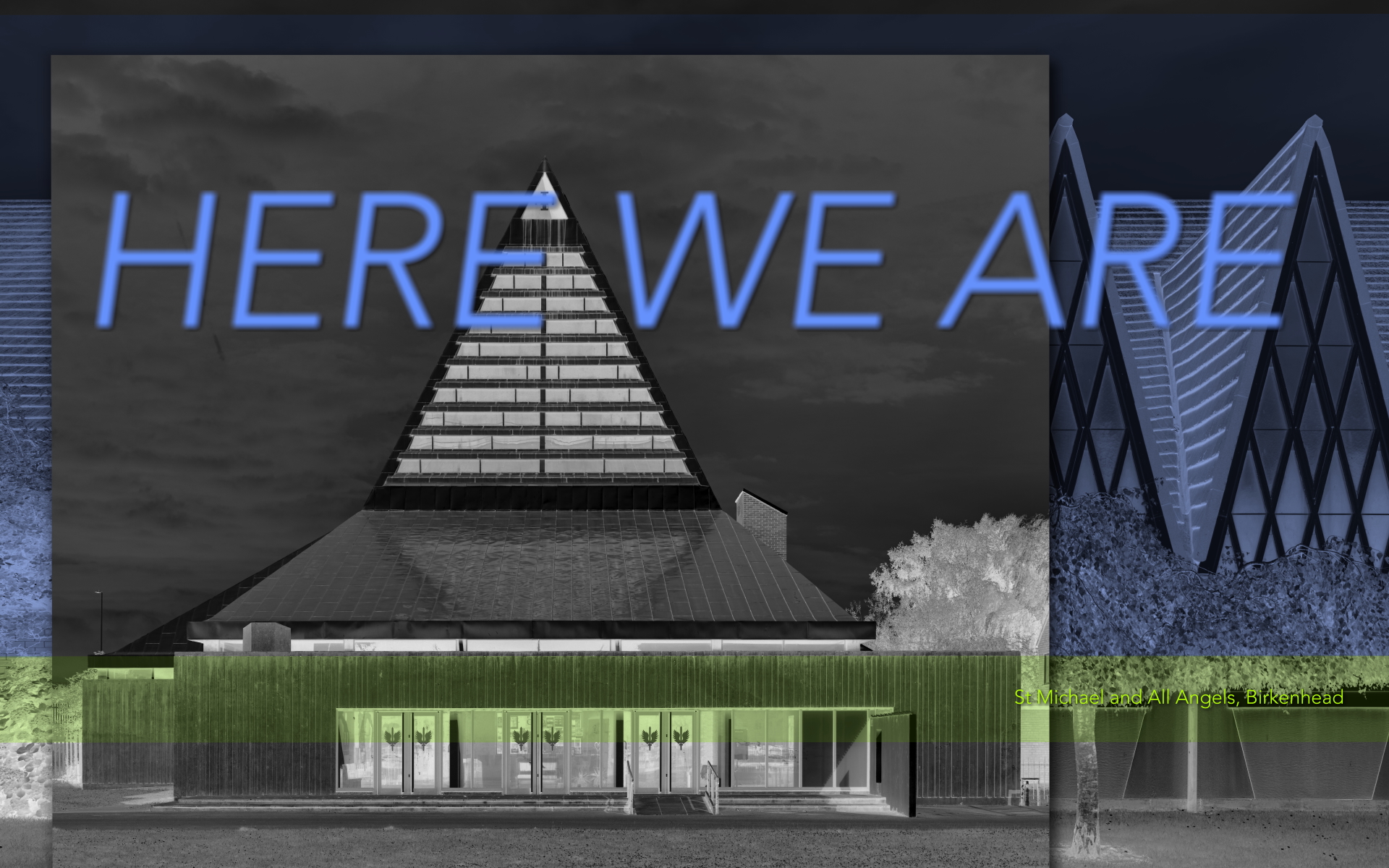
Elizabeth Price’s presentation at the 2025 Liverpool Biennial is ‘HERE WE ARE’, a new single-channel video which centres on striking architectural examples of modernist Catholic churches in post-war Britain. Combining black and white imagery with dialogic text and an original score, the work explores how these radical built environments reflect migratory patterns from across Europe, the social and labour conditions of mid-twentieth century Britain, and their resonances today.
Price’s work elaborates obfuscated social stories. She refamiliarises cultural artefacts, utilising digital animation and archival images, to make seemingly unlikely connections that are outlined by unnamed, yet implicated, narrators. The films unfurl with quiet revelation and surprise, presenting alternatives to how we read and receive histories.
‘HERE WE ARE’ is installed in the dark basement of the Black-E Community Centre, originally the Great George Street Congregational Chapel – an apt setting for Price’s exploration of religious buildings as dynamic social spaces. Its location at the top of Nelson Street, Liverpool’s Chinatown, further links to the work’s themes of historical migration, as well as the local focus of the 2025 Biennial by curator Marie-Anne McQuay.
The film’s story, however, begins in Amlwch, Anglesey. We see the shimmering, digitally-rendered apse of Our Lady Star of the Sea and St Winefride, a Futurist church built in reinforced concrete with a distinctive curved roof and star-shaped windows. Five anonymous speakers guide the story: we don’t hear their voices, only read their furtive texting, which appears in popping, colour-coded textboxes of red, green, blue and purple. As the animation scans the European continent, these narrators describe the migration of labourers from Northern Italy to the Rhondda Valley in the early twentieth century, seeking work in the mining or shipping industries, before settling in regions across the Welsh coast, including in Anglesey.
Star of the Sea was built, the narrators tell us, as the parish for the island’s growing community of Catholic migrants, designed by Italian-born engineer Giuseppe Rinvolucri and consecrated in 1937. Over an animation of the church’s components falling into place – the base of the structure dotted with portholes, the ‘ribs’ of the arches, those star-shaped windows – the narrators compare notes from archival newspaper reports and architectural scholarship, arguing over their interpretations of this unusual structure and what it signifies. Recounting the prevailing interpretation of its design – that the Star of the Sea resembles a capsized boat – enacts a beautiful sequence in which the upturned church sways in the dark blankness, the music shifting to a dreamy, doo-wop progression.
The unresolved feel of the narrators’ exchange is characteristic of Price’s polyvocal exposition. The narratives she constructs have the feel of research unfolding, of connection points being carefully mapped. In an interview with Katrina Palmer, Price states:
Whenever I propose a recourse to the imagination in relation to a historical artefact in my work, I am not just making stuff up. I am not saying history doesn’t matter or that making stuff up shouldn’t be distinguished from history – I’m applying imagination to the inconsistencies and unfulfilled possibilities of the artefact. I’m saying that the past’s present conditions are available for radical invention.
Whether the stories align with historical facts or are flecked with fiction, the narratives are never voiced as didactic explication, but are inclusive; they invite the viewer into their questioning.
Price’s early videos took cues from pedagogical presentations, with simple graphics and transition effects. Her most well-known work, ‘THE WOOLWORTHS CHOIR OF 1979’ (2012), which won the Turner Prize, is instructive as a model of her historiography. A film in three parts, ‘WOOLSWORTHS’ begins with an illustrated lecture on the nomenclature and architecture of churches, highlighting violent imagery carved into the church ‘choir’. The film then establishes a motif of a twisting wrist gesture observed in sepulchral effigies, tracing this through the dance moves of The Shangri-Las performing their 1965 hit ‘Out in the Streets’, and finally finding the gesture again in footage of a deadly department store blaze at Woolworths Manchester in 1979. In that final part, workers’ hands are seen throwing items through the window rails.
The conjunction of ideas in ‘WOOLWORTHS’ builds on the artist’s personal recollection – she recalls being affected by televised reports of the Woolworths fire – and imaginative connections to architectural facets and cultural references. But the power of the work comes from the critical way the materials are assembled and the language used in the telling. Its narrative is made up of bold declarative sentences that bring the story and the viewer into the here-and-now. ‘Here’, ‘this’, and the plural pronoun ‘we’ are markers found throughout Price’s texts – deictic words whose semantic meaning is dependent on context. These markers require a specific referent to make sense, and for the viewer to make the connection, but allow for joining different spaces and different times. Price’s narrators gesture to specific historical circumstances while insistently evoking effects of the present.
This grammatical ambiguity is in the title ‘HERE WE ARE’, a refrain in the on-screen text that invites a connection between the projected world of the film and the surrounding installation in the Black-E basement (and, as well as sharing analysis of church architecture – positing what is ‘revealed in the Gothic turns’ – ‘HERE THEY ARE’ is already a phrase found in the ‘WOOLWORTHS’ film). The narrators speak in the present tense, use incantatory repetition: ‘We don’t know’ | ‘no, we don’t know but we can speculate’ | ‘Yes, we can speculate’. Their text boxes are presented as a live conversation, with interface sound effects warped into dramatic percussion as the messages arrive; key-tapping becomes a spectral hammering and chiselling as the Star of the Sea church is built. Price’s framing of her stories through the vernacular mode of messaging interfaces, often underscoring themes of administrative labour and technology, positions viewers as fellow users – as participating agents in the uncovery of forgotten histories.
The second half of ‘HERE WE ARE’ shifts the narrative from the Star of the Sea case study to a broader regional and historical context. We move between black and white photographs of modernist Catholic spaces across Britain, taken from the RIBA (Royal Institute of British Architects) archive as well as new architectural photographs by Andrew Lee. The proliferation of modernism (including brutalism and futurism) in church design, more often associated with social housing and civic structures, was initiated by Pope John XXIII to align the church with some aspects of modernity following the Second Vatican Council of 1962. This resulted in ambitious ecclesiastical architectural projects across the world, but in the British context, the narrators suggest, this is entangled with the expanding Catholic diaspora largely from Ireland, and the new migrant population’s involvement in the post-war reconstruction of British cities.
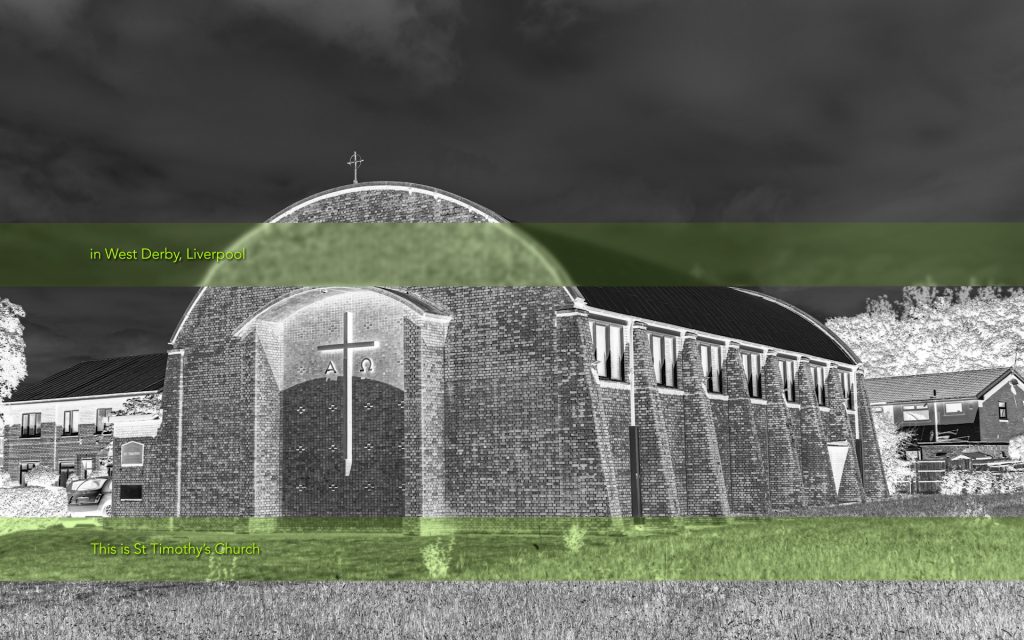
‘Other patterns exist here’, a narrator types; they consider how these buildings manifest the experience of these communities and their parishes, noting connections with secular buildings, as well as new social conventions. We see pre-fabricated units of corresponding churches – St Andrews in Sandwich and Saint Finbarr’s, Aylesham. We see Our Lady Help of Christians in Kitts Green, with swooping shafts and battlement windows; we see understated examples (St Cuthbert in Wigan, St Barnabas in Hawkhurst) and imposing pyramids (St Josephs in Bracknall, Holy Name in Folkstone). There is an emphasis on churches in the North West but we also see examples from east London (the Church of St Mary and St Joseph, Poplar) and north Nottingham (the interior of the Church of the Good Shepherd, Woodthorpe). These are presented in striking negatives, sharpening the textural aspects of the buildings and their materials. Close-ups linger on tactile mosaics, concrete patternings, modernist decorative flourishes. The monochrome photography – still scenes without people – is punctuated by the colour textboxes, roving over the images like flicker bands on VHS transfers, accompanied by a brooding, diatonic bassline.
In the final sequence, photographs of the church interiors morph from detached negative, to positive, to colour-treated; captured from the aisles, the bricks and stained glass patterns become vivid, hyperreal. The perspective of these interior shots from among rows of empty seats returns the viewer to their own seated position within the Black-E installation and again invites reflection on urban spaces and community. ‘HERE WE ARE’ defers the question of institutional power; the closest the film comes to a discussion of the politics of the place of the church is when a narrator suggests the Star of the Sea might resemble a boat turned over on land for shelter, and the narrators concur that churches acknowledge both refuge and peril. Instead, its open-ended structure invites viewers to navigate their own interpretations.
This critical indeterminacy allows Price to never exhaust the material she draws on; rather, the work extends and enlivens the artefacts, images, songs, and sounds it deploys in the drama of the research. The narratives question how stories are told without explaining them away. There is joy here, in the revelatory affect – uncovering sites of active enquiry.
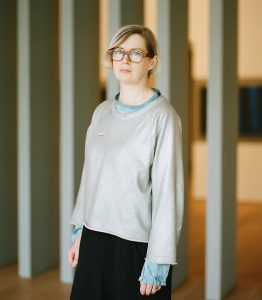
Rory Cook is a writer and editor from Nottingham.
HERE WE ARE was programmed as part of the Liverpool Biennial and is on at the Black-E from 7 June- 14 September 2025.
This review was supported by Liverpool Biennial.
Published 04.09.2025 by Natalie Hughes in Reviews
1,560 words