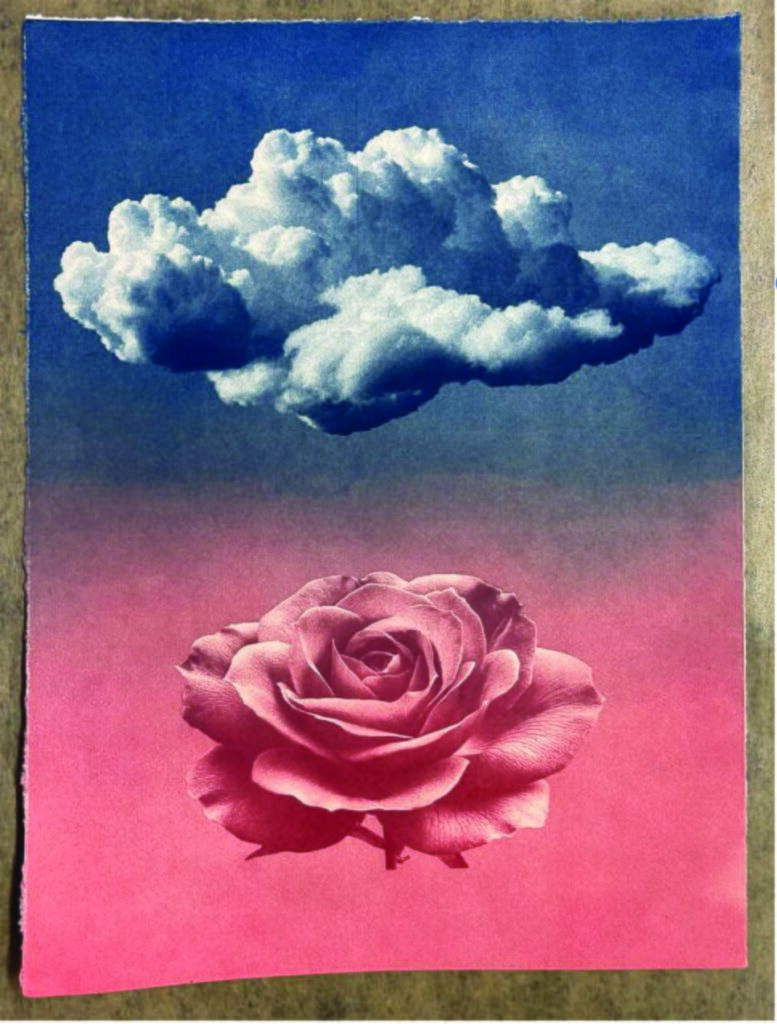
As I sit down to chat with artist Sana Obaid over a cup of coffee, she shares her sketchbook with me. A loose print falls out, floating for a moment. A vivid pink and blue image of a delicate rose with a cloud suspended above it hits the floor. It’s a dreamy image, the striking colours managing somehow to bleed seamlessly into one another. This work is a polymer gravure print, a method for transferring images onto a light sensitive metal plate without the need for chemical etching. It is a technique new to Obaid, something she has been experimenting with when we meet at the halfway point through her two-week Women in Print residency at ArtLab Contemporary Print Studios (ACPS) at University of Central Lancaster (UCLan).
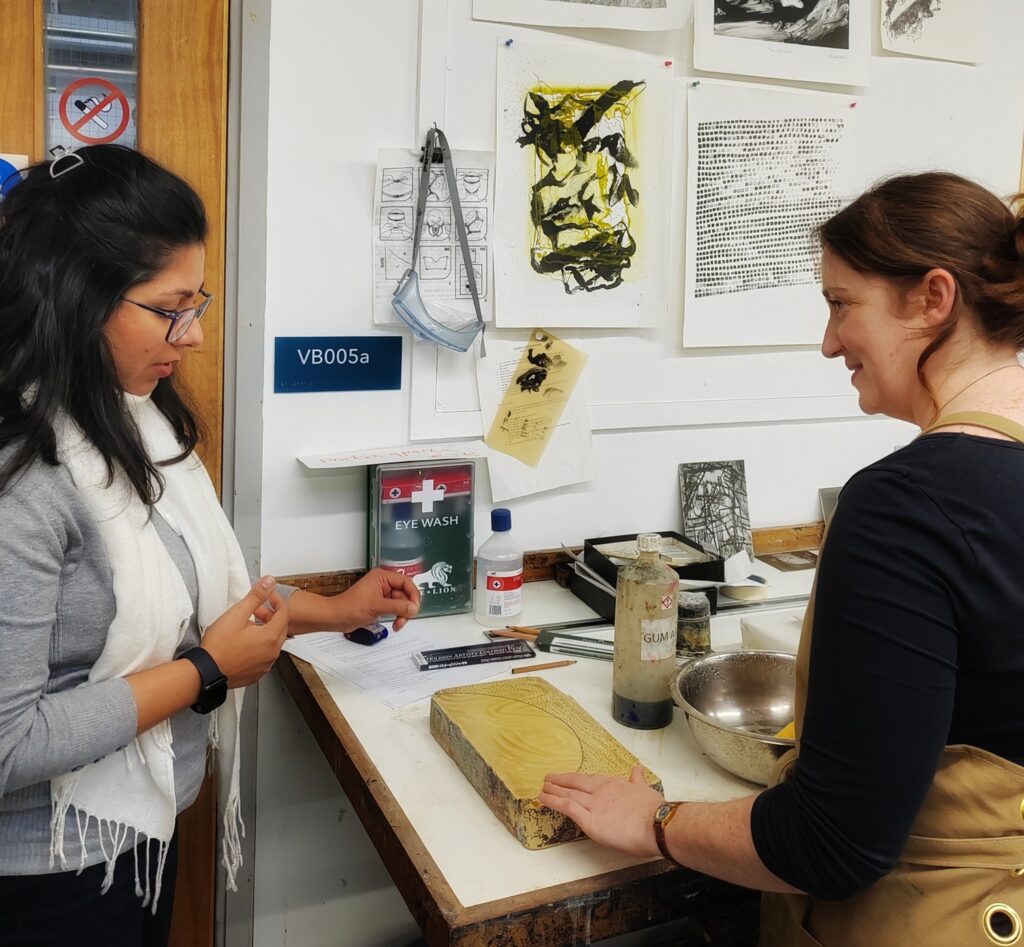
Obaid’s time at ACPS is part of their ‘Women in Print’ series; a research and residency programme that invites female artists to spend time creating new work, with full access to UCLan’s printmaking resources and facilities. Artists do not have to have a background in printmaking, and are instead encouraged to use the residency to explore how their existing artistic practice may translate and transform through experimentation with printmaking techniques. ACPS is also a research facility, led by Tracy Hill and Magda Stawarska with a team of technicians on site, dedicated to exploring, developing and promoting printmaking as a contemporary fine art practice.
Obaid studied at Lahore’s National College of Arts, graduating from traditional miniature painting in 2007. This form of making is extremely detailed. Beyond painting, Obaid’s practice is wide-ranging; she has produced works over the last fifteen years using a multitude of materials and techniques across sculpture, performance and sound. Despite the variation in forms, media and subject matter, there is a particular thread that runs through the making of all her work – something inescapable and largely ineffable. ‘It’s always the same thing, but through a different lens,’ she tells me; it’s about finding the extraordinary within the mundanity of the everyday. It is a powerful feeling of interconnectedness with the world, an inherently spiritual connection, that compels Obaid to create. This feeling is the driving force behind everything she makes.
It is through creating art that Obaid first became aware of her spirituality. Miniature painting is an extremely meticulous and repetitive practice, one that she explains requires ‘a complete single-minded focus’. You must invest your absolute attention in where each mark is laid, whilst never losing sight of what the overall image is being transformed into. Obaid’s description equates it to a meditative and intimate experience, one that has led her to enter ‘a dialogue within myself’, and at times tap into something transcendental.
Many artists have spoken about achieving a similar feeling when making work; a kind of ‘flow state’ that, when accessed, suspends time and allows for focus to sit solely with the act of creation. For Obaid, this experience is akin to channeling or connecting to God (or Allah or The Source, she uses all three interchangeably throughout our afternoon together). It was when she discovered this spiritual connection that her practice shifted, became more embodied and physically arduous, creating many durational pieces. She began making work that was more explicitly influenced by her spirituality, became inspired by sacred geometry, William Blake, and began using her body as a medium. She shares a video of one work titled ‘Building a Wall’(2013), which documents the four and half hours she spent laying bricks in order to build an enclosed space around herself, time spent creating ‘without a break, without water, because you don’t feel that you need it’. This mundane and physically demanding task transforms the act of making something into something, into a kind of meditation in which Obaid becomes connected to God.
I pick up the fallen print and we turn a page in her sketchbook. Scrawled lightly in pencil on a piece of tracing paper are the words:
Flower is a cloud
Man is a tree
I am, You
And
You
ME
This simple poetic scribbling encapsulates the core of Obaid’s practice: that everything that exists is equal to and dependent on one another. A complete sense of oneness.
Obaid’s spirituality has also been deeply informed by her family heritage. She tells me how her Indian great-grandfather descended from a lineage of Sufi Saints, how people would visit his mausoleum in order to pray or make wishes. Sufism is a mystic dimension of Islam, one concerned with an individual’s direct experiences of God. An importance is placed on each personal journey to connect with divine truth. It is introspective, rebutting the emphasis that much of contemporary life places on materiality.
This approach to making feels very personal and self-contained to me initially, but Obaid’s practice is not purely inward-facing. She tells me about how external factors can affect her, particularly since becoming a mother, and how these feelings are often a place she feels compelled to create from. Since October 2023, Sana has produced a significant body of work in response to the genocide in Gaza. Some of this work was presented recently at her Glasgow School of Art MFA degree show, where etching prints featured prominently. She shares with me a powerful series of print works all made in 2024 depicting children’s clothes; in ‘Rubble I’ the shape of a tiny jumper erupts from a mound of black clay, whilst ‘Scent of the Lost One II’ displays dainty etchings of little leggings. In both of these works, the garments are spread flat, their presence distinctly marked by the lack of person that should fill them. There are multiple etchings depicting the same delicate gown (‘Scent of the Lost One I’ and ‘Stars’). These prints are large, life-sized if not bigger, and hung away from the walls so that they levitate in mid-air. The dress billows in a wind that does not exist, supported by a body that is nowhere to be found. Ghosts haunting the room. Obaid experimented with the same subject multiple times, in blacks and whites, and, most strikingly of all, a deep blood red.
There is a physical intensity to making prints of this size. The process of intaglio printing is time consuming, with many repetitive steps needed to produce impactful results. Clean the plate / apply the ground / engrave the marks / expose to acid / clean the plate / apply the ink / rub / rub / rub / wipe away. Then perhaps it’s ready for printing, and if not it might require a repeat of any number of these steps. It can be an exhausting process. It centres slowness. Requires sustained concentration, not unlike the making of thousands of marks necessary to complete a miniature painting. Once ready to print, the inked plate is rolled through the press and then an image emerges from the mess, a hidden secret revealing itself. Only one print can be produced at a time and in order to get any more from the same plate, you would have to clean and re-ink it. The tones and textures vary greatly with each attempt, which can mean multiple attempts are often necessary to achieve the desired result. Labour is part and parcel, along with love, of the process. This is something Obaid is certainly familiar with, as so much of her practice not only features patience and repetition, but demands it. The transcendental experiences arise from this kind of meditative engagement.
This residency is timely for Obaid. After finishing her MFA last year, it provides a welcome contrast to academic life where she felt there was often pressure for students to explain their work, to situate it explicitly within political and social contexts. She has also recently returned from a stay at Zulma Reyo School of Consciousness in Mallorca, and says the residency ‘offers a space to understand my growth… an opportunity to reconnect with my creative self’. The programme at ACPS is designed as a chance to produce work free from any external expectations, and to let artists see what they might produce from a place of pure experimentation and playfulness. Obaid tells me how when she first arrived in Preston, ACPS’s Tracy Hill asked if she had a particular project or ideas in mind. ‘I told her no!’ she laughs gently, ‘I came here to explore. I trust my intuition and see what comes. Then the ideas come’. We discuss what a pleasure it is to be granted the time, space and resources to simply make. It’s a luxury that most artists don’t have access to, and a reminder of why residencies are so vital. Even one as brief as this can have a meaningful impact on an artist’s work.
The print studio is a large, light space, and a wonderful place to be a fly on the wall. You will see other artists working away or take a peek at their drying racks packed with their latest investigations. The industrial print presses are immense anchors in the middle of the room. Obaid directs me through to the area she’s been working in, where gorgeous glossy monoprints lay in wait. Thick globs of ink next to smooth and sensual lines. Deep burgundy blends away into midnight blue and black and then back again. These are the pieces she had been experimenting with during the previous week, before returning to Glasgow briefly where she is currently based. These prints are an array of colourful screen-printed shapes and configurations with trails of marbled monoprint falling from and through them. I can see the progression in these works, how she began with a chaos of colours and has reworked them, distilled and refined them, until what is left feels essential. Of these, I find the most impactful to be ‘Circle on a Ride’ (2025)which, again, took multiple attempts to achieve (‘I spent ages trying to get a perfect circle!’). It depicts a black circle in the centre of the page, with a snake-like monoprinted band underneath, cycling through black, deep purple and ochre yellow as it eventually fades into obscurity. The circle is severe, like a looming black hole, suggesting something cosmic and unknown.
Obaid has also experimented with lithography, a centuries old technique that involves drawing directly onto limestone to print, and one that she had never tried until this residency. The outcomes are elegant and almost ephemeral, with marks so delicately laid on the thin Japanese paper that they look more like pastel pencil dots. I am amazed by the amount of care and patience that goes into each piece, and by the variety of textures and finishes that each form of printing can produce. Obaid emphasises the generous support she has been given and the wealth of information shared by the staff at UCLan whilst she’s been here. The passing of knowledge and shared love for the art of printmaking is central to the studio’s ethos.
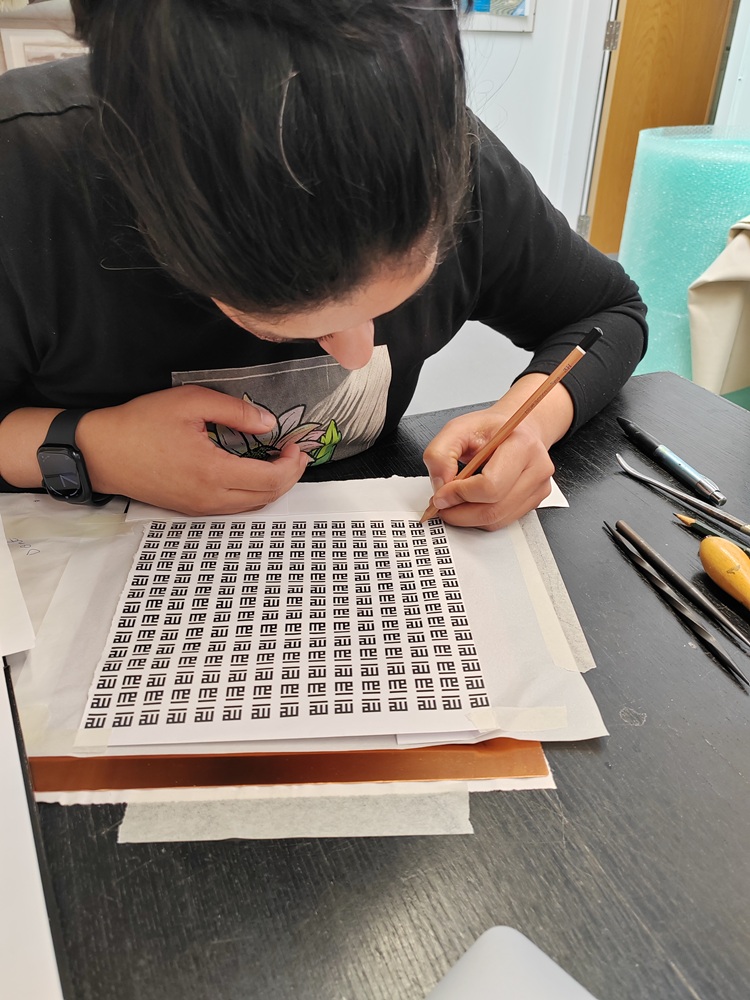
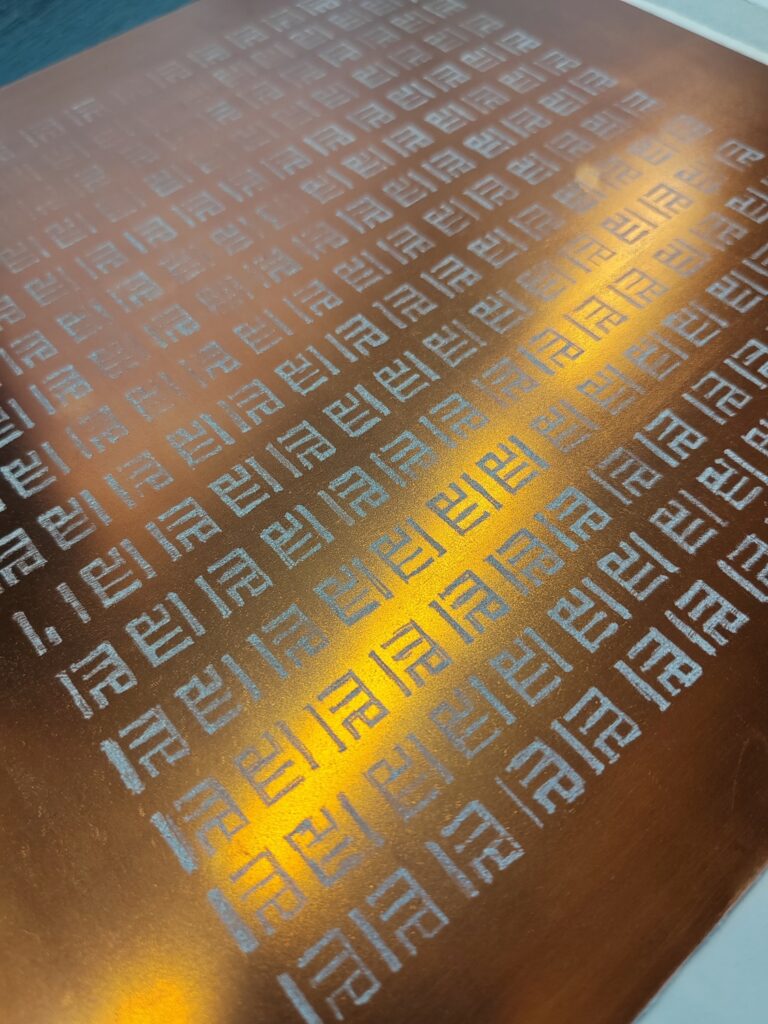
As we part ways, Obaid sits down with another cup of coffee and begins etching a new plate. This time she is working with the Arabic word الله meaning Allah, which she points out looks like the English word ‘me’ when flipped. Beginning from an outer edge, she will work her way in, repeating the word over and over and over again in a sacred spiral. I think about something she told me earlier, about the Sufi belief that we should always be looking inward for divine connection. Producing art, through whatever form, is a deeply personal pursuit. Yet what strikes me most about Obaid’s practice is that it isn’t only a means of connecting with herself, but to others, the world, and possibly even something larger than all that.
This exploration was informed by conversations with Sana Obaid, the eighth in a series of written responses to the Women in Print artist residencies at Artlab Contemporary Printmaking Studio, UCLan, Preston. www.artlabcontemporaryprint.org.uk
Nina Newbold is a creative producer from Liverpool.
This exploration is supported by UCLan.
Published 22.03.2025 by Jazmine Linklater in Explorations
2,052 words