‘If I Wasn’t an Artist I’d Be a Terrorist!’ (2025) –the title of a newly commissioned sculptural installation at the heart of Hardeep Pandhal’s exhibition Saag and Fish Fingers at Midlands Art Centre (MAC)– offers a clue as to how we might best read his work. A pair of freestanding wooden cut-outs (a recurring format in Pandhal’s practice) depict a trio of cartoonish characters loosely painted in a naive style; complete with oversized feet and eye-popping faces. These figures are frozen in a fantastical scenario littered with floating brick castles, fluffy clouds and some famous ‘Golden Arches’ hovering mid-air. And yet, this ‘fantasy’ actually refers to a very real and politically charged incident involving far-right agitator Tommy Robinson; reimagining the moment he had a milkshake hurled at him by a member of the public in 2019. In retelling this story, Pandhal doesn’t just satirise a political event in his own lampooning way, but, with a particularly British sense of humour, provokes us to ask ourselves a more uncomfortable question: which political wrongs (or rights) are we willing to tolerate, or even vicariously enjoy?
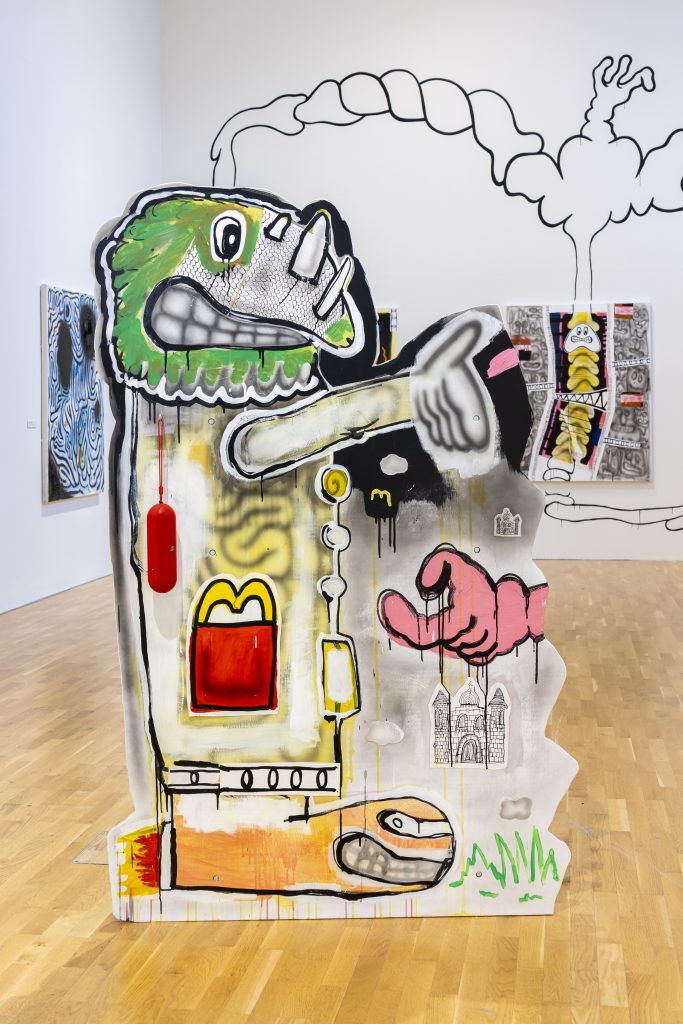
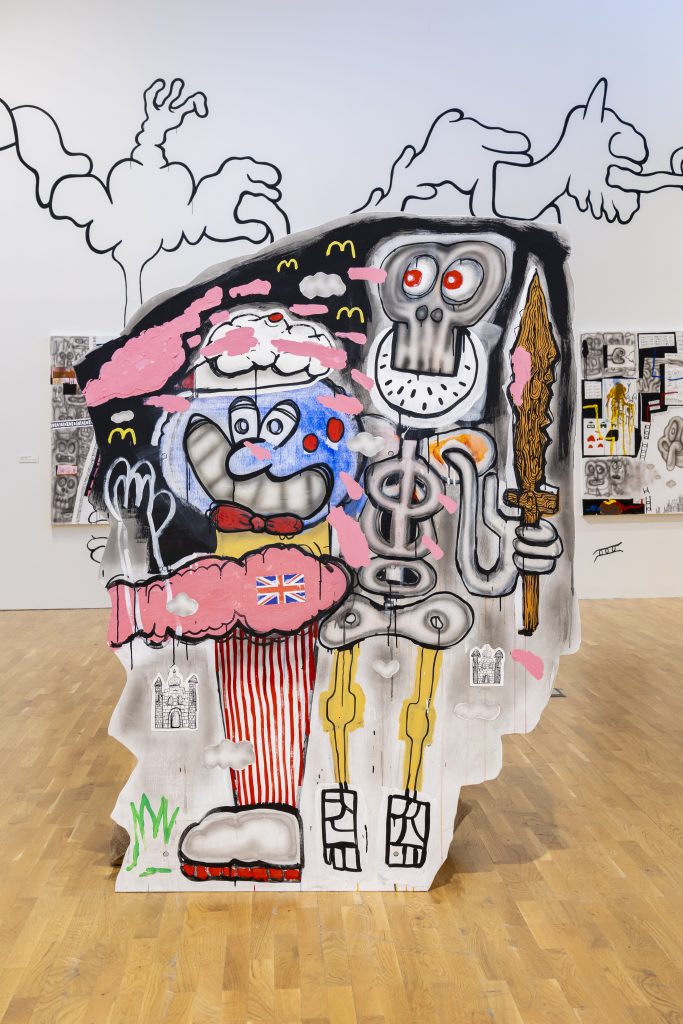
It’s an interesting premise on which to centre an exhibition. Questions of identity, nationalism and power are at play across the fifty-plus works on display, and the resulting narratives are politically complex and striking. We encounter disembodied, fanged faces ingesting totemic columns of torsos; comedic knights in shining armour and skeletal security guards, alongside withered crucifixes and soft-edged representations of the Union Jack encased within writhing, intestinal tracts. Pandhal’s ‘terrorism’ and the questions it provokes are palpable, though the real battle it seems is a deeply personal one.
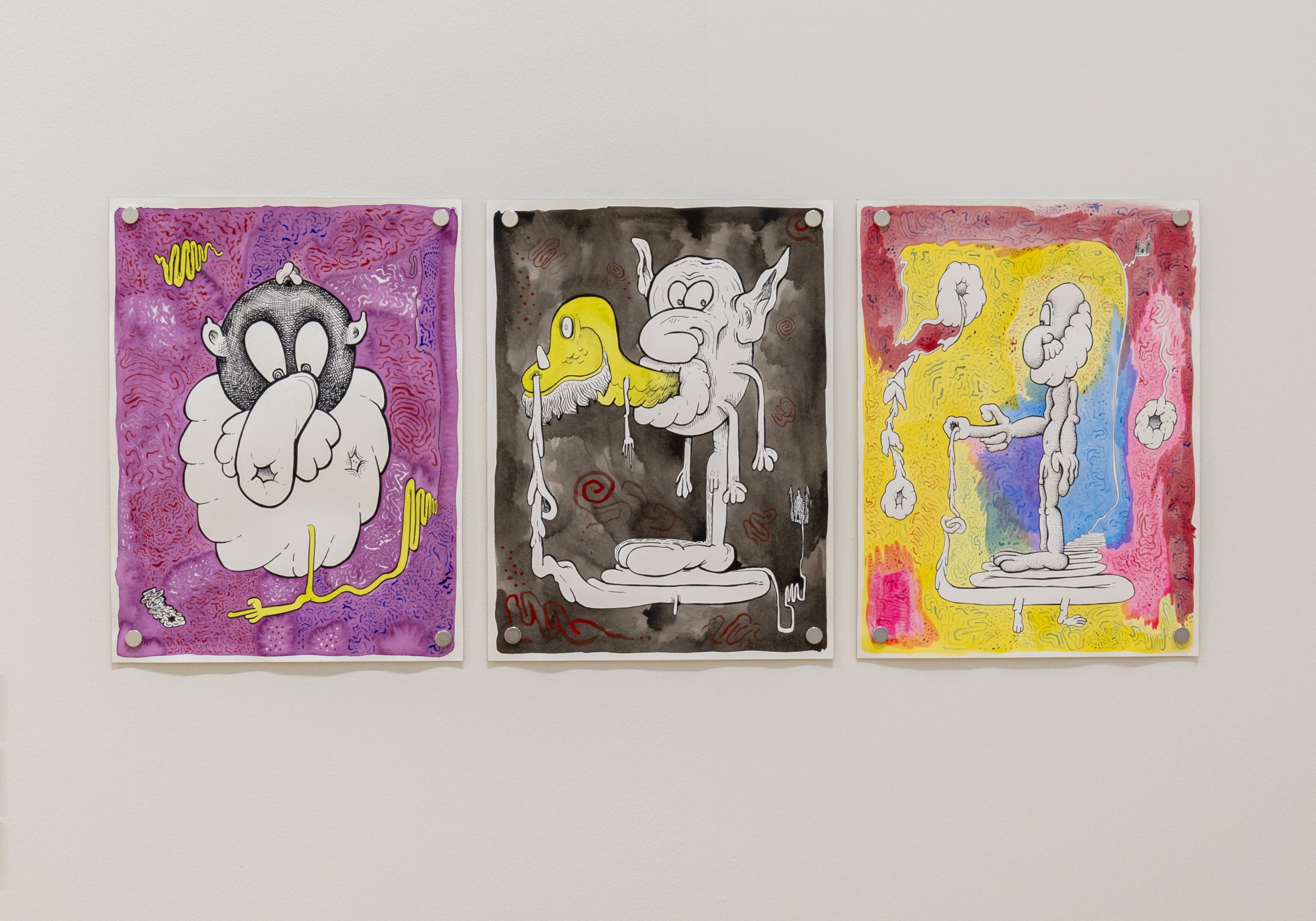
‘Sepoy Man’ –a heroic alter ego that regularly recurs in the artist’s paintings, drawings and animations– is influenced by the Indian colonial soldiers, commonly known as sepoys, who served under British orders from the 18th to the mid-20th centuries. In one drawing, ‘Dragon Mouth: Adventures of Sepoy Man series’ (2025), a character vomits up a green dragon-like creature whilst standing atop a platform generated by the beast’s own snot. It’s a complex and symbiotic relationship, one that stands clearly as a metaphor for British Asian experiences. These sepoy-like effigies take many forms, shapeshifting as needed, illustrating the contradictions of everyday immigrant life as they contort themselves to fit the dominant narrative. Other alter-egos of sorts – the ‘Gutter People’ populate the margins of Pandhal’s work. Born from years of graphic drawing, and referring to the gap between comic-book panels known in the world of publishing as the ‘gutter’, Pandhal’s peripheral characters inhabit the negative spaces within his narrative, haunting the gallery at MAC. Depicted with floppy limbs and often stuck inside a never-ending network of pipe-like forms, they represent those who are marginalised and caught within systems of class power; people who are frequently silenced.
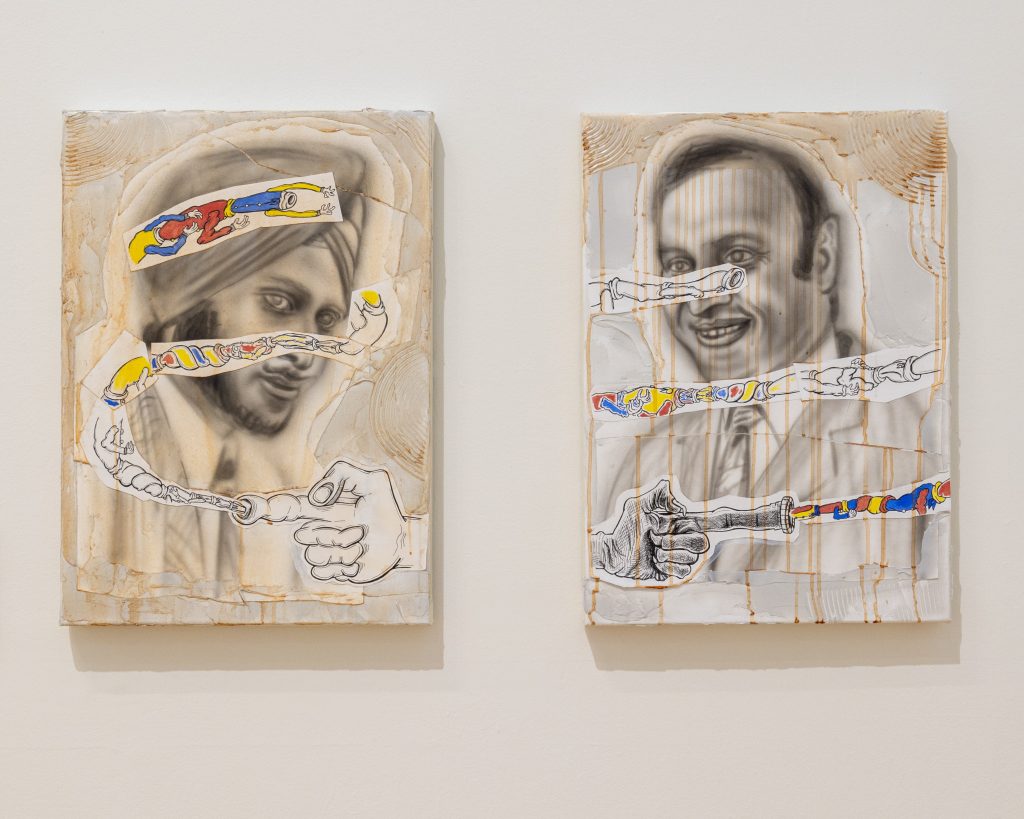
In the diptych of paintings: ‘A Familial Romance’ (2023), swarms of these ghostly ‘Gutter People’ intertwine around airbrushed images of the artist’s father at younger and older stages in his life. Directly collaged on top, these cut-and-pasted paper figures sit at odds with the more ethereal parental renderings underneath, jarring further with quivering semi-circular lines scraped into the work’s top-layer glaze. I’m reminded of Artex, that decorative coating etched into the psyche of anyone who, like me, grew up in a working-class home. We didn’t have much, but we had highly textured ceilings! Swirling together many of Pandhal’s major concerns, these paintings open a wormhole between the past and the present. Politics remain, but the focus here is something more intimate: the fantasy of adulthood in the mind of a child, the legacies we inherit from our parents, and the ways these things shape who we become.
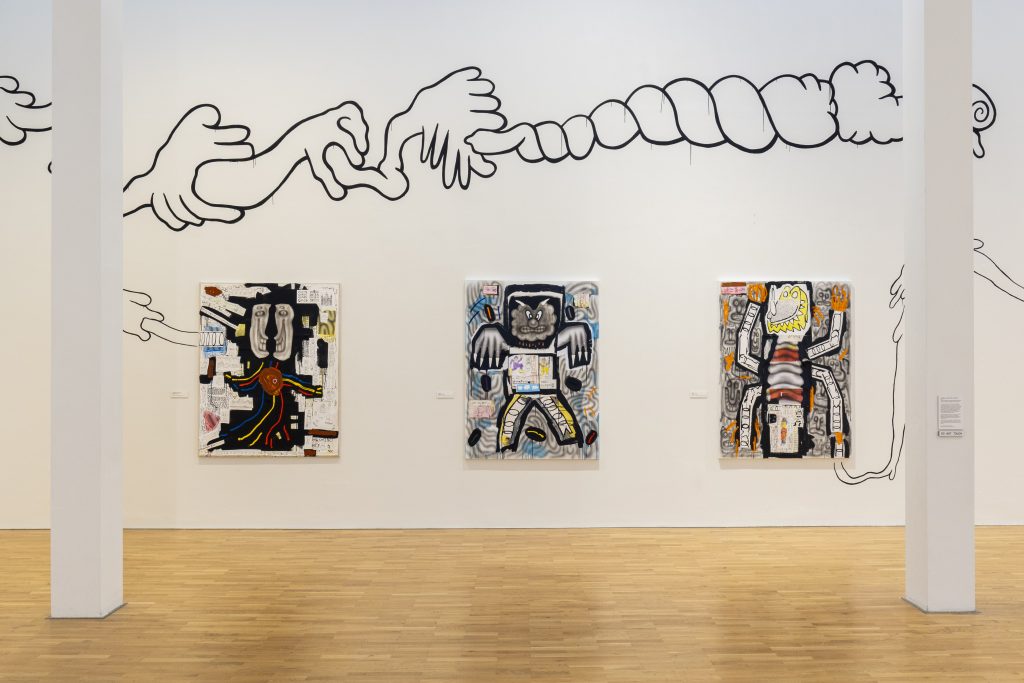
Pandhal grew up in Cape Hill, a deeply working class neighbourhood of Birmingham with a rich cultural diversity including long-established Afro-Caribbean and South Asian communities. The sights, sounds and memories of that place seem to smear themselves around the exhibition much like an Artexed ceiling; heavily textured, layered, and ingrained with nostalgia. Echoes of the artist’s adolescent love of playing video games also weave in, and as I move through the gallery, navigating its sequences of works from left to right (Pandhal often makes in ongoing series unfolding like a book), it really starts to feel like I’m playing a ‘side-scrolling’ platform game. Eight large and lurid paintings displayed across the back wall of the gallery seem to move at a different pace to the rest of the exhibition. Connecting the canvases is a mammoth-scale wall drawing, ‘Lived Experience’ (2025), feeding its way through each work, bisecting and dissecting their individual narratives. My eyes naturally follow its snaking forms as they poke and pull at the paintings, and I think of the many fantasy landscapes I also navigated in the video games of my youth: simulated realities that sat in the background of the action at my fingertips. This giant backdrop to the exhibition unfolds to create a kind of parallax effect, the illusion (as happens in the artificial world of the video game) that I, along with the rest of the works in the exhibition, am moving faster in the foreground – a sensation that enfolds me in Pandhal’s world.
‘HARDOUUUKENNN!’ – an oddly familiar sound bite interrupts my train of thought. It’s quickly followed by a downtempo rap of sorts, written and performed by the artist himself, set against a thudding mash up of audio references including Street Fighter II sound effects and a chopped-and-screwed sample of Kelis’s Milkshake. The sounds emanate from a humble Bluetooth speaker casually, almost carelessly hung from Pandhal’s ‘artist/terrorist’ cut-out installation, intermittently blaring out its noise. “Is indigestion Indian?” asks Pandhal, quickly followed by the more provocative question: “Is indie music Indian?” delivered in a bemused and distinctly Brummie tone. It’s direct and abrupt, yet never abrasive; for Pandhal’s ‘terrorism’ is more affable than most. He wants to talk (this sculpture quite literally does just that). His work thrives on dialogue rather than closing it down, slamming a hoi polloi of references together to force those difficult, awkward conversations – not least, what it might really mean to be British today.
Hardeep Pandhal: Saag and Fish Fingers, Midlands Arts Centre, Birmingham, 22 November 2025 – 1 February 2026.
Kevin Hunt is a visual artist, lecturer and writer originally from Liverpool, now working cross-regionally between the Midlands and the North West. He is the West Midlands Editor of Corridor8.
This review is supported by Midlands Arts Centre.
Published 09.02.2026 by Kevin Hunt in Review
1,155 words