Oscillating between the figurative and abstract, Jayne Simpson’s exhibition LION is part of Grundy Art Gallery’s ongoing programme of solo exhibitions, Turning Point – an opportunity given to artists living and working in Blackpool and the Fylde Coast to ‘catalyse artistic and career development’. Curated by Paulette Brien, and developed over twenty-four months, this exhibition marks a big step in Simpson’s own career, which sees her producing works at an increased scale. Continuing her exploration of a personal landscape and ‘identity as woman, mother, daughter’, Simpson presents an exhibition of four oil paintings and two mixed media works on repurposed bedsheets, centred on qualities of bravery, strength, and courage as part of a wider female experience.
LION invites us to view the works through the notion of ‘expanded painting’ – described in the accompanying text as an ‘installation, sculpture, and environment’. Expanded painting is an approach historically used to push the limits of painting off the canvas, and dissolve boundaries – here, we’re nudged away from the two-dimensionality of the image, towards the emotional and experiential aspects of the work. On one level, this encourages an understanding of the works in relation to one another. Moving around the room, paintings titled ‘Arrival’ (2025) and ‘Departure’ (2025) suggest a narrative order which follows the passage of time. On another level, the show can be read through Simpson’s painting style where colour, surface, and scale are all at play. Between expansive brushstrokes, she leaves visible gaps which expose the linen canvas underneath – interrupting the illusory, dream world of image, and bringing the materiality of the room into the frame. Gestural marks trail off in a way that suggests the possibility of shapes continuing beyond the canvas. This, combined with her dramatic use of colour, injects a kinetic and emotional quality to abstract forms. It’s through recurring motifs of the lion, ghostly figures, and anatomical drawings of bodies, that time seems to shift back and forth in the way that memories join up and blur together. Traversing the halls of personal memory, physical and imaginative space, Simpson’s paintings are felt as well as seen.
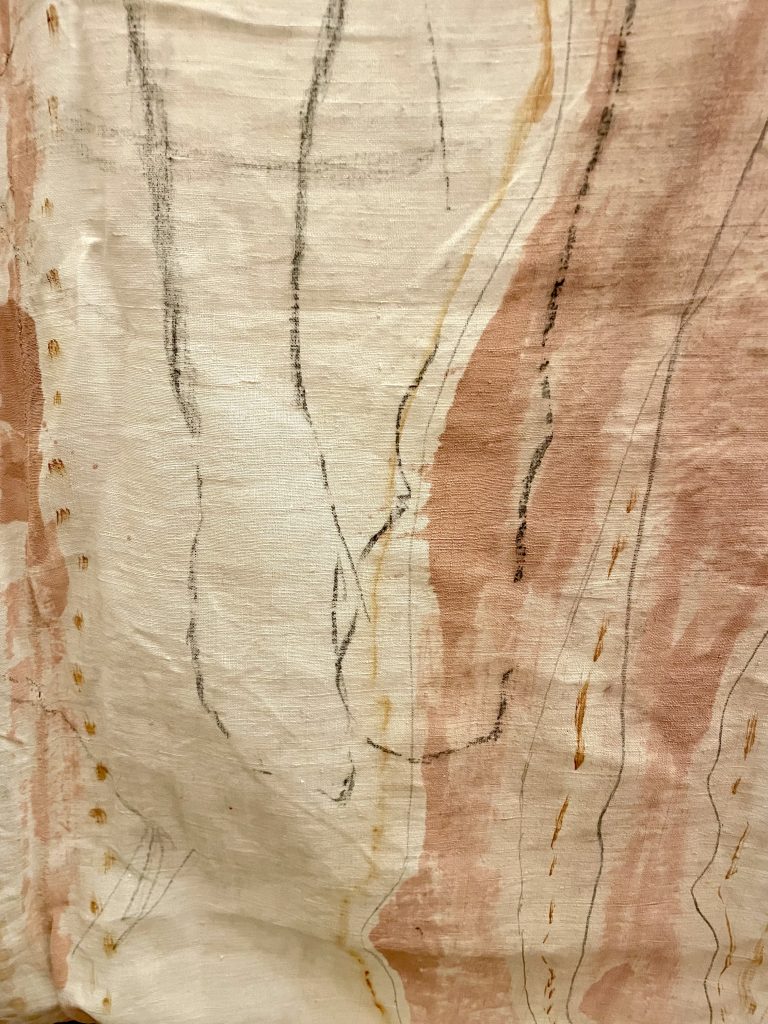
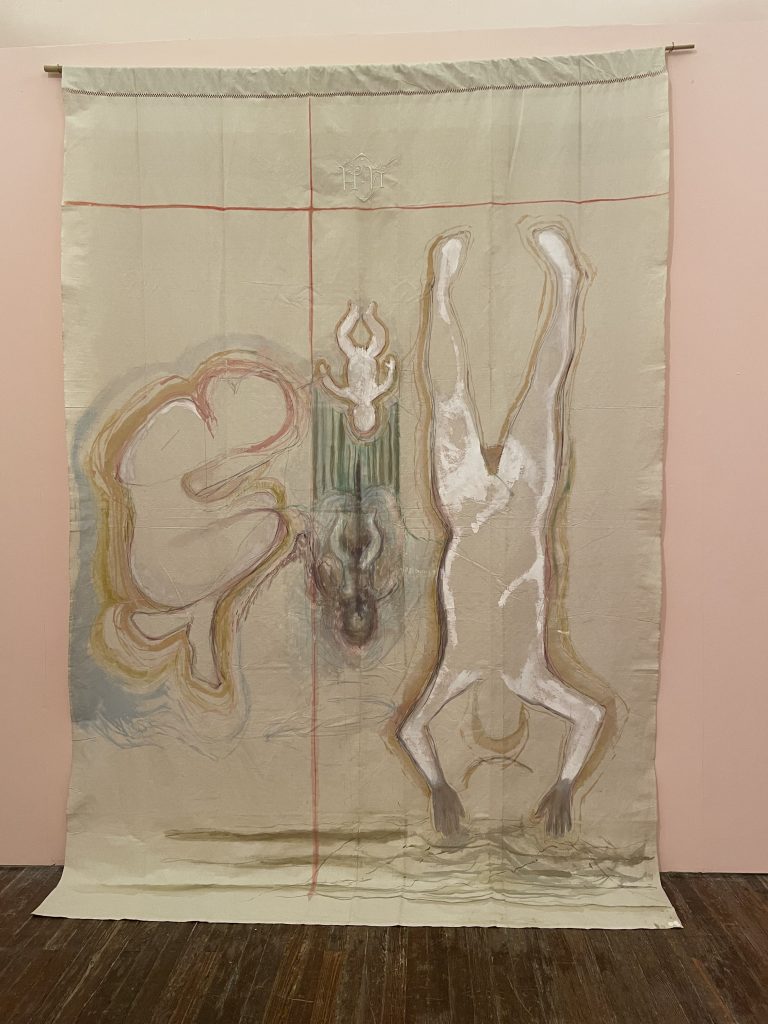
To get inside, we must pass through the ‘Cloth House’ (2025) – an oversized playhouse made of repurposed bedsheets, which features screen prints and painted silhouettes of nude figures. By bringing us inside this enclosed structure, we’re drawn into a private realm of domesticity, which evokes shelter, comfort and the thrill of den-making as a child. On one side of the inner sheets, a seated figure is outlined in blue paint, hands in prayer with a halo over the head. On another side, two overlapping nude figures are painted from behind – their proximity and intertwined shapes suggesting the closeness of lovers. To the right of that, a line of paint runs down the middle like a seam, with a vulvic-shaped hole. Each feels like a private or intimate moment. The paint is applied thinly, softly, merely tracing shapes, such that the layering and fabric is visible – like the marks and scars left on the body as we age. Simpson builds a threshold which shores together identities from childhood up to motherhood – tracing the physical forms each took – and forces us to step through her world.
Alongside the figurative paintings are screen-printed photographs of Simpson’s model taken shortly after she’d given birth. She describes how this was intended as a gesture to reclaim the nude from male artists in a non-sexualised way. It seems to form part of the personal archive she assembles – representing the body in a way that celebrates the natural, unobjectified female form. The images are soft, tender, and empowering, and bring her own identity as a mother into part of a wider conversation on the female experience.
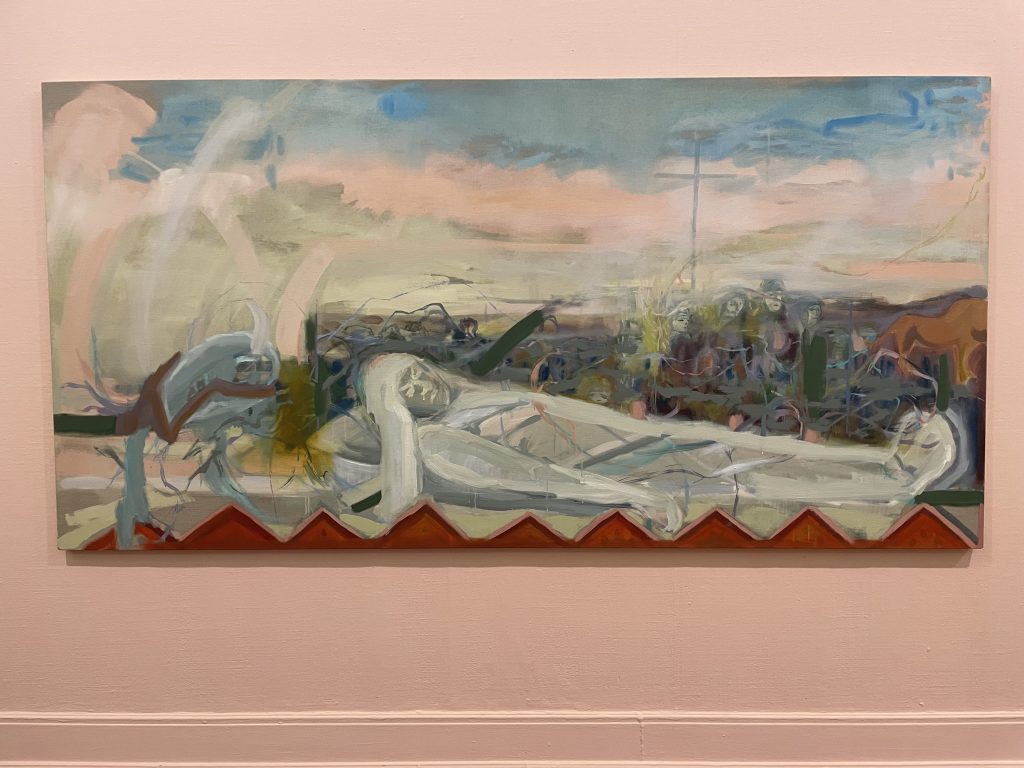
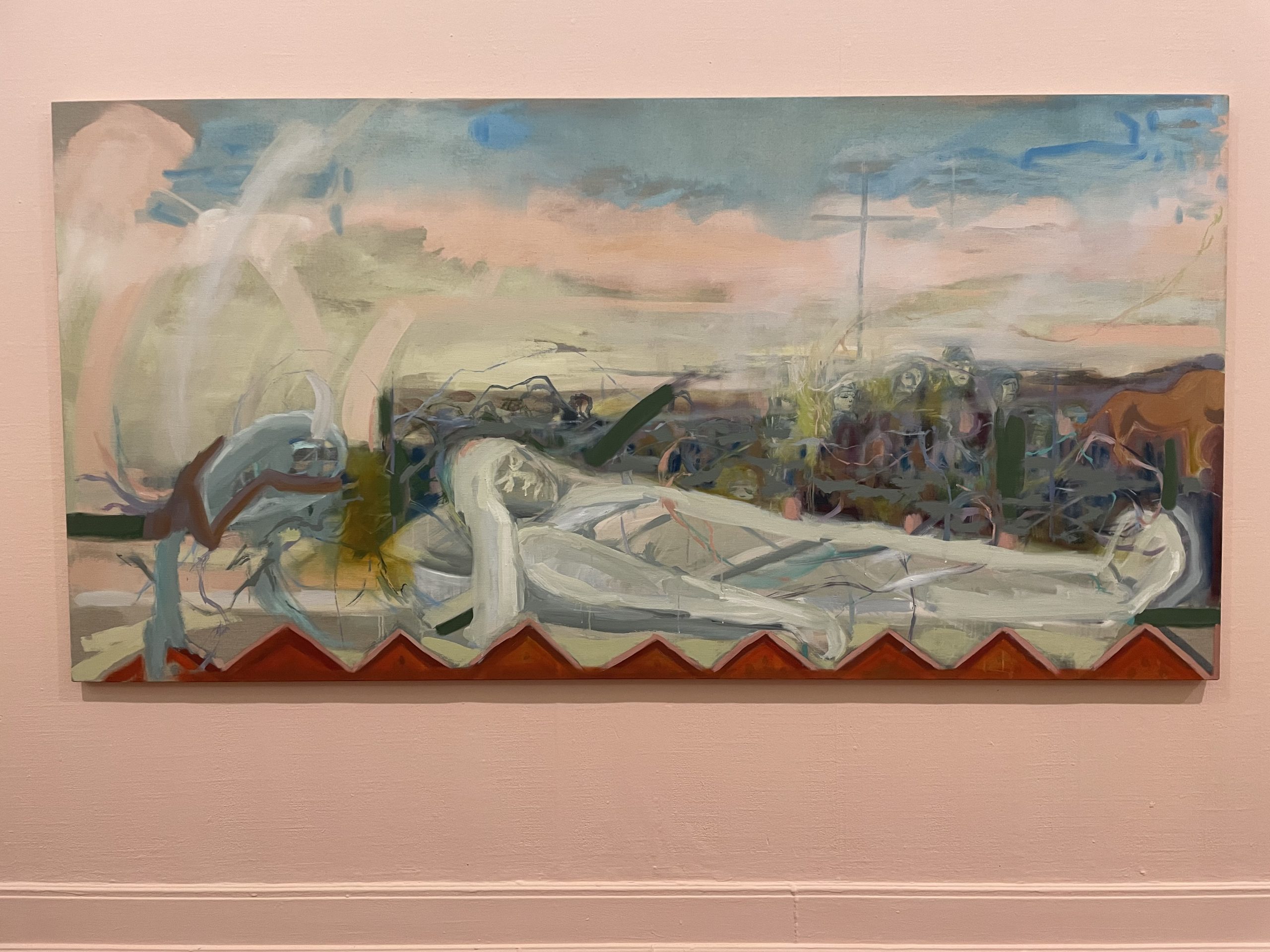
Themes of loss and grief are most prominently depicted in ‘Departure’ (2025) – a painting which references ‘The Funeral of Shelley’ (1889) by Louis Edouard Fournier. In the foreground, the embalmed figure of a woman is being carried into the procession. Ghostly figures gather round the body on a cold, grey landscape– a scene which echoes other elements of Fournier’s burial painting. For this piece, Simpson describes thinking about her position in the world as a woman getting older, and feeling as if she wasn’t a daughter anymore after her parents had passed. Mingling art historical references, memory, and imagination, it’s a reflection on her own mortality, grief, and her legacy in the world as a female artist. Scratchy, barely-there figures hover, and the blustery movement of brushstrokes surface and dissipate like memories. As a whole, the painting exists in a landscape of spirits, the imagination, and real geographical space – layering one realm over another, in ways that recall how we collectively process and understand grief.
Across the oil paintings, her use of colour is eclectic and expressive – phosphorous greens and yellows, mixed with pastel hues, and darker swatches of blue and red – evoking the balance of joy, vibrancy, loss and sobering sadness. In ‘Arrival’, outlines of female figures and lions appear against a forest green floor or watery surface, like mythological beings. An ominous pair of legs dangle downwards in a dark corner, a nod to the ‘Blue Stockings’ of the eighteenth century, a literary salon that promoted intellectual discussions and functioned as a social, artistic, and academic network set up by women, while a fountain of bright light seems to spring up in the top right, creating a dramatic dreamscape. This painting feels like a new beginning – woman as protector, the site of renewed strength and creativity. With its dramatic play with colour and metaphors, Simpson seems to build her own mythology of womanhood.
Throughout, Simpson invites us to understand the word ‘lion’ as a way of being or state of mind. In ‘Arrival’ (2025), Simpson depicts male lions – distinguished from lionesses by their manes – seemingly morphing with the hair of female figures. The gendered symbolism of this feels like a slightly odd choice in an exhibition about celebrating the strength and courage of a woman. Perhaps it is to be understood defiantly – a way of claiming qualities which have been symbolically understood as masculine as her own.
Accompanying the exhibition in the next room is Collection Spotlight: A Body of Work, displaying a number of works selected by Simpson as inspiration for her creative process from the gallery’s permanent collection. Here are depictions of women of all ages – young girls, mothers, students; bodies at work, rest, and play – connecting Simpson’s work to themes of female identity and representation. For example, in ‘No. 1 Dressing Room’ (1947), by Dame Laura Knight, we see the semi-nude figure of a female dancer getting ready backstage. Posed, proud, and strong, it too feels like an empowering female representation made by another female artist, and an anchor point for Simpson’s perspective.
With its vivid, luminous palette and dynamic mark-making, LION is an exhibition which leaps off the canvas and stays with you long after you leave, weaving a narrative of grief, loss, courage, and joy. Simpson paints a full emotional landscape of her life experiences in such a way that specifics aren’t revealed, yet we can follow along and feel. For me, her work is at its strongest with large-scale works like ‘Arrival’ and ‘Departure’, when it’s simultaneously intensely personal and abstract.
Turning Point: Jayne Simpson – LION, Grundy Art Gallery, 24th January – 7th March 2026
Natalie Russett is a writer based in Manchester.
This review is supported by Grundy Art Gallery.
Published 05.03.2026 by Jazmine Linklater in Reviews
1,283 words