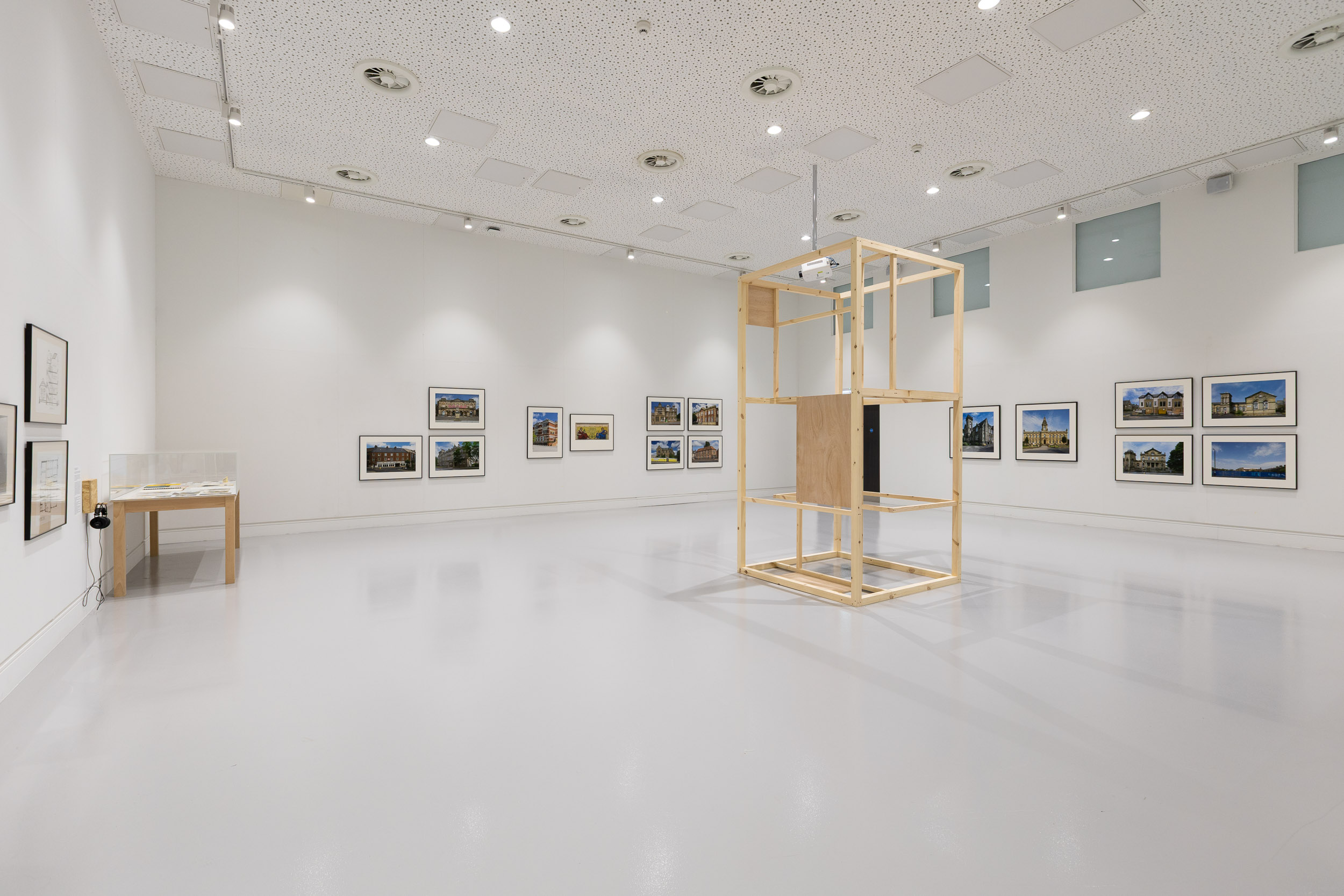
The Art Schools of Yorkshire represents the latest stage of artist Matthew Cornford and writer John Beck’s sprawling project documenting England’s historic art school buildings. Central to their endeavour is Cornford’s striking photographic survey of the facades of these buildings – or, where they have been demolished, the spaces in which these buildings once stood.
I never went to art school, but art schools have long been central to my life. Initially only in the imagination, my curiosity sparked by the glamorous adults in my parents’ social circles known as artists, who studied and taught in such places. Given their presence in our lives, it’s slightly remarkable that art was not considered a subject fit for serious study in our household, but ‘art appreciation’ and skills like drawing and painting were viewed only as addenda, badges of hard-won middle-classness – to dedicate one’s life to them academically would have been to invite a level of precarity too real for my dad in particular. So, my curiosity in this direction was stymied for a while. Then, as an adult – gradually, inevitably – I began to surround myself with artists once more. I jumped into a career in the arts in my thirties and now find myself surrounded by art school people and a regular visitor, whether to see BA or MA shows, or exhibitions in the public gallery spaces that have become part of the modern art school’s purview. I even entertain, on a semi-regular basis, the idea of going back to study at one.
I would ordinarily apologise for this wistfulness, but here, a certain romanticism is part of the point. The Art Schools of Yorkshire very deliberately works on the memory and imagination – it imbues the buildings themselves with gravitas, with a monumental importance, and seeks to provoke reflection on their legacies, their present situation and possible futures. There is romance too in the project’s origins – a chance trip by Cornford to Great Yarmouth College of Art, the artist’s alma mater, where he found the building not just closed but up for sale. The shock of this – the implied promise of permanence made by the building’s venerability suddenly broken – prompted conversations with long-time friend and fellow Great Yarmouth alumni Beck. These conversations gradually initiated a country-wide tour to find other schools, to document the buildings in their present state and learn their histories.
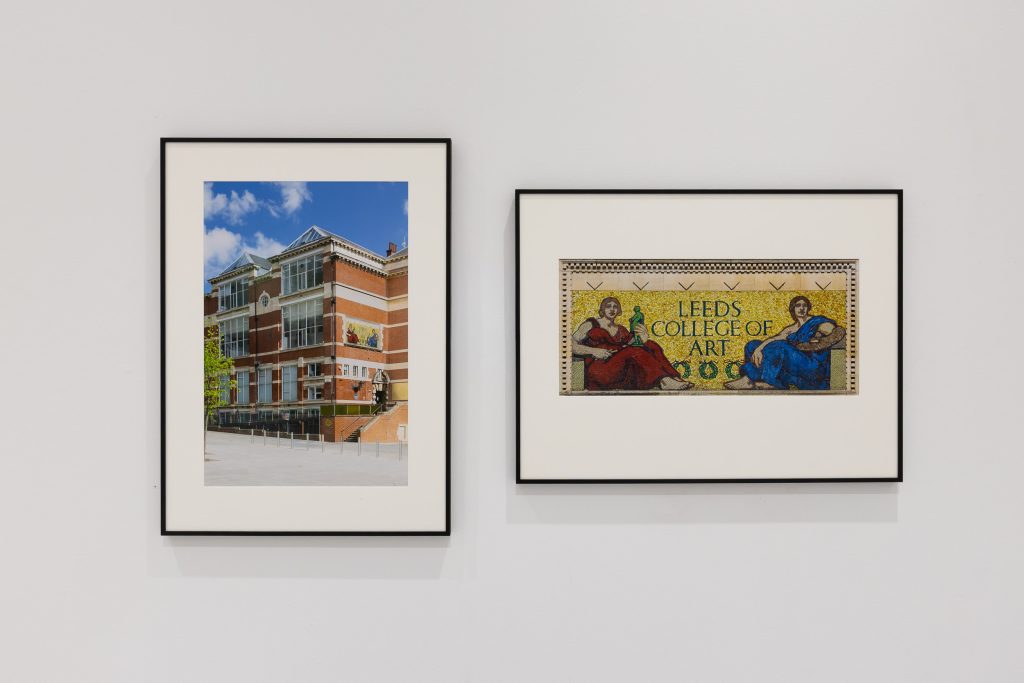
The photographs themselves are fantastic – crisp, large format shots of some very beautiful and unusual buildings. They present a full range of architectural styles deemed suitable for civic architecture in Victorian and Edwardian England, but escape feeling blandly taxonomic. They are, in essence, portraiture. Squared up or in three-quarter pose, the subjects dominate the frame but sit comfortably in their setting, do not feel pinned down by the camera. As in lots of architectural photography, there is a sense of the buildings looking back at you, but these seem particularly self-contained, helped by some smart compositional choices. Backdrops have been standardised as much as possible, a consistency of tone achieved by shooting them all beneath blue skies with just the right amount of white fluffy clouds. They are also shot entirely without the presence of people or vehicles – to a remarkable degree, in fact: I cannot find even a single face visible in any of the hundreds of windows across all twenty-two images presented here. They clearly exist within a long tradition of topographical photography, but are kindlier than many famous earlier examples.
Other regional subsets of this series have been exhibited across the country at galleries including the Bluecoat (Liverpool), Touchstones Rochdale, the New Art Gallery Walsall, and Bonington Gallery (Nottingham). Here, the latest set of photographs are bolstered by items from the archives of Leeds Arts University [LAU], to help describe a history that begins with the industrial dynamism of the Victorian era, traces the various evolutions, absorptions, demolitions of the twentieth century, to bring us finally to this modern exhibition space in the heart of the first and only specialist arts university in the North.
Though there is an unarguable romance here, Beck and Cornford claim the project is not nostalgic – in the sense that, for them, it does not represent a sentimental longing for a particular period in the past. I think they succeed in communicating this. These are affectionate shots that give their subjects dignity, but which allow the buildings to be themselves rather than overly idealising them. Even the sites of lost buildings are treated in this same way, with equivalent attention given to scale, framing, setting etc, such that a stretch of cloud-spotted blue sky over an empty lot in Keighley has as much presence as the off-kilter beauty of Bradford School of Art alongside it. Similar can be said for the image of a clutch of new-build housing now to be found on the Dockin Hill Road site of Doncaster School of Art, or the image of an unfinished row of modern townhouses where Bingley School of Art once stood.
Photography as an art form has always wrestled with connotations of objectivity, and choices have been made that do unavoidably put forward a narrative, if not necessarily a misty-eyed one. Many of the art schools are represented by the first purpose-built edifice to house them, but this is not always the case. The building chosen to represent Harrogate School of Art, for example, is Belvedere House, which, although built in 1860, did not house the art school until 1955, and then for only three decades of its 150-year existence. York School of Art is represented by the building currently known as York Art Gallery. This was the school’s third home since its inception in 1842, and though its presence there from 1892 massively influenced the development of the building on Exhibition Place, the school leased the space it occupied (initially just the north wing) from the York Fine Art and Industrial Institution (then, later, the City of York) and moved into purpose built accommodation only in 1976.
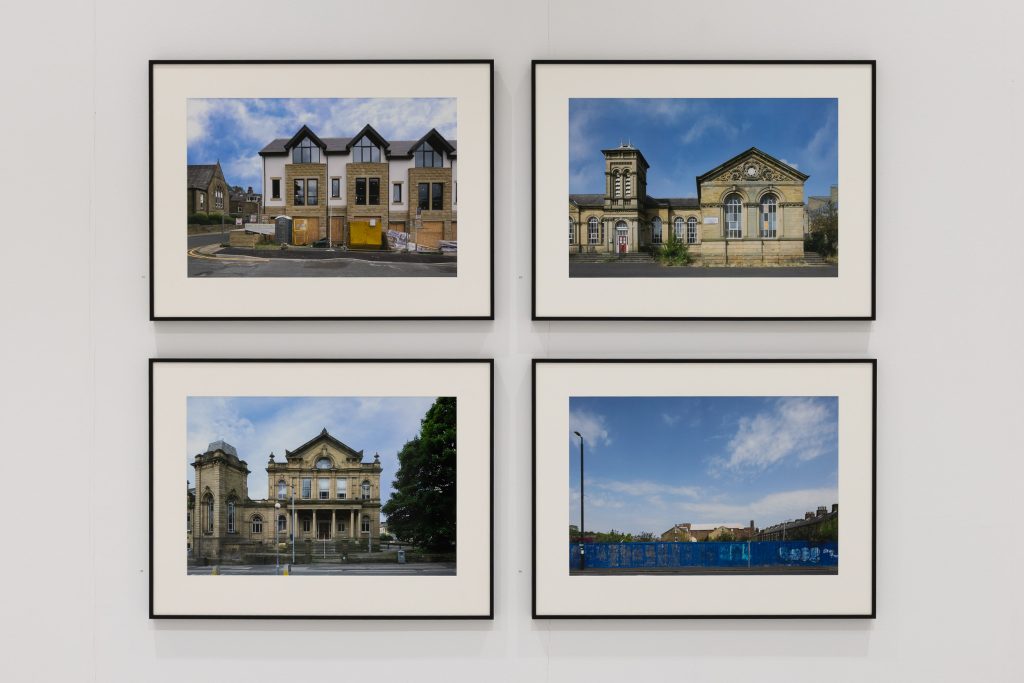
The rationale for these choices is not always clear, but I suspect aesthetic concerns might occasionally have come into play. Though they might not be seeking to idealise the institution of the art school or the buildings that housed them, Beck and Cornford are always necessarily picking a part to stand in for the whole. All the extant buildings presented here were built in the Victorian and Edwardian eras. This necessarily privileges the long nineteenth century – and perhaps the artists are right to do so, as it was the need to retool local workforces during a period of rapid industrialisation that birthed these institutions. It also gives the viewer the longest possible run at their histories.
It would be a very different series if photographs of all buildings previously, subsequently or currently home to these art schools were included alongside the chosen Victorian or Edwardian edifices. That’s not to say better or more rigorous – this is a project with a strong point of view and is more compelling for it – but perhaps there’s a limit to how much the photographs alone can represent ‘an exploration of the present moment’, a phrase that appears in the exhibition handout. The artists have written previously that they consider this a research project and an art project, ‘the disciplinary demands of art practice and scholarly research in permanent negotiation with one another’, so it’s perhaps in their role as an imaginative jumping off point for further investigation that the photo series ought also to be evaluated. There is a certain dynamism produced by drawing different lines of enquiry together in this way, but a question remains as to whether the compact histories of each school supplied in the handout are enough to fully open up the images in the context of an exhibition.
An additional way Beck and Cornford inject dynamism into the project is by allowing space for it to adapt to local context. For example, in the Rochdale exhibition they presented stained glass panels from the now-demolished local school alongside the North West photo series, which included a shot of the carpark that now occupies the site. At LAU, the extra depth provided by dipping into the university’s own archives is what ultimately provides this exhibition with a sense of continuous history. In vitrines in the gallery and the library upstairs (viewable by appointment), there are student publications, prospectuses from down the ages, and a selection of artefacts drawing attention to Leeds’ centrality to the story of Basic Design, the experimental programme that reshaped art education in Britain and Europe in the 1950s. Some lovely colour snaps and elevations of the Jacob Kramer College building from when it was newly minted in the 1980s perform a hyper-localised version of the trick of perspective carried out by some of the main photographic images – the gallery and library in which the exhibition is situated are later additions, and stepping outside one can see where part of the postmodern facade described in the vitrines has already been gobbled up by a later glass and steel extension.
LAU is an interesting case study in other respects. Though it has gone through a number of name changes, its provision of an arts education has continued more or less uninterrupted since its inception. It has achieved this not through absorption into a larger institution, as others have, but by staying the course. The Vernon Street building (1903) chosen to represent ‘Leeds School of Art’ is one of the few surveyed here that still functions as an art school today.
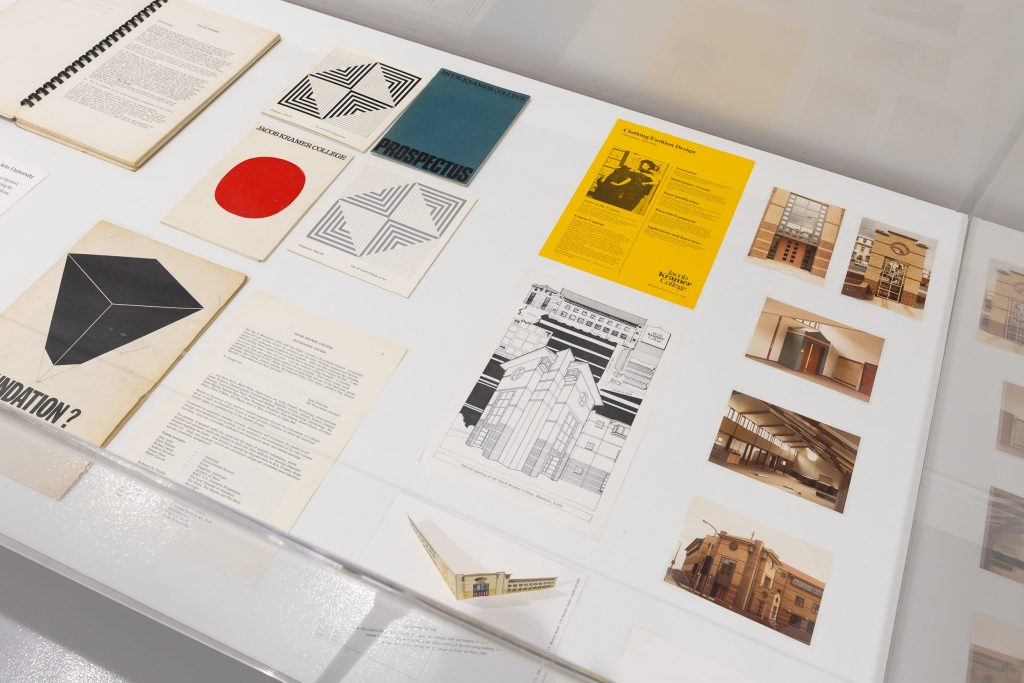
This unbroken lineage back to Vernon Street (and beyond) is one that LAU shares with another local institution, Leeds Beckett University, the splitting point coming in the late sixties. The shared lineage is acknowledged here, as is the intertwined nature of the various Leeds institutions of higher learning, including the University of Leeds across the road, particularly in relation to the early history of Basic Design. This element is represented by photos of students’ work and other documents from this period, along with what is described as a ‘space frame’ in the centre of the large, square gallery space. Newly made by Adam Baker from milled two-by-fours and panels of thin ply, the structure suggests a kind of unfinished kiosk. It is offered less as an art object and more as an example of such structures’ potential as educational devices to encourage students into thinking differently about spatial organisation. This version doesn’t necessarily immerse the viewer in the space (except to highlight how vast the gallery is, by virtue of being somewhat swallowed by it) or structure a viewing of the photographic work, but it is provocative in its slight awkwardness.
Beck and Cornford are also interested in these exhibitions as conduits for further research, as a collecting point for stories – those belonging to the people hidden behind the facades. In the exhibition space, voice is given to an otherwise mute presentation by a listening point with recorded conversations between Prof Samantha Broadhead and other alumni of Batley Technical and Art School. Hearing their familiar accents sends me back around the room looking for more humans. I find them in a LAU archive image from 1907 depicting a pile of students in one of the studio spaces at Vernon Street. Classic high-jinks are afoot, the students posing with various props – a giant foot, holding a cigarette to the lips of a classical bust, a human skeleton or two in the mix. I get the feeling you’d see some of those same faces today out on the Otley Run, give or take the slick side-partings, the collars and neckties perhaps swapped out for Minion costumes.
I never went to art school, but I find myself visiting art schools often nowadays, and none more so than this one. At a time when other parts of the local art ecology are struggling, Leeds having lost numerous spaces for showing contemporary work in recent years, the consistently excellent programming overseen by Curator Marianna Tsionki and team over the last few years here at LAU has been a great consolation. That’s not to be complacent about the fact that there is also a great deal of uncertainty in academia currently, and in the arts in particular. I think it is well worth taking stock of what art schools are and do, and even getting a little romantic about it.
Benjamin Barra is a writer, editor and curator based in Leeds.
John Beck and Matthew Cornford: The Art Schools of Yorkshire is on at Blenheim Walk Gallery, Leeds Arts University, 26 February – 18 April 2026.
This review is supported by Leeds Arts University.
Published 01.04.2026 by Lesley Guy in Reviews
2,187 words