The Whitworth in Manchester is currently showing a selection of works by Roma-Polish artist Małgorzata Mirga-Tas until 7 September 2025, after a major exhibition at Tate, St. Ives that finished in January this year. Spread over two rooms, the show features pieces from several of her series that explore historic visual representations of Roma communities, inserting real people with real histories in her image constructions, thereby disrupting viewers’ possible presumptions. All these figures and portraits are based on the photographs she collects from different Roma family and museum archives.
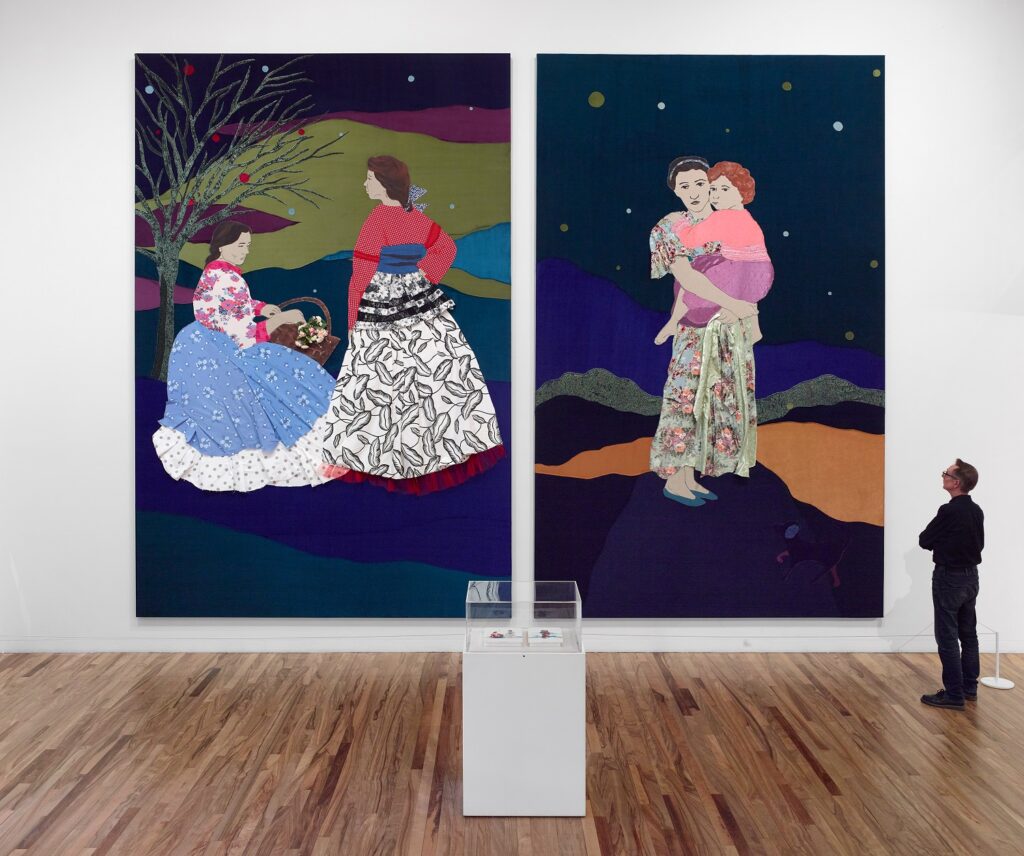
Mirga-Tas specifically explores visual storytelling about Roma culture but from within, to create space to tell the parts of this community’s history she finds important to explore and memorialise. Her figurative pieces are almost tapestry, but use folds of clothing and household textiles acquired from Roma friends and family, repurposed and sewn into layers on canvas or board together with small uses of acrylic paint.
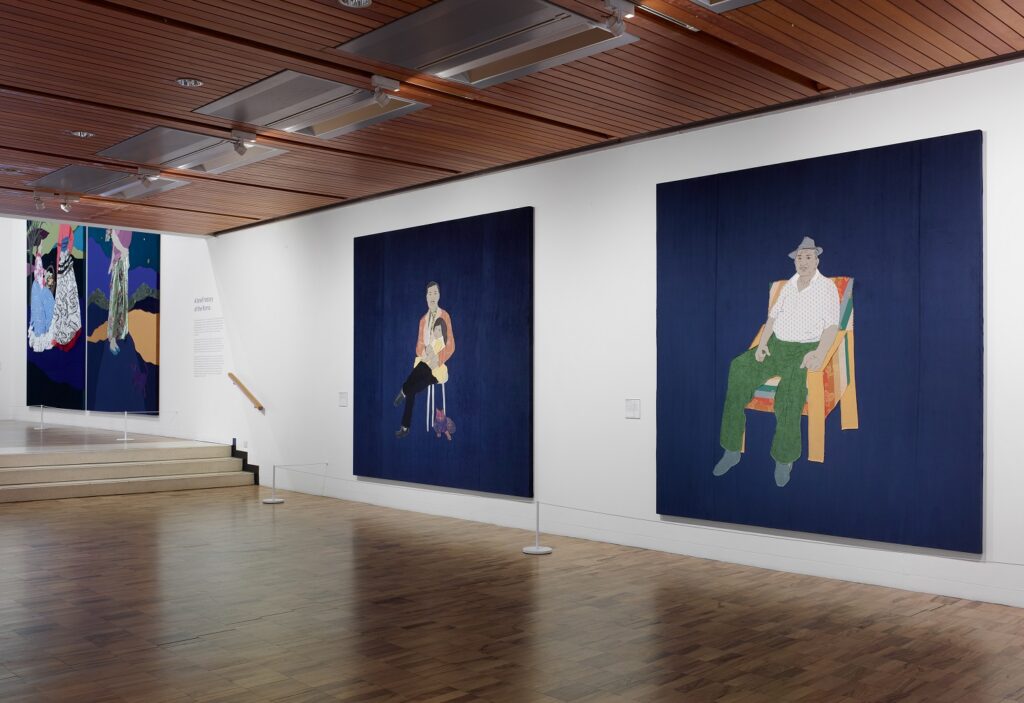
In the first exhibition space, the images encountered are from a series of portraits titled ‘Siukar Manusia’ (2022), a Romani term meaning ‘wonderful people’. Two monumental portraits, around ten feet tall, face each other; their stories entwined through the history of the Roma during World War II. Made in collaboration with the USC Shoa Foundation and the Fortunoff Video Archive for Holocaust Testimonies, one is a picture of a woman called Wanda Siwak. She is depicted with plaited hair, a bright lace-lined blouse and a bright red flower patterned skirt. The figure of Siwak is larger than life. She is standing against a dark background suggesting, as the artist states, that ‘she is emerging from darkness… to gain the visibility and dignity she deserves’. The story Mirga-Tas commemorates is Siwak arranging for her daughter to be hidden from the Nazis – who went on to slaughter approximately 90% of the Roma population in central Europe – before being imprisoned herself in a concentration camp during the war.
Siwak survived the camp and then spent the rest of her life trying to find her child. On her death bed she handed the task over to her nephew, Edward Dunka, a Roma community activist. He is depicted in the monumental image facing her, sitting on an easy chair, casually dressed and wearing a brown pork-pie hat, looking at ease. He did eventually find her daughter’s family in present-day Ukraine. Both portraits emanate a quiet dignity, and by honouring these histories, Mirga-Tas opens up the story to what is not usually associated with Roma stereotypes – both personal and community acts of heroism.
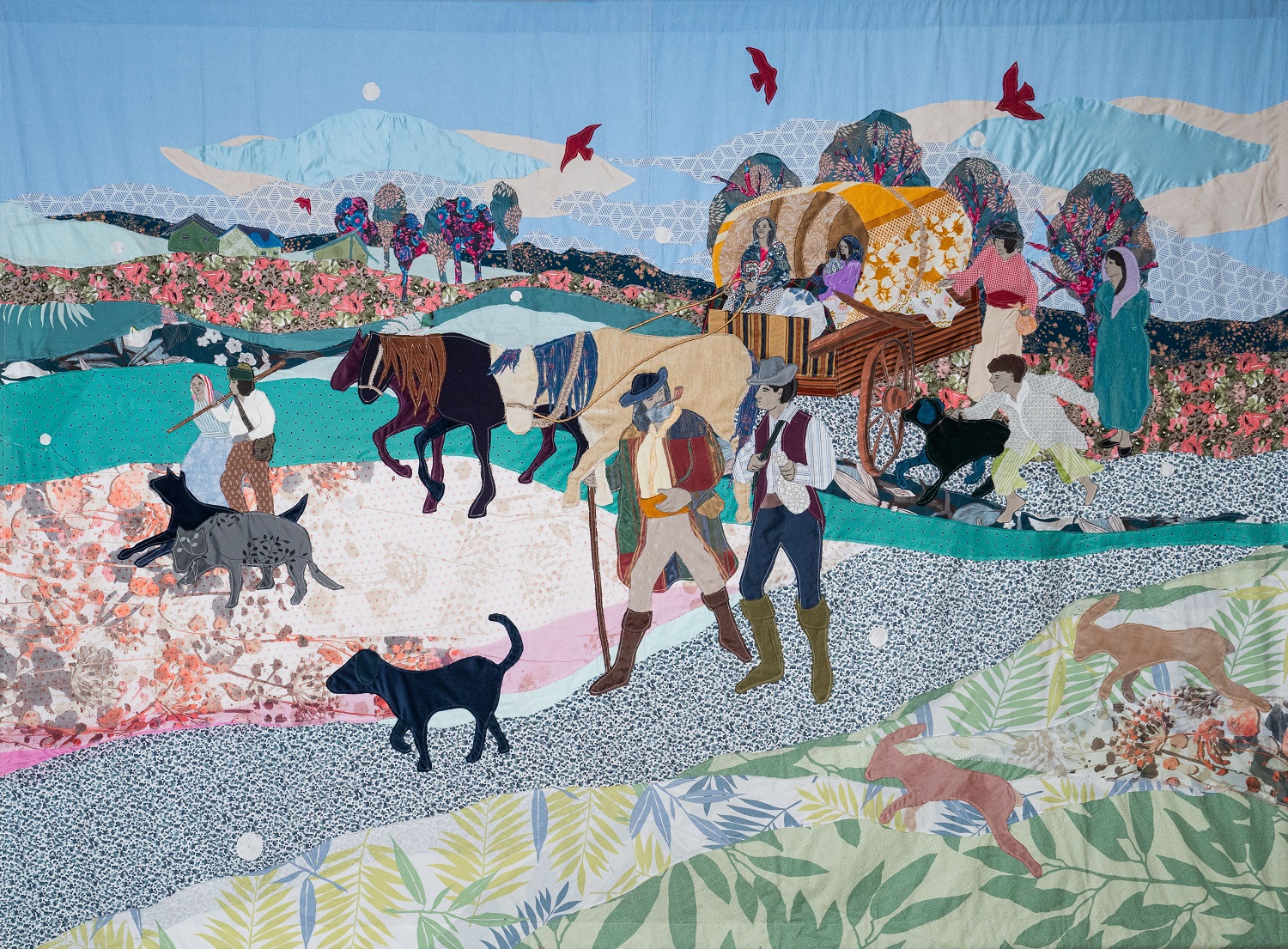
Other images Mirga-Tas has re-imagined come from archival images, engravings by Jacques Callot and Auguste Raffet in particular, that depict Roma as dangerous wanderers always guilty of vagrancy, stealing and camping out on the fringes of civilisation. ‘Miri Daj (My Mother)’ (2019) and ‘Familia’ (2022) for instance, allow the viewer into the real story of Roma lives distinguished by marginalisation and attempted annihilation, and enable a rebuttal from inside of her community mostly hidden by the same forces.
While it is good to talk about remembrance, social justice and advocacy, Mirga-Tas’s work also offers an opportunity to think about what Daniel Baker, a British Roma artist and one-time Chair of the UK Roma Association, calls ‘Roma aesthetics’. Mirga-Tas uses a vernacular of textiles sourced entirely locally, reflecting not only environmental responsiveness but also the enduring cultural heritage and artistic systems that surround her. The works reference women sewing or adjusting their own clothes, threads of conversations, the short bursts of rattle and buzz of sewing machines and female efficiency. Her work is an exploration of the boundaries between art and the every-day world, following the post-modern practice of Appropriation Art but from a distinctly feminist perspective.
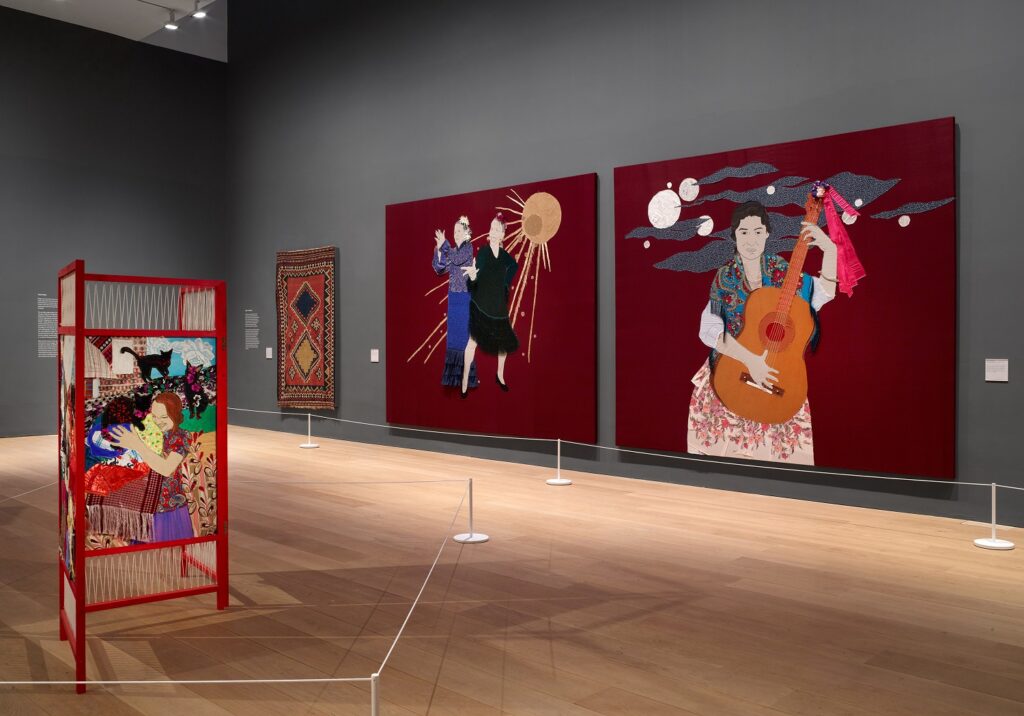
Mirga-Tas does not only honour her own Polish community’s survival. In the second gallery space, there is a portrait of Herminia Borja, the flamenco vocalist. It is from a series of works titled ‘The Sacrity of Gitanes Flamencas’ (2023), produced for the Centros Andaluz de Arte Contemporeaneo in Seville in 2023. Flamenco music and dance is largely the cultural creation of the Roma populations in Spain yet is considered to be the country’s national folk music. The image is based on two portraits of Borja by photographer Aitor Lara and conveys the singer’s passionate energy for her music.
Roma culture in Eastern Europe had until recently little to no voice in the mainstream creative milieu. Since the end of communism however, Roma communities have become more politically organised and culturally visible. In 2022, Mirga-Tas represented Poland at the 59th Venice Biennale as part of the Milk of Dreams exhibition (named after a book by the English-born Mexican surrealist artist Leonora Carrington), and she was the first Roma artist to represent any country at this prestigious event.
In the second gallery space there are also pieces from the Whitworth’s textile collection. The juxtaposition of these rugs and Mirga-Tas’s artworks expose something else – although both are made by women, the concentrated weaving of the rugs as craft and her constructed images using textiles based on artistic choices jar, because the distance between their histories of manufacture are vast. Maybe that’s the point. Consciously or not, I think Mirga-Tas senses the displacement of textile design as a fine art by modern manufacturing industries, which directly links her practice to explorations of mass-production and consumerism.
Her auto-ethnographic approach to image-making provides, as well as an introduction to Roma culture, another conversation between women’s histories. Inside the theory and thinking of the women’s movement itself there are challenging stories when it comes to notions of culture, ‘race’ and ethnicity. Angela Davis in her book Women, Race and Class (1981) stated that the development of feminism in America dropped supporting Black women’s inclusion to gain the support of their country’s ‘Southern’ women in the cause for women’s suffrage, for ‘expediency’, curving the cause to run in a parallel line with racist theory around maintaining the ‘purity’ of Anglo-Saxon blood. It could be argued that Roma women in Europe occupied the same position as African-American and working-class women in this first wave of feminist thinking.
Interestingly, in a piece from the series ‘Out of Egypt’ (2021), Mirga-Tas takes on the Medieval thinking that Roma travelled to Europe from Egypt. Modern research has revealed, through linguistic and genetic analysis, that the Roma came from India and are now informally considered to be part of the Indian diaspora. However, enslaved Roma were first shipped to the Americas with Columbus in 1498 and Spain sent enslaved Roma to their Louisiana colony between 1762 and 1800, meaning that regardless of genetic origins the historical social and political links are undeniable.
Artistic voices from ‘others’ crop up in the exhibition Women in Revolt! next door, where second and third wave feminism (1970 until 1990) grappled with exclusionary thinking and tried to realise the role of identity in solidifying a united message to seek societal change. There is a complex conversation between the two exhibitions because, although Mirga-Tas also contests exclusion and devaluation, she does it from her position as a Roma woman and mother. Her research includes hearing oral histories that explicate the terror of displacement, forced sterilisation and targeted violence. She demonstrates how the plastic arts can be used in this context to unite community and act as a point of remembrance, even when moments of fear get in the way. Unfortunately, Roma communities all over Europe continue to be excluded and harassed, discriminated against and often have limited access to education.
The work shown at the Whitworth invites audience to think about their own relationship with history and how it is and has been used culturally – this exhibition tells some of the valuable stories that often get left out of the mainstream narrative. Mirga-Tas uses the materials women already use, to engage with potent issues around both female and community identity. She has provided new threads of research for me to follow now, because viewing her work and exploring the subject matter she engages with offers an active encouragement to imagine and produce, by claiming a bit more freedom.
Małgorzata Mirga-Tas, 11 April – 7 September 2025, the Whitworth, Manchester.
Chantal Oakes is a writer artist based in Preston, Lancashire.
This review is supported by the Whitworth.
Published 16.05.2025 by Jazmine Linklater in Reviews
1,420 words