“Everything’s a prop. I’m wearing the socks that are in the film right now.”
Anthony Shapland points to the socks laid out on a cushion amongst the rest of the clothes belonging to the model on screen, posing amongst easels within an art school classroom. I look down at his feet and mentally confirm he’s correct. They are the same socks; white, ankle-length, Adidas. Or at least, they appear to be the same socks. Within this shared moment we get to what the work is really about.
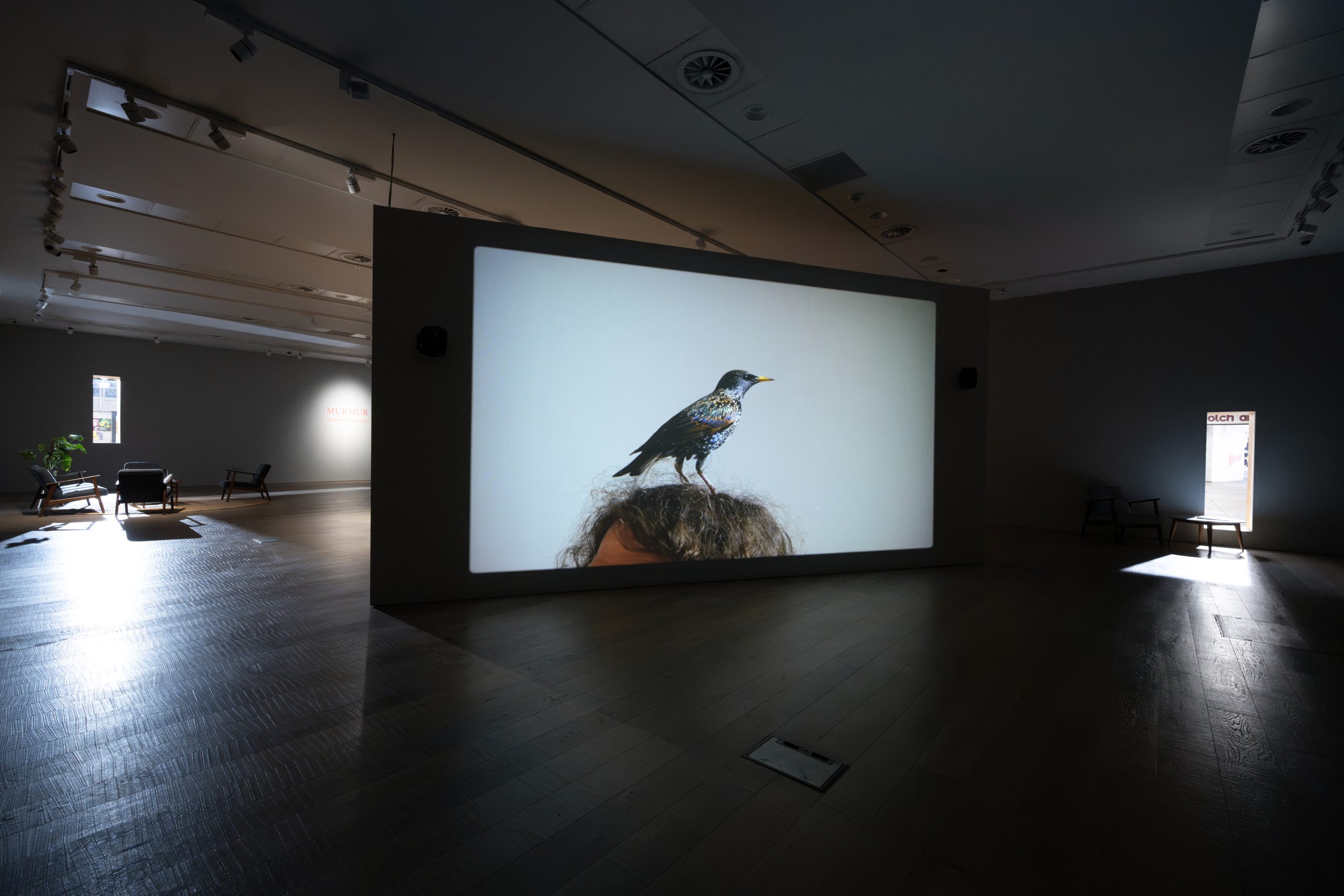
Shapland’s new solo exhibition, Murmur, presented at Tŷ Pawb and guest-curated by Marie-Anne McQuay, consists of two newly commissioned works. ‘Sleeper’ (2026), a large-scale, single channel film, and ‘Night after night becomes day’ (2026), a montage of found-sound starling calls soundtracking studio lights shining in from outside the gallery through narrow windows, sequenced to mimic the cycle of dawn and dusk on a quicker timescale. These works are situated alongside two older works, ‘Seven Starling’ (2025) & ‘Between the Dog and the Wolf ‘(2019-26).
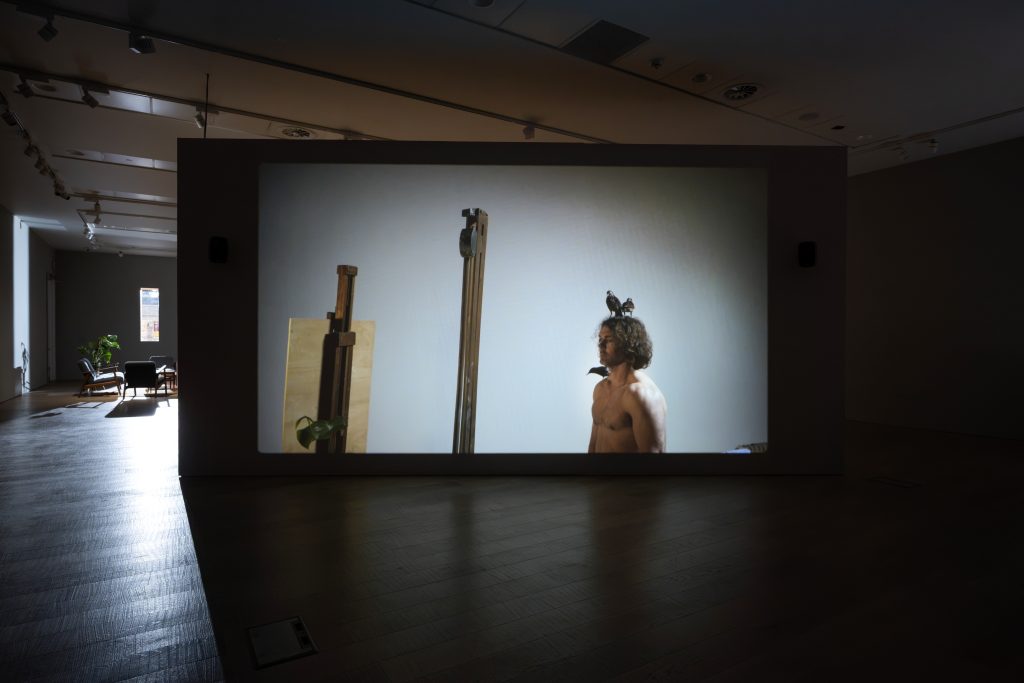
We’re standing together, Anthony & I, watching a static shot unfold in ‘Sleeper’ of a hand poised beside a thigh. The thigh’s hairs are illuminated and golden, perfectly still, while the hand trembles, perhaps with the concentration of the model’s pose; a natural and involuntary movement that, under microscopic clarity, feels unnatural. Cut to the beauty of a stomach inflating in and out. The model is as static as the furniture surrounding, the wooden easels and art master’s desk, chairs. A starling enters the room, appearing on screen with a jumpscare’s suddenness, after which shots are cut with frenzied pace. The model remains immobile, his nest of hair becoming a resting place for the birds, in between knocking sticks of charcoal to the ground, an enamel bowl clatters to the floor scattering pencils.
A murmur becomes a hornet, a drawn-out breath, heavy machinery operating in the works. Starlings are gifted mimics, seemingly able to manipulate sound to their will using their syrinx, the vocal organ of birds that is their specialised instrument. As such one is disorientated, unable to differentiate whether a sound is originating from its proper source, or from a starling, and even whether a sound is coming from the events onscreen or outside of the gallery walls.
Love song, territorial marking, a warning, imitation—a starling’s song is unique, complex. Throughout the show double meaning is at play; language twists, is performed, displayed. The name of the show, Murmur, is a sound from afar, low and continuous like a prayer or chant. It is a whisper, a rumour passed from voice to voice. First contained, then spread. A flock of starlings in synchronized aerial display, twist and shift in unison, a murmuration, to both be seen and unnoticed. ‘Seven Starling’ takes the soundtrack element of ‘Night after night becomes day’, playing it through the gallery space, out of the gallery and spilling into the market hall and food court of Ty Pawb, causing heads to turn as unsuspecting punters search for the source of the noise. Traffic noises, ringtones, birdsong. Coming from speakers in the walls, outside the automatic doors, from someone sat over there? You can see them asking themselves, did I really just hear that?
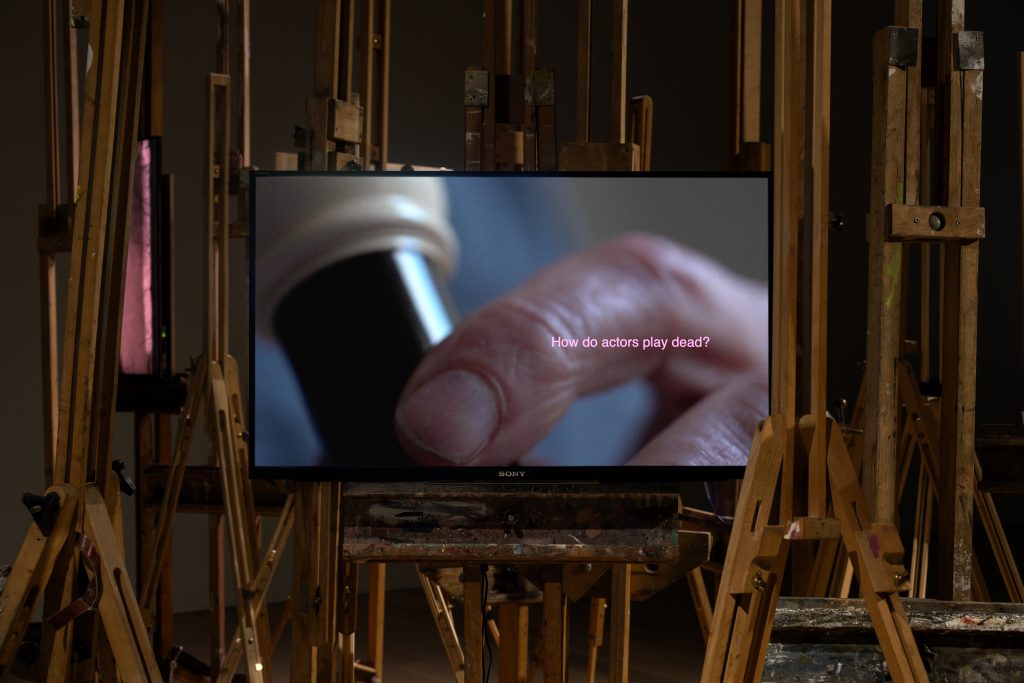
This spilling out is failure of containment, or is in spite of it. As starlings adapt to their surroundings and blend in, so do queer folk. Shapland draws on his lived experience of rural queerness, his working-class upbringing, and “performing straight”. Straightness is just as much a performance as homosexuality, his work seems to say. Keeping a secret so close to heart, trying to maintain a performance of fitting in, eventually overflows. ‘Between the Dog and the Wolf’ is situated at the heart of the gallery space, with the other works and the reading area arranged in a constellation around it. An ongoing work, in which iterations of previous work are reimagined through new edits, split across three screens which are presented on art school easels. The immobility of the easels possesses an uncanniness, like a shipwreck salvaged and brought into the gallery space. A structured copse of dead tree trunks and bare branches. Softly echoing footsteps murmur, walking the circumference of this central work.
On one screen, pink texts rolling upwards reads:
‘When an actor plays a role, part of the brain switches off. The part which is connected to their sense of self dims in activity as a new role is learnt. This suggests that when we perform different roles we physically change parts of our brains. We mimic, absorb and mirror. We know how to pretend. How to fit.’
In one sequence, moths, flies, midges swarm, alienlike. A standard flashlight is directed at them, triggering phototaxis, a behavioural response / survival instinct in insects to either seek or shrink away from light. On another screen, a disembodied Point of View moves through fields and woods in green night vision—which, these days, is considered retro now that night vision cameras have moved to black and white. It has a nostalgic quality to it, like watching Brandon McMillan’s TV documentary series, ‘Night’ (2009). Text on screen reads, ‘Anyone around?’ ‘Now?’ ‘Is anyone here?’ ‘What’s this like’? A nod toward the loneliness of cruising, of being somewhere you shouldn’t be but you are there all the same. While some insects are drawn to light, others, like men cruising for sex, scatter. From afar, dogs and wolves appear the same, as do straight and queer men.

Sequences within this central work contain blue light filters that are usually attached to cameras to make it look like a day shoot is happening at night. In some shots, the filters are held in front of the camera by disembodied hands. In others, it’s difficult to tell whether the filters are physically attached to the camera or added in post as a digital effect. These filters are sculptural, static mirrors placed within the bodies of the art school easels. I was personally struck by these filters, made to think of my mother’s slow slide into blindness, as the result of a rare skin condition causing the skin to tear behind the eye and the retina to detach. Watching these sequences in which the circular filter simulates twilight on daytime film shoots, I wondered if this is how her world might come to look. I was also reminded of Derek Jarman’s ‘Blue’ (1993), whom I know has had a lasting influence on Shapland’s work. Jarman’s exploration of queer meaning and desire, his personal interest in magic, illusion and the concept of a filmmaker as alchemist are all present here.
While Murmur is a physical constellation of works, Shapland is adept at weaving a thread between his larger body of work as a novelist, filmmaker and artist. His use of the Welsh language alongside English appears throughout the show, in sequences of Between The Dog And The Wolf and Dylan Huw’s text in the book that accompanies the show, harkens to his collaboration with writer, artist & translator Esyllt Angharad Lewis on ‘Lân Star’ (2025), which is more of an adaptation than a direct translation of Shapland’s debut novel, ‘A Room Above A Shop’ (Granta, 2025). ‘Lân Star’ explores the role of language between the two men at the centre of the story; one of these men grew up speaking Welsh, while the other is a learner. They codeswitch within language, they struggle to communicate, sometimes the learner doesn’t have the words for what he wishes to communicate.
In one shot of BTDATW a man is eating an apple, waiting against a drystone wall. This is also a scene from the beginning of ‘A Room Above a Shop’. He is wearing a grey Adidas hoodie, which also appears amongst the life model’s discarded clothing on the floor of the art room in ‘Sleeper’. Adidas is a fetishistic object within Shapland’s oeuvre; it speaks to working-class aspirations, of having to make do with cheap knockoffs when one couldn’t afford the real thing, hoping nobody would be able to notice. After Adidas slipped out of fashion, it became a gay signifier, a reappropriation of working-class subcultural aesthetics. The fetishisation of heterosexual masculinity and sports-made aesthetic, pulling at the thread of heterosexuality’s inherent queerness.
In his short fiction text, ‘Sleeper’ in the show’s accompanying, eponymously-titled publication, Shapland writes:
“He plays dead. Plays possum. His mind strays … There are a few connected things we talked through, how you mimicked other people’s accents, making your voice disappear…”
There’s a parallel at play here with working-class, queer folk blending in, ‘playing possum’, and Shapland’s enduring fascination for starlings, their capacity for mimicry and adaptation. I also resonate with these works as a disabled, neurodivergent person—masking, blending in through picking up people’s mannerisms, learning their codes. In her commissioned text, ‘You and Me’, Maria Fusco writes:
‘You want to be not visible … Being not visible and invisible are totally different things, for if you’ve ever had to prove your worthiness to hold space, you’ve learned how to be acceptably visible when it’s required, to be visible when no-one wants to see you (or your kind).’
Elsewhere in the text, Fusco writes about working-class imposter syndrome, shame, humiliation and precarity. Using the second-person pronoun, ‘You’, Fusco reaches through the page to the reader. I wonder if it will reach some and alienate others, depending on their relationship with class, poverty, otherness. At art school, and as the first of his family to go to college, Shapland discovered reinvention, a new language, and the disquiet of trying to fit into places where middle-class peers appear more at ease.
Suspended, a place one step removed from reality; Murmur has the quality of an art school classroom, or a film-set with the studio lights shining through the windows, and the starlings’ song as foley, the use of props, paid actors. Separated from the material reality of the world outside, of bad pay and shit jobs, of precarity and disguise. In his previous show at Aberystwyth Arts Centre, Liar Liar (2025), Shapland inverted the tricks and illusions of filmmaking—like a magician showing his hand with his fingers crossed—putting them out front for anyone to see. In Murmur, Shapland looks to the push and pull of performance and presentation; what’s shown, what’s held back, how something may be perceived. ‘Everything is a prop’, he says. He’s talking about his Adidas socks and grey hoodie. All the hidden details, the threading of details through his works as a writer and an artist, are present in a galaxy of the artist’s making. Shapland is incredibly generous as an artist, inviting anyone who has felt the same way he has to share this space with him, even if it isn’t ‘reality’.
Joshua Jones is an artist and writer based in Cardiff. He is the Founder and Editor for Dyddiau Du Press, a publishing platform supporting experimental writing from Wales.
Murmur is on at Tŷ Pawb until 31st October 2026.
This review is supported by Tŷ Pawb.
Published 28.07.2026 by Natalie Hughes in Reviews
1,916 words