I walked up the footpath to Allan Bank on the hottest Saturday of the year so far. A Georgian villa and National Trust property, it is large but homely in appearance, stretching out across the top of a grassy knoll in the Lake District. Grasmere village at the foot of the path was packed with drivers jostling impatiently for parking spaces, and pilgrims in search of its famous gingerbread. The cool, dim, wooden-floored rooms at the top of the path offered a welcome respite, setting the tone for a trio of exhibitions on the house’s upper floor that place significance on carving out personal time and space.
Occupying the central of the three upstairs rooms is The Caravan Press, an exhibition about printmaker Gwyneth Alban Davis’s time living in nearby Langdale. Alban Davis arrived in the Lake District post-war and in the aftermath of romantic heartbreak, seeking solace in a change of scenery. In a remarkable story of single-minded application, once there she resolved to stay, inhabiting and renovating an abandoned caravan, and setting up the eponymous Caravan Press, a one woman printing business that she ran during the latter half of the 1940s. Alban Davis worked in proximity to the exiled artist Kurt Schwitters, and both were part of a close-knit creative community; a scaled-up black-and-white lightbox photograph on the landing shows them in the leafy outdoors with friends, relaxed and smiling. Her printing blocks and treadle platen printing press were latterly recovered from the shell of Schwitters’ Merz Barn, and artists Heather Mullender-Ross and Lukas Hornby led a project to bring them back to life. Framed reprints of the brochure illustrations, advertisements and business cards she created line the walls here, as crisply-inked and pristine as Alban Davis’s originals would have been some eighty years ago. This exhibition opened last year and was written about in some detail by Francesca Brooks; its continuing presence anchors the two exhibitions that currently occupy the adjacent rooms.
Outside the entrance to the Women in Print exhibition is ‘A Space of Tenderness Held’ (2025), a framed lithograph by artist Heather Peak, who is known for her sculptural collaborations with Ivan Morison. It is a tangle of thick, soft, black hand-drawn lines teased into a circle; spontaneous mark-making and the calmness of order and symmetry sit together in an easy contrast. Another edition of the same print hangs on the other side of the wall, inside the gallery space. The circular motif is now a dark blue-grey that spreads outwards and bleeds into the grain of the paper, punctuated by pale ochre splodges; it suggests the night sky, or mysterious organisms dwelling in the depths of the ocean. Peak’s experimentation with process and materials was facilitated by the Women in Print residency programme at the University of Lancaster’s Artlab Contemporary Print Studios (ACPS), and this exhibition is a survey of work created over several years of residencies, curated by Tracy Hill and Dr Heather Mullender-Ross.
Women in Print was initiated in 2018 by the pioneering artist Lubaina Himid, who is currently representing Great Britain at the Venice Biennale. Her print ‘Hyena in a Picnic Basket’ (2025) is included in this exhibition; it is a hand-drawn stone lithograph, depicting a darkly brooding hyena, nose to the floor, being transported in a wheeled wicker basket so cramped it barely contains its sorrowful load. Maybe my hot journey to the Lakes wasn’t so bad. The Women in Print programme is directly inspired by Alban Davis’s story; creative risk-taking within a supportive artistic community is at the heart of the residencies’ philosophy, as is the development and platforming of women artists. The residencies offer invited artists two weeks’ access to the ACPS studios in Preston, including mentoring from experienced printmakers and critical feedback. As well as providing the ingredients and impetus for experimentation – many of the artists have limited prior experience in printmaking – the residencies are designed to be self-sustaining. Just as Alban Davis’s artistic output encompassed greetings cards for sale and advertising materials commissioned by local businesses, a limited-edition print is produced following the residencies; it is these that are displayed at Allan Bank. Half of any sales income goes to the artist, and the remainder goes back into Women in Print, supporting further artists to benefit from the residencies and growing a burgeoning community of printmakers.
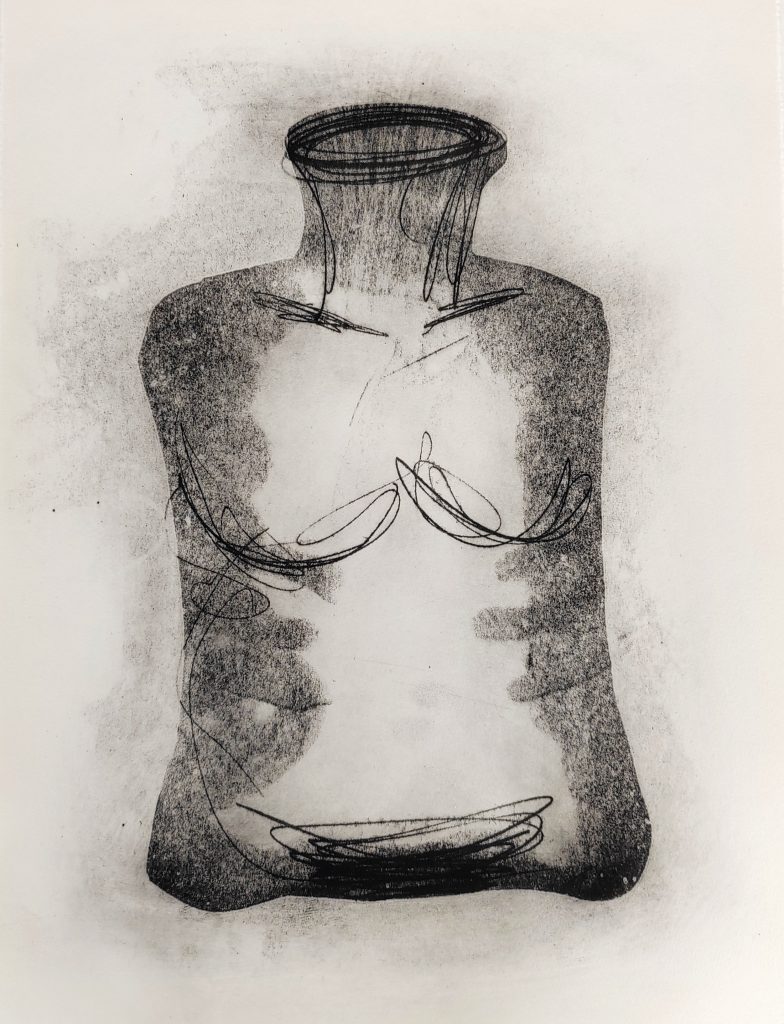
Allan Bank is primarily known as the former home of the Romantic poet William Wordsworth, and a place where his friend and peer Samuel Taylor Coleridge stayed for a period. There is a gentle subversion in introducing perhaps unwitting National Trust visitors to the creative outputs of an array of contemporary women artists in these former bedrooms. Bristol-based artist Emma Gregory’s contribution to the exhibition, ‘Comforter’ (2025), announces this feminine presence assuredly. It is an etching of a rubber hot water bottle, drawn in sketchy black lines with heavy, inky shading around its edges. While unmistakeably a hot water bottle, Gregory’s drawing also clearly suggests a woman’s body: the rounded underneath of a pair of breasts, two sharp clavicles, the shadows of ribs, a scribble of pubic hair, creating a visual correlation that feels instinctively playful in spirit.
The human body, and particularly its relationship to architecture, is central to artist Emily Speed’s practice. In contrast to the works on paper on display, ‘Soft Touch’ (2025) is a lithograph cast in plaster; a flat, solid tablet shaped with a roof-like apex, placed in front of a window here, where it is framed by the verdant landscape outside. It is beautifully mounted, held by a pair of wooden fingers that curl under the base, displaying it precariously like those old-fashioned stands for decorative plates. As in Gregory’s work, Speed merges parts of the body with inanimate features. A pair of legs – or a single leg with feet at either end – snakes in exaggerated curves across the surface of the plaster, joined in the centre by a section of neatly-drawn brickwork. A curved arm floats above it, palm upwards, curtailed at the shoulder end by one half of a dovetail joint with nothing in which to interlock. It’s unclear if these limbs are hard, or soft, or somewhere in-between; Speed’s work has an illusory and shifting nature, carried through in the painterly ‘shadow’ that runs down one side of the piece, making the flat surface appear three-dimensional.
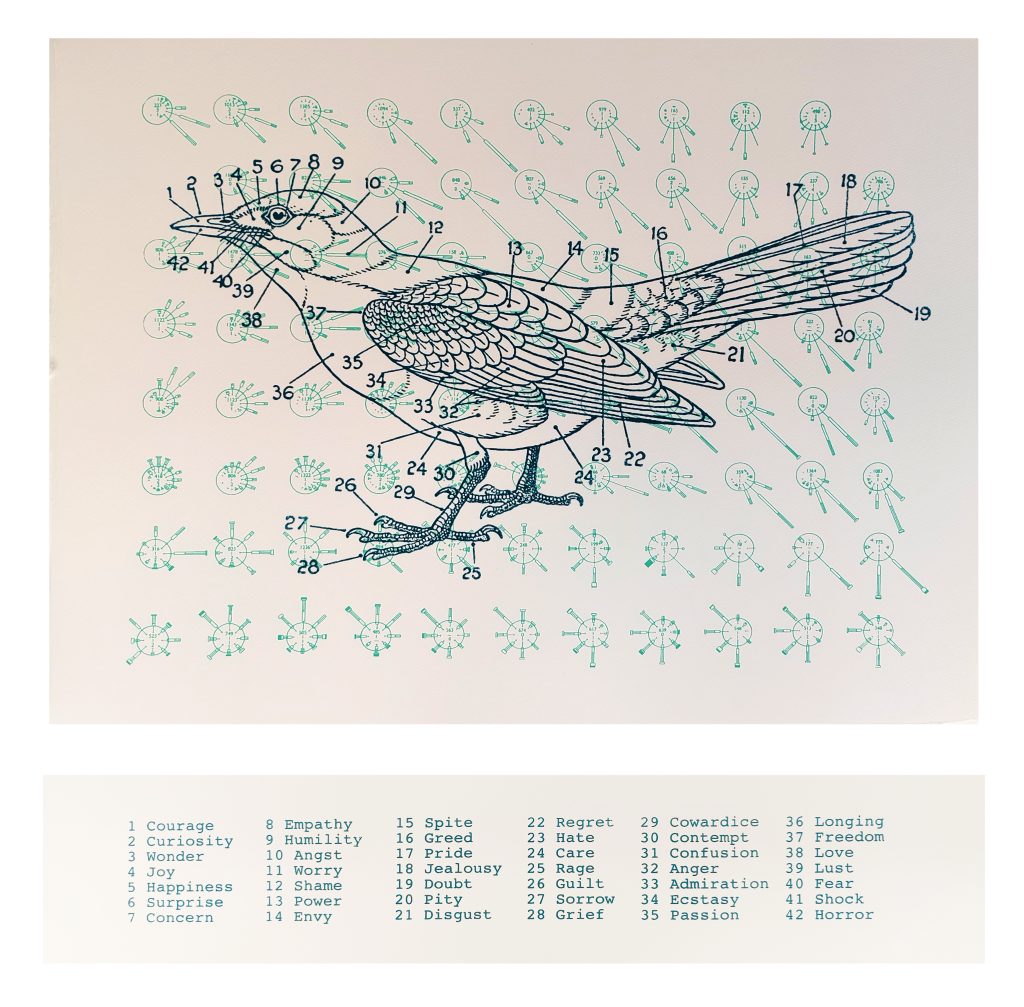
Above the fireplace opposite hangs ‘Hear the Unheard’ (2025) by Rebecca Chesney, a large, screen-printed diagram of a bird; possibly a blackbird, although my identification skills aren’t sharp enough to be sure as its plumage is colourless here. This is overlaid on a grid of arcane weather symbols, printed in green; they look like little pincushions, with the length and positioning of each pin corresponding to an undeciphered meteorological code. The bird is also peppered with protruding lines, numbered from one to forty-two, that work their way around the creature pointing to tiny individual feathers, talons, and other features of its anatomy. Unlike the weather symbols, this code is revealed to the viewer; a smaller framed print hangs directly underneath the bird, with a list of numbered emotions in a typewriter font. There are pockets of joyful feelings in the list – ‘3 Wonder’, ‘8 Empathy’ – but many betray darker emotions, in a discomfiting juxtaposition with such an innocuous-looking bird. ‘Spite’, ‘Disgust’ and ‘Cowardice’ lie here. The accompanying artwork label poses the question, ‘Do we ever really consider the feelings of those unknown to us?’, hinting that our lack of curiosity might contribute to nature’s depths being unknowable.
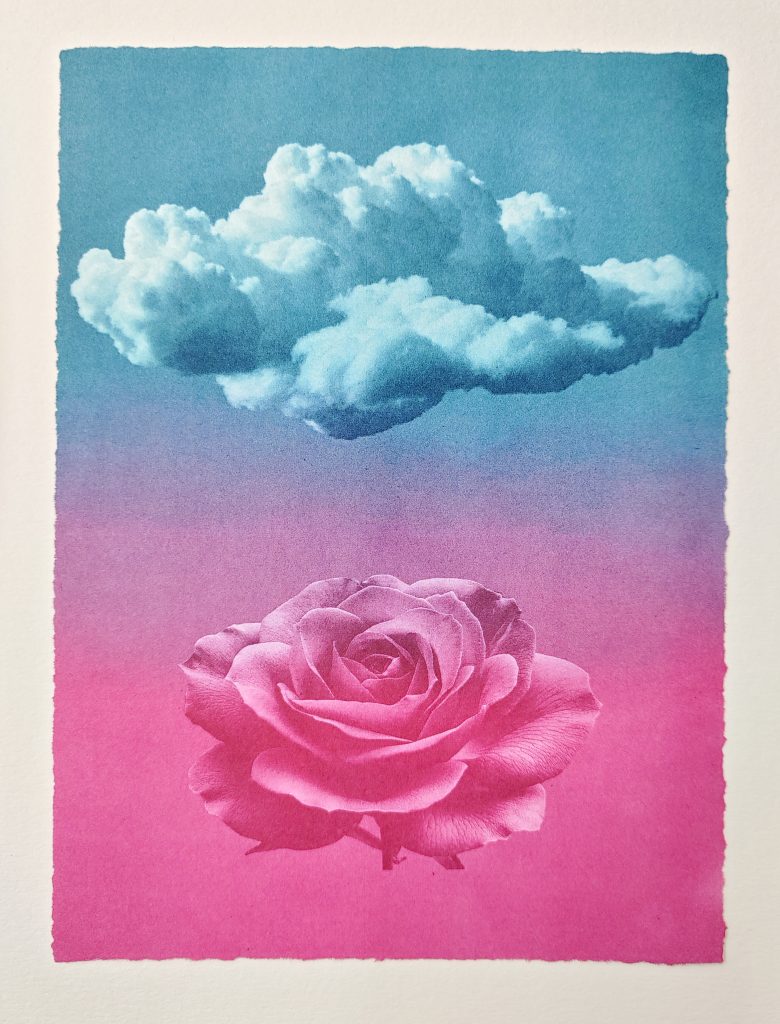
The works in the exhibition by twelve artists traverse a wide range of techniques and subjects, a visual record of the residencies’ ethos as a space for artists to experiment in print as an extension of their ongoing practices. A pair of small prints hung side-by-side demonstrates this neatly. Jenny Steele explores traditional weaving techniques through her recent artistic practice. Her print ‘Festoon’ (2025) depicts a thick tassel surrounded by cord, rendered in a hand-drawn watercolour screenprint. Pink and green inks bleed into one another around areas of negative space, making the tassel abstract, almost spectral in appearance. The paper’s surface is pocked and dented with embossings of botanical material. Next to it hangs ‘I Am You & You Me’ (2025) by artist Sana Obaid, continuing her ongoing exploration of spirituality through art. A full-bloomed rose opens itself up to a cloud floating above; they are similar in size and nearly fill their halves of the paper, presented as symbols of earth and sky. This work is a polymer gravure print, a kind of photographic print. The images within it are captured in fine detail, and the vivid background blends seamlessly from blue to pink; its pristineness creates an uncanny, dreamlike effect, and sits in contrast to Steele’s highly gestural work.
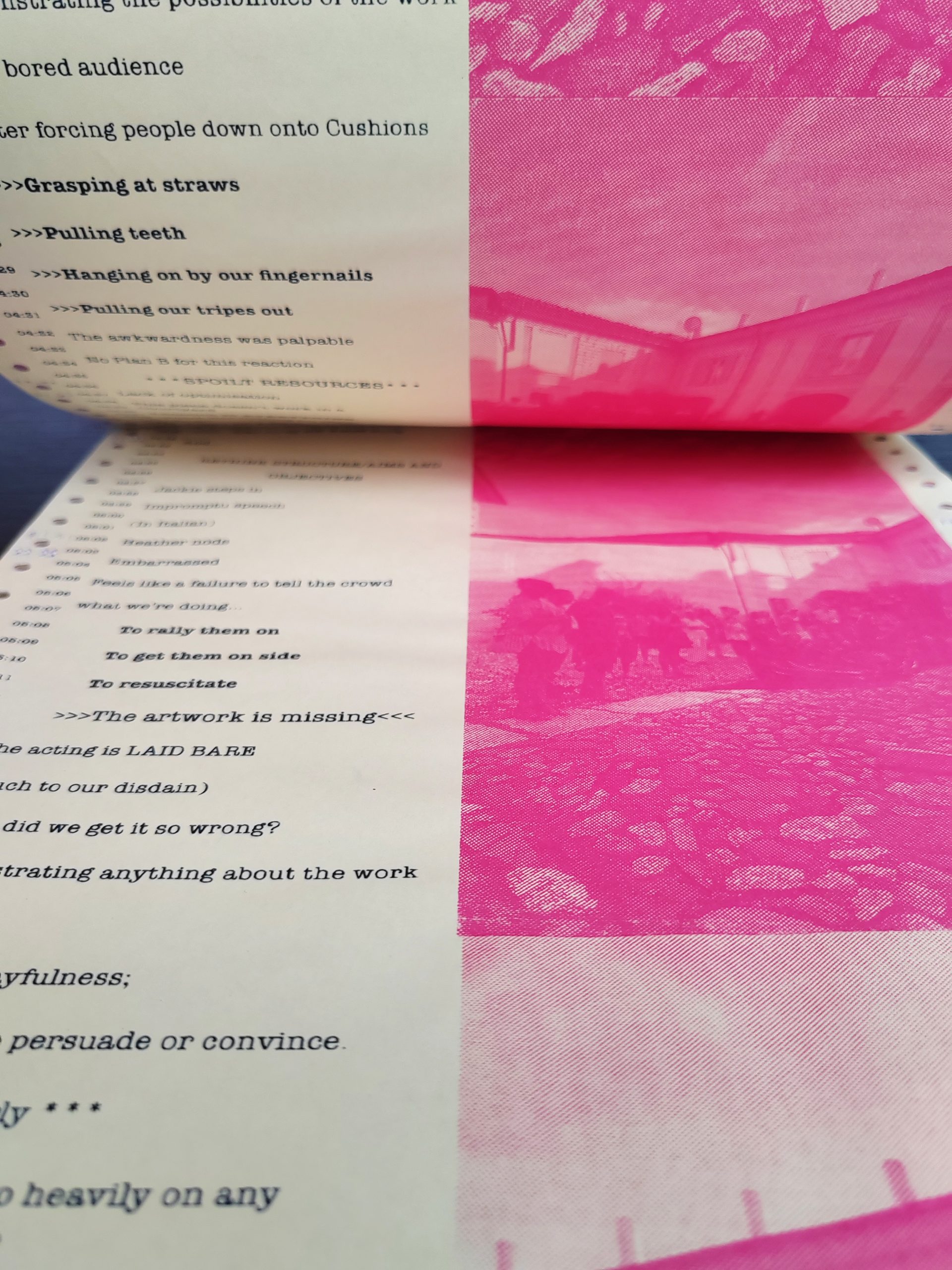
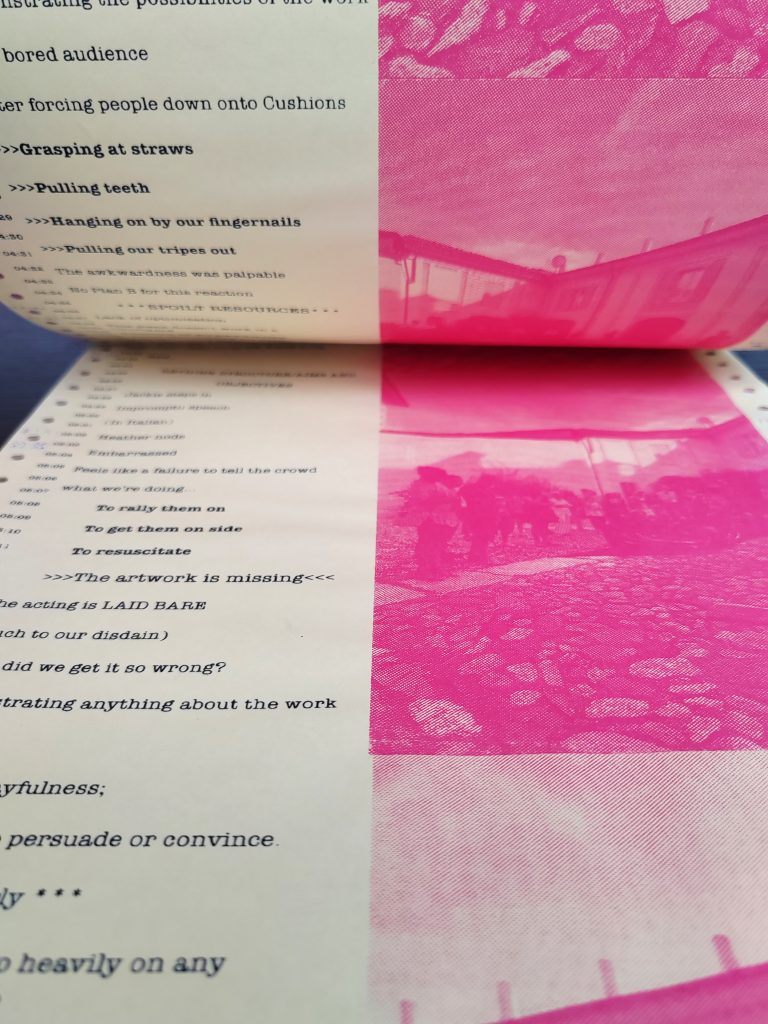
A display case in the centre of the room holds my attention for some time. It contains a copy of ‘Fever Dream in Triplicate’ (2025), a book by Artist A & Artist B: the collaborative name for Dr Jackie Haynes and Dr Heather Mullender-Ross, artists linked by their academic interest in Kurt Schwitters. The book is printed onto triplicate computer listing paper, the kind that comes in long, connected sheets with perforated edges. For practical reasons, just a section of the almost nine metres of text is visible, but it provides an absorbing insight into the book’s contents. Within it, the artists analyse what they describe as the ‘dismal failings’ of their participatory performance piece ‘La Gamba Selvatica’, which was performed at Dadameno art festival in Northern Italy in 2024. Printed alongside red-tinted photographic images of the event, their self-critique dismantles every detail of their work: ‘‘So what-ness’ dawns on audience, with each sip of their complimentary drink’ is typical of the acerbic written commentary. It is both devastating and funny, and its production in triplicate serves conceptually to hammer its criticisms home. A video elsewhere in the space displays the extended text as the artists narrate it, their voices overlapping and relentless, echoing the ‘fever dream’ of the work’s title.
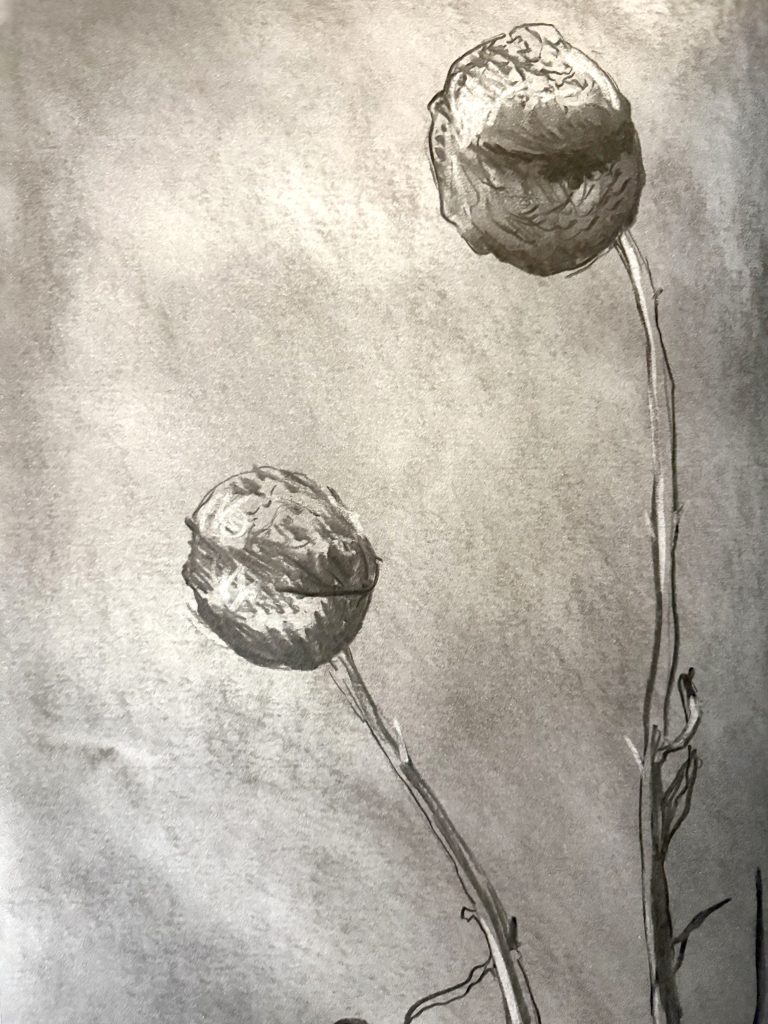
A recent Women in Print resident artist, Karen Davies, is given the expanded space of a separate exhibition at Allan House. Notes on Rest is mounted in the room formerly occupied by Coleridge. A set of four framed monochrome etchings of botanical drawings, from her ‘Everything is normal’ series (2026) produced at ACPS, is hung against the bedroom walls. They are intricate line drawings of plants grown on the artist’s balcony; a seed head like a cotton wool ball, the bend and curve of a leaf, a nascent bud, all cropped and brought into detailed focus. Davies showed me around the exhibition, and explained that as she was unable to begin her residency in person due to ill health, but was keen to get started, Women in Print arranged to mail the etching plates to her; a gesture in keeping with the supportive, cooperative spirit of the residencies.
A National Trust text panel explains how the relationship between Wordsworth and Coleridge had soured when they lived here together in 1808, exacerbated by the latter’s excessive intake of wine and opium, and keeping of antisocial hours. It sets the scene of a bedroom accustomed to witnessing nightmares and torment; Davies’s exhibition seeks to offer some relief from this anguish, and restore it to a place of rest. She has designed the space thoughtfully, embellishing the existing bedroom furniture with features espousing her artworks’ themes of care and recovery. The single bed is spread with a newly-made blanket, knitted in bright wavy lines by the artist’s mother. Leafy houseplants have been added to the shelves, and contemporary books on the subject of rest have snuck in front of leather-bound volumes on the British countryside, with notes inviting visitors to ‘Read me’.
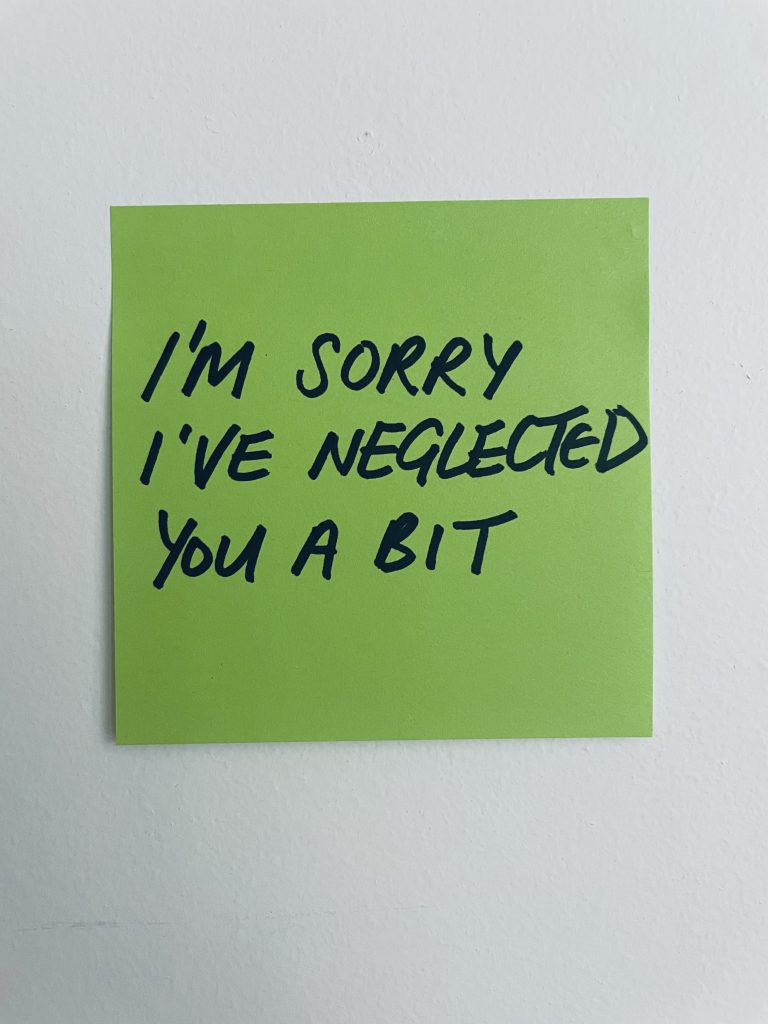
The artist’s nurturing relationship with plants is further explored in ‘Notes to Plants’ (2024), a set of green Post-it notes displayed here in a wooden vitrine. Messages are written on them in the artist’s handwriting: ‘Is that a new leaf?’ ‘You’re so beautiful.’ ‘Do you want to go outside?’ They remind me of the way I spoke to my infant child: soothing, with questions not expecting answers, but posed as acts of care and connection. The series is an offshoot of Davies’s work ‘Notes to Self’ (2020 – present), which she began posting on Instagram during the Covid pandemic. In a text panel, Davies observes how much more kindly she speaks to the greenery she shares her home with than to herself. It made me reflect on the lengthy critical ruminations in Artist A & Artist B’s work, the heavy feelings held within Chesney’s bird, and the hidden internal dialogues we all wrestle with.
There are numerous such connections to be teased out between the artworks on display at Allan Bank; the time for thoughts to percolate is important for viewers as well for artists. At the root of this trio of exhibitions is the space and support for creative experimentation, a philosophy carried from Alban Davis and her small artistic community in the 1940s, and given a contemporary legacy. The works produced as part of the Woman in Print residencies span printmaking in many techniques and guises, sometimes surprising, pushing at the edges of what print might mean. Mounting them together here in Cumbria, alongside the archival work of Alban Davis, feels like a point of taking stock, rather than the endpoint that exhibitions often signify; a moment to reflect on what has come before, and to consider how this community might develop next.
Women in Print until 1 July 2026; Notes on Rest until 5 August 2026; The Caravan Press until 20 December 2026, Allan Bank, Grasmere.
Women in Print includes works by:
Artist A & Artist B (Heather Mullender-Ross and Jackie Haynes)
Emma Gregory
Rebecca Chesney
Heather Peak
Lubaina Himid
Helen Cammock
Anna Júlía Friðjörnsdóttir
Jenny Steele
Alicia Paz
Sana Obaid
Denise Courcoux is a writer based in New Brighton.
This review is supported by Artlab Contemporary Print Studios.
Published 26.05.2026 by Jazmine Linklater in Reviews
2,407 words