Early in our conversation, Lisa Milroy directs her gaze over my left shoulder, gesturing to an artwork on the wall. We’re sitting in a small office adjacent to Artlab Contemporary Print Studios (ACPS), the practice-led research and printmaking studio in Preston where Milroy is currently artist in residence. I pivot, look towards the large monotype, made up of several individual prints positioned to construct the flat patchwork image of a checkered dress. The pattern’s red-blue lines are misaligned in places, or entirely faded. Sweeping earth-tones fill the negative space but leave a white halo around the form, which reads as an echo or memory of a dress rather than a direct imitation. Fragments of an unspoken story are implicit, both revealing and withholding the impression of a body or identity.
This work, ‘Taken Apart’, was made in 2019 during Milroy’s first visit to ACPS and is now on permanent display here. Recalling this fondly, she remarks how pleased she was to be invited back this year for the Women in Print Residency, joining a growing list of artists including Lubaina Himid, Alicia Paz, Emily Speed, Jenny Steele and Sana Obaid. Established in 2018 and now an integral project within ACPS, Women in Print is dedicated to exploring printmaking as an expansion of women artists’ existing practices. Since 2022, Tracy Hill and Magda Stawarska have curated the project’s residency programme, which offers four artists per year full access to the studios in a ten-day residency. The participating artists may never have worked in print before, but with the support and expertise of ACPS’s research team, they are afforded the opportunity to experiment with the vast materials and processes available here.
It is early morning, mid-week, late winter when I visit Milroy, who has just a few days of her residency left and is eager to get to work. I promise concision, and so, skipping past idle chat, we dive headlong into conversation. Milroy speaks freely and with spirit, her voice soft yet exuberant, detailing the ever-evolving, interwoven strands of her practice.
In mid-1980s London, after studying at Saint Martin’s School of Art and Goldsmiths College, Milroy began to gain recognition for her compositions of everyday objects painted with a highly-detailed, realistic style yet totally displaced from their expected, or even any, context other than an imagined space. These works, depicting shoes, lightbulbs, doorknobs, handles, vases and countless other familiar items, represent her early enquiries into the nature of making and looking through the lens of still life. Also included among her objects categories are Greek vases decorated with scenes of people, and postage stamps characterised by landscapes, animals or portraits. As her career evolved, she continued to explore artist-subject-viewer relationships through collections of objects but also expanded her still life repertoire to include buildings, landscapes, textiles and representations of people and animals, approaching each with the same meticulous attention. Recent sky paintings explore moments of light and space in painstakingly rendered expanses of drifting clouds. Her painting ‘Finsbury Square’ (1995), currently showing at the National Art Centre, Tokyo, depicts the face of a city building which, on second glance, reflects the vast sky in its small square windows, implying the vastness opposite the building, behind the gaze of the viewer. The static, human-made subjects of these paintings act as portals to other spaces, and throughout her career, these have given her a way to explore the parameters of still life and just what a painting can be.
Milroy recounts her interest in still life, reflecting on its ability to draw us materially closer to a subject while setting in motion a departure from it, catalysed by the memories and/or emotions we associate with it. This duality, the co-existence of opposing states or the transition between states, has always been fundamental to her work, which spans painting, 3-D paintings, painting installations that can include a performative element or audience participation and printmaking. Presence/absence, logic/intuition, stillness/movement, order/disorder, past/present. as we converse, I grasp her deep, felt awareness of these dualities, and I get the sense that artmaking itself might represent some internal negotiations around their presence inside her – both the light and the dark.
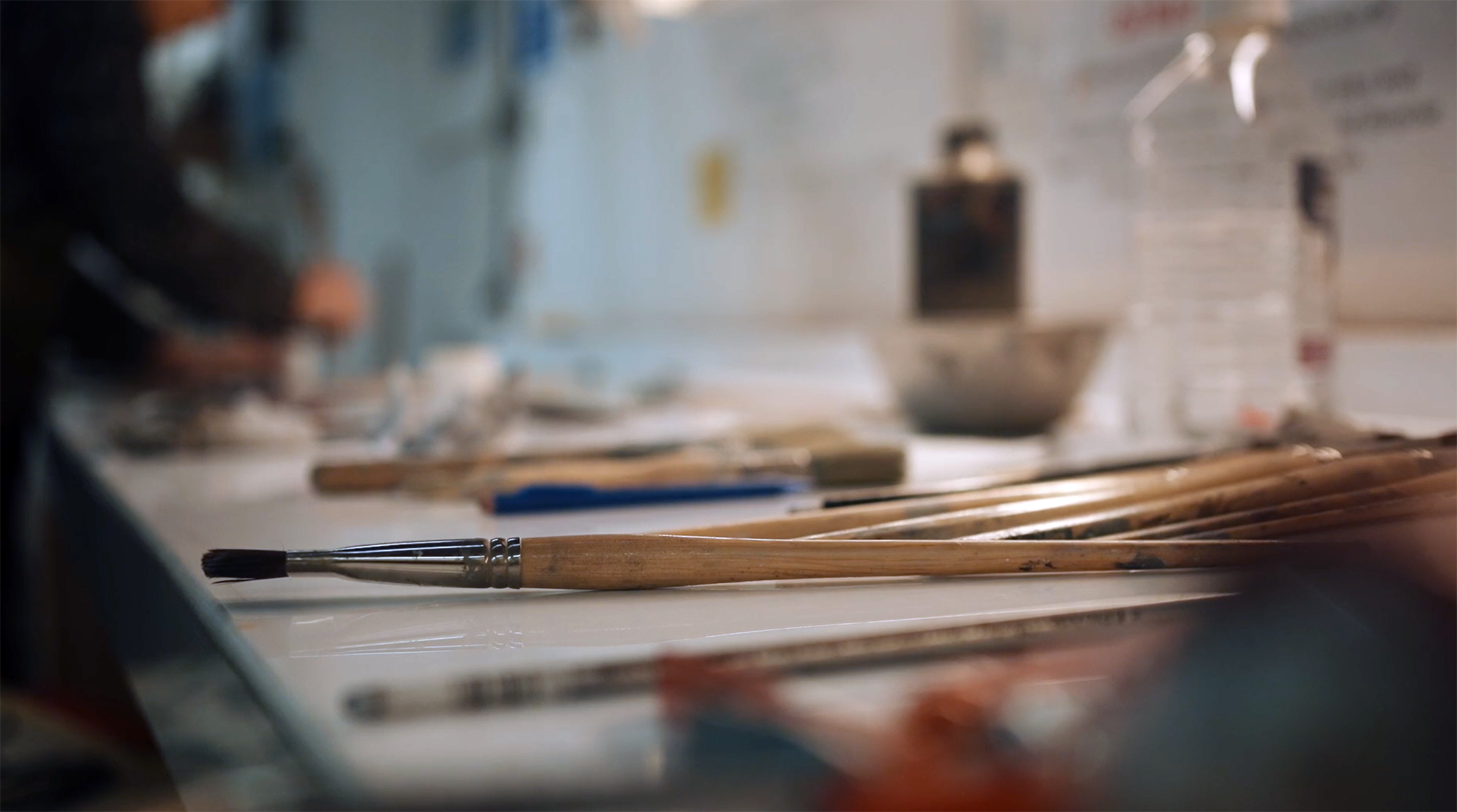
Milroy pushes on with her work as I sift through some of her early residency prints, observing how these multitudes and dualities turn over in her work. Ahead of me on a work bench are countless attempts to excavate the potential of new mediums through variations on certain motifs: shoes, dried wildflowers, feathers, building façades. For her, this residency is all about materiality: how might it shape the representation of a motif? How can it shape meaning? In Milroy’s words, how does it ‘affect the feel’ of a work? These are the questions she asks of her materials, weaving between processes of etching, monoprint and lithography.
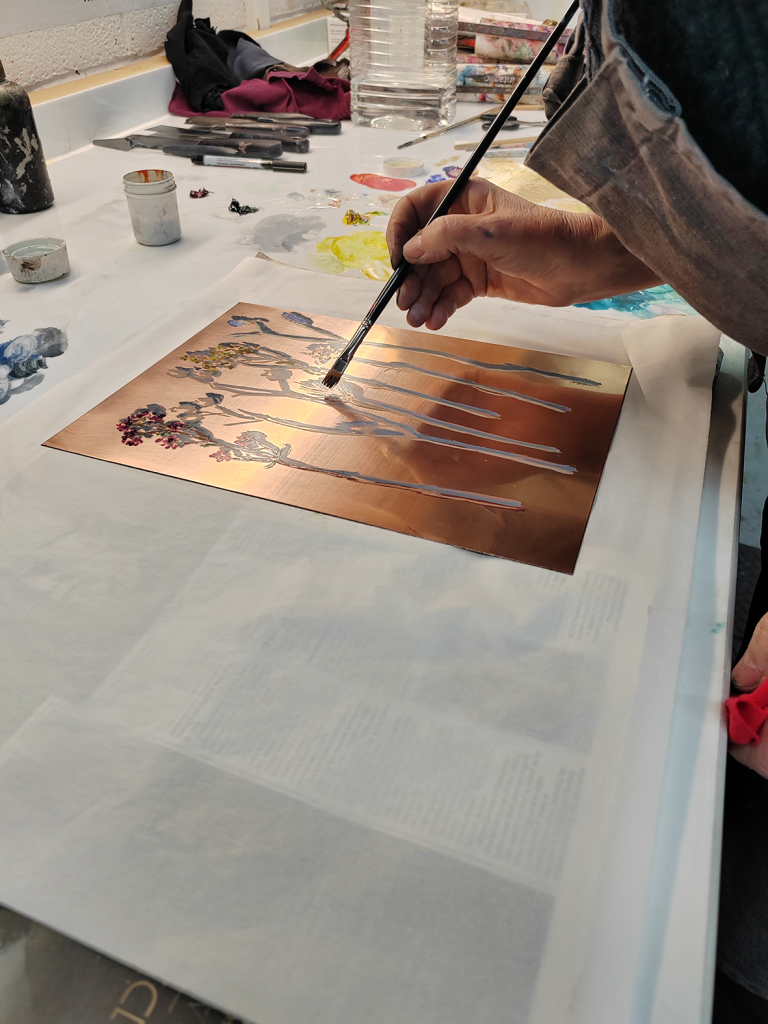
In etching, her skill as a draughtswoman is evident. I am drawn to the intricate contours of plant matter and feathers, laid out in a row in the print, as if being collected and categorised. The subject is one of a fleeting and transient nature, with connotations of lightness and air, yet has been rendered with solidity – in its form, its dark shadow, its crisp lines.
In monoprints, one of her chosen motifs is a black, closed-toe kitten heel black court shoe. Milroy has often returned to this pair of shoes, which she initially drew from observation early in her career, but has since only drawn from the image inside her head. With paint brushes she works directly onto an aluminium plate, diluting ink with linseed oil and a little turpentine. In the resulting prints the variations lend some images to realism, with definitive marks in deep black and shades of red, while in others the marks still reference the shoe but appear more flowing, ethereal, abstracted. Some evoke liquid: I turn a print on its side and in strokes of hazy grey, translucent ink I see water, swimming bodies, marine life. Some are printed on Japanese Kozo paper, which is made from the bark of mulberry trees. It is thin but the natural fibres make it very strong, giving the work flexibility, translucency and a fibrous texture, so they feel grounded yet retain a certain lightness. In the printing press, a sheet of cartridge paper lays beneath the Kozo paper to absorb any ink that bleeds through, making a ‘ghost print’ – a strangely beautiful, dislocated shadow.
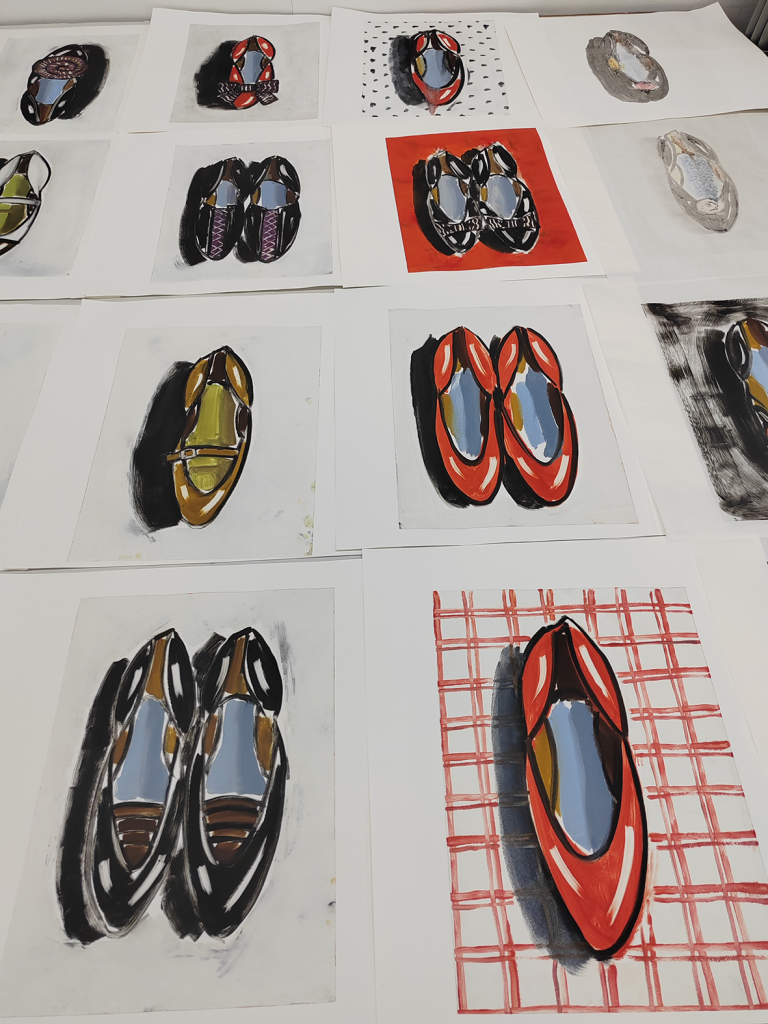
Musing on her growing collection of works and printmaking processes, Milroy tells me how she ‘want[s] these works to be studies on memory’. The black court shoe, for example, has persisted as a motif in Milroy’s practice in many paintings and a range of stylistic approaches. Milroy initially drew the pair of shoes from observation early at art school but went on to draw from an image of the shoes held inside her mind. The shoes in Milroy’s work have a timeless quality and the depictions can trigger associations for the viewer, taking them far away from the literal shoe whilst still referencing the familiar ordinary object.
In her printmaking residency, by placing existing motifs in new material contexts, Milroy encourages their interactions with different processes, and the resulting artworks tread a path between the past and present, informed as much by their own subject as their previous iterations. Viewing the artworks, I feel I am moving in and out of focus, in and out of my own recollections, ahead of an object that appears to repeat and change and yet remain resolutely itself. The visual or emotive qualities that persist through each image – what makes the shoe the shoe – are revealed with each repetition, the variants drawing out some essential truth or essence held within, be it miraculous or mundane. Milroy’s work attends, at a deep level, to our human relationship with what surrounds us, inside and out: how we might transform it, how it might transform us, and what about it remains.
The co-existence of opposing elements in her prints – fragility and weight, realism and abstraction, past and present – is reflected in the contrast Milroy feels between the mark-making in etching, which lends itself to lightness , fragility and delicacy, and the mark-making in monoprint, which feels to her ‘exuberant… sensual… energetic’. During her residency, she is both encouraging and tempering these characteristics by experimenting with linework, colour, texture and tonal variety, the visual components of her work which probe and question their boundaries and their fixity. The works produced during the residency see Milroy engaging with the diversity of printmaking as a medium, which offers an abundance of processes and endless capacity for variation within those. Peeling through print after print, I imagine that, by the end of her time here, she will surely have made hundreds. They reflect not only that abundance of printmaking processes, but the multitude of ways that an artist might interact with a subject and a viewer might receive it.
Milroy acknowledges her deep appreciation, gratitude and debt to Japanese art and culture in her practice over the years. Since her first visit to Japan in 1990, when her work was in a survey exhibition on British Art at Fukuoka Art Museum in Kyushu, she returns regularly to travel, to research and to exhibit her work in the country. Her paintings are now populated by motifs of Japanese food, architecture, ceramics, clothing, textiles and Ukiyo-e woodblock prints.
On an artist residency at Kyoto City University of Arts in the early 1990s, Milroy drew inspiration from the infrastructure in the Gion district. After this residency, she made a drawing from her own photograph of a traditional Kyoto Machiya house, then transferred the drawing onto acetate film in the process of making photogravure etchings. This acetate, kept in her studio for many years, has resurfaced with her ACPS residency, allowing her to revisit these building façades in lithography – a process that involves drawing onto smooth limestone using greasy crayons and tusche that ink adheres to. Milroy has reproduced the monochromatic image at a larger scale before experimenting with different papers and overlaid hand-drawn details to create an edition of ten unique prints. The original has solidity, the shadowy building exaggerated by a bright surround, whereas in her new lithograph prints, the same clustered shutters and panels are treated lightly, with lines that waver, shadows diffused. Later, I watch Milroy working on the stone, head down, rubbing away and blurring strong lines to invite this softness to the image, which gives the impression of a faintly rendered memory. Milroy is devoting herself once again to the Kyoto houses by offering new materials and processes to them. Two points in her life are connected through these prints, and both are as present as the many years that have elapsed between them. Like a rhythm, her work often explores this cyclical movement towards and away from a subject, offering attention to both the present and the past, infusing one with the other.
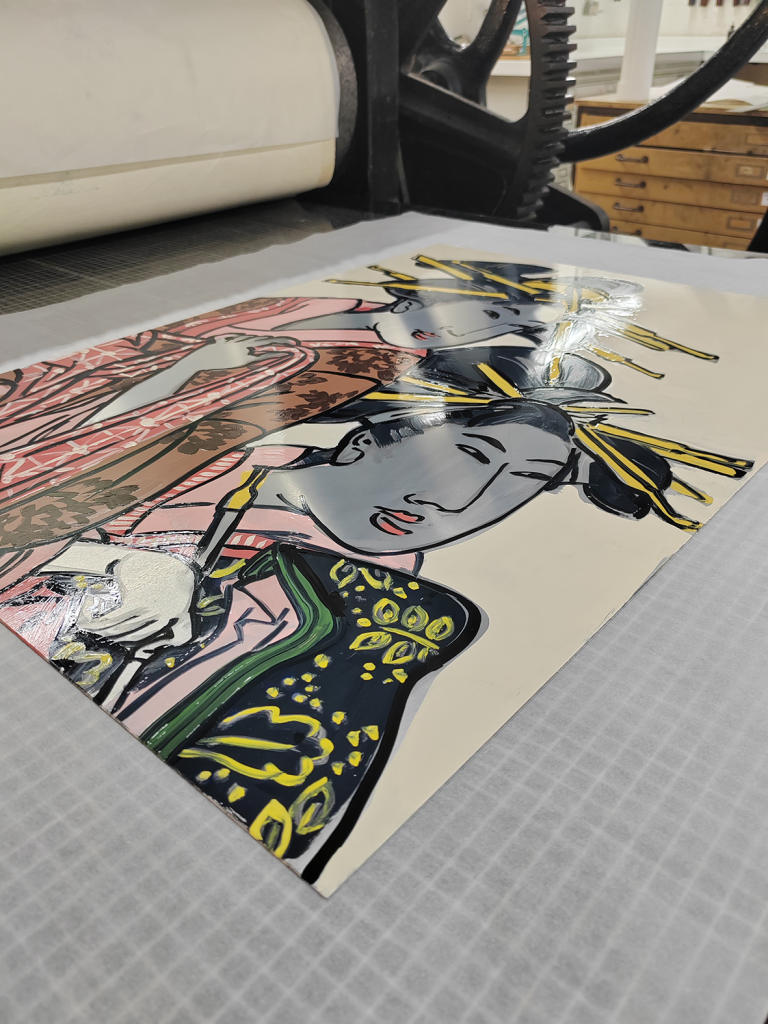
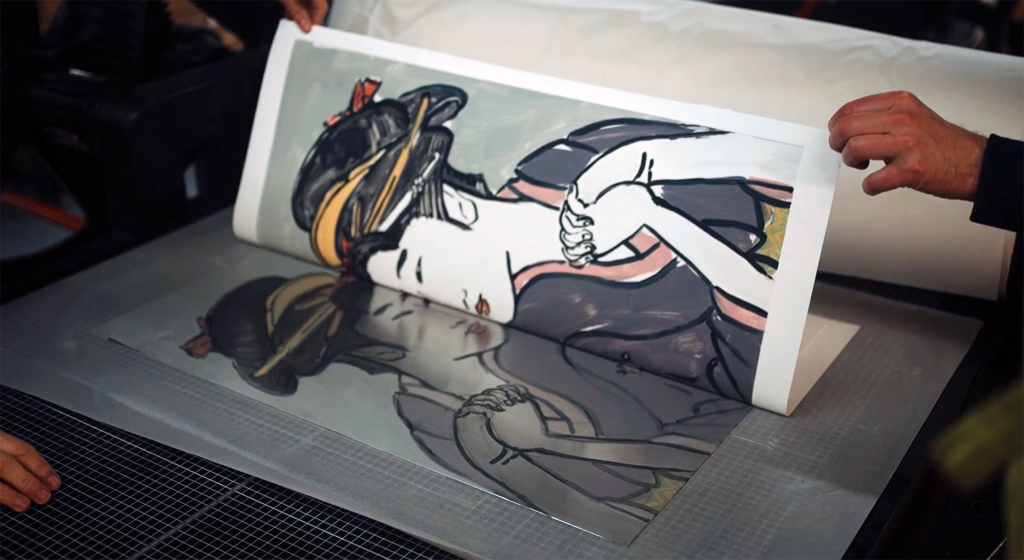
The fourth material experiment of Milroy’s residency is her monoprint transcriptions of Ukiyo-e woodblock prints, immensely popular during the Edo period, by Kitagawa Utamaro, Chōbunsai Eishi and Kitagawa Kikumaro. Commonly translated as ‘pictures of the floating world’, Ukiyo-e prints visually narrate scenes from folk tales, history or everyday Japan, often in detailed and vibrant depictions of pleasure, love, beauty and nature. Her own visual transcriptions respond to their form and feeling, a method that has been integral to her practice since the 1980s, and makes clear her deep and sustained appreciation for Japanese art. Milroy mentions that their stylised, often idealised depictions of women offer her the opportunity to celebrate solidarity between women in her own work and inspired her Mannequin series of the mid-2000s. Rather than replicating the Ukiyo-e prints directly, she translates the pleasure she finds in their imagery and their notions of the everyday into line, colour and pattern, exploring how drawing and painting operate around each other. Her careful renegotiation of past works, whether her own or her appreciation of the Ukiyo-e prints, keeps them alive and continually evolving. Each new work unfolds from the seeds planted by another.
The most striking constant amongst Milroy’s prolific output, both in her wider practice and within this residency, is not a subject, motif, technique or material, but a mindset. For her, still life is not a tradition, a visual language, a habit or a crutch but a way of seeing the world and representing its complexity, and this carries across all her works. At the heart of this method is the duality within the word itself: still to mean looking, life to mean action. Both stillness and movement, bound together. Milroy’s work is searching for that movement and how it might manifest through moments of stillness, return, repetition. ‘You’re going to see the same thing, but always in a different way.’ Printmaking itself, as a process of reinvention through the repetition and alteration of vastly adaptable processes, matches slowness with action, intention with a releasing of control, and can afford an artist the opportunity to observe their own work unfold and expand capaciously.
Milroy observes this expansion in her own work, describing how the residency has given her the opportunity to unlearn habits, or at least learn which habits she harbours. We talk on this – how habits can be useful but also deadening, how they might stagnate an artist but also provide impetus towards making, towards maintaining a critical focus. Milroy recounts the habitual way she depicts shadows in her work and tells me that the shadows in all her paintings will always fall on the right-hand side of an object with an imagined light source coming from the left. She speculates that the habitual positioning of this imaginary spotlight might come from reading in English, left to right, the same direction she usually begins to scan an artwork. For her, these shadows translate in the image as light to dark, which could also read as life to death.However, in printmaking, the resulting prints depict the reverse of the plate, so the shadows are on the left, ‘…it’s almost like seeing it from behind, in a mirror’. Dark to light, death to life. Her shifting shadows remind me of the presence of a ‘shadow self’ – one’s inner world, the self behind the ego, and I suggest that printmaking might be a good method of stripping back these layers, rendering an artist partly blind to their usual methods of control over an image, so they might be able to see or make in new ways.
Milroy’s curiosity towards these complex elements in artmaking is radiant. It’s refreshing to see an artist visibly excited by their practice and its continual transformation, the value of which must extend not only to me but to Tracy Hill, Kathryn Poole, and all the other creatives at ACPS who are working alongside her. As our conversation darts between years, subjects, objects, countries, I realise how critical it might be for Milroy to articulate the concepts and questions on her mind, and she agrees that this residency provides rare companionship for an artist who usually paints on her own, ‘alone but never lonely’. Here in the printmaking studio, she is offered artistic freedom alongside company, structure and support from technicians that, for a while, become essential to her continued work. There is movement here between the singular and collective, between intuition and order, that reminds me of the dualities at the heart of Milroy’s work. It seems to me that ACPS have cultivated a space of the same synergy, which, through ongoing experimentation, dialogue and collaboration, might just pin down the movements of the artist’s mind and encourage them to hold shape, even if just for a moment. With the next print, the shape can change again.
This exploration was informed by conversations with Lisa Milroy, part of a series of written responses to the Women in Print artist residencies at Artlab Contemporary Printmaking Studio, University of Lancashire, Preston. www.artlabcontemporaryprint.org.uk
Sally Button is a writer and artist living in Lancaster.
This exploration is supported by University of Lancashire.
Published 17.04.2026 by Jazmine Linklater in Explorations
2,745 words


