
I first met the North-East based performance artist Ziza in May 2025 at The Late Shows in Newcastle Upon Tyne. We stood together in the office and studios of visual arts producers D6: Culture in Transit, watching a projection of their performance installation ‘Tracepace’ (2025). The video is part of a body of research-based artworks Ziza is producing during their three-year residency as part of D6’s Contested Desires: Constructive Dialogues, an international programme for artists and organisations engaging in discourses surrounding colonial legacies.
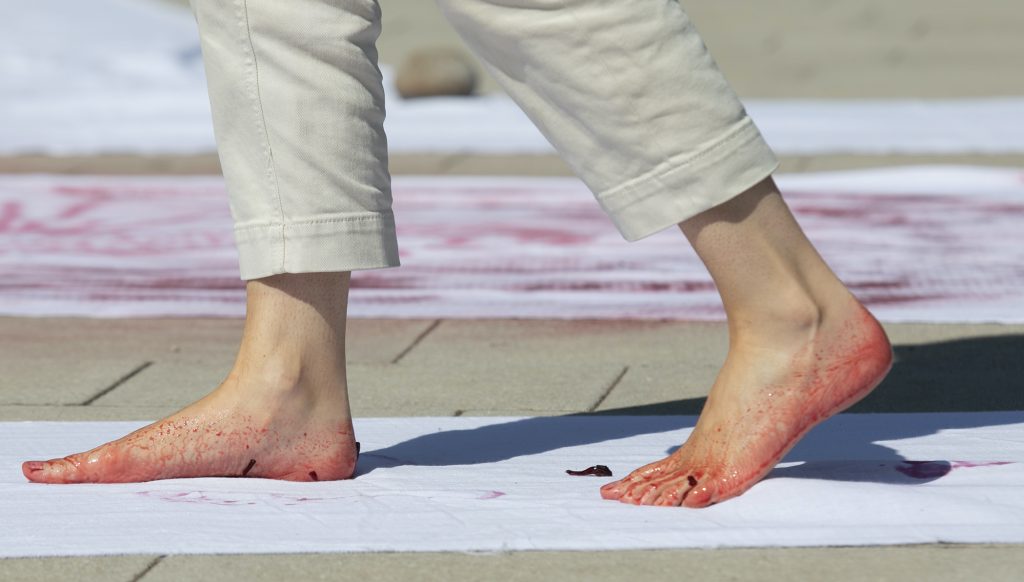
‘Tracepace’ was made during Ziza’s six-week residency in April 2025 at the Memory and Human Rights Museum in Santiago, Chile – a museum dedicated to victims of Pinochet’s 1973-1990 military dictatorship. Performed and filmed outside on the museum’s esplanade, a drone camera offers the perspective of a helicopter. Ziza is the central figure on the screen. The top of their head is petalled by a blousy handmade ballgown, sewn in the colours of the Chilean flag. As the camera circles, we watch Ziza bend and paint an emoji-like motif of a seahorse on the floor canvas that they then walk over, their bare feet dipped in organic hibiscus ink, leaving a trail of pink prints. Ziza invites onlookers and passers-by to remove their shoes, dip their feet and leave their marks on the cloth.
That night at the Late Shows, Ziza and I had a tantalisingly short conversation about that cute pink seahorse. I wanted to know if it referred to queerness, and a gender fluidity that was, to me, both alluring and jarring in a piece of work drawn from a museum collection dedicated to disappeared people. Ziza explained that yes, initially they were drawn to the seahorse in the museum’s collection because of that queer symbolism and were then overwhelmed by its origin story.
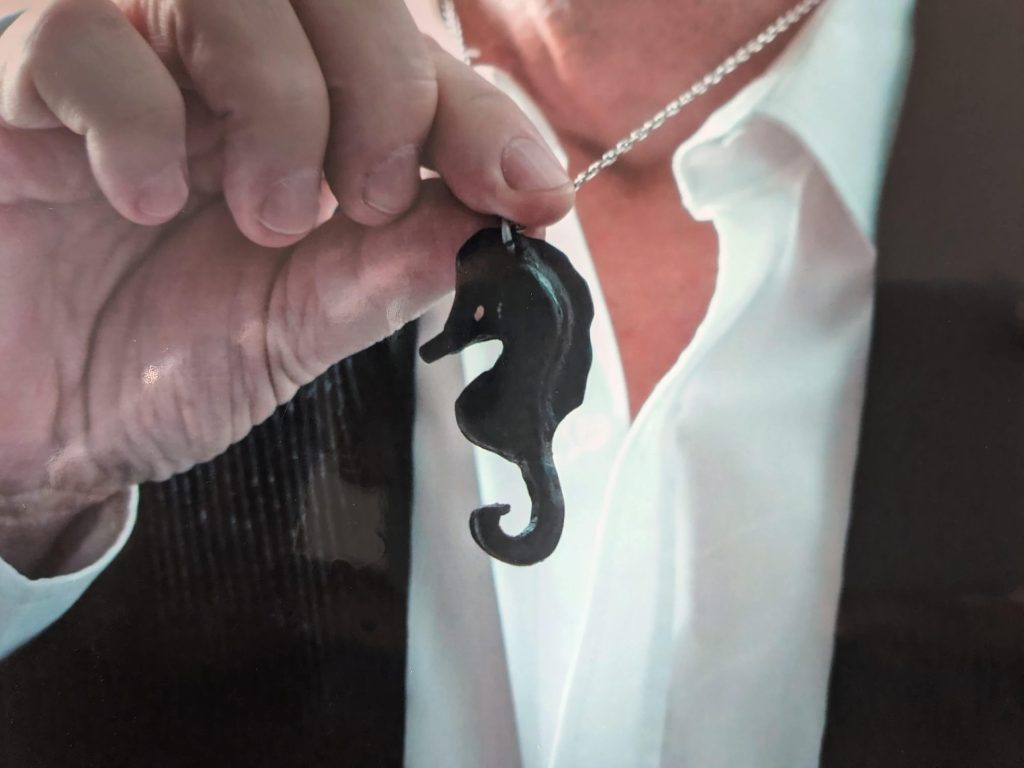
I remember looking at it on its tiny plinth in the museum’s cabinet and asking, ‘What is this figure of the seahorse?’ The museum curator explained that the prisoners were blindfolded after beatings from the guards, and the only time they were allowed to lift the blindfold a little was when they were taken to the bathrooms, enough so they could see just their own feet, and the drain covers that were in the shapes of little seahorses. We were touring the museum with two survivors and one straight away pulled out of his shirt a pendant of a seahorse hanging from a necklace. He told me that the prisoners would carve these seahorse pendants from the remains of bones in the meat they were fed. For them, it was the only thing they could see as the water washed away their blood over their feet and down through the seahorse drain covers. They had chosen to make the seahorse a symbol of their experience. It became this figure of hope, that there is light. It is a symbol of witnessing. We saw this. This happened.
I felt such a connection with Ziza at that moment, and really sensed their overwhelm with the responsibility that comes with making work that draws on elements of other people’s stories. I wanted to talk more about the ability of this little fish to hold so much meaning and do so much work. I wanted to reflect upon the ways artists approach residencies; what we bring and take away from them, and what we leave behind. The rest of this article is a collage of extracts and reflections from our long follow-up conversations.
Kate Sweeney: The way your work blends your Rwandan identity, queer identity and your passion for clothes and dressing up feels really joyous and celebratory. Is that fabulousness a sort of ‘tool’ to get into a room, to begin a conversation?
Ziza: I’ve always said that I can’t be bothered with being fabulous as a daily thing. It has always been a tool to create. Back home, there was always this fabulousness that happens on Sundays, you know: Sunday Best, as they call it. We would dress up just for the service at church. Sundays were not religious as such for me, it was more an opportunity to see my friends and to just be in this congregation and dance. It would become a whole party. In Britain, as soon as we got here, we lost it. The community of Black people in Gateshead was very, very small. It’s small now, but 22 years ago, it was something else. I just remember kind of being starved of that expression.
KS: How did you end up here, in a tower block in Bensham?
Ziza: Well, I’ve moved now, to a different part of Gateshead, but yes, there was an estate called Chandler’s Estate, which was by the big Tesco. There were these big flats and we lived there when we came to Britain – actually from Nairobi in Kenya as we had to leave Rwanda before that – to join my dad, who came here as a refugee in 2000.
KS: Not so easy to find fabulousness there maybe?
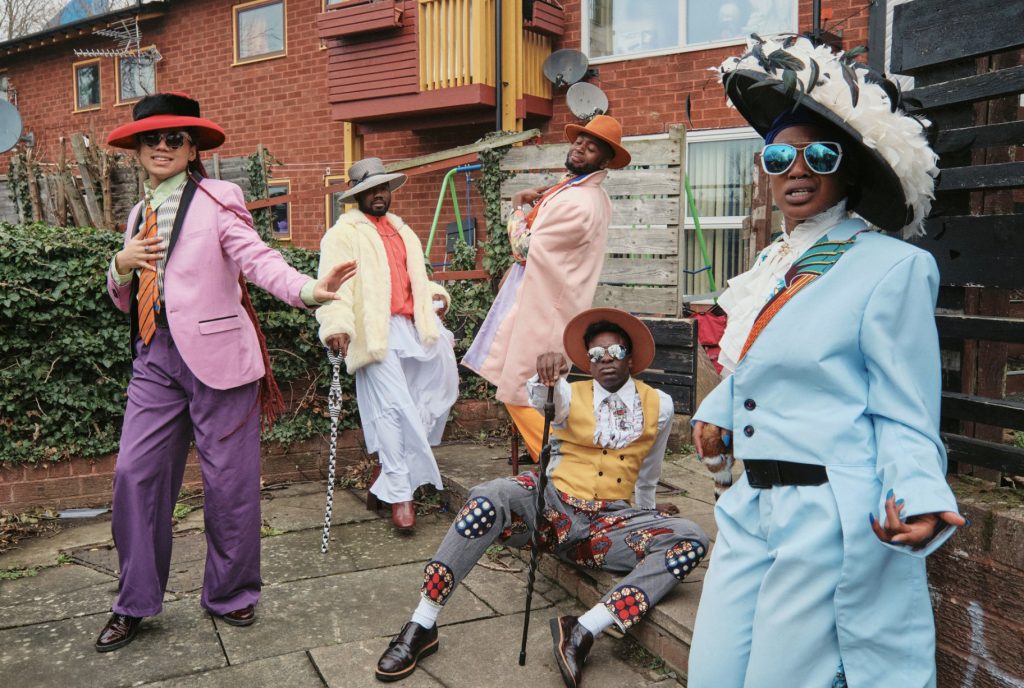
Ziza: I would dance in my room. But I was not out to my dad, who wanted to mould a certain kind of masculinity around me. So, I actually enrolled on a foundation dance course at Newcastle College without his knowledge. I did a computing course and secret dance classes at night. I did find the fabulousness we’re talking about, because if we had a show, we would dress up – there’s always costume in dance. But it was challenging to go into the contemporary Western way of holding oneself, you know, keeping your hips square. I wanted to make work about being flamboyant. And I really didn’t see any representation of my world, or things that I wanted to be part of, so I started creating work I wanted to be in. I drew on my memories of growing up in Rwanda, and being a part of other African communities, like the Congolese migrants who had come to Rwanda because of economic poverty. We just used to dress up and dance on the streets.
KS: When watching ‘Tracepace’, I felt like I was watching an attempt to shift focus from the pain of displacement to incorporate a celebration of what movement releases in the body. I wonder whether you could talk about the ways you interpret moving bodies – across rooms, lands and continents. Is it a form of communication and a way to create connection with others?
Ziza: People are always moving in my work, I don’t know why. Moving in the same direction, almost in procession, whether migrating across Central Africa, or being led, as with Pinochet’s prisoners in Chile; not meeting, just all moving in the same direction. I have moved a lot so I feel that experience, I think.
KS: In the video I really liked that the footsteps are much clearer and dense near the ink bowl and, as they spread out, they fade. The footprints seem to become a map of both presence and loss.
Ziza: I love feet. The museum is full, full of all these faces of people who disappeared. I was really interested in this idea of just using feet. I wanted to bring an audience into a collective action. I remember thinking about this idea of being led somewhere, and I wanted, in a very simple way, to give those people’s journeys visibility. They were going somewhere, all in the same direction.
KS: Why pink? Is the pinkness of the footprints and of the seahorse a ‘remove’ from their original references?
Ziza: The hibiscus ink, yes. I remember thinking, oh, my gosh, this is going to be quite bloody. But it was actually pink-ish, it doesn’t look bloody, it looks beautiful. As a performer, coming from improvisation and experimentation, I’m thinking, what power do I have in my body right now? Where’s the agency? It’s not about regurgitating history. The question is, who am I in this? I have to be rooted in my way of seeing things, and my way of imagining, and my playfulness, even in difficult conversations, even with difficult subject matters.
KS: Is the seahorse like the hibiscus then? A sort of key to connect you to the museum collection, but also to take you out of and forward from the museum and back to yourself, I suppose?
Ziza: Yes, that’s a good way of putting it, I think. From there I am involved! I want to create a beautiful outfit, for example, or what is beautiful to me anyway. In ‘Tracepace’, you see a figure, it does not matter whether I’m a male or female, it doesn’t matter, and you see someone who is not white, and they are being… unusual… and for me, this is my seahorse, or maybe, I am even the seahorse!
KS: And the performance is, is it a way to honour the stories you have worked with? To leave something behind?
Ziza: Yes, I think so. It’s an exchange. After my time in Chile, I left with my video, and all these photos I took as a way of taking in the landscape. All these little things, the memories, the seahorse, the photos – these are like notes in a sketchbook.
KS: Do you feel a compulsion or an expectation to bring those elements together into a finished thing as part of the wider Contested Desires project?
Ziza: This is a good question because I have to say, this is one thing that is challenging with a short residency. The Museum of Memory and Human Rights is not an institution of artefacts from thousands of years ago. It is rooted very much in the legacy of recent oppression, dictatorship and the disappearance of people. There are those who think Allende was actually not good, and that Pinochet was great, you know, they loved Pinochet. This kind of thinking made me reflect on my native country, Rwanda, where genocide also happened, and people killed each other. I did think maybe that could have been an interesting direction to continue with, but a residency is a short time and there is danger in making work without time. So, it feels like the work functions as threads, these small beautiful things are enough, I think.
Ziza’s video, and our conversation that night in May at The Late Shows, reminded me of how fertile a residency can be. It is an opportunity for an artist to create a body of work, not as a set of outcomes, but as an archive of drives and desires. It is a chance to gather up our materials, tools and methods to draw from this bodily repository in a brand-new context. During their time in Chile, Ziza has let their ‘body’ rub up against other figures and forms in the hope of reproduction. By exchanging and combining echoes and traces of personal histories, they have produced seeds for new work. For me, the pink seahorse has become a metaphor for this ‘queering’ of the reproductive process, by which new individual entities, still containing the residues and imprints of their separate origins, are generated.
Kate Sweeney is an artist based in Newcastle upon Tyne.
Published 17.10.2025 by Lesley Guy in Explorations
1,915 words


