Resounding Diasporic Sonic Worlds at The Newbridge Project was an exhibition presenting ten multimedia and archival projects conceived by artists, researchers, and community collaborators. Curated by Ellie Armon Azoulay, the exhibits took various forms including film, sound, installation, and assemblages of archival materials, but shared a common thread in their focus on diasporic lived experiences and music-making.
I caught the exhibition on its last day to attend a presentation by artist and archivist Faisal Hussain. Upon entering, I was drawn to the curatorial statement on the wall which set the tone by framing the show against the backdrop of global crises, humanitarian catastrophes, and turbulent international political climates. Its rationale was laid out: to amplify both individual and collective voices of resistance that emerge from oppression.
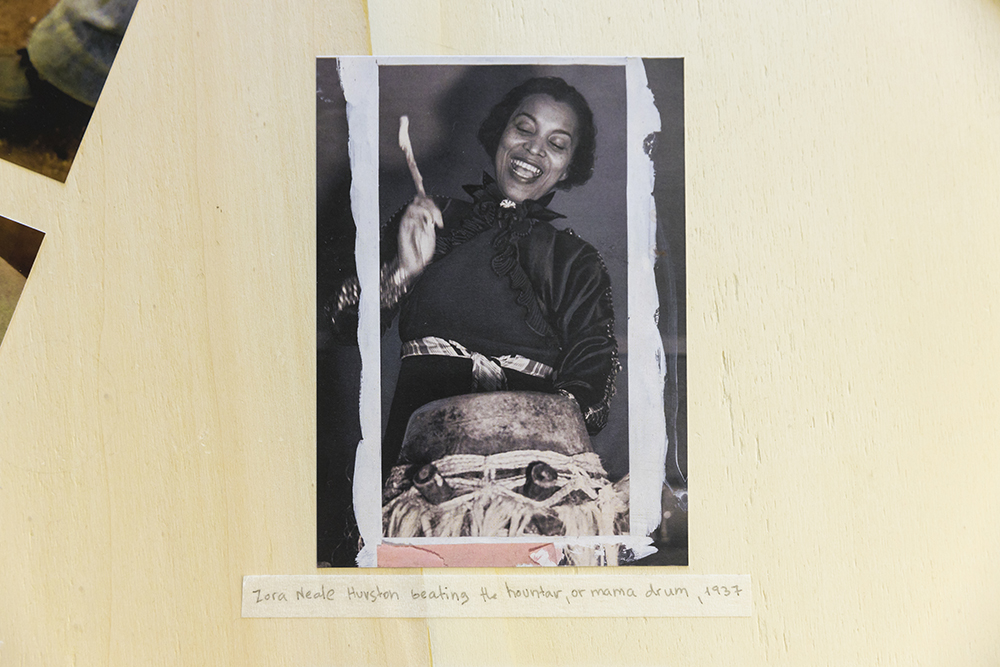
In the busy gallery space, a dissonant soundscape unfolded around me as the visitors’ chatter mixed with the soft utterances and songs spilling from the headphones at the exhibits. The configuration didn’t seem to suggest a strict order of viewing, so I took a random route through them. I found myself gravitating towards the disc-shaped table at the centre where photographs, record covers, and songbooks were displayed alongside moving images and sound recordings, each annotated with pencil on strips of masking tape. Titled ‘Black Feminist Vernacular Sounds’ (2025) and collated by Azoulay herself, this selection of archival materials celebrated three music collectors from different generations of the African diaspora – Zora Neale Hurston, Louise Bennett-Coverley, and Olive Lewin. Each of these individuals appeared to have distinct areas of interest, ranging from work songs and children’s folk songs to drumming and cultural rituals such as Kumina – a Jamaican spiritual and cultural tradition with strong dance and music elements. Altogether, the materials provided a window into women-led sonic practices, challenging the underrepresentation of female practitioners in the historically male-dominated field of music collecting and field recording, whilst also showing the power of musical expression in community building in the aftermath of, and recovery from, colonialism.
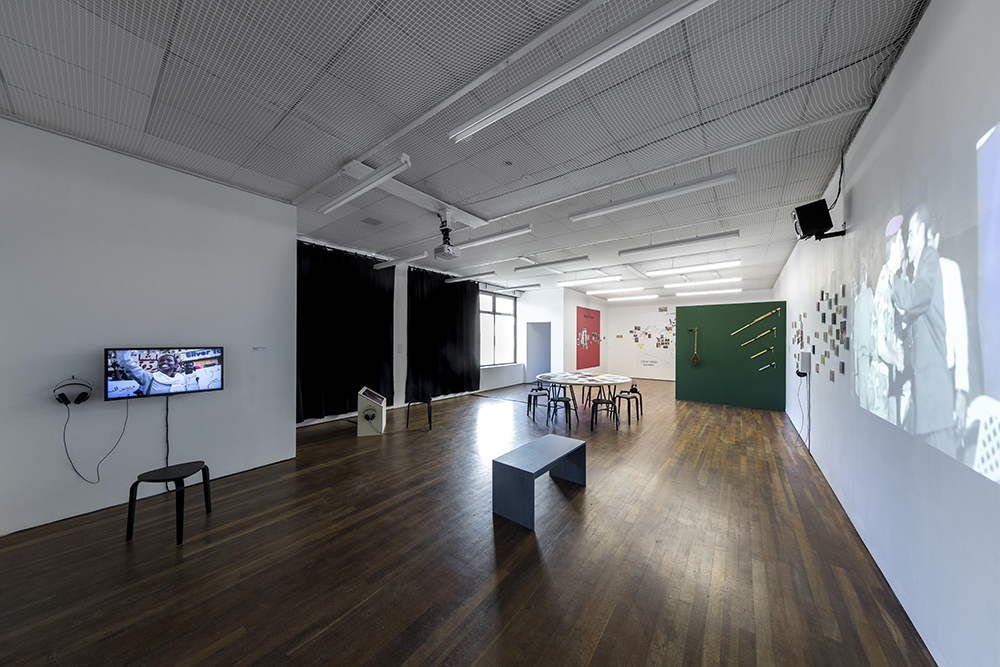
In the back of the gallery, a map of North Africa spanned the entire wall, overlaid with digitised soundtracks, excerpts of lyrics and stories that accompanied images of musicians and record labels, positioned in relation to their geographic origins. This map offered a visual snapshot of Christopher Silver’s book and research, Recording History: Jews, Muslims, and Music across Twentieth-Century North Africa (2022), sketching out the rich Jewish–Muslim musical heritage and exchanges of the region throughout the two World Wars and beyond, and bringing to light the music and narratives of music makers that may have otherwise been lost to the gash of time.
Nearby, Nesh Dadgostar’s video installation ‘Moshtagh’ (2024) featured a black-and-white film on one side of a dark green stud wall and a setar on the other. The setar, a Persian stringed instrument, had its Moshtagh string removed and displayed separately beside it. The full meaning of this arrangement became clearer when viewed alongside the film’s prologue, which opens with the story of 18th-century Muslim musician Mushtaq Ali Shah. A Sufi mystic, Mushtaq Ali Shah is remembered for adding a fourth string – later known as the Moshtagh string – to the originally three-stringed setar and thereby expanding its sonic possibilities, not long before he was martyred for performing with the instrument during prayer. This prologue is followed by intimate interviews with four contemporary Iranian artists, who reflect on their creative practices and negotiation of identity and belonging while living in displacement. Having first encountered the Moshtagh string through the film’s narrative, its physical presence put into context not only its material form but also its metaphorical significance as a symbol of innovative dissent – perhaps a simultaneous vulnerability and strength embraced and shared by the featured artists.

Shortly before Hussain’s live session started, I seized some time to view ‘Request Line’ (2023) by True Form Project. Tucked inside a dark screening room, the film installation would later become one of the focal points in Hussain’s sharing. Through a montage of photographic documentation, it traced the history of Oriental Star Agencies (OSA) – a Birmingham-based record store and influential label that held a special place within South Asian diasporic communities since its establishment in 1970. Following its closure in 2017, over 3,000 records and artefacts were rescued and archived by Hussain and his collaborators at True Form Projects, prompted by the store’s founder Muhammad Ayub. Some of these materials appeared in the installation, including colourfully designed vinyl covers and handwritten request letters from East in West, a BBC Radio WM programme once co-hosted by Ayub. Inspired by those song requests sent in as postcards by listeners back then, ‘Request Line’ pays tribute to the legacy of OSA by replaying the records, showcasing their designs, and sharing the stories behind them.

Hussain later explained that ‘Request Line’ was just one example of how they had approached interpreting the OSA archive, with recent plans to open it up to artists for new forms of reinterpretation, such as animating record covers, remixing tracks, or translating lyrics to explore other socio-cultural themes. The project, as Hussain described, is not about storing the archive somewhere out of reach, but rather treating it as ‘a living and breathing thing in terms of our loved ones and their stories’. It is an ongoing endeavour of sharing and activating the cultural, musical, linguistic, and familial memories contained within these nostalgic objects – things that continue to connect members of the diaspora across time and place; things in which they continue to find pieces of themselves.
As an exhibition meant to be experienced auditorily as much as visually, Resounding Diasporic Sonic Worlds certainly didn’t shy away from the dissonance embedded in the past and the present. At the same time, it tapped into the language-transcending, widely resonant experience of sound as a means of protest, celebration, recollection, and solidarity. It was a thoughtful showcase of the creative and organic forms that archives can take, opening up opportunities to explore how they might provide access to intergenerational knowledge and help mediate difficult but important conversations that too often fall to the periphery.
Christie Yung-hei Chan is an artist, writer, and digital cultural heritage researcher based in Newcastle and Edinburgh.
Resounding Diasporic Sonic Worlds was on at The Newbridge Project from 10 May to 19 July 2025.
The exhibition was developed with NewBridge’s Programme Committee and included works by Majazz: Palestinian Sound Archive, Sara Nacer, Christopher Silver, True Form Projects, Nesh Dadgostar, Arthur Larie and Bastien Massa, Liza Prins and Marie Ilse Bourlanges, Andrea Zarza Canova with the Shieldfield Youth Programme. Booklet, visual map and posters design Niall Greaves.
This review is supported by The NewBridge Project.
Published 28.08.2025 by Lesley Guy in Reviews
1,135 words