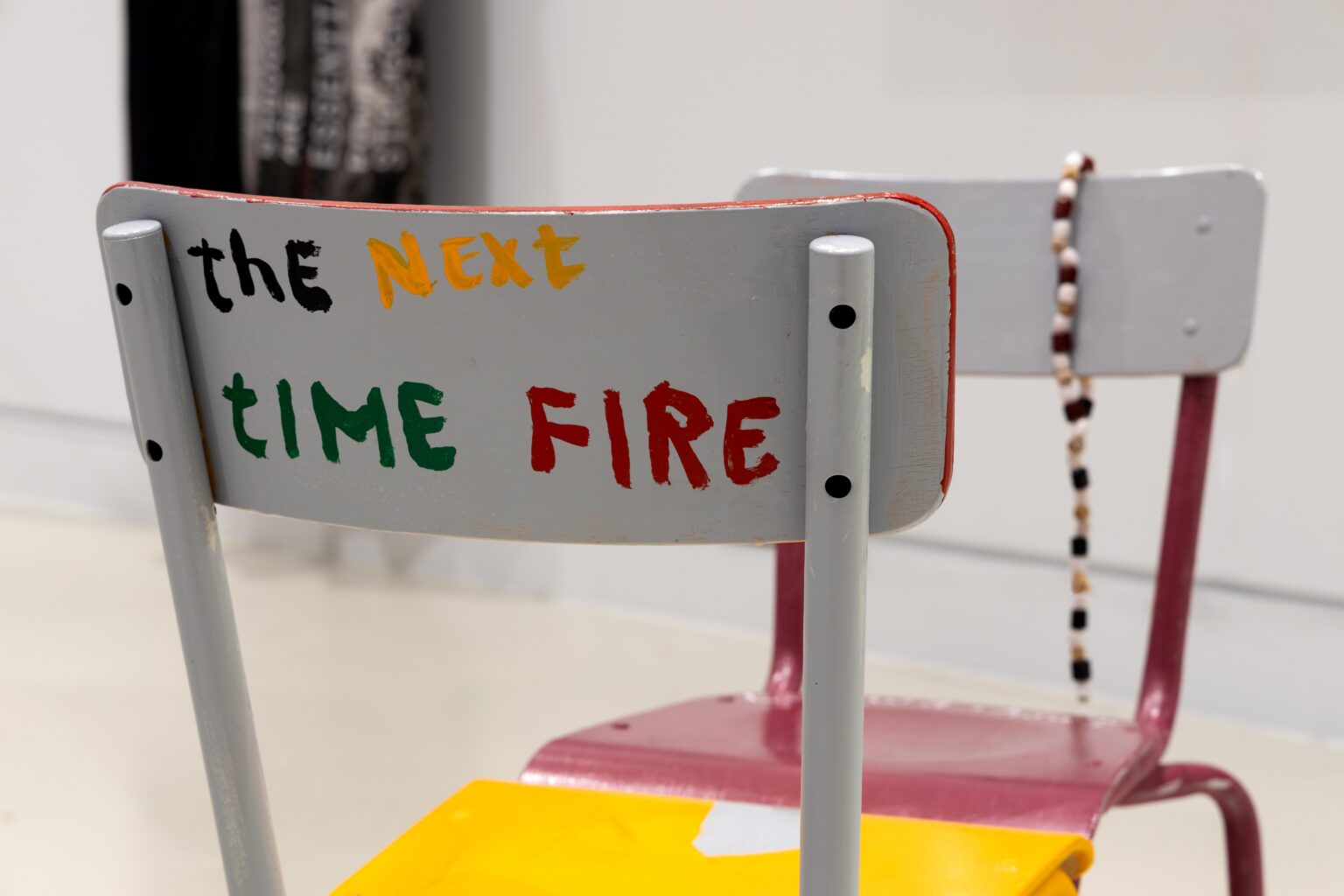
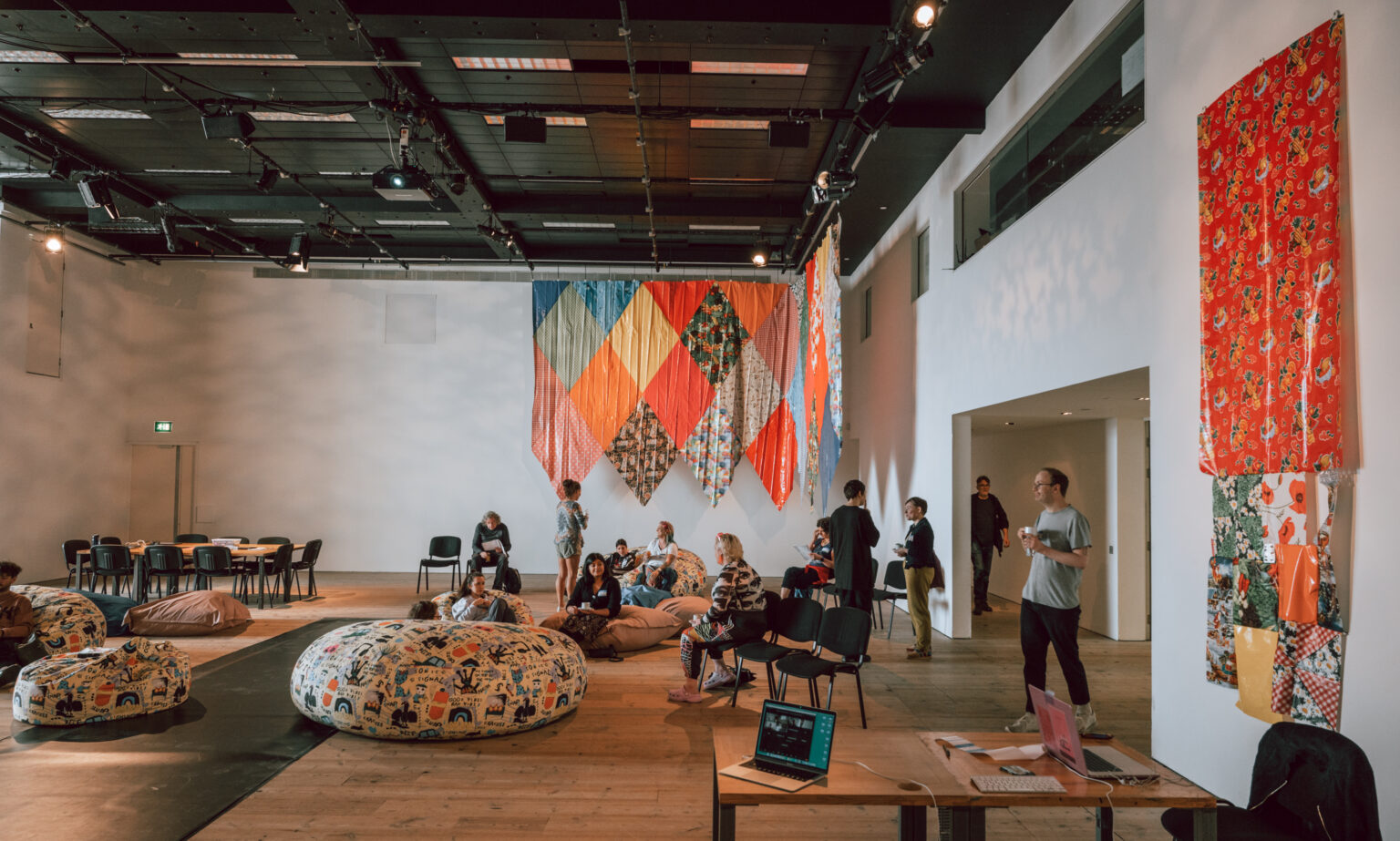
Alice Theobald’s Perfection is a Lie (An Ode to your Potential) is a brilliant, multifaceted project that stems from research and practice undertaken during a Wheatley Fellowship with Birmingham School of Art, Birmingham City University, and Eastside Projects. It distils theoretical research, conducted workshops, edited video documentation, score making, and construction design, into an accomplished installation at Eastside Projects.
I am applying promotional and peppy language as a subdued account of the exhibition would disservice the ideas Theobald is self-reflexively striving to awaken. Firstly, language (which will be discussed below) is integral to the artwork. Secondly, the film relays how capitalism (through technological and cognitive modes and signs) strangles its blue-light-faced citizens into conformity. The reviewer’s text must also strive to be conscious of and perhaps be resistant to the codes and proformas of the medium it works within.
A large, timber, hexagonal construction dominates the main exhibition space. Inside is a darkened seated chamber, where a large projection, a smaller side monitor and a sloped horizontal screen are synchronised to display textual, computational, and recorded imagery. Across the screens, image and text appraise each other and chop and change. The documentary is edited footage from a series of filmed workshops that took place in the summer of 2024 at Midlands Arts Centre (MAC), Birmingham. The workshops engaged a group of year six children, and a throng of adults who met on an Improv Theatre course the artist also attended. Children and adults are encouraged to respond to and reimagine concepts of perfection, success and failure in past scenarios and future desires.

Like most video installations, I stumble in midway through the running time, so any sense of a beginning or ending dissolves. This is pertinent, as deterministic teleology – a directed progression towards a definite conclusion – is refused by Theobald who conveys in her onscreen meta-commentary her preference for the atelic: that which is unfinished and imperfective. Snubbing narrative arcs, denying an anticipated conclusion and revealing stage illusions are all tools Theobald employs within the film. We see cameras recording, view off-stage activity, and eavesdrop on off-screen directions. The film reaches what appears to be a climax, although it doesn’t finish and continues. Theobald uses onscreen text to self-referentially reflect on the filmed footage as she comments directly on the action and doubts her own thinking. The text also credits conceptual, contextual and theoretical influences, such as the improvisational methods of Keith Johnstone, the philosophy of Kieran Setiya, and the publication Born Losers: A History of Failure in America (2006) by Scott A. Sandage.
The different graphical qualities and applications of text on screen are key to understanding the various voices and approaches in the film. Subtitles in square brackets deliver concrete expression to what the adults and children contribute. In another sequence, words break down into flying letters like a bad PowerPoint effect. Text is typewritten across the screen and other words pulsate yellow. On the lower screen, words scroll like the opening crawl of a Star Wars movie, sliding answers presumably to what success means:
Top Job
Happy Family
Children
Good Education
Time for Hobbies
Social Life
Good health
Great Diet
Auditorily, there is a delightful score composed by Theobald, with a thrilling use of the harpsichord. There is also diegetic sound such as applause as the children congratulate each other, and giggling, as the kids curl in embarrassment. Some of the children hesitate when reading out aloud, whereas the adults are more au fait with performative activities. In one exercise, they line up and take turns to confess (possibly fictitious) foibles or specific regrets from their lives. This remorse is consoled by other members of the group who respond reassuringly:
‘I never went after my dreams’
‘Start today’
One earworm in the film is the playful, Teletubby-esque, repetitive refrain of ‘BUNNY TICKY TOCKY’, sung and danced by the adults during an improvised game. I found myself mouthing along in the dark. ‘BUNNY BUNNY TICKY TOCKY’. The self-aware onscreen commentary acknowledges the seduction of jingles and how consumable mantras and soundbites lull subjects into compliance. ‘BUNNY BUNNY TICKY TOCKY’. Self-help guides, marketed remedies and neo-liberal pick-me-ups also rub our distracted heads and stroke our grumbling tummies, whilst swiping contactless chips.

Theobald also employs onscreen text to recount personal memories, such as how her mum was amazed humans could ping a photograph, almost instantaneously across the ocean but fail at vanquishing world hunger. This is real failure, not the personal sense of failure subjects are burdened with through capitalist mirages of success. Failing is primal to human developmental processes. As babies, mistakes are essential for learning. However, as one of the film’s participants enounces, if you try something new later in life, it is expected to be a success. Success is not how many TikTok followers you have or owning a Lamborghini. Be your true self. Live your truth. Live your best life. These maxims are usually the guff of chat show platitudes or magazine articles but here Theobald poses them as serious questions to how one can conduct an authentic life unbridled by capitalist subjugation. We are encouraged to be better versions of ourselves, but on social media we feature as the main characters, measuring our levels of success through selective parameters picked by algorithms. We feed social media profiles and stories with images of success rather than celebrating success itself.
Ideas about success, failure and perfection are brainstormed by the children on Post-it notes. These cringe-worthy squares are the yawning administrative aesthetics of participatory pretence on corporate away days. But in the hands of those not yet bureaucratised, they seem empowering. Perhaps the ‘TICKY TOCKY’ singsong is shrinking my cynicism, but the children unstick the Post-its, read out statements of what they will or will not have in the future, and ceremoniously flick them onto the floor.
Of course authenticity is in question in an era of post-truth and simulacra. The sceptic would sniff improvisation as a method for whiffs of mannered or learnt behaviours. The posing of documentary as a transparent and an objective dose of reality or fact is also questionable. Hito Steyerl would remind us that ‘documentary is always twinned with uncertainty’ (2007). Are we not forgetting editing, the authorial cut, a montage which imparts knowledge and power? No, of course not, but somehow in the self-disclosure of Theobald’s methods, and the posing of these questions, we are reminded of the structures that confine us.

Drawings sketched onto the outside walls of the wooden structure show a woman smirking, gawping at her mobile phone, possibly looking at herself. There is also a framed copy of Time magazine where a computer screen on its front cover is made from foil, reflecting the Person of the Year: ‘You. Yes, you’. Me? As I chuckle at this absurdity, the simple conceit expresses how images of ourselves are distorted by media and capital, fed back as TICKY TOCKY. Instead, it may be worth jotting down or word showering what our true sense of self is and what success might mean.
Alice Theobald, Perfection is a Lie (An Ode to your Potential), Eastside Projects, Birmingham, 8 March to 5 July 2025.
Rachel Magdeburg is an artist, writer and lecturer and is based in Wolverhampton.
This review is supported by Eastside Projects.
Steyerl, H. (2007) Documentary Uncertainty. A Prior Magazine 15, June 2007
Published 20.05.2025 by Lesley Guy in Reviews
1,273 words