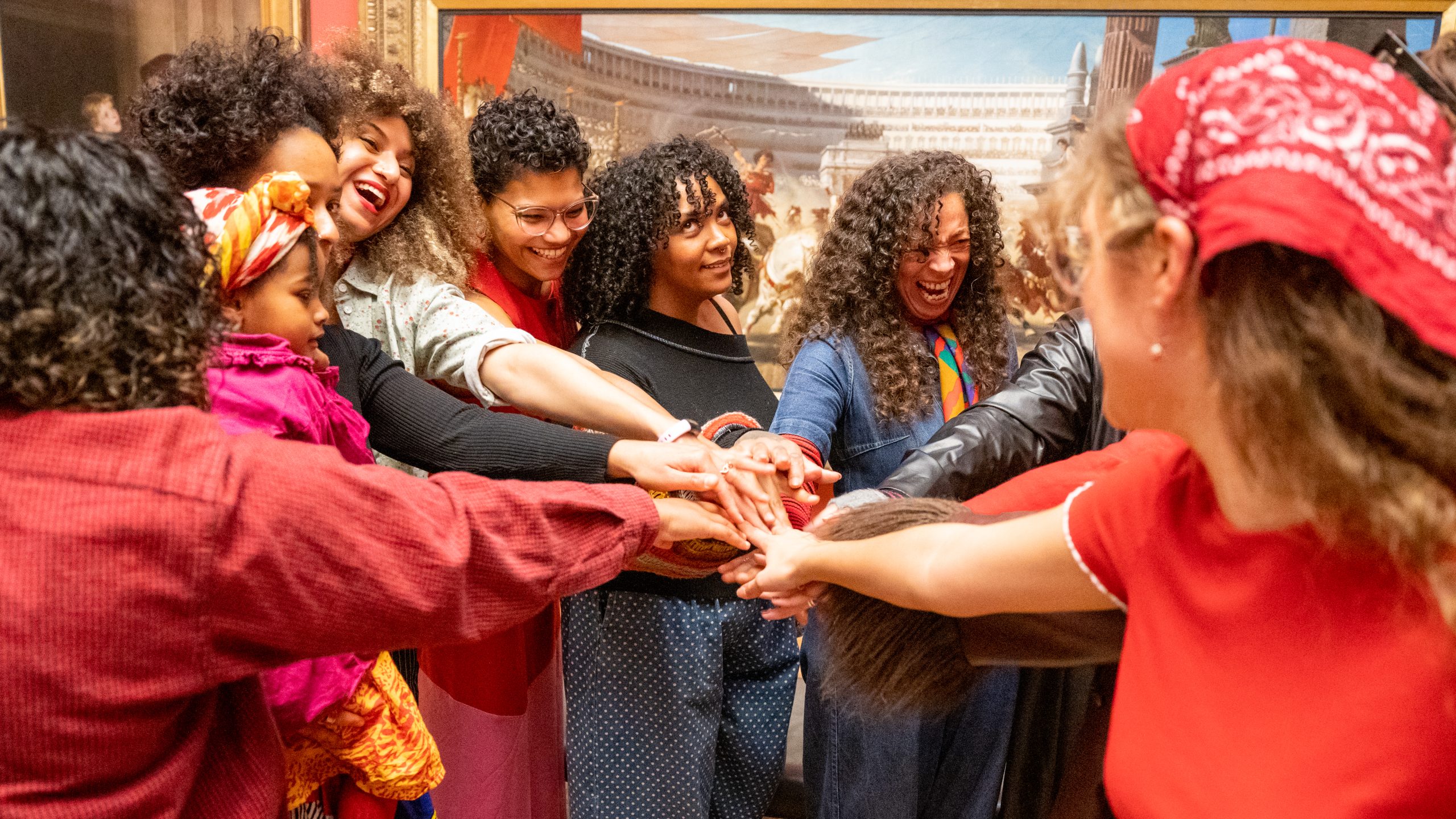
On 26 November 2025 at Manchester Art Gallery, ten women and non-binary writers of European and African mixed heritage performed texts about themselves and their lives, that they had written over the course of four workshops at Lowry. Surrounded by Victorian and Pre-Raphaelite art and crafts in the packed gallery, the performers shared personal stories of their mothers and fathers, their children and their life experiences, delivering perceptive social commentary and showing defiant persistence in environments that are obstinately stratified and hostile when it comes to notions of race. The performance was part of artist Amy Townsend-Lowcock’s project ‘Enter, Tragic Mulatta’.
Townsend-Lowcock is an emerging mixed heritage multimedia artist with Jamaican, English, Irish and Scottish ancestry, who is inspired by experimental theatre, documentary filmmaking practice and public history. ‘Enter, Tragic Mulatta’ aims to question British identity in the post-colonial era.
For anyone who doesn’t know, the word ‘mulatta’ was found in slave registers, literature and even film, and was used to describe a child born of African and European heritage as early as the sixteenth century. The combined social and political use of the word spread different messages about people of colour, especially during enslavement. In 1842, the first ‘tragic mulatta’ character was born. Written by abolitionist author, Lydia Maria Child, the ‘tragic mulatta’ represented a light-skinned mixed heritage woman who was fated to suffer on account of her African ancestry. The ‘tragic mulatta’ stock character was adopted by several authors in the nineteenth century to endear readers to the plight of enslaved women and to reveal the horrors of chattel slavery. After the end of enslavement and into the twentieth century, it was a commonly held belief that mixed heritage people were the biggest threat to organised western society. Depicted as a danger to segregationist and nationalistic thinking, the ‘tragic mulatta’ characters of this era were portrayed as power hungry, and eventually came to be understood as villainous temptresses.
Townsend-Lowcock’s piece reverses that historical conversation by giving voice to some of the people who still have to shape-shift to avoid, as one of the performers put it, ‘Rugby racist fathers and a few twats or two’, but in doing so have developed a tapestry of voices that ‘do more than touch words, play roles’. These are mixed-heritage creatives who instead, in their poetic descriptions, ‘stretch and embrace continents’ and, in the blend, ‘move earth to meet its distant cousin tree’.
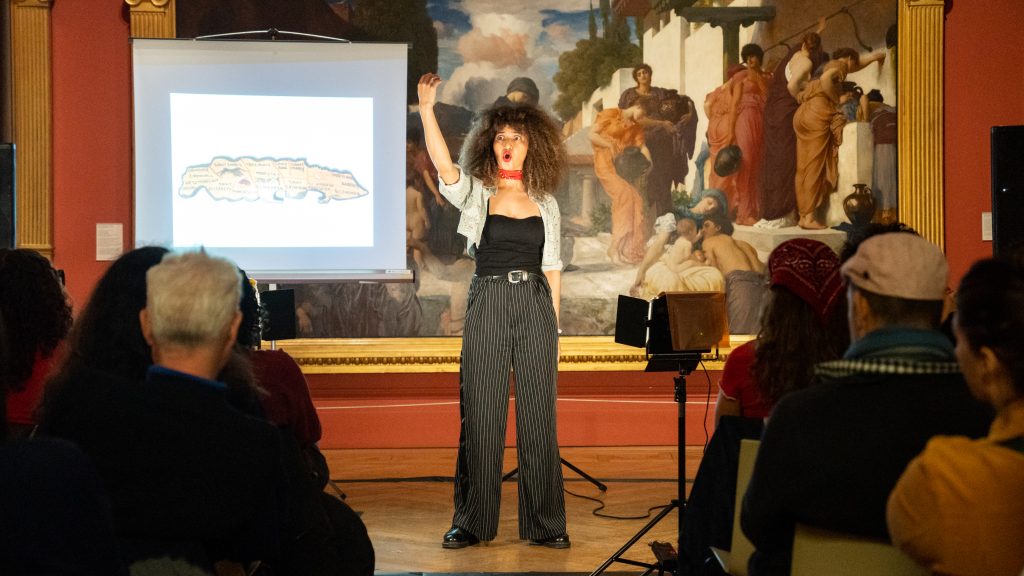
The performance at Manchester Art Gallery was part of a larger project that first consisted of painful research built on an initial exploration of the artist’s own ancestry. One bloodline relative, she discovered, came from the Outer Hebrides. His children in Jamaica, who it seems he had no trouble enslaving, were labelled ‘mulatta’ or ‘mulatto’ in his ledgers. The concepts these labels represent rattle through an ugly history that still influences modern British culture, because ideas repeat like an echo. Time isn’t a line we move along; it’s a web we’re all caught in, and in this case consists of the classification of people and therefore their relationship to place.
Salford’s Lowry supported the project through its artist development programme, working closely with Townsend-Lowcock as a supported artist to realise the work, including providing space for creative writing workshops and rehearsal. This vital support enabled the artist to widen the lens on her own experiences. The research focus took shape after Townsend-Lowcock spent a month in Venice, nominated by Lowry, on the British Council’s 2024 Venice Biennale Fellowship Programme. John Akomfrah, who was selected for the British Pavilion at the Venice Biennale that year, and his work with the Black Audio Film Collective, was a major influence, she tells me when we speak. ‘I’ve taken a lot of inspiration from his work’, she says, ‘often challenging and interrogating which stories are implicit within archival imagery’.
Live performance and installation were also inspirations. ‘In terms of theatre, I love Katie Mitchell’s live cinema work and have drawn a lot of inspiration from her. I love how she invites the audience into the creative process by exposing the means of production. Part of her motivation for creating the form was to focus on representing female interiority, and I’m really interested in how it could be used to decolonise theatre, and how we understand race and (Black) British history by drawing audiences’ attention to the creative process that takes place when historical narratives are written.’
The word ‘Mulatto/a’ is now considered abusive language, but Townsend-Lowcock’s use of this word to map more of the British experience through notions around race, and the history of its theories, highlights the function of language in our own moment. I am thinking especially of the language around migrants and who belongs where, as the fables of mono-culturalism and nativism seemingly reach into every corner and conversation.
Mark Fisher and other contemporary philosophers have discussed ‘hauntings’, parts of the past persisting in the present. They recognise that the history of concepts and the ways they are mobilised in the political present are dynamic, including being carried in language. Townsend-Lowcock’s piece shows how it is possible to trace aspects of social cultures and histories through words because they contain multifunctional conceptual ‘ghosts’. ‘Enter, Tragic Mulatta’opens conversations between people who share a portion of the same ancestral blood and still suffer under the effects of stereotypes and seemingly perennial presumptions about racial character.
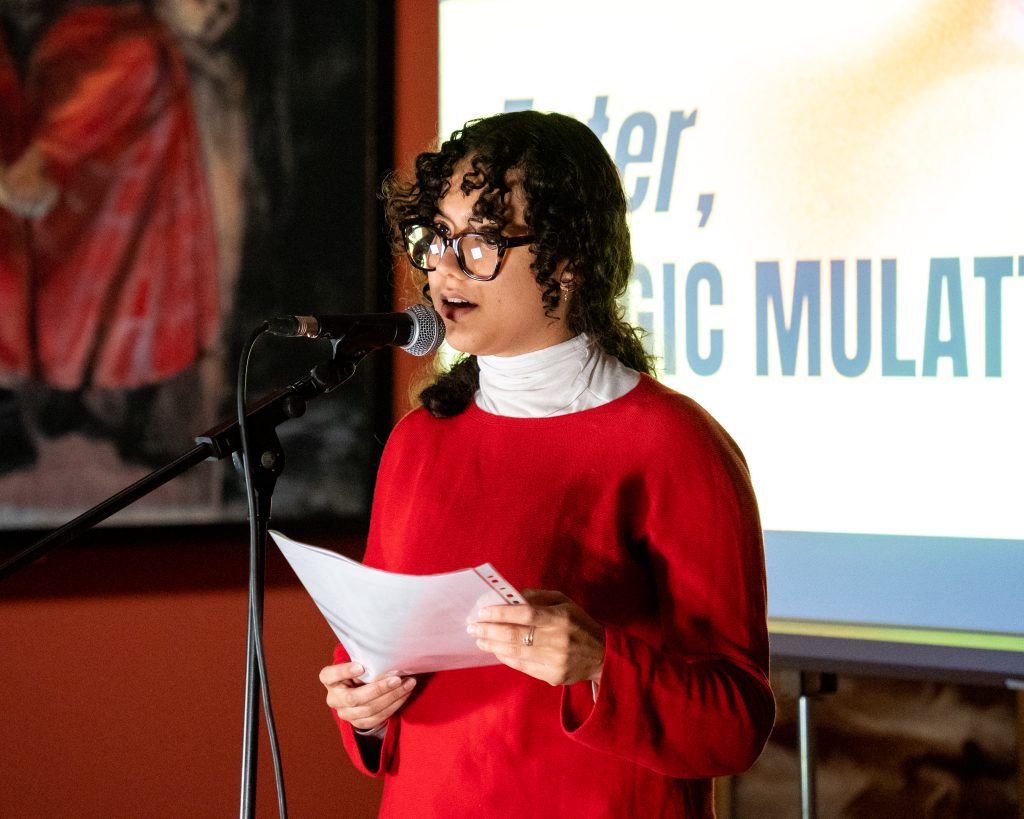
For the performance, poet and artist Ella Otomewo worked with participants to help realise the stories they wanted to tell, while Townsend-Lowcock directed the staging of the showcase, incorporating video feeds and imagery of ‘tragic mulatta’ characters through the ages.
In the tangle of living language, projects like this pick away at indifference and through presence enable awareness, highlighting the choice to see clearly and act differently. The project is an act of quiet resistance, because sometimes the most radical thing you can do is simply tell the truth about what hasn’t yet gone away.
Written across human history is the fact that there are no ‘pure’ cultures. ‘Enter, Tragic Mulatta’, as a piece of creative research, can show communities of various backgrounds and heritages how they might re-contextualise their histories in the face of persistent political narratives of transgression and separateness.
Townsend-Lowcock has produced an archival record that explores one of the subjects at the forefront of contemporary Black creative and social discourse, that is, studies linking power and language to how social action and individual thought is shaped. The project provides a place to reflect on and discuss the complexities of lived experience. A collection of all this research, including information about the ‘tragic mulatta’ stereotype, oral histories and a video of the performance is now available to view at the artist’s website. I hope you can spend the time with this project that it deserves, and take forward its spirit of connectedness and strength.
‘Enter, TRAGIC MULATTA’ by Amy Townsend Lowcock was developed at Lowry as part of their Artist Development Programme and was supported using public funding by the National Lottery through Arts Council England . More information about the project is here.
Chantal Oakes is a writer artist based in Preston, Lancashire.
This article is supported by Lowry.
Published 05.05.2026 by Jazmine Linklater in Explorations
1,235 words


