The auditorium of the Hallé St Peter’s was draped in long, loose fabrics under soft lighting before the performance began. The stage was set for a captivating journey from Japan to Manchester, ready to unfold through the movement of dancers and the resonating sounds of the orchestra, pulling my attention away from the evening’s thunderstorm and in to the world of BLOOM. The three Company Chameleon dancers (Alice Bonazzi, Lucia Taylor and Kadafi Mulula), dressed in outfits by Manchester based queer fashion house, Belladonis (Charlie Orr-Ewing and William Kerr), moved their bodies in fluid and expressive gestures.
BLOOM was devised as part of a creative offering from Manchester to the city of Osaka in Japan, representing a new era of collaboration and exchange between the two cities. Shown during Japan Week in Manchester, BLOOM began in Islington Mill, a converted cotton mill that has become one of Greater Manchester’s most innovative creative hubs and home of creative producers, From the Other. From the Other brought together artists from across Manchester to retell a story of the city’s past by entwining dance, music and fashion.
As the first section of the show unfurled, Henrietta Smith-Rolla, known as AFRODEUTSCHE, took her place at the microphone. Regal and poised in her kimono style robes, the composer, DJ and radio host sung the first words of the show in Japanese, lyrics which can be translated to mean ‘music of love, joy, victory’. The combination of song, strings and electronics was ethereal and atmospheric, sometimes mimicking a gentle rainfall, before returning again to the lyrics, powerful and bold. The Hallé Orchestra trio (Roberto Buisi, Martin Schäfer and Lucy Arch) who were present onstage for the entire performance were part of an effortless weaving together of strings and synths.
The fabrics of the dancer’s pleated shirts and wide legged shorts in opposing shades of grey, mimicked the peppered moth, a species whose population shifted in colour from light to dark grey during the Industrial Revolution, allowing them to camouflage themselves in the soot covered cities. These symbolic costumes gave us a way in to the narrative which unfolded over the course of the performance in three parts. Beginning in 1865 and reflecting on the journey of the Satsuma students from Japan to Manchester, to their time in the factories learning the art of textile production, to what the future would hold in relation to industrialisation and environmental consciousness.
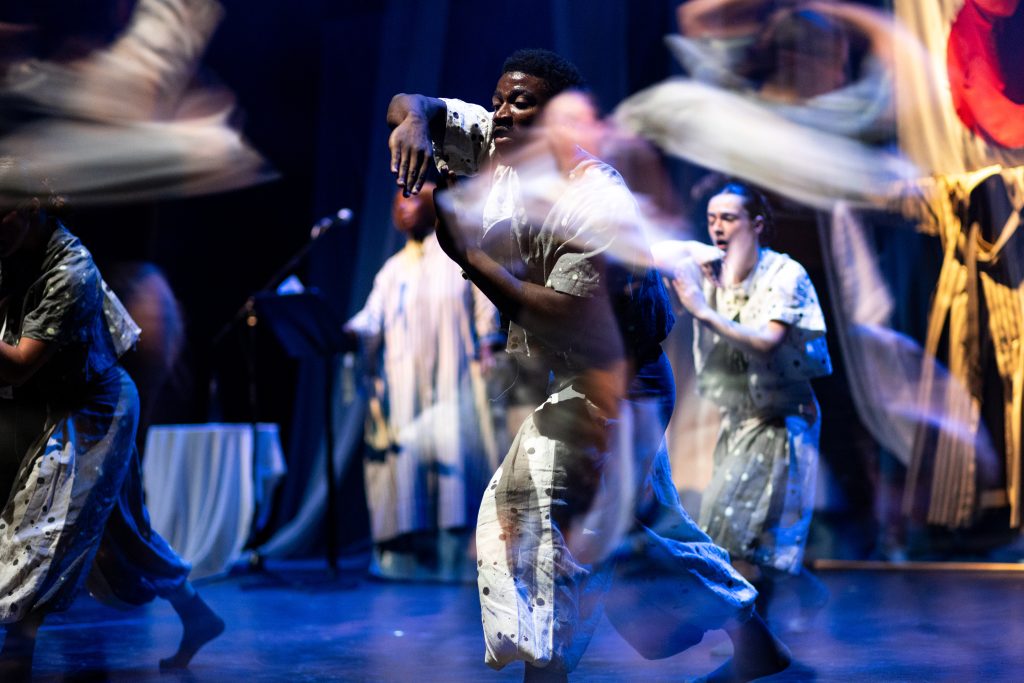
The trio of dancers seemed to be suspended in time as they moved with an intricate balance of stillness and motion, their bodies extensions of one another. Fabric fluttered like wings, intertwining as they often moved together as one. Founded by Kevin Edward Turner and Anthony Missen, Company Chameleon is known for its ability to create dance theatre that is at once accessible and deeply emotional. I was struck by the emotions portrayed by their movements. This was not simply a story of industrial transactions between countries, but also of the individual young men who travelled further than they had ever been, to place so full of unknowns – would they find what they were looking for? Would they feel that they belong? Who would be there to welcome them?
The first iteration of BLOOM was performed at the World Expo 2025 in Osaka, Japan earlier in the year, before making its way to the Hallé St Peter’s in Manchester. These two performances, however, were very different in scope and feel. While the World Expo iteration was a massive, multi-national gathering, the Manchester performance was intimate, described by From the Other as a ‘love letter’ from one city to another. Mimicking the narrative of the piece, the creative team travelled between both countries to share creative new ideas.
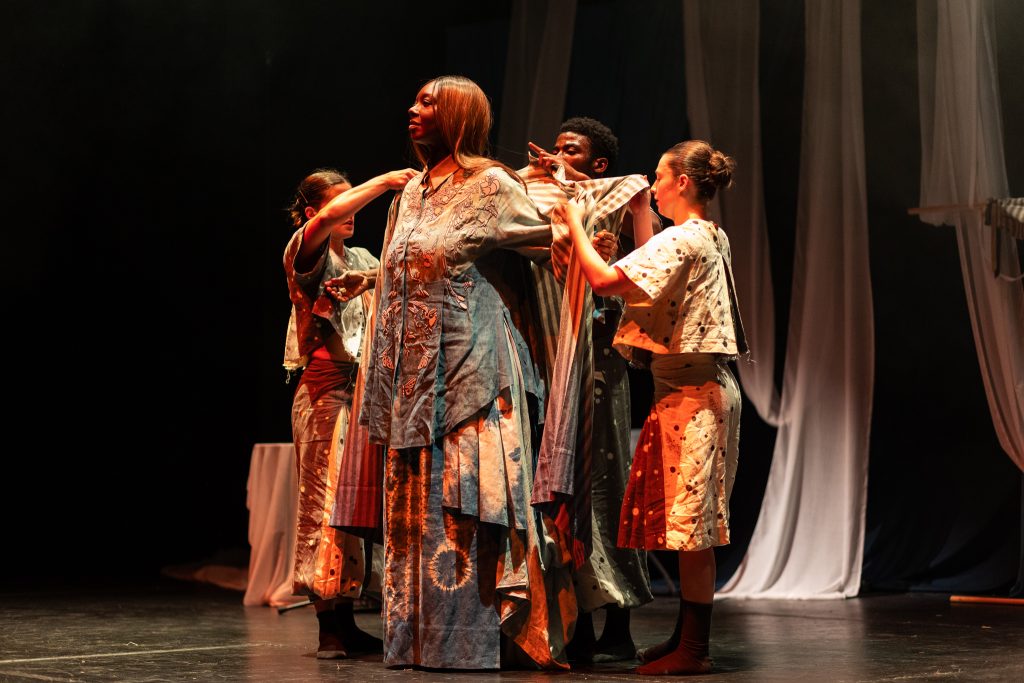
BLOOM is an exploration of place and people, of histories intertwining, and of art that speaks to both the past and the future. At its heart is the story of nineteen Satsuma students who, in 1865, travelled from Japan to the UK to study Western technology during the Industrial Revolution. Three of them spent time in Manchester and Oldham, learning the intricacies of the textile industry. It was a visit that would help ignite Japan’s own industrial revolution when they returned home by bringing back textile machinery and technology that would be used to establish the first modern cotton mill in Japan. This historical moment serves as the backdrop for a performance that, for me, felt quite ceremonial. The dancers’ movements are precise and strong, adding to the sense of occasion and creating something that feels almost holy. In one memorable scene, the dancers took part in a ritual of slowly removing AFRODEUTSCHE’s outer robes to reveal the beautiful layers of dresses underneath in gradients of rich turquoise. They recreated this moment again to give us time to admire some of the items of clothing, by gently hanging the robes up like an altar to become part of the tapestry in the background.
When I spoke to AFRODEUTSCHE after the show about her creative process, she described how she had first had to ‘spend time with the music, before the words came’. She had long been fascinated by the idea of migration, transformation, and the connections that can be forged across cultural boundaries. AFRODEUTSCHE has ventured into new sonic territories with the music she created, crafting an audio landscape that articulates the emotional and physical journeys of those who leave home, working with the string ensemble from the world-renowned Hallé orchestra, layering classical arrangements with ambient textures. There was something poignant running through the composition; this was just one story of migration and its impact on the people and places involved, but there are countless other stories that have not been documented, and have not been given the respect or tribute that the BLOOM creative team have given to this one.
For a show inspired by the textile industry, the costumes played a huge role, and Belladonis did not disappoint. Their focus on storytelling through fashion resonated deeply with the themes of BLOOM. When the duo spoke to me about the design process, they talked about the journey the pieces had been on. The first costume designs ended up being quite different from the final pieces we saw on stage during BLOOM, as the team discovered that the performers would get tangled in the loose layers of fabric; these were clothes not just to be worn, but to be danced in. Through collaboration, the costumes evolved, becoming delicate yet strong, flowing yet structured. The two designers described the fulfilment they felt from seeing their work in performance ‘sweeping across the stage as the dancers brought them to life’. The dancers’ movements mirrored the adaptable nature of the fabric, swooping and spiralling. It was also a new way of working for Belladonis, a freeing and collaborative approach, where the concepts were devised together between the designers and performers. There was a story to work with, and this led them to creating something more abstract. The performers illustrated how each garment was as precise and beautiful on the inside as they were on the outside. Each piece was an intricate fusion of (Manchester grown) indigo-dyed fabrics, traditional Japanese design elements, and a modern touch of 3D printing.
The connection between Manchester and Osaka, their pasts and futures, runs deep in BLOOM. This team of Manchester creatives merged sound, movement, fashion, and culture across oceans and centuries into a breathing organism of expression. When portraying the Japanese students leaving their homes, the creative team were tasked with representing people who were learning new ways of being in the world, and ultimately shaping the future of their country with the knowledge they gained abroad. As the performance drew to a close, the movement on stage told a story of struggle and hope. The dancers moved as one, embodying the unity and interconnectedness of people who cross borders, who share experiences, and who influence each other in unexpected ways.
The final moments of the performance were bathed in warm light and subtle interactions between the dancers and musicians, as if they were saying goodbye to each other one by one. Like the peppered moth, at its core, BLOOM is about renewal and transformation, it reminds us of what can happen when we are open to discovery. As the lyrics, ‘feels like home’, echoed through the hall, there was a palpable sense of reflection amongst the audience. At a time when Britain seems set on creating the most hostile environment for immigrants, this felt like a moment to breathe and to dream on how different things could be. The dancers rested upon one another’s shoulders, holding the shared weight of the narrative and the collective effort of forging new futures.
BLOOM showed at Japan Week in Greater Manchester, 4-9 September 2025.
Ella Otomewo is a poet, performer, and artist based in Manchester.
This review is supported by From the Other.
Published 07.10.2025 by Jazmine Linklater in Reviews
1,500 words