With a quarter of an hour to go before her exhibition opens, Manchester-based artist Pippa Eason is moving slowly around PINK’s second floor gallery, wafting a smouldering wodge of tightly bound sage. She is ‘smudging’ the space, cleansing it of negative energy and evil spirits. A line of smoke curls gently away from her hand, dispersing into the hazy light that filters through the semi-opaque white spray paint that dapples the windowpanes. The smell is familiar and comforting. It promises safety. This gesture of ancient ritual is emblematic of the intentions that run through Eason’s new solo show, Four-fold Reverie: spiritual and physical embodiment; care; acceptance of difference; process and practice.
This body of work emerges from a period of ill mental health and both documents and represents Eason’s journey back towards herself – and further, towards something new. Supported by a Developing Your Creative Practice grant from Arts Council England, Four-fold Reverie is the artist’s first venture into sound and moving image, alongside an expanded exploration of her burgeoning ceramics practice, as an attempt to communicate neurodivergent and dysmorphic experiences.
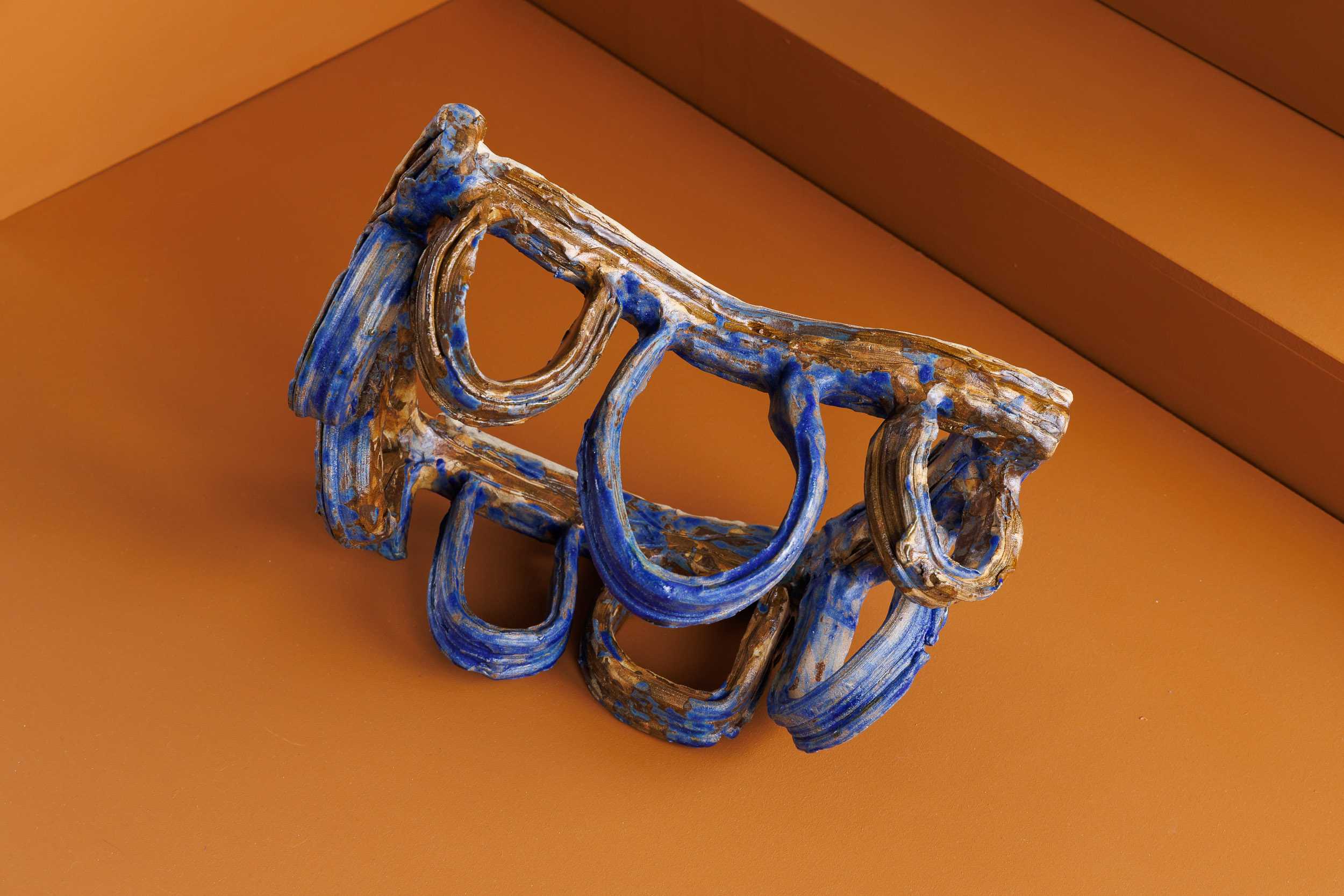
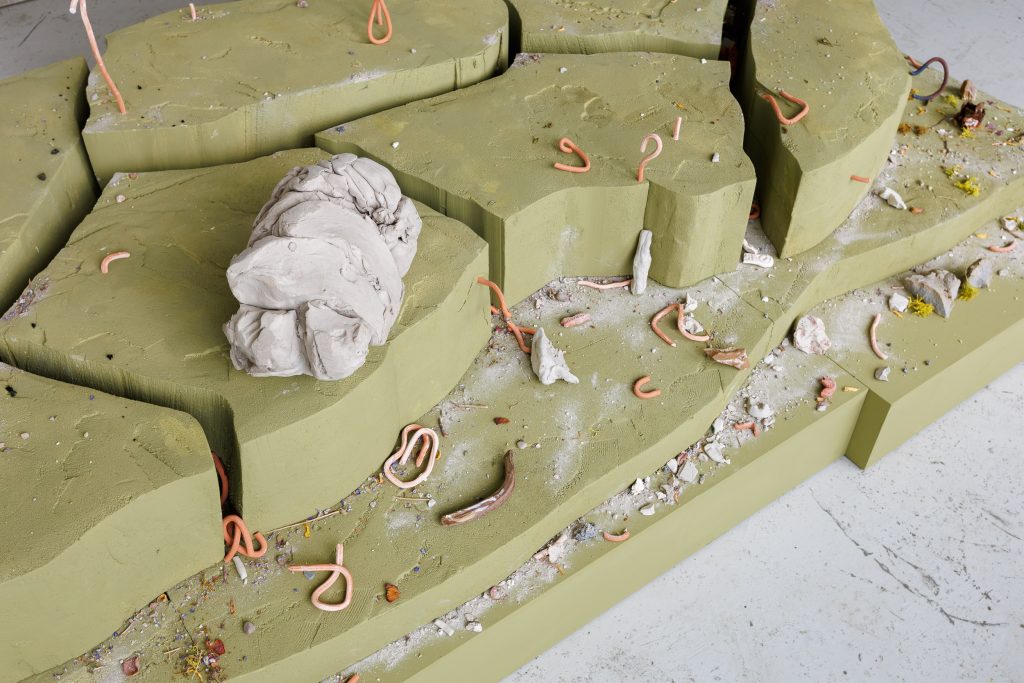
The gallery is equally divided by four low, rectangular, boxy platforms, the negative space between and around them acting as pathways encircling and dissecting the room. Finished in earthy tones of bright umber, swirling greys and creams, neutral beige and mossy green, Eason’s stages are stepped and layered with surfaces, walls and recesses at various heights. They make me wish I was small enough to clamber into the perfect hidey-holes of their nooks and crannies. Displayed all over them are clusters and arrangements of ceramic works – abstract forms of waving lines and rectangles, ranging from miniscule and fragmented to larger and composite. Some are the unfinished hues of brown and grey clay while others are glazed in blues, greens, violet, rust and indigo. The scene is enveloped by a gently ambient soundtrack of watery field recordings, chiming bells and distorted layers of choral voices. It cycles through suggestions of melody, emerging then falling away. A wall-mounted monitor shows a film work in greys, greens and blues. Towards the front of the space, a single candle glows red. Everything feels sacred, primed for introspection and worship.
I’m intrigued by how the pull of a linear trajectory from the entryway to the back wall – smooth and clean to rough and messy – is disrupted by the exhibition text, which posits a numerical order to navigate the four areas, described by the text as ‘environments’. Following the map sequentially makes a Z shape, so I move back on myself in the middle of the quadrangle. Here is the folding, the hinge of the whole installation.
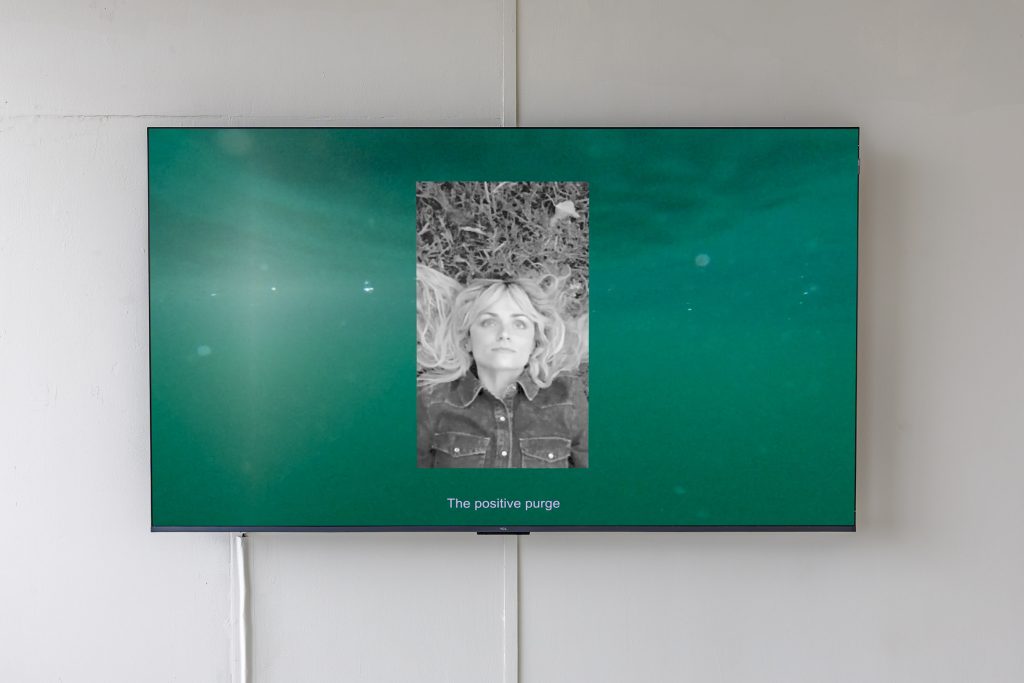
This four-part arrangement represents four facets of experience that Eason is exploring: neurodivergence, selfhood, sensation and perception. It’s interesting to try to read these as four separate components in the space, as they merge into one another, with visual and sensual echoes across all four corners of the room. Four-fold Reverie offers neither individual titles nor labels in the space – all its elements are equal parts of the whole. It feels borne of earth: the mud and flesh of clay; the spirituality and embodiment of experience. The film explicitly links clay with flesh, through images of the artist’s hands kneading the material and running slip through fingers, overlaid with shots of hands massaging and stroking skin.
Other four-part structures comprise the exhibition too. The four elements are the plinths, the ceramics, the video and the sound. There are also four collaborations in this project: film with designer Nick Booton, sound with composer Jia Lee, the plinths built and installed with joiner-fabricator Johnny Billinge and the exhibition text itself, written with PINK director Katy Morrison. All these elements were developed in tandem with the ceramics, for which Eason was supported by artist Maeve Thompson, and ceramicists Florrie Andrews at Clay Studio in Stretford and Joe Hartley at Yellowhammer in Stockport.
I find these four-part layerings deeply satisfying – they manifest the kind of ordered predictability that creates safety for some neurodivergent brains. Such compartmentalising throws light on just how the whole is constituted, what holds it together. Here, it feels like the all-pervading elements facilitate the work’s cohesion: the scent, the sound, and the text guide us through, gently highlighting the tensions between parts and whole.
This is, I think, one of the main thrusts of the show – navigating the incongruity of trying to hold contradictory truths. The first environment exemplifies this. Its impulsive, twisted ceramic forms, like severed Möbius strips, and the compulsively pinched edges of brightly coloured, undulating planes, sit in sharp contrast to the smooth surface of the egg-shell finish, deep terracotta box plinth – all straight lines and sharp angles. Spaghetti worms of clay curl softly over its corners. Here and elsewhere, Eason’s installation represents the difficulty of not quite managing to conform to expectation, despite our often self-destructive desires to do so. Not a single ceramic piece is wheel thrown, but crafted through fiddlier and more intuitive processes including extrusion, coiling and slab building, producing beautifully unconventional shapes.
As the text puts it, this work seeks ‘the courage to dwell in uncertainty, to live with complexity, and, at last, to begin to feel at ease in one’s own skin.’ I’m fascinated by these aims which seem, to me at least, utopian. During the opening, I talk with Eason about safety – how everyone deserves it, how horrifying it is to see so many presently being denied it, how impossible it sometimes is to feel it, even when we logically know it’s a material reality for us. To feel safe, we need to feel free. In following intuitive making processes to create this work, I think Eason was trying to set herself free – from the pressures of expectation, both external and internal, and perfectionism. The tactile medium of clay enables the immediate expression of feeling. Wandering among the ceramics, I wonder if I can distinguish between the products of an anguished day and a calm one.
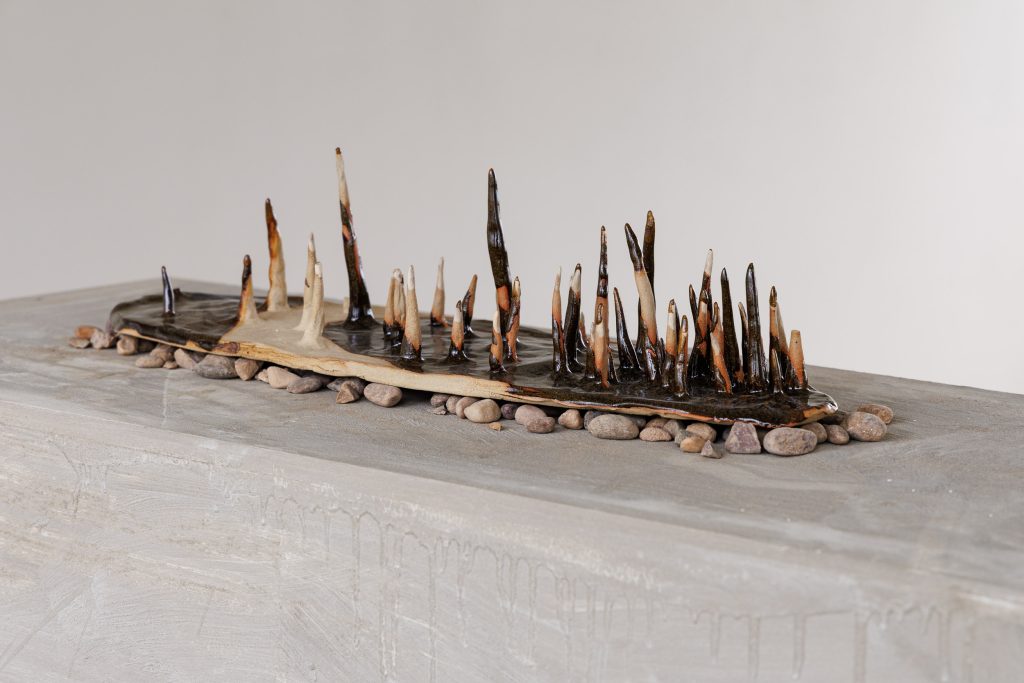
In the first environment of the exhibition, ceramics are exhibited directly on the plinth’s surface, but in the second they are often raised on an extra layer of material. Shapes that look like sagging chocolate bars melting in the sun rest uneasily on dark black clumps of earth. A layer of small grey pebbles supports an oval plate punctuated by thin, spiky stalagmites. It suggests both care – I’m reminded of spreading layers of pebbles under potted plants that need humidity – and discomfort. Many pieces feature flat planes with emerging vertical structures: here a comb, there a tree, here fingers reaching, there a shape without a name collapsing on itself, another getting tangled up. It’s such tactile work, you can see its making baked into it. But there’s also apparently accidental matter. Amongst gravel and dust is a scattering of white rock salt and golden frankincense, both ritual ingredients, with strands of chartreuse moss popping against the grey, and deep mauve and sunset gradient petals. These visual differences articulate, to me, a contrast between control and acceptance – a tension which is key to Four-fold Reverie.
This tension is explored most fully in the fourth environment of the installation, the most organic looking, which seems to have grown of its own accord and been fashioned by human hands in equal measure. It is both messy and magical, a glitteringly haphazard construction of mossy green, roughly finished surfaces and crevices hiding dust and detritus. Pink-coloured coils of worm-like clay emerge from the ground, scattered among that same salt-frankincense-gravel-moss-petal mixture as before. What Eason manages to represent in this particular part of the installation is a feeling so many of us experience on a daily basis – self-sabotaging acceptance of ourselves by exerting too much control. Masking, you could call it. Which is another reason this final area is so alluring – some might see only chaos and detritus, but to me and I’m sure to many others, this represents a calming space where we might be able to lie down, hidden from view – a desire I find myself battling as the gallery fills up with visitors.
It’s an active process of recovery from this urge towards hiddenness and the unhealthy, dream-like dissociative states it can tip us into that Eason is exploring here. ‘I was hiding for so long from being in my own narrative,’ she tells me during the opening, ‘the point is, this work is from my struggles.’ The film reflects this too – ‘I want to walk in the woods at night,’ reads the text onscreen at one point, spliced over images of Stockport’s urban environment – a visual representation of the public places we might be most on show. Elsewhere there are cropped and abstracted shots of the artist immersed in bodies of water and green spaces, representing places other human eyes can’t trawl her surfaces, places that offer escape from the feelings of surveillance that plague some of us. But as she articulates it to me, she realised she had to recognise that she does exist – a candid admission of immense bravery. So there she is, in the video work – even including a direct portrait in one frame.
Crucially, however, this process of self-actualisation was not done alone but in collaboration with others, through both making and dialogue. In conversation before the opening, Maeve Thompson describes how assisting Eason with the ceramics led to some of the most vulnerable conversations they’d had for a long while, both of them opening up about their neurodivergent and gendered experiences. They’d been surprised at how quickly this relationship arose, which really centred on care, ‘bringing intuition and friendship into the making process,’ as they put it. It’s the practice itself that enables these new insights to flourish, not only making with hands but also the daily practice of being alive, being seen and navigating other bodies in space, as we do now in PINK’s gallery, but also being seen closely by others, making together and seeing them as well.
But if shared language is one of the project’s sites of healing, it’s also one of the sites of difficulty. The accompanying text seems to play such a crucial role here, it does far more than elucidate. I keep getting snagged on these poetic ironies, slippages between descriptions and effects. I’m starting to read them as articulations of dysmorphia. When, for example, the exhibition’s third environment is described as ‘soft’ but appears the hardest, or with the second environment’s description as ‘unrefined’, suggesting an unfinished or abandoned state, when evidence of labour is visible on all its surfaces. These forced incongruities in my encounters with the work on a textual and visual level gently encourage an acceptance of different perspectives, of holding two, sometimes contradictory, truths at once, nudging me towards Eason’s stated goal of dwelling in uncertainties.
The hot evening sun sliding across the artworks gives everything an idyllic sheen, but we carry such mess in this dwelling. And that’s one of the central explorations here: the confusion of experience. ‘How do I know,’ Eason probes as we chat, ‘if this is spirituality, zenness, an ability to compartmentalise, or neurodivergent hypersensitivity?’ What Four-fold Reverie does, so beautifully, is make space for holding all those possibilities at once. Here, the safety and comfort of a clearly delineated four-part schema is precisely what allows us to look beyond, both outwards and internally. It is significant that the insights it offers emerge overwhelmingly from a hands-on, material practice. As Eason puts it while discussing her ceramics, ‘the glaze removes the order or planning – mostly it decides what it wants to be all by itself.’ We learn ease in the process, and by that note, acceptance.
Pippa Eason: Four-fold Reverie, PINK, Stockport, 31 July – 5 October 2025.
Public events: A Saturday Afternoon with… Pippa Eason, 27th September, 2-4pm; A [CLAY] Workshop in collaboration with Manchester’s Little Artists, 4th October, 11am-12:30pm + 1:30-3pm. More information and tickets are available here.
This review is supported by PINK.
Jazmine Linklater is a poet and writer based in Manchester where she is a regional editor of Corridor8.
Published 10.09.2025 by Jazmine Linklater in Reviews
2,083 words