The tenth edition of AND Festival, the nomadic digital arts festival produced by Abandon Normal Devices, finds 2026 host town Barnsley at an unusual chapter in its history. For centuries a centre of coal and steel production, this year it was named the UK’s first ‘Tech Town’, meaning that it will receive substantial government funding to support the roll-out of AI across all of its public services and become ‘a national blueprint for how AI can improve everyday life’. What this will look like in practice remains to be seen, but it sounds like a suitable provocation for AND’s first venture into Yorkshire. As Barnsley makes the leap into a more automated world, the festival seizes the chance to air out some anxieties about where all these technological shifts leave us, the humans.
Fittingly enough, my first encounter with the art comes courtesy of a giant screen. Like the rest of the town, Barnsley Civic is undergoing big changes, marking its upcoming 150th birthday with expansions, restorations and opening up rooms that were previously sealed off to the public. Instead of clearly signposted gallery spaces, the festival occupies these unexpected nooks and crannies of the building, and it’s up to you to go find them. So, I wander down into a dark basement, where a soft, purplish glow guides my eye towards the video piece ‘SERVER‘ (2026).
Conceived by AND Festival and Going Away.tv as a kind of community film channel, the work is a deep dive into some of the weekend’s key ideas, distilled into video essays, lectures, artist talks and gameplay walkthroughs. Arriving midway into a keynote speech by Jussi Parikka titled ‘Environments of Digital Culture: Data Ruralism and Layered Landscapes’ (2026) admittedly feels like a fairly intense introduction to the festival, but there’s a playfulness to how the lectures are rendered on screen, the speakers’ heads bobbing about on avatars which pass through computer-generated reconstructions of Barnsley.
Virtual spaces, and what it means to inhabit them, are a recurring topic throughout ‘SERVER’. Total Refusal’s video essay ‘Hardly Working’ (2022) explores the role of NPCs, or non-player characters, in the game Red Dead Redemption. These background figures, the narrator explains, exist to ‘bring a bit of bustle into a lifeless world and thus simulate normality’. Unused to the spotlight, NPCs such as the carpenter, laundress and stable hand endlessly carry out automated tasks, never deviating from their routine or stopping to ask questions. Do their blank gazes conceal rich inner lives? Or are they sleepwalking in an automated nightmare?
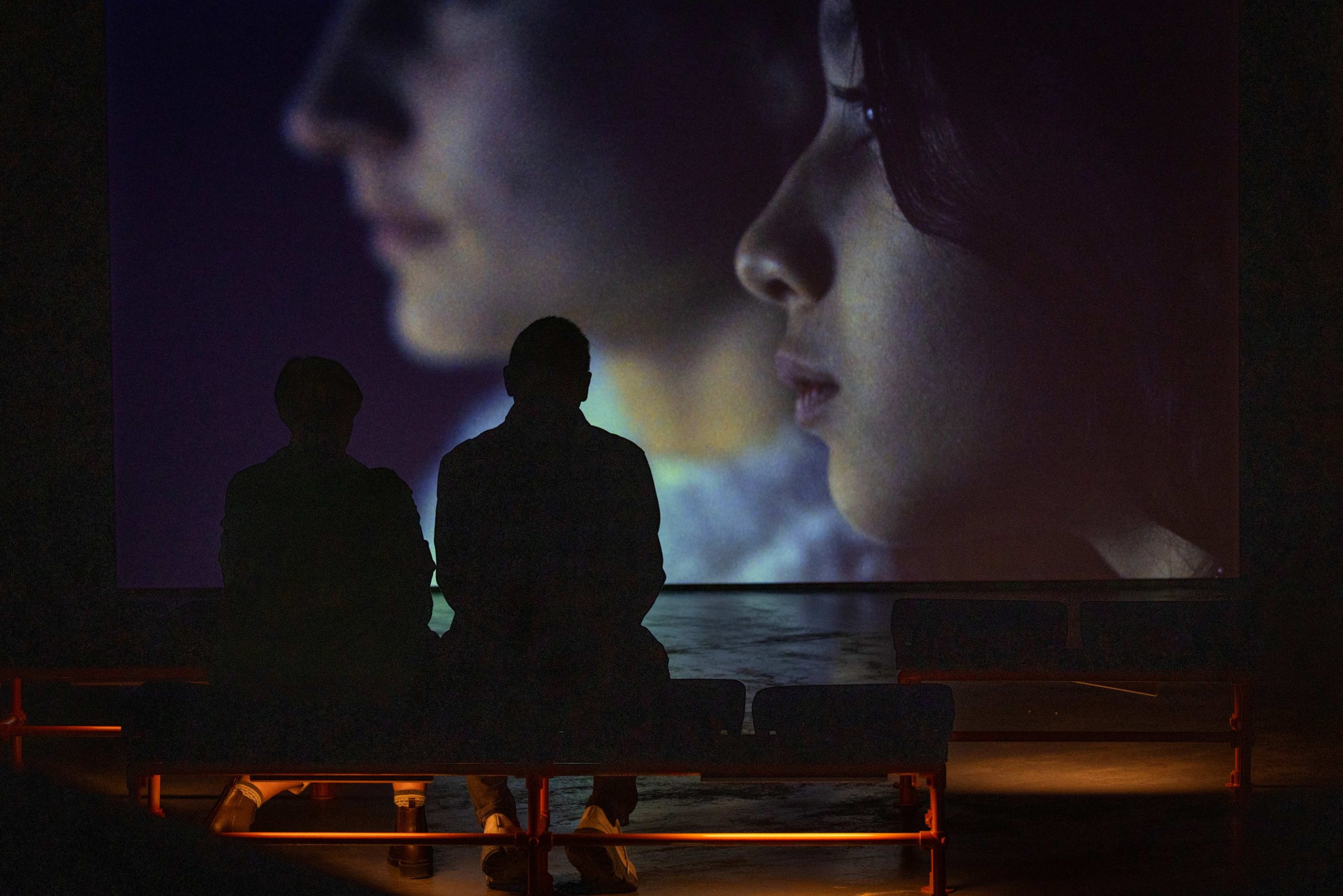
Silvia Dal Dosso takes this theme and runs with it. In her film essay ‘The Future Is Now Finally Weird AF (The Ultimate AI CoreCore Experience) – Part Three’ (2025), she suggests that we are all fast becoming NPCs: while billionaires celebrate the rise of AI, the rest of us passively watch our world crumble in real time, unable to change or influence events. ‘Once we were taught to believe that if we did things properly, we would be rewarded,’ the voiceover intones, in an eerie simulation of filmmaker Adam Curtis, ‘but now our only certain reward comes from gaming.’ Various scenes unfold from around the internet: dancing women, warzones, police raids, explosions, presidential galas, some Kardashian slicing a courgette – all in an endless, hypnotising loop.
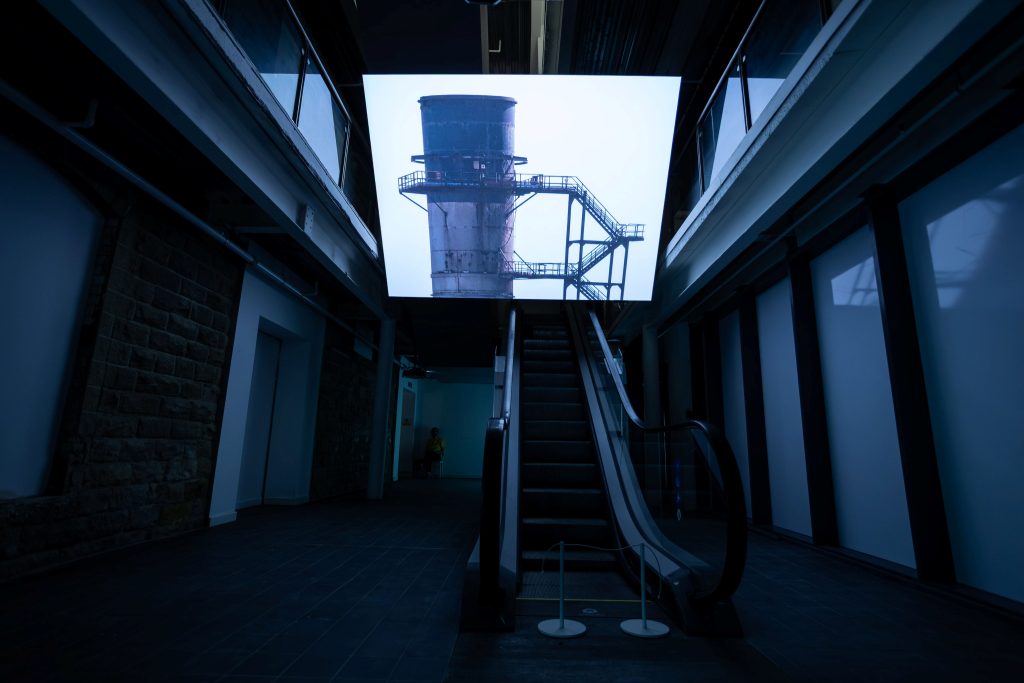
One disadvantage of kicking off the festival with a seven-hour screening is that I can’t tell when to stop watching. Am I missing the art by staying glued to my chair? Or will I miss the art if I don’t stay here consuming all the content that comes my way? It’s starting to feel dangerously like scrolling. When I finally break away to the next room to wander through Dian Joy’s ‘Krumville’ (2026), the sense of disconnect lingers; here also, a series of screens transmit seemingly unrelated sequences with no apparent beginning, middle or end. Joy’s hazy vignettes and algorithmically-generated images feel cinematic but scramble your sense of time or place. There’s a factory, a snooker hall, a butcher pushing a trolley. A woman eating in a wood-panelled diner. Each scene mimics real life, but the action unfolds painfully slowly, like a dream you can’t snap out of.
Despite the ethereal quality of the films, Joy’s approach to worldbuilding has a strict order and logic – image ideas are plotted into a spreadsheet, then actors are hired to bring those scenes to life. Though Joy took inspiration from a number of real-life locations, including in Barnsley, Krumville both is and isn’t any of these places. It’s a strange, unplaceable composite, made extra uncanny by the liminal space AND have situated the work in. With its glass-panelled mezzanine and dormant escalators, this area of the building feels more like a shopping centre, perhaps in a town whose inhabitants have all since been evacuated.
After so long staring at screens in dark rooms, it definitely feels like time to ‘touch grass’, as they say on the internet. The next stop on the itinerary is Elsecar Heritage Centre. Immediately it’s a very different setting to Barnsley Civic – the blue of the sky and the birdsong feel exaggerated; the sandstone cottages with their slate roofs suggest some kind of pastoral paradise. But the picturesque exterior masks years of hard graft. Elsecar was developed as a model industrial village in the 1700s, both to exploit local resources and show off the benevolence of its aristocratic owners. By the mid-nineteenth century the site was home to workshops, furnaces, engines, sawmills and saddleries, to say nothing of a private railway for Earl Fitzwilliam to receive visiting peers.
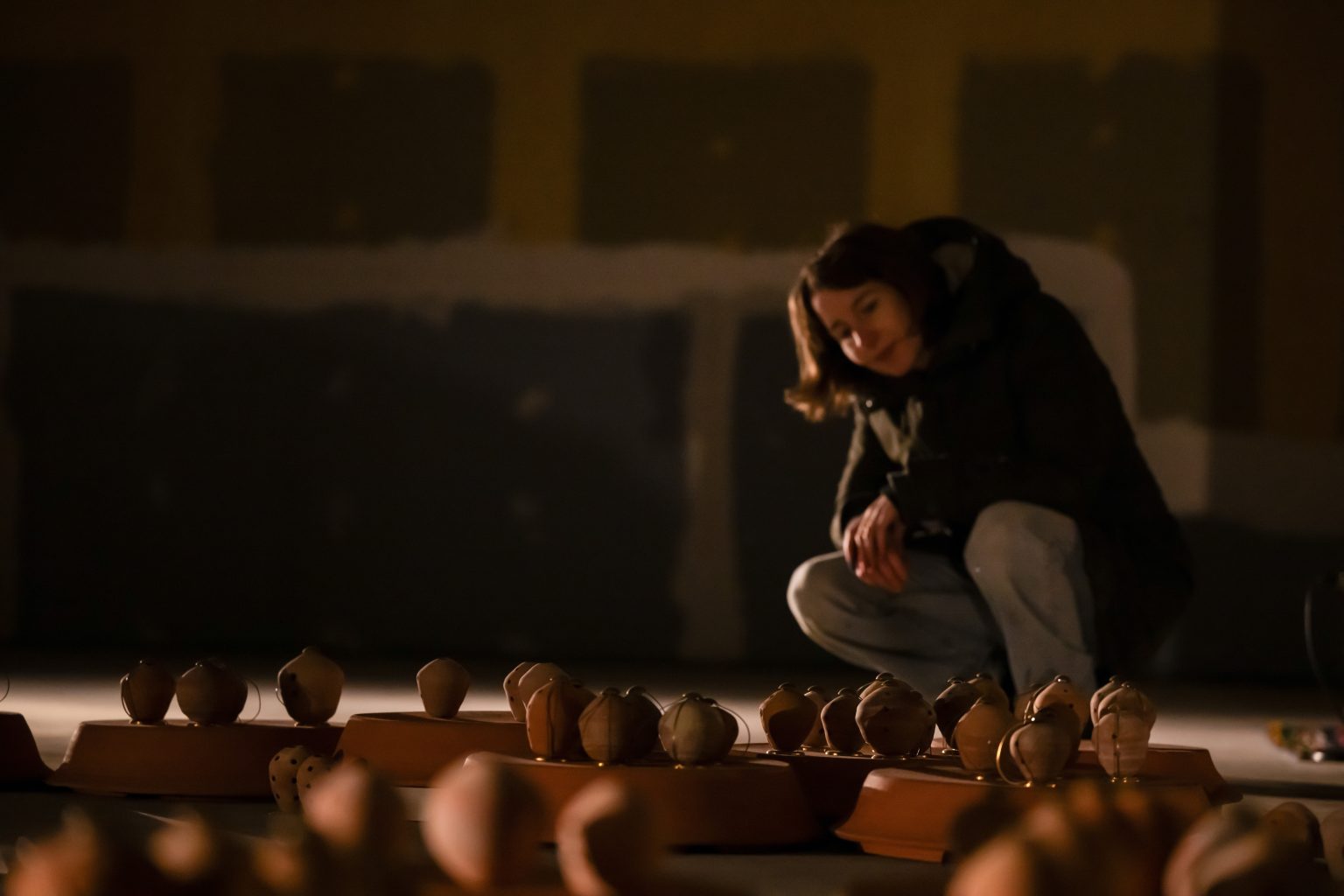
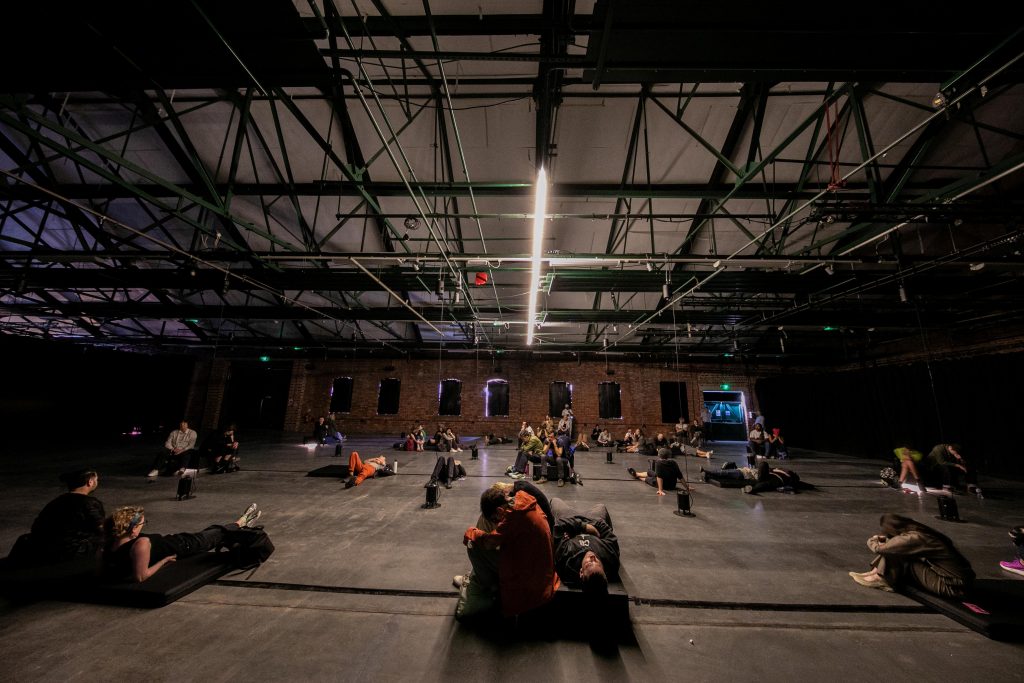
Elements of this long industrial history are brought to life in MONOM Studio’s 4DSOUND spatial audio installation ‘Acoustic Memories’ (2026), staged inside a former Victorian iron mill. Though it’s now a venue space, no doubt deathly quiet between weddings, back then the machinery in here would have operated at a nerve-shredding volume. In a nod to the building’s noisy past, ‘Acoustic Memories’ is therefore designed not just to be listened to but felt. On entering the space in darkness, I see visitors sprawling across various surfaces, priming their bodies to absorb the sound. When the piece finally starts, it’s with a dense rumbling that volleys around the space, a hellish growl from deep within the earth – or just another day at the colliery. The piece conjures up a vast panorama of sound, filled with steam engines, pneumatic drills, the chime of a shaft bell, and various scattered voices which recall the people and labour that made technological advances possible.
Next door is Metahaven’s film ‘Chaos Theory’ (2021), a multi-lingual dialogue about childhood and parenthood. Instead of a traditional narrative structure, the film is told through familiar textures: bright bus upholstery and primary-coloured pencils scratching into paper, enormous shimmering raindrops. These abstractions recall the intensity of everyday life as children, when we made sense of the world around us by letting its shapes and patterns imprint on our minds. While the script grapples with complex questions about subjectivity and the passing of time, the screen fills with simple colours and outlines, as careful hands arrange stickers into various formations. Like much of the work in the festival, it seems to yearn for a shared past, unearthing dreams and flashbacks to reconstruct a disappearing world.
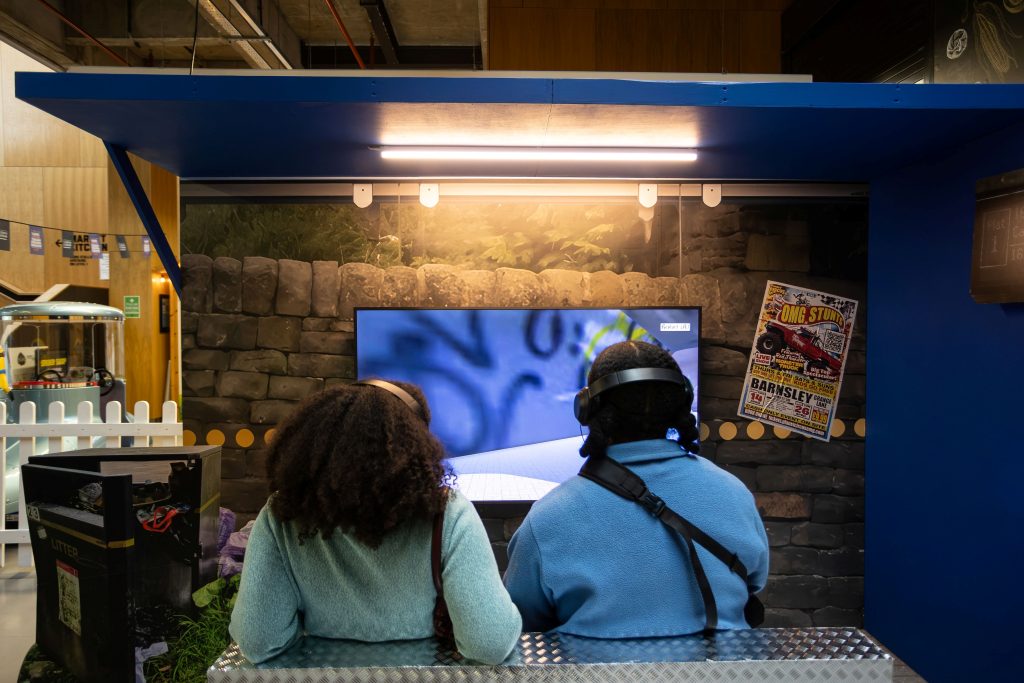
Back in the town centre, two further works invite visitors to interact with the current landscape. Clusterduck’s ‘(W)HOLE’ (2026) is a new iteration of a project originally conceived in 2025, which rethinks manhole covers as gateways: thin layers of metal separating ordinary streets from the complex subterranean systems that lurk beneath. Six QR-activated designs are scattered along a trail, each undetectable to the naked eye but springing to life with the help of Snapchat. Meanwhile, in the market, Jazmin Morris’ three-level game ‘Northern Passage: A Quest to Hopian’ (2026) is a chance to roam gloomy 3D-rendered versions of Barnsley and Doncaster, filled with discarded cans, burnt-out cars and shuttered restaurants. Her cartoonishly bleak aesthetic extends into the exhibition space itself, which is fitted out with overflowing bins and hard-edged metal benches. The mission screen explains why – local towns are in turmoil because humans are trading centuries of knowledge for AI slop, have forgotten how to cultivate food from the land, and are wasting their days picking fights with neighbours.
After fruitlessly wandering this virtual space and bumping up against endless dead ends, a chance move suddenly enables you to ‘find your powers’ and the screen is flooded with colour and music. The bus interchange transforms into a library, a ruined building blooms into a garden, and good overrides evil as functioning civic spaces are restored. While Morris’ game might draw on well-worn fantasy tropes, it’s hardly escapism. Instead, the work asks what might happen if we did the opposite of escape – i.e. stay in our hometowns and find ways to make them better. If that sounds too much like a pipe dream, then maybe doomscrolling in a dark room is what we deserve.
Returning to the real Barnsley interchange after a day spent among so many eerie, depopulated environments feels strangely grounding. The shouts of teenagers racing backwards up an escalator sound more musical than they did before, or maybe I’m just craving noise. With its focus on AI, and tools becoming the master, this iteration of AND felt less a celebration of technology than a warning. Perhaps for that reason, drawing out the quirks of Barnsley’s past felt all the more important, making us notice the hidden, overlooked and underused. As this freshly-minted Tech Town readies itself for an uncharted future, such interventions are a reminder that we don’t always need to choose the path of least resistance.
Orla Foster is a writer based in Sheffield.
AND Festival 2026 was held across various venues in Barnsley and Elsecar between the 25th and 27th of September 2026.
This review is supported by Abandon Normal Devices.
Published 03.11.2026 by Benjamin Barra in Reviews
1,667 words