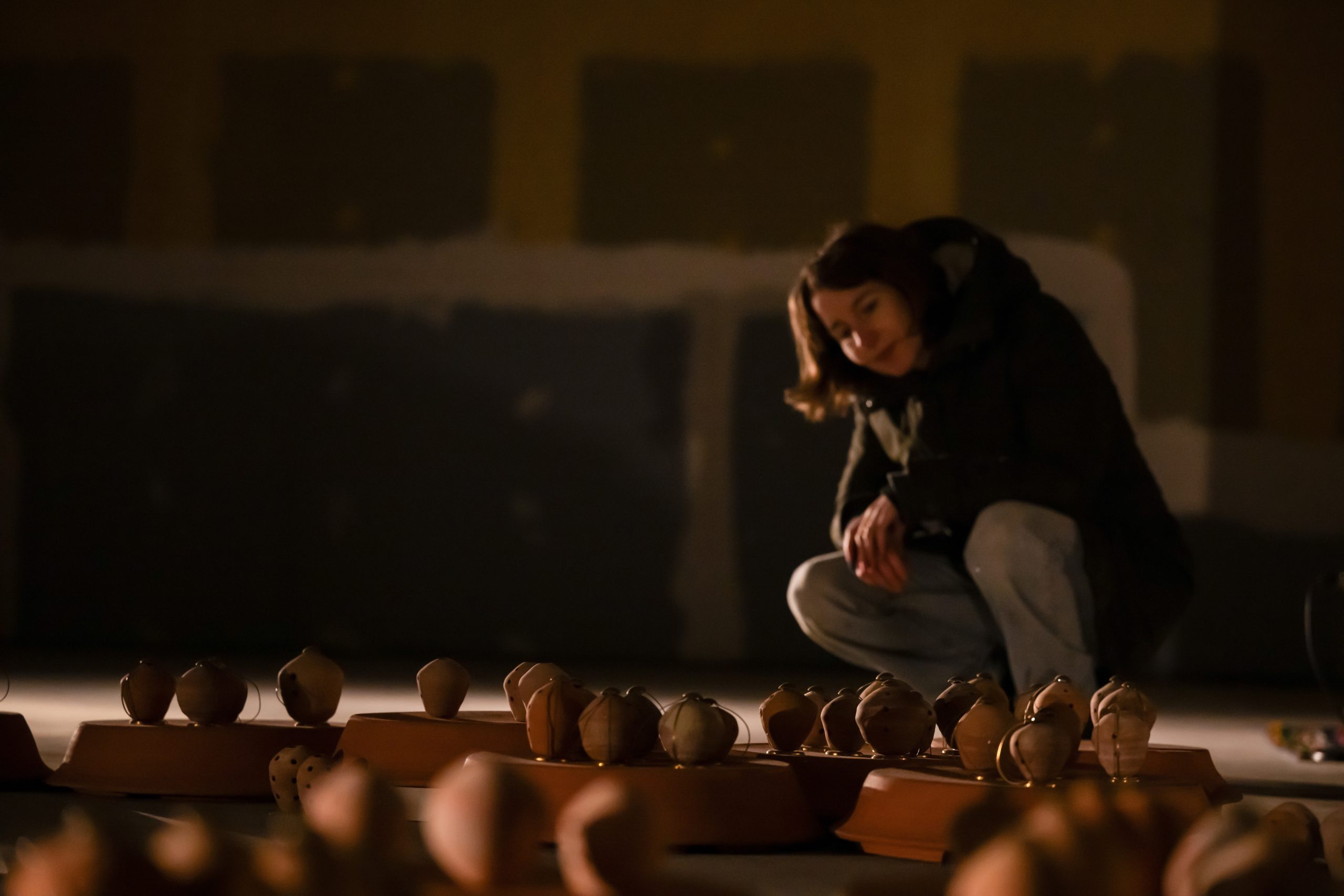
Microtonal is an installation comprising 200 borindos (pronounced boreendo) – a clay wind instrument from the desert of Sindh, Pakistan. Officially added to the‘UNESCO List of Intangible Cultural Heritage in Need of Urgent Safeguarding’ during the twentieth session of the Intergovernmental Committee, in New Delhi, India, in December 2025, it gained global recognition as an instrument worth preserving. The installation, winner of the Karachi Biennale Jury Prize for 2022, formed part of Lancaster Arts’ season on the theme of Dissent earlier this year, before opening at Barnsley Civic in June.
The room in Lancaster Arts’ Peter Scott Gallery was dimly lit, with the tiny borindos strewn across the floor. With close ups of the instrument featured in the show’s poster with no reference to scale, their size struck me first: small and delicate like creatures nesting in desert sands. Wires spilled out of them, making them appear as an alive network of connected beings, with a video work showcasing the process of their creation mounted on the back wall of the gallery demonstrating their fabrication. Tied to the land from which it hails, the borindo is made from the earth of the Badin area of Pakistan and named after an insect whose nest it resembles. The clay is not chosen abstractly: it is that specific earth, within reach of its specific water source, with its specific mineral content, responding to the specific humidity of the air above it, that creates the exact conditions for crafting it. Born of this vast landscape and transported to a windowless gallery in Lancaster, their journey seemed to mimic that of the many people who leave their homeland in the hope of a better future, only to find themselves in the gloomy climate of the North West.
A small rug was placed at the far side of the gallery, with a microphone low on a stand atop it. Due to the familiarity of the rug’s pattern and persian style motifs, reminiscent of many a living room, I took it as an invitation to take off my shoes and sit with it. The exhibition invigilator explained the functionality of the microphone for aspects of the installation, how for one section out of six of the installation’s score, sounds made into the microphone by audiences would reverberate through the wires which visibly connected it to the borindos and echo back out into the space.
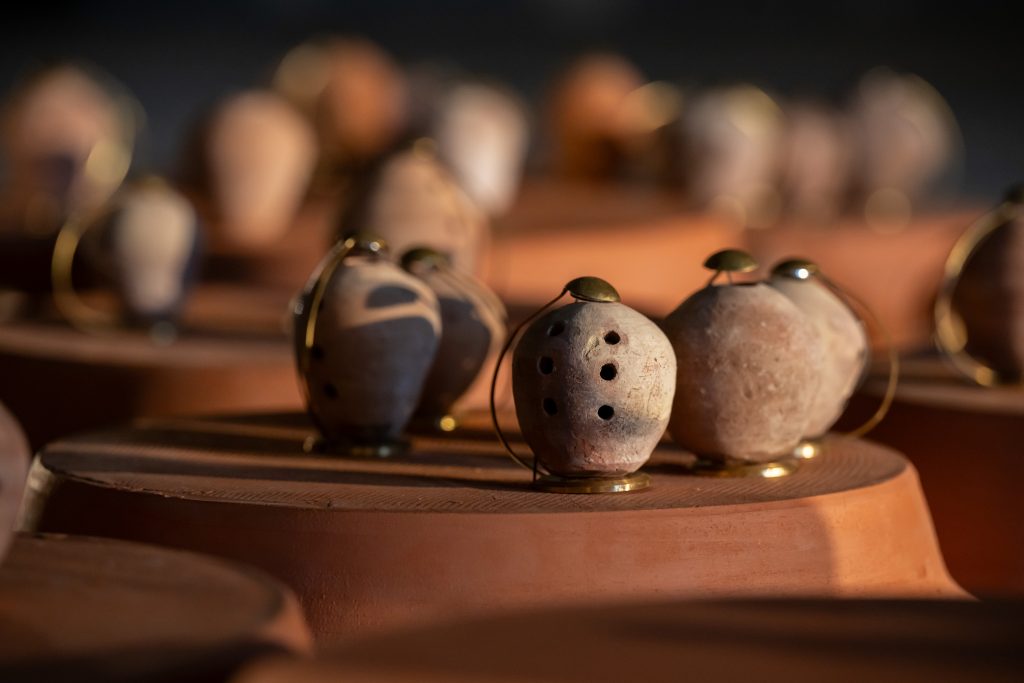
Rooted in the Indus Valley Civilization, the hollow, sun-dried clay instrument is symbolic of Sindhi folk heritage, traditionally played at bonfires, weddings, and festivals. The nomination to UNESCO, submitted by Pakistan, highlighted its immediate risk of disappearing, with only a few practitioners believed to retain the complete knowledge of making and playing the borindo, in spite of its 5,000 year legacy. It is emblematic of many provincial musical practices in the region that are disappearing, as those who hold the knowledge of the practices are fewer in the ‘post’-colonial world, in the face of growing neoliberalism and globalisation.
Allah Jurio, who is thought to be the only remaining craftsman with the knowledge of how to make borindo, and Faqir Zulfiquar, the only known musician able to play them, are two of the Pakistan-based artists behind the Microtonal installation, in collaboration with Invisible Flock, a Yorkshire-based artist studio led by Victoria Pratt and Ben Eaton.
The installation offers a new way to look at craft, heritage and conservation, with two ustads (a term of respect for a master craftsman who has perfected their art and could teach apprentices) who stand steadfastly in the face of potential extinction, willing to give a rare glimpse into the millennia of ancestral knowledge that stands behind the practices of making and playing borindo. The new UNESCO classification calls for immediate action to train new generations, document the crafting techniques, and to preserve what UNESCO describes as the borindo’s unique melodies.
While sharing the practice may seem a self-evident method of preservation, it is neither a small feat nor a given that an ustad would share their work with just anyone. I find that in Global Majority contexts, craft knowledges aren’t taught based on wage labour – a teacher being paid per hour to teach a student, for example. Rather, there is sacredness attached to artisanal practice requiring a high level of trust and, most importantly, respect. Respect for the practice itself, the ustad and the generations of ustads that came before, as well as a dedication to the preservation of the craft’s sanctity; its cultural, spiritual and even political sanctity against co-optation and degradation. It’s therefore a great honour that Invisible Flock, based at Yorkshire Sculpture Park and known for their blend of creative storytelling and technology, were able to visit Sindh and become apprentices of the practice, learning the ways of the borindo in order to offer new technological processes to open up alternative ways of engaging with the instrument.
With previous projects in India, Indonesia COP27 and 28, in Egypt and Dubai, respectively, and many countries in Europe too, the collective is no stranger to working across cultures, technologies, languages, or temporalities. As such, it is not surprising that they developed, according to Eaton, ‘a notion of how to know if you’re invited and how important it is in a process to keep checking in on that invitation to make sure that you are participating as an open equal collaborator, showing respect and awareness of your own positionality within a process’. In conversation with the artists after visiting the show, he also expressed his concern for the barriers that mastery can place upon a practice: ‘Folk should be considered at its most potent when it is alive, changing and evolving and participated in actively, and in that sense, I think mastery can serve as a barrier to a culture that actually is desperate to be played and participated in.’
Eaton makes an interesting proposition, and one which is very inline with decolonial heritage discourse: that rather than being stuck in time, heritage can and should be alive. Within the context of heritage in Pakistan, the British Mandate established the first framework for conservation back in 1904 with the Ancient Monuments Preservation Act, which was exclusively concerned with built environments, pre-colonial monuments and archaeological sites. Not only were intangible expressions largely ignored in this mandate, but it also set the precedent for placing the culture of the Global Majority into a colonial chokehold – trapped in time. Through preservation laws and separatist ideas, this western perception of heritage created rigid binaries between old and new (and by default contemporary/obsolete, civilized/savage) whilst also commodifying cultural artifacts as ‘medieval relics’ for tourist consumption, rather than things or practices with an everyday use. This tactic was copy and pasted across the colonies, and resulted in very strict ideas about what is worth saving, preserving or updating.
‘It’s all about whether they are kept alive by being played, by their stories being told, by being handed down or handed across to other musicians or to children or grandchildren’, Eaton told me.
It seems that Microtonal approaches heritage in a similar framework to architect, restorer, and socio-cultural anthropologist Dr Khaldoon Bishara, of Riwaq, who calls for a reframing of heritage to be not what it is, but what can be done with it – creating jobs and cultural infrastructure, prioritising the intangibility of craftsmanship over the tangibility of construction.
The installation attempts to be a gentle act of resistance through technology, intending to make the 200 borindos featured ‘breathe again’, as written on the Lancaster Arts website. The installation has allowed the borindos to breathe on new shores in front of new audiences and, most strikingly, breathe alone – without the need for a musician to play them.
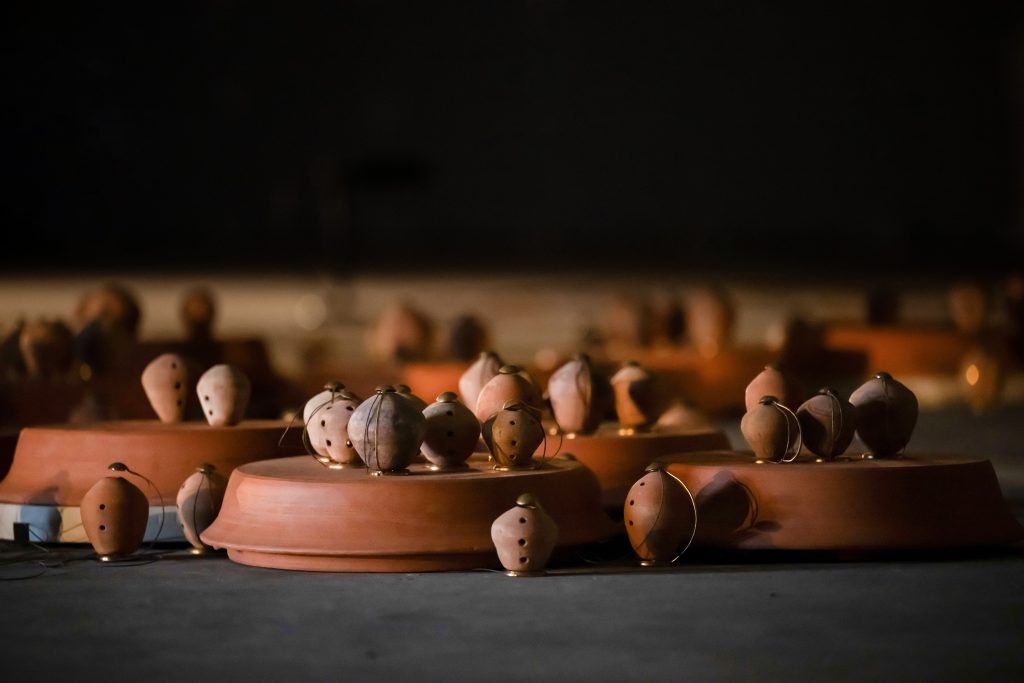
Each borindo placed on the gallery floor has a small speaker poised just above its opening, tuned to the resonant frequency of their corresponding instrument. The shape of each instrument naturally amplifies otherwise imperceptible sine waves creating a chorus of 200 instruments playing autonomously. Each individual borindo emits sound in response to what audiences put into the microphone – they may clap or jeer into it and hear it come back out through the borindo, though distorted into a drone-like sound, along with field recordings collected in Sindh. Most of the time this results in a highly ambient sound throughout the installation, apart from one section in which we hear Zulfiquar playing a melodic tune. Occasionally, you hear bird song, indicative of the biosphere of the landscape in which the work was made. Speaking on the sound of the installation, Eaton states: ‘The intention wasn’t so much to create something ambient as it was to just explore the instrument sonically, and to let the sounds that were there fill the space.’
He also spoke of how the installation is built around the idea of listening outside of the comfort zones or strict aesthetic parameters that we are used to, which they explored through the shape and sound of the borindo. ‘I think of deep listening as a practice, whether or not that is to the natural world around us’, Eaton told me. This sentiment is echoed in the wall text, which introduces the installation with a pertinent quote from Ustad Naseeruddin Saami, who is widely regarded as Pakistan’s preeminent living classical vocalist: ‘All of the world’s problems are derived from a lack of listening.’
The technicality of the borindos playing alone is most definitely innovative, though personally I couldn’t help but feel a lack of emotion in the sonic landscape created. Sound is a respected and spiritual aspect of Pakistani, and Islamic, culture, deeply rooted in the belief that the right kind of music can bring us closer to God. The borindo itself is a feature of the traditional folk identity of the Thari community and is often used in local Sufi music. In this context, sound can awaken the soul, quiet the ego, soften the heart and bring listeners into a deeper state of union with the divine, irrespective of their own beliefs or upbringing. Although the sine wave which the installation uses is a smooth and clean sound, consisting of a single frequency with no added harmonics or overtones, this purity also creates a slightly clinical, cold sound in my opinion. It was loud enough to fill my ears and create a sense of awe at its technological mastery, but my heart was left eagerly reaching out for a tone or rhythm to hold onto, or for the sound to dance around a more complex microtonal scale to carry me towards sacredness. It was a missed opportunity to revere Islamic musical traditions, I felt, especially when exhibited in a country with an alarming rise of far right and anti-Islamic propaganda. In the face of this harrowing reality, the Ustad Saami quote used to open the exhibition text rings even more true.
Ultimately, my experience of Microtonal at the Peter Scott Gallery in Lancaster Arts left me with pertinent questions around what it means to experience an ancient tradition in a new space, and how tradition can collaborate with innovation, whilst still being provincial. Although Microtonal offers no concrete answers, what it does do is create a space for reflection and active participation in heritage. It succeeds in presenting heritage in a new way, not as something behind glass which we should be too afraid to touch, or to stain, but as something with which we can interact and play and engage in call and response. It is an invitation into the world of the borindo that is too irresistible not to listen to.
Microtonal, Lancaster Arts, Peter Scott Gallery, 20 April – 22 May 2026; Barnsley Civic, 12 June – 11 July 2026.
Jessica El Mal is British Moroccan writer, curator and artist based. She currently curates for The Arab British Centre, is the founder of A.MAL Projects and is a current PhD candidate at University of Leeds.
Published 11.06.2026 by Jazmine Linklater in Reviews
1,996 words