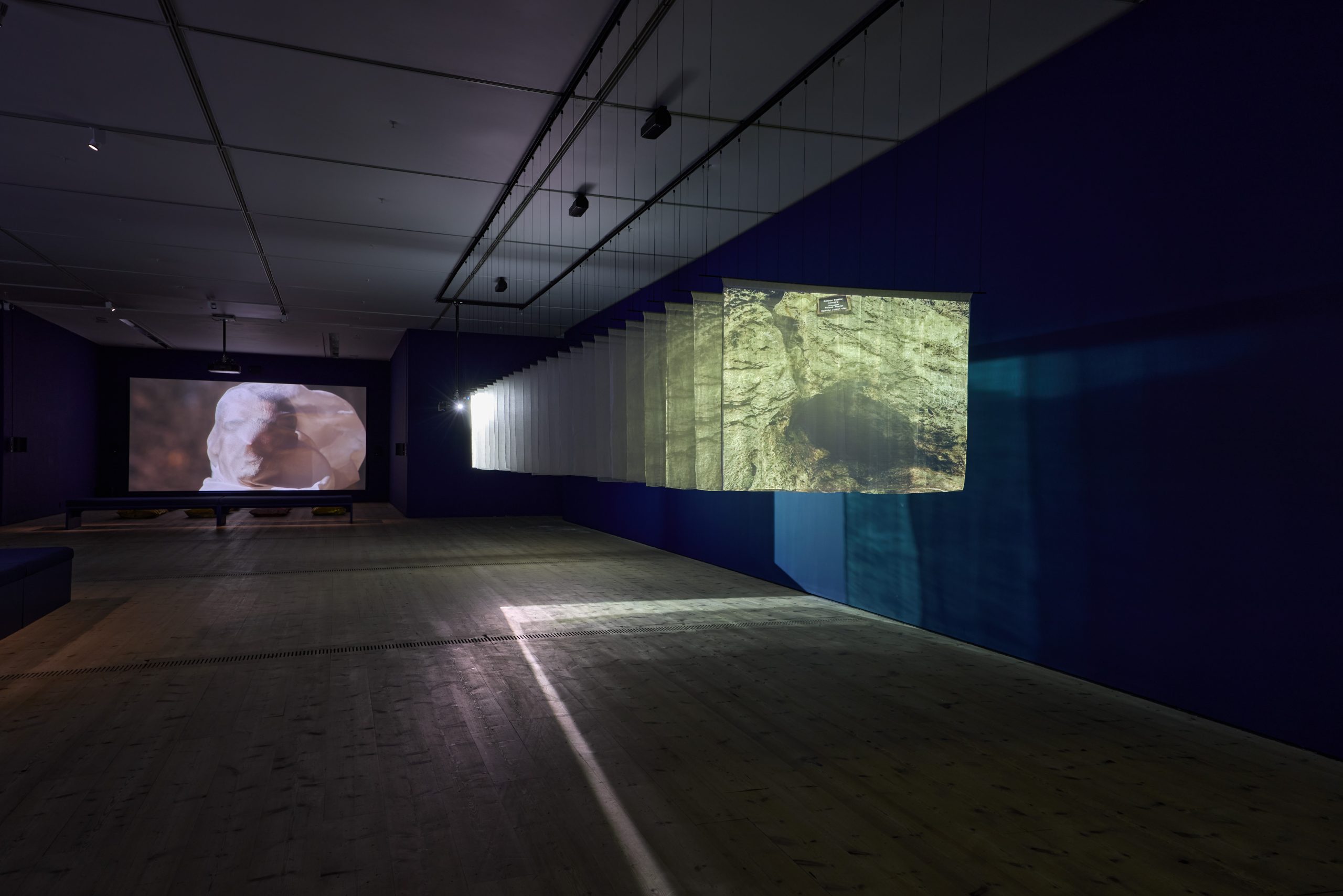
I hear before I see. Two pendulum speakers hang from the square-panelled ceiling. The sound is directed toward the ear, yet interference thickens it into a heavy sonic mud, obscuring its edges. Electric fencing snaps; wire scrapes against concrete. A translucent silhouette appears—not still, but stilled. The sound continues: water pouring over a head into a glass. A gentle polyvocal “Ahhh” gathers like spectres in the dark. Mouths clatter; lips press. On screen, the figure dissipates into darkness as fragments of 1980s pop collide with animal calls in an ambient synth register. Crackles and scratches. The figure, lying in their bed like a coffin, leaves us. What remains: pitter, patter, batter—pitter, patter.
I still haven’t moved, but the shadows of passersby come in and out. Someone tells me that on the other side, the body is inverted in a brightly lit room; they can see the figure clearly. Female or feminine presenting, suggested by stature. A ring on the third finger. The head moves slightly towards us—still a Sleeping Beauty in slumber—the body relaxed, propped by ivory lace pillows. This work, ‘Zukhra’ (2013), obstructs the entrance to Gallery 3 at Gateshead’s Baltic Centre for Contemporary Art, where Uzbek artist Saodat Ismailova’s exhibition As We Fade unfolds across moving image, sound and spatial installation. Throughout her practice, Ismailova returns to the unstable afterlives of Soviet and pre-Soviet Central Asia, where memory persists not as record but as disturbance. One concept at play here is sound and media theorist Steve Goodman’s (aka Kode9) notion of déjà entendu—the ‘already heard’— from Sonic Warfare: Sound, Affect, and the Ecology of Fear (2009): sound that feels eerily familiar before the image explains why. We realise this only as we move past ‘Zukhra’, one of Ismailova’s earliest pieces.
I walk to the large-scale, two-channel film installation ‘Swan Lake’ (2025). Lounging on a communal, cushioned rectangular banquette, we sink into an artwork that unfolds slowly, then with sudden intensity. Presenting amalgamated fragments is all I can do, because I feel fragmented myself—poetically drained after thirty minutes of hypnotic archival footage in black and white and colour of an enduring Soviet past. Perhaps that is the goal: Soviet drilled deep into the amygdala. Blinked. A cut, but not in the film—in me. The sound of an automatic rifle firing into water strikes in rapid bursts, shifting from sharp crackling impacts in the air to deep, muffled thuds beneath the surface—a mixture of explosive bangs, mechanical clicks, and a heavy sloshing gulp as bullets break the water, forming chaotic cavities. Then the sound of water pouring rises again, looping, echoing, drawing me further into the rhythm of the work.
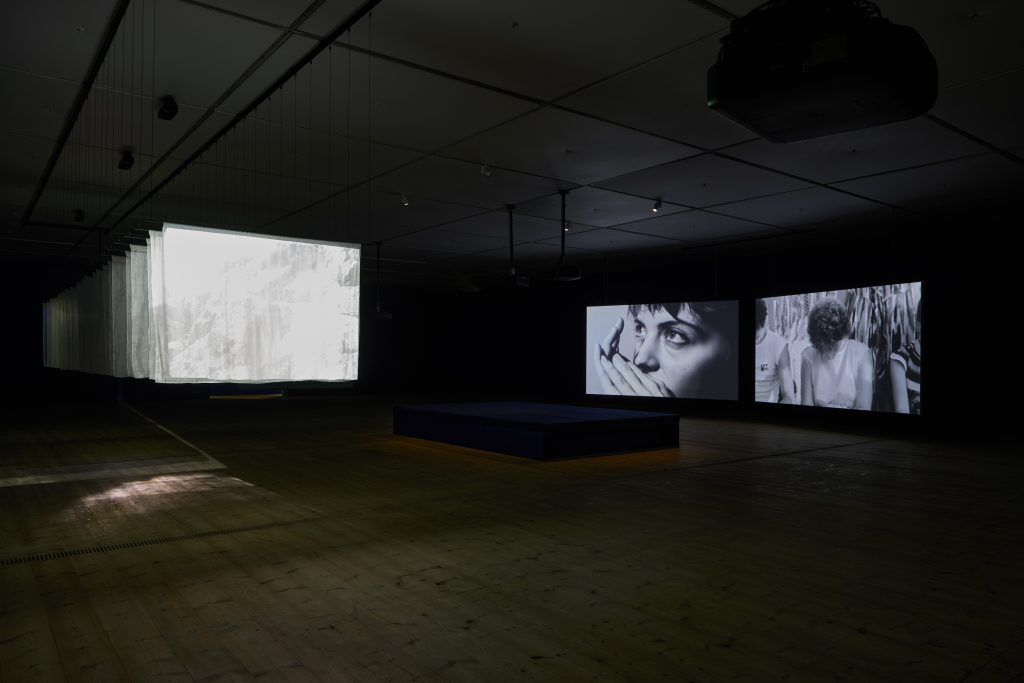
On the left screen, in black and white, a half-full glass of water; on the right, a snowed, lacklustre street lined with a few people, houses and barren trees from a low oblique view. Now a close-up on the left reveals feet and lower legs—potentially male, suggested by the size—shod in shoes with metal heels, walking at a measured, deliberate pace along the paved ground. Heavy rain hits the surface in intricate detail, yet there is no sense of haste. On the right, footprints appear in the sand, while on the left, people stand lined up against a wall wearing ushankas, the fur winter hats with ear flaps widely used across the USSR, including Uzbekistan, for protection against the cold. Originating in Slavic and nomadic traditions such as the treukh or malakhai, the ushanka remains in use across Central Asia. Blinked again. Two workers bend over a hot, barren wasteland. Still, footprints in the sand. The image holds at ground level, where history registers not as narrative but as pressure, imprinting itself onto bodies, surfaces and gestures that persist beyond explanation.
We ascend; the ground disappears.
A single biplane flies toward our trajectory. Could it be a Polikarpov Po-2? If so, it is the most iconic Soviet biplane, serving from 1929 to the 1950s throughout the USSR, including the Central Asian Soviet Republics, for training, mail delivery and wartime bombing—positioning these clips within a suspended wartime temporal condition. Blinked. A figure lies on a sandy floor, jaw clenched, clothes tattered, pressing a rod into another person’s mouth to shut them up, holding their neck in place so they cannot move. The object recalls the gag, but denied consent, agency or play. The scene from Смерч (‘Tornado’) (1989, dir. Bako Sadykov) slows, becoming floaty.
Produced in Uzbekistan during late perestroika, Смерч emerges at a moment when Soviet visual culture was loosening under glasnost—Gorbachev’s mid-1980s policy of ‘openness’, which relaxed censorship, exposed state operations to scrutiny, and permitted criticism previously held in check. Conceived to revitalise the Soviet system, glasnost instead destabilised the ideological coherence that had long governed representation, allowing images to detach from certainty and become capable of contradiction. Within this expanded field, violence no longer appears as a contained event, bounded by cause and consequence. It persists elsewhere—in the body, in gesture, in the image itself—outlasting the moment of its occurrence. What remains is not an explanation of the violence but its residue: a trace that continues even after the conditions that produced that violence have withdrawn. The archive no longer operates as evidence. It begins to function as infrastructure, organising the perceptual conditions of the present. Curatorial frequency is how an exhibition is tuned—not what it shows, but how works are modulated to resonate, interfere, and transmit through time and bodies.
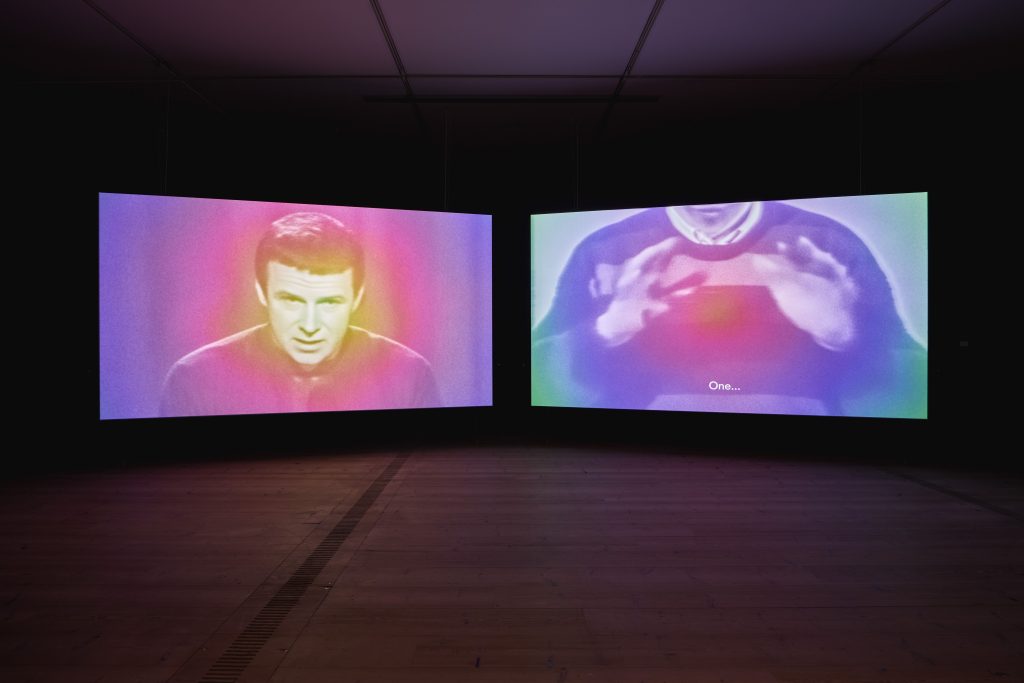
A male-presenting subject in a stripy, long-sleeved top rolls into frame. They turn in bed, covering their face completely with a pillow, as if to block out the droning synth of ‘Swan Lake’ or steady themselves against it. Profuse sweat is blotched across their face. Blinked. Flames burn inside an open mouth. Fire sits where breath should be. Blinked. From Я тебя помню (Ya tebya pomnyu, ‘I Remember You’) (1985, dir. Ali Khamraev), light falls across a corridor floor but does not reach the end. A boy stands in the doorway, half-held by shadow. He does not step forward. He does not retreat. He remains static at the threshold. Such interiors structured everyday life in the late Soviet period, regulating movement while producing hesitation. By the mid-1980s, institutional structures in Soviet Uzbekistan remained intact, but their authority no longer secured certainty of direction. Here, the corridor does not simply enforce order; it interrupts movement. Figures hesitate at thresholds, neither fully arriving nor departing. Reappearing in ‘Swan Lake’, the corridor shifts function. It no longer advances narrative. As throughway, it reactivates a condition in which movement persists but orientation falters, and memory remains unresolved.
Reframed within Ismailova’s installation, the image no longer belongs to its original story; instead, it acts as a prompt that sets something else in motion. ‘Swan Lake’ is the newest work, and the soundtrack heard near ‘Zukhra’ returns here—we have already encountered it elsewhere in the exhibition. This creates a strange feeling, the déjà entendu: sound arrives before the image, shaping our experience before we fully understand what we are seeing. Time no longer feels linear. Rather than moving forward, it loops back on itself, so that what feels new is also familiar. Throughout the exhibition, Ismailova uses repetition to produce this effect. Images and sounds reappear not to explain the past, but to make us feel its presence again. These fragments do not function like historical evidence; instead, they stir recognition at an emotional level before we can consciously make sense of them. As they accumulate, clarity begins to slip. We recognise what we see and hear but cannot fully hold onto it. The more time we spend within As We Fade, the more we fade. Images do not remain fixed or certain; they detach from their original moment and continue to act in the present. They leave behind impressions—sensations that persist beyond their source, no longer anchored to a single time or place. What remains is not a stable record of the past, but an aftereffect: the feeling of having encountered something that continues to operate, even as its origin recedes from view.
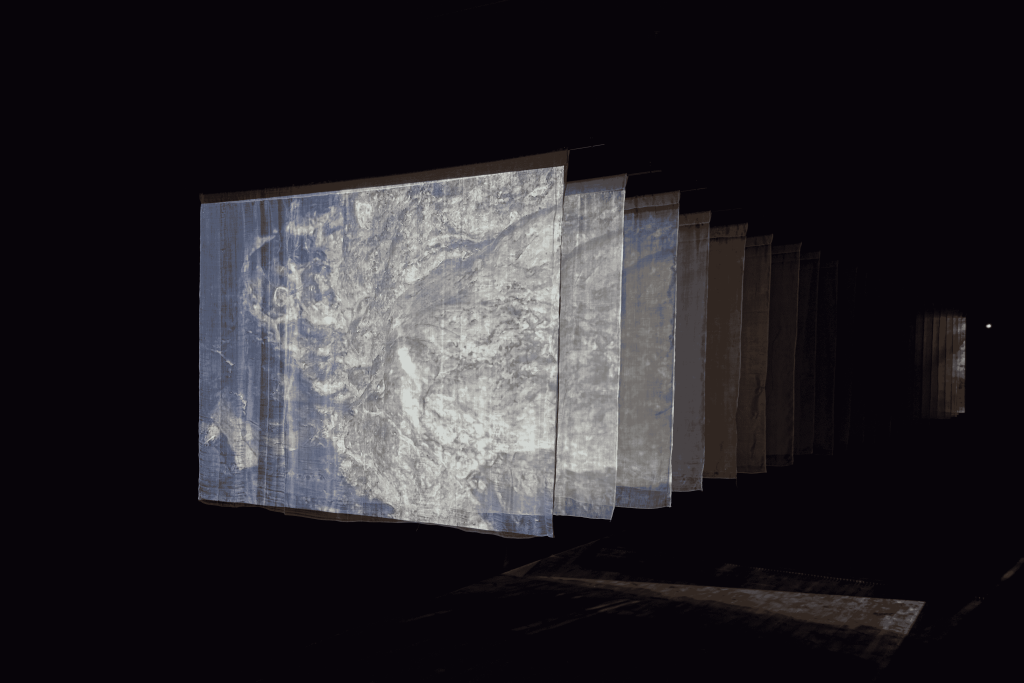
The Needle. A needle in a haystack. Viktor Tsoi? Kazakh New Wave, forgotten but now free in the 90s. 1996. I am born into the afterlife of these images. They continue working on me regardless. Caged birds can still sing and write. Blinked. My eyes now track to the artwork the exhibition takes its title from, ‘As We Fade’ (2024), across the room from ‘Swan Lake’. Slits of illuminated waves, going from loud to quiet, like a silked whisper. Twenty-four suspended elements, as I later read in the exhibition text—one for each frame per second of film—mark cinema’s underlying cadence, the interval through which stillness becomes motion. Cast onto silk, projections shimmer and diffuse, saturating the room in a low, luminous atmosphere. Silk functions as a kinetic membrane. Movement does not belong to the image but to the surface that receives and alters it.
Reminiscent of the scrim environments of artist and filmmaker Anthony McCall, the translucent chambers of multimedia artist Nalini Malani’s video/shadow plays, and filmmaker Chantal Akerman’s suspended screens, Ismailova moves projection away from fixed screens, so what you see depends on the surface the image lands on. I am also reminded of how video and installation artist Tina Keane extends this condition further, using skin and wallpaper as surfaces that interrupt rather than simply support the image. In works such as ‘Transposition’ (1992), reperformed at the Tanks at Tate Modern, London in 2012, and ‘Faded Wallpaper’ (1988), figures flash in and out of a patterned, wallpaper-like surface, their outlines dissolving. The exhibition at the Baltic shows that Ismailova is part of a group of artists who don’t treat the screen as neutral—they use it to actively shape or interfere with what we see. Image and surface enter into conflict, each reshaping the other’s behaviour.
Here, projection and weave meet and begin to break apart. Edges fray. Light fails to settle. Nothing fully lands. By contrast, ‘Swan Lake’ fills the room, forcing the body to confront what it sees and hears. This work refuses that position. The image flickers, disappears, returns changed. Scale no longer guarantees control. The surface absorbs, releases, and disrupts. Sound moves without anchor. It comes back altered. If ‘Swan Lake’ makes history unavoidable, the projection installation ‘As We Fade’ lets it slip. The image is neither held nor gone. It stays in motion, unfinished, still acting on those who encounter it.
Ismailova’s As We Fade works like acoustic weaponry. Sound builds until it overwhelms. Impact replaces understanding. The image will not stay still long enough to be known. Memory does not settle. It is shaken loose as it forms. The viewer is not protected from this. They are placed inside it. The work does not show violence at a distance. It brings its force into the present. Some memories survive. Others are worn down. Others never fully arrive. Ismailova does not reactivate history; she retunes its frequency until it begins to act on us again.
Jade Foster is a curator and art historian based in Yarm, North Yorkshire.
As We Fade is on show at Baltic Centre for Contemporary Art, Gateshead, until 7 June, 2026.
This review is supported by Baltic Centre for Contemporary Art.
Published 31.03.2026 by Lesley Guy in Features
1,935 words