Felicity Hammond’s installation ‘Reactor’ is an interrogation of technologies’ implications for the future of warfare. Located at Signal Film and Media in Barrow-in-Furness, an industrial town that is home to the largest indoor shipbuilding facility in Europe where submarines have been built for over 140 years, the exhibition could not be more relevant in asking questions about autonomous weapons systems and AI. This is Hammond’s second exhibition at Signal Film and Media. Her previous installation ‘In Defence of Industry’ (2018), won a Lumen Art Prize. Since receiving her PhD in 2021, Hammond has been exploring the use of AI, data mining and its ecological implications in a series of ambitious exhibitions in the UK, the USA and Canada, but with this new installation she turns her attention to the defence industry.
‘Reactor’ simulates the control room of an autonomous submarine – a submarine guided by preprogrammed computers, using sensors, sonar and AI to navigate. Unlike a manned submarine with a crew and captain making decisions, an autonomous submarine makes decisions based on computer algorithms that process data from sensors. In focusing on autonomous weapons, Hammond asks philosophical questions that point to larger geopolitical issues that go far beyond Barrow. What if the exhibition’s premise came true and an autonomous submarine could ‘become aware of its own autonomy, reflecting on whether it might follow or refuse its orders’, as the accompanying handout puts it? As speed and efficiency are prompting increasing use of automation, what does it mean to entrust decision making, especially life and death decisions to computer algorithms?
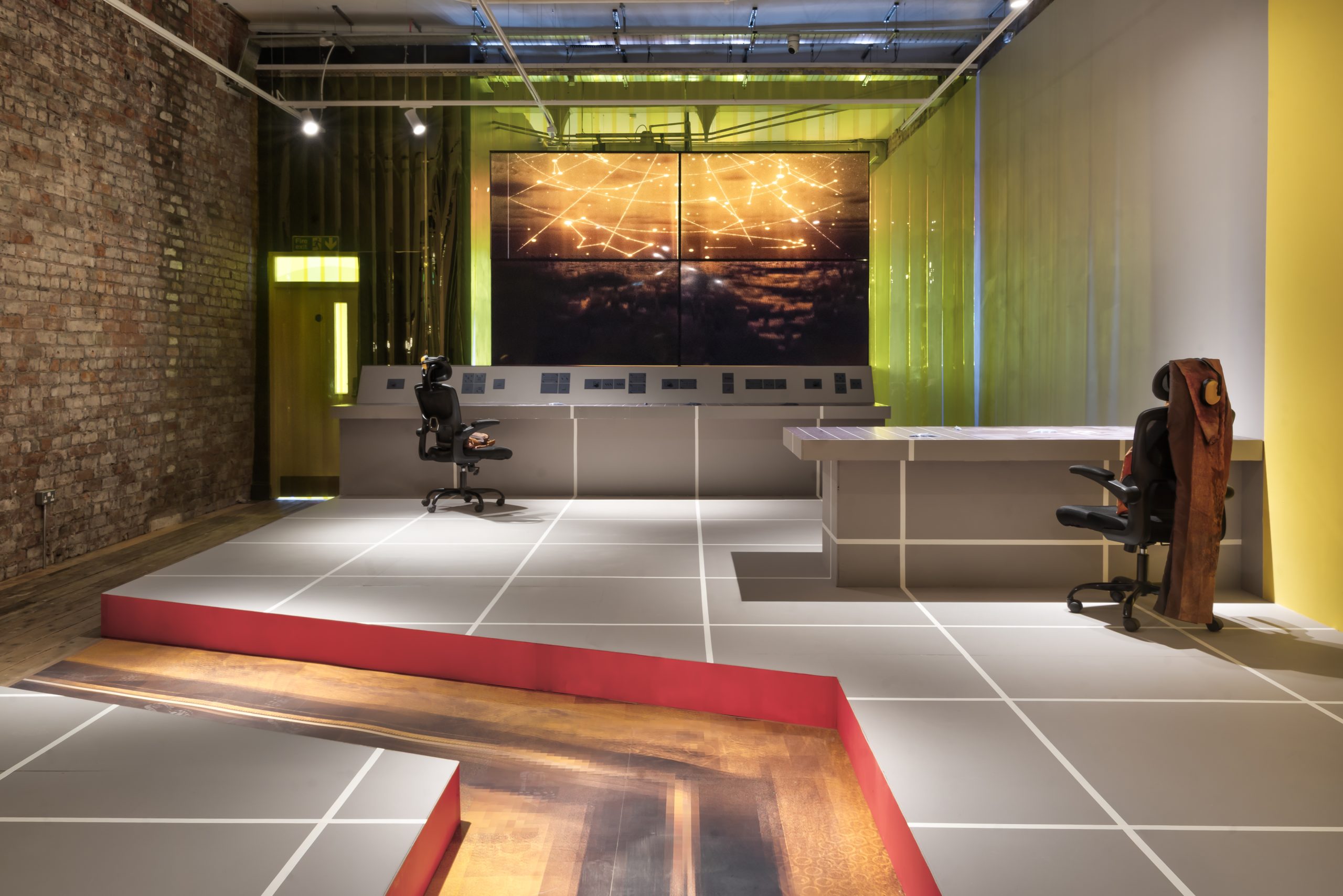
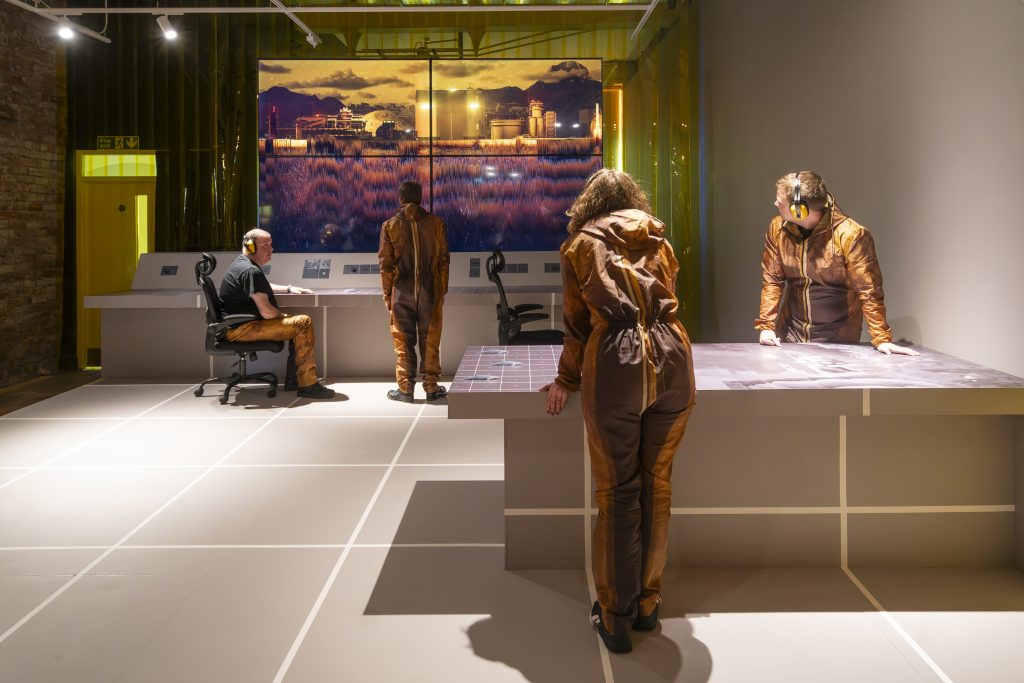
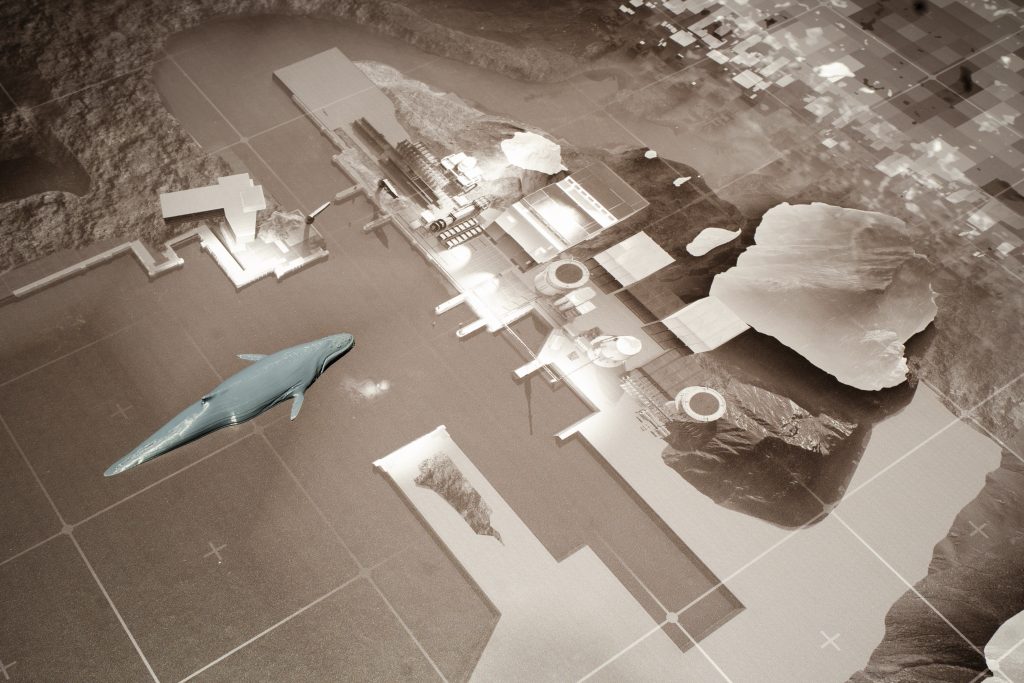
On entering the gallery, the space is filled with pulsing sound. On the end wall is a huge screen with glowing images of waves, buildings and a night sky. Below the screen is a simplified wooden construction evoking a control panel with various painted knobs and dials at which two chairs are placed. The floor of the gallery has been raised to create a channel leading to a circular recessed shape containing the collage of sonar imagery of the seabed with a whale’s eye. A group of actors from local company, Theatre Factory, gather around a mapping table, wearing costumes created by the artist, they respond to the installation through a series of improvised interactions.
The enveloping soundscape is a collage of sound, spoken words, sonar, whale song and other rhythmic machine noises. Central to the piece is the script for the soundscape, which evolved from workshops with local people who had ties to the shipyard. One of the great strengths of Hammond’s work is collaboration, connecting this installation with the people who live and work here makes the work far more powerful. The script for the spoken word component is an imaginative exploration of the inner thoughts of an autonomous submarine as it becomes aware of its agency and questions its orders. I was moved by the poetic, complex and thoughtful language of the script as Hammond confronts the enormous challenge of this project. In the script, the submarine speaks in the first person, recounting its thoughts: ‘Objects emerge from the darkness. I know my orders. I know how I am expected to react. I arrange them. Avoid them. Approach with caution.’ I was given a copy of the script but the experience of reading it is quite different from hearing the text in the gallery, as the voiceover mingles with other more mechanical sounds. I only caught fragments of text, making the submarine’s thoughts more mysterious and otherworldly.
The moving images on the giant screen show dark water and night skies. Stars and constellations appear and then dissolve. The voiceover recounts: ‘The night sky has become my mirror. And I understand now that I am made from them, the origins of my body located in their after image. I track them to fix my position.’ At the opening, Hammond explained to me that stars are still used as the backup system for ballistic missile navigation in nuclear submarines, as they have fixed coordinates. She noted that the planets represent both destruction, as they are used for targeting, and creation. When I asked her to explain why the stars represent creation she told me that the submarine ‘is starting to develop an ecological awareness, it is also starting to understand that everything is made from recycled cosmic dust’. She explained to me that as the submarine gains agency and awareness, it thinks about the elements that make up our bodies such as carbon, calcium and iron, which originated in the cores of exploding stars. ‘Reactor’ takes us on a journey into deep time and unimaginable futures.
The film’s visual world, encompassing surging black waters and vivid skies, was created using Unreal Engine, a computer graphics game software commonly used to build immersive digital environments for games, film and animation. The images are a simulation of a simulation, a collage of images creating a vivid glowing seascape. Though the dominating imagery is of waves there is a recurring composite collage of luminous buildings on the shore which captures aspects of the Barrow Shipyards but also refers to the global defence industry more broadly. Glitches repeatedly fracture the images, seas and buildings collapse into interference bands suggesting system failure. Underwater scenes show circular forms which resemble mines. Hammond tells me that while she was making this work a school in Iran was hit by a US targeting system apparently operating on outdated information, killing at least 175 children. On the screen a ghostly image of a whale is seen briefly then disappears into a glowing orange ocean. I hear the whale songs in the soundscape and see a whale’s eye in the center of the floor sculpture. Whales haunt this installation. Perhaps the submarine is speaking to whales when it says, ‘I mis-interpret your body as you mirror my own. A threat. A target.……I mis-judge….I, I didn’t realise’. Misreading of data is a theme of the show. A simplified rendering of a whale as a three-dimensional mesh model is an important image for this exhibition and is being used on the handout. The digital mesh model of a whale resembles a submarine. Both whales and submarines have streamlined bodies to glide silently through the water and use echolocation to navigate, and tragically whales have been targeted because their shadows and surfacing patterns have been mistaken for submarines.
The images on the screen are constantly changing in a repeating loop. The seas turn from black and purple tinted waves to a toxic yellow and pink underworld. Bubbles float up through a hazy fluorescent orange which suddenly flattens as graphic rectangles invade the screen, which now evokes video games. Bright yellow ice flows break against a blue sky. The images become two dimensional and graphic. In conversation with Hammond, she mentioned that she intended to reference the gamification of war, the simulation of war games and military training. The use of video games to teach recruits shooting skills in a virtual environment is now established practice. On the screen the night sky returns, the ceaseless waves, the distant mountains and the silhouette of industrial buildings. We are back in Barrow.
At the opening reception I spoke with John Harrison who had worked in the Shipyards from the age of sixteen until he retired at sixty. He had been part of the workshop developing the script and had also helped build the sculptural components of the control room. He had enormous insight into the complexities of the defence industry and how vital it has been to generations of families in Barrow who have depended on the Shipyards for employment. We talked about the industrial history of the Cumbrian coast and concerns about the changes AI could bring in replacing the livelihoods of workers. There are currently conflicts between governments and AI companies over the use of technology by the military leading to questions of who controls AI. In the context of both the community in Barrow and the wider global community, Hammond’s installation ‘Reactor’ is thought provoking and prescient, as autonomous weapons are now being deployed in modern battlegrounds.
Felicity Hammond: Reactor, Signal Film and Media, Barrow-in-Furness, Friday 29 May – Saturday 1 August 2026.
Caroline Bagenal is an artist and writer based in Hutton Roof, Cumbria.
This review is supported by Signal Film and Media.
Published 08.06.2026 by Jazmine Linklater in Reviews
1,412 words