Barrow-in-Furness-based arts charity Signal launch their Artist Lab exhibition with the first group show in their newly refurbished venue, Cooke’s Studios. There is a profound question at the heart of the exhibition: what if the land remembers differently to the people? Hailing from or working in the area, the fourteen artists have spent two years in collaboration, experimentation and development; shaped by themes of landscape and protest, their work unhooks industrial heritage from its history and makes it anew. The exhibition becomes collaborative cartography, mapping alternate versions of Furness, Barrow and Morecambe Bay.
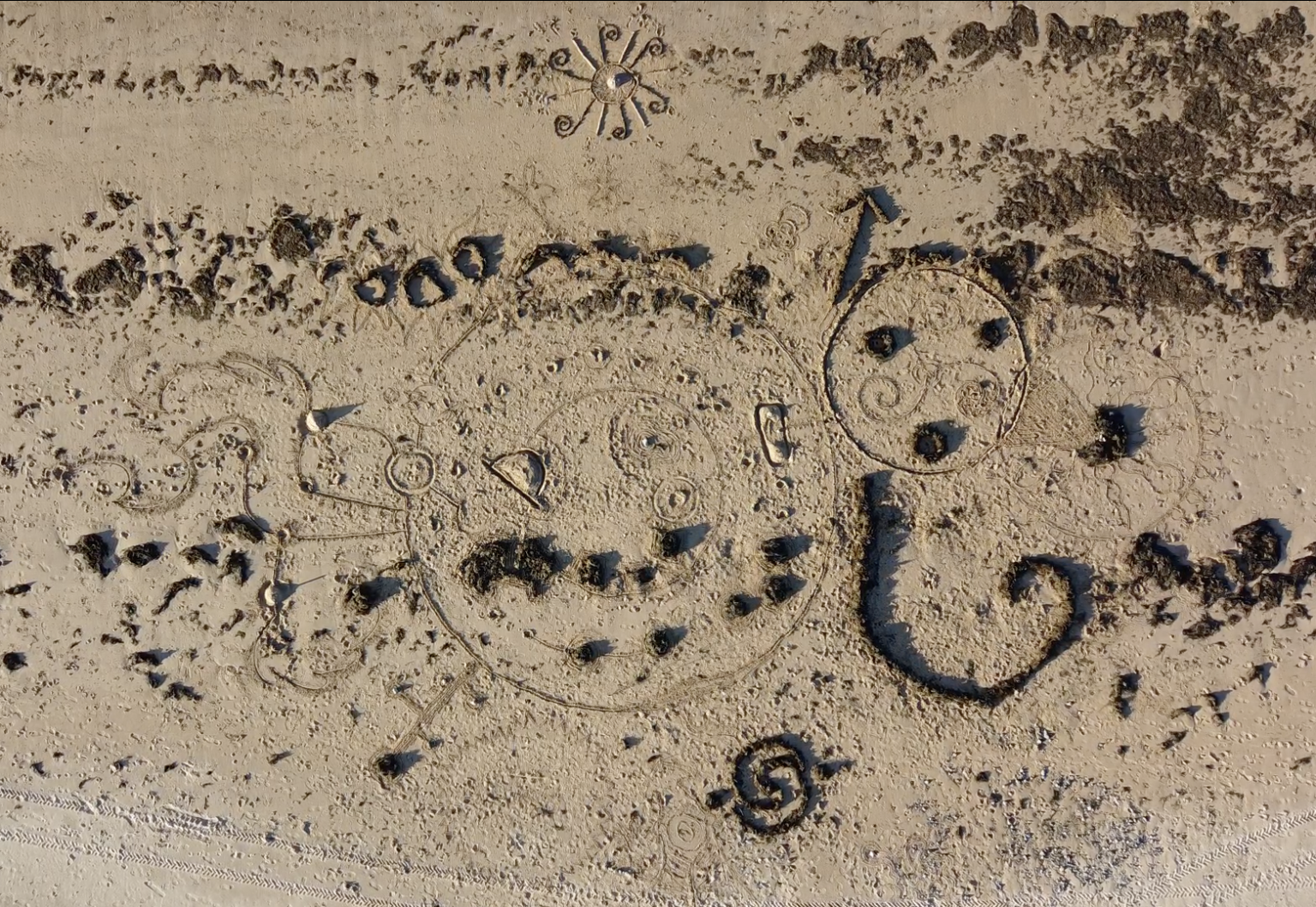
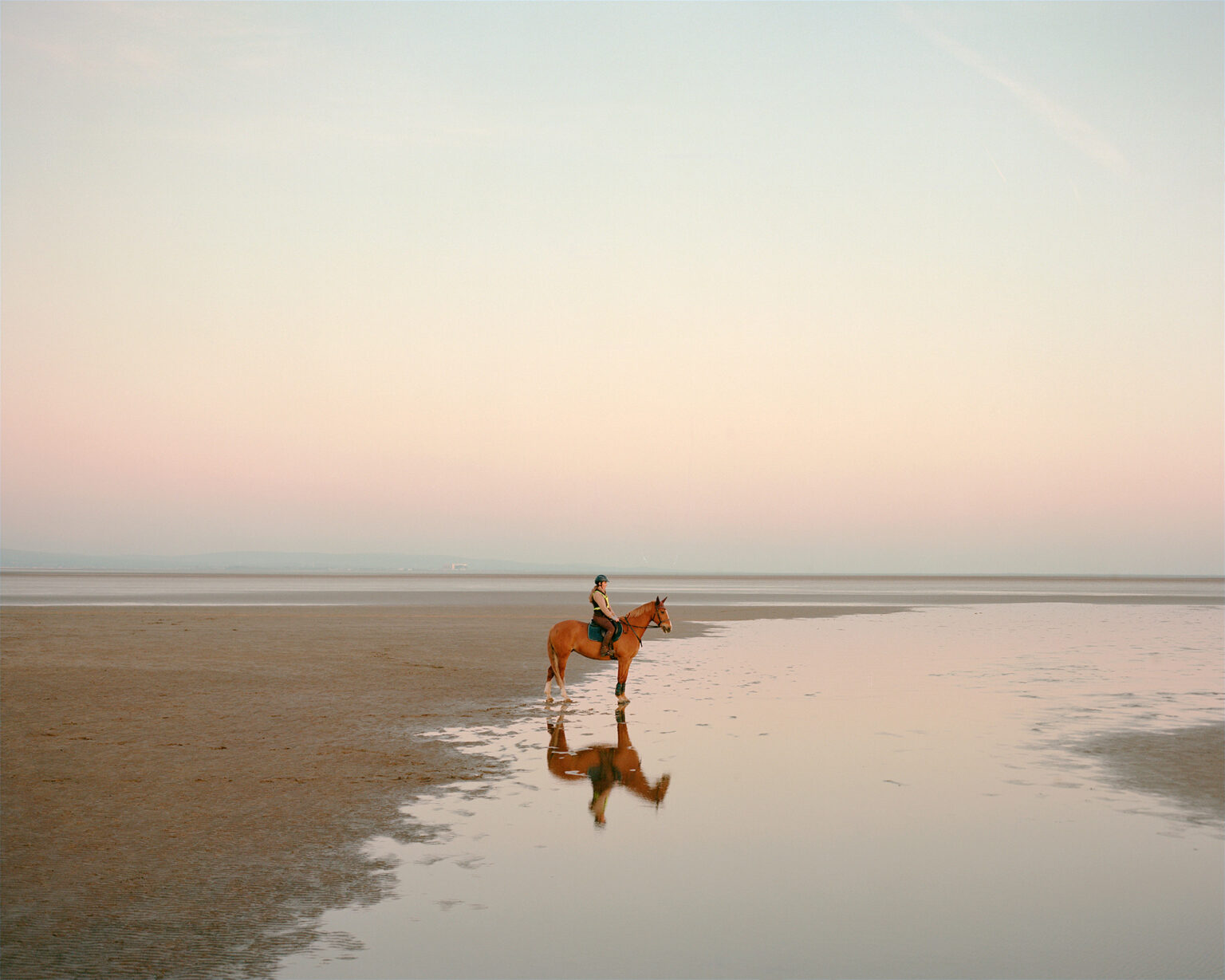
For Debbie Yare, walking the coast fosters a devotional study of landscape and its textures. Her work ‘Uncertain Geologies’ (2025) combines sketches and journals of her travels with historic maps, a chorus of pages arranged across a table. Some of her photographs are double- or triple-exposed, echoes in place and time that reinforce the patterns of the landscape: ripples in sand, wrinkles in time. Memory made tactile. This physicality is present also for Giles W Bennett and ‘The Adventures of Floaty-Cam’ (2025). Bennett’s makeshift pinhole camera is mounted inside a transparent ball and floated down the River Duddon long enough to expose an image. Bounced from rock to pool, the photographs are abstract, organic: the camera spins in eddies, carving perfect circles of light in the film; or bounces over rapids, exposure detonating as the abstractions of the river shape the image. Giving voice to land is a theme throughout the exhibition; by scattering Walney Island sand across film and developing a negative, photographer Liam Collins raises vertiginous questions of scale in ‘Star Fields’ (2025), where every grain is a star in a new galaxy. Knowing these suns are pinpricks of shell and stone transforms the galactic into the microbial, both staggeringly large and vanishingly small. Collins and Bennett surrender some control of their process, the images formed by movement inherent to the land. Who, exactly, is taking the picture?

The exhibition fosters a feeling of Furness as a world removed from the rest of the world. Natalie Sharp channels her dual UK-Seychelles heritage into ceramic masks studded with flotsam and shaped as though from estuary mud: salt marsh ceremonial. Hanging above an altar of sculpted coconuts, the masks suggest both untouchable magick and colonial acquisition, asking questions of the industrial landscape to which they’ve travelled. One of the masks has fallen from the wall and remains in pieces, Sharp ascribing this to ‘misalignment of ritual and material’. I wrote in my notebook: ‘land out of time / time out of land?’ …and within a few steps, came to ‘Yarl’ (2025) by David Haley and Laurence Campbell. Their collaborative film traces the tributaries of Barrow’s Mill Beck, the work prefaced by poems on gallery walls:
Over time land flows
In dialogue with power
Over land time flows
Haley and Campbell’s film tracks the beck through time as well as place; a fish-eye lens abstracts and transforms, juxtaposing seedheads with antique surveys, tattoos, the halos of insects in sun. They meditate on industrial traumas of pollution, groundwork and spoil, but also recovery once industry is abandoned. The themes emerge as a delirious intersection of past, present and future, blurring misremembrance with premonition. This is the essence of the Artist Lab: to unbind shared heritage and imagine it anew. Where Haley and Campbell examine industrial legacy, Núria Rovira Terradas and Mel Galley daydream a past that hasn’t happened yet. A bridge spanning Morecambe Bay has been mooted for decades; Galley and Rovira Terradas make it unreal through story, sculpture and sound. Translucent paper sweeps across the gallery floor, and this becomes the bay. Dwarfed by the expanse around it, an architectural model of the bridge is almost apologetic – a fragment made miniscule against the erasure of the tide. On an adjacent table, tiny speakers in whelk shells play underwater sounds – knocking boats, the rush of current – while a stack of story cards assembles the moments and childhood misremembrances of a life lived on the bay. With each thought presented on its own card, the narrative becomes indexed, a catalogue of loss and possibility, love and grief. One phrase jumps out, a riddle: ‘What is closest to the end at the very start?’

…and I am spun in the great circle. It’s testament to the collaboration that such disparate works capture so coherent a sense of land unhooked from time. Side by side in the gallery, sculptors Zoe Forster and Cj Pitcher present overlapping visions of Furness past and future. Forster has recreated a firepit suggesting settlements abandoned and this makes a nomad of me, following the footsteps of other travellers, excavating their traces. The ashes suggest a past of stone and bone but also a future of climate migration, the forced movement of people. Look again: the stones are hollow, eggshells, and this too discombobulates, conjuring thoughts of creatures hatched into flame, and this connects me to the nuclear furnace of Cj Pitcher’s altar. Bricolage sculpture set inside an ammunition case, the shrine combines military, religious and pagan iconography – salt, copper, candle, clay – Pitcher creating his own version of an atomic priesthood to shepherd human interaction with nuclear waste over the millennia to come. Warnings in the shadows beneath the shrine speak to the silent dread of radioactivity and I think of Irish fairy forts, the spectre of anthrax: folklore as warning. This altar is the relic of a lore as yet unspoken.
The Artist Lab reimagines past and future, but present too: Johannes Pretorius carries themes of land and labour into ‘Sediments’ (2025), a series of photographs documenting Askam brickworks. His access to the factory is superb, the photos natural and intimate: slag and spoil, soot-stained men, towers of creaking bricks. Capturing groundwork, flame and brutalised machinery, ‘Sediments’ sings in chorus with the pagan elements of the firepit and the atomic altar. It is grounding: in truth, have we travelled so far?
Maybe a little too far for the protagonist of Ellie Hoskins’ animated film. Despondent after doomscrolling online, she seeks inner peace by visiting a monolith (again paganism, tribalism, ceremony). Unfortunately Ellie’s protagonist finds neither wonder nor healing because it’s only a rock, albeiovit a big one; and from disconnection comes loss, then grief, then rage. Naked and feral, she begins to dig, becoming beastlike as she scrabbles for absent grace. The animation screens inside a gigantic cubicle shaped as the naked protagonist, both babylike and wild.

I note that present feels more anarchic than past or future; like Hoskins’ protagonist deliriously detached from her reality, Jennifer McMillan dresses Mutually Assured Destruction in the garish fabrication of the beauty pageant with her film ‘Miss ABE’ (2025). She plays Miss Sub-Mission and Miss Guided Missile, shilling for nuclear armament, and also kidnapped Miss Demeanour, who doesn’t want to compete. The work is satirical and feminist, a riot of colour, the contestants gross manifestations of the corporate arms lobby.
A stone is dropped into a pond, sending out ripples. These artists have dropped a multitude of stones into that pool, and the ripples converge, contradict and cohere: the language of landscape is polyphonic. Signal’s Artist Lab maps the geographies and histories of Furness as ancient and unstable, shaped by industries that maul them but cannot endure. What futures for this land? Navigation comes as ‘BIOLLUMINATE’ (2025) by Tom Mortlock-Jackson, using responsive light and sound to make science-fiction of hydroponic herbs and edible plants. This carbon negative work looks to an inevitable future, lasers bringing high technology to the simple work of food. Against a backdrop of nuclear fire and haemorrhaging carbon, this is not premonition but promise: if we are to survive at all, the land must become something different. If we can reinvent our past, maybe we can reimagine our future.
Artist Lab, Signal Gallery, Barrow-in-Furness, 28 Nov—20 Dec 2025; 6 Jan—31 Jan 2026.
Simon Sylvester is a writer and film editor working in Cumbria.
This review is supported by Signal Film & Media.
Published 17.12.2025 by Jazmine Linklater in Reviews
1,375 words