Simon Starling’s Boat Works is an ambitious exhibition across two venues in Cumbria: Abbot Hall in Kendal and Windermere Jetty Museum. The exhibition comprises several works Starling completed in the past twenty-five years that involve boats, as well as a new project which is being fabricated here on the shores of Lake Windermere and destined for a journey down the Po River in Italy. Each of the works on display have multiple references and complex histories connected to their original locations, yet they gain additional layers of meaning in the context of The Lake District. Starling is an internationally recognised artist who has received numerous awards including the Turner Prize in 2005. He was born in England but is now based in Copenhagen.
The first piece a visitor encounters at Abbot Hall is ‘Autoxylopyrocycloboros’ (2006). In thirty-eight slides ‘Autoxylopyrocycloboros’ tells the story of a steamboat previously salvaged from the seabed and returned to Loch Long, in Southwest Scotland. We watch the two sailors, Starling and an assistant, saw up the wooden boat to fuel its engine causing it to take in so much water that it sinks into the loch. Britain’s nuclear submarines are housed in Loch Long, but the gorgeous photographs of the loch with its inky black waters create a compelling slide show. This work is also a darkly funny parable. Like characters in a silent movie, the artist and his assistant are completely focussed on sawing up their boat, industriously working away, oblivious to their dangerous predicament. Given its original location, the piece becomes a political warning about our rush to self-destruction. Experiencing the work in the Lake District gives the work another layer of meaning as we busily destroy the ecology of our beautiful lakes.
‘Island for Weeds’ (2003) in the adjoining gallery is equally relevant to its location in Cumbria. The sculpture consists of an island of stones, soil and several rhododendron ponticum shrubs which were collected locally. The island is supported on a structure of large blue and yellow plastic pipes that enables it to float on water. Though originally intended for Loch Lomond in Scotland, ‘Island for Weeds’ resonates with Cumbria as it points to the vexed history of the rhododendron in the Lake District National Park. Rhododendrons are celebrated for their spectacular and colourful blooms but have become labelled an invasive plant as they have caused ecological damage. The sculpture was considered too controversial to be installed floating on Loch Lomond because it was sustaining an invasive species that the Scottish National Park was spending taxpayers’ money to eradicate.

‘Project for a Rift Valley Crossing’ (2015-2016) seems like a wildly improbable idea; to make a canoe out of the magnesium collected from the Dead Sea and then paddle the canoe from Israel to Jordan. Starling was inspired by lightweight bike frames made by Frank Kirk from magnesium which was extracted from seawater. He chose the Dead Sea as it has the highest concentration of magnesium in the world. The beautifully edited film of the project combines shots of the canoe gliding across turquoise waters, close ups of the mineral rich waters and images of the large drone that was used to create the film. The reflexivity of Starling’s work is exemplified in this piece as the production and documentation become part of the artwork. A long credit list of collaborators runs for several minutes attesting to the huge amount of labour and large number of skills needed for a project of this complexity. It’s so heartening to see Starling acknowledge all the people who worked to make his idea a reality. Though chosen for practical reasons, the Middle Eastern location engages with the fraught political borders between Jordan, Israel and the Israeli occupied West Bank, a political context which gains resonance due to Israel’s genocide in Gaza, prompting the question of whether this project would be possible today.

‘Blue Boat Black’ (1997) began as a wooden display case from the National Museum of Scotland. Starling dismantled the case and transported it to Marseilles where he made the wood into a small fishing boat and set sail. After catching a few fish, he burnt the boat to create charcoal which he used to cook the fish. After eating the fish, he returned the remains of the boat to the museum. In Abbot Hall the charred remains are displayed along with other items used in the realisation of the project in neat piles, like relics, on a table. ‘Blue Boat Black’ again illustrates beautifully the process-based nature of Starling’s work.
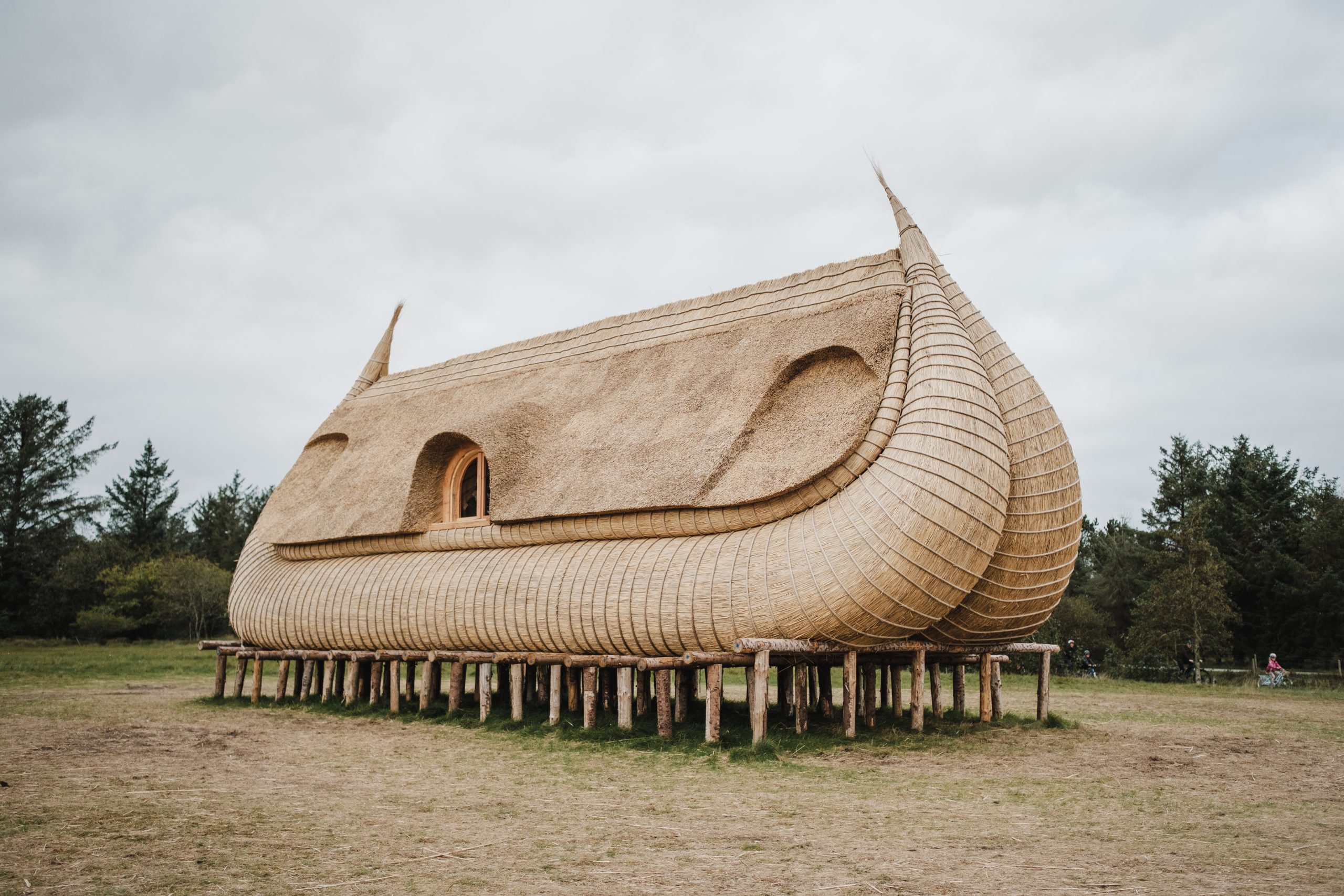
The final gallery at Abbot Hall shows a small model of ‘Houseboat for Ho’ (2023-2024). Ho is a low-lying village in Denmark that is threatened by rising oceans. The Houseboat is a fabulous and otherworldly structure with a curved hull constructed from reeds by the Arratia-Esteban family of reed boat builders from Bolivia, who collaborated with local Danish roof thatchers Bjarne Johansen and Jeff Brankley. The houseboat sits on a forest of supports ready for a high tide to carry it away like an ark. This work is both a stark warning about climate change and a remarkable example of collaboration and artistic design. Vitrines in this gallery contain books, photographs, and diagrams of other projects by Starling involving boats, such as ‘The Mahogany Pavillion’ (2004) and ‘Shedboatshed’ (2005).

Building on the theme of climate change is a collaboration between Starling and the Boat Conservation team at Windermere Jetty Museum to fabricate an extraordinary bicycle powered boat. Designed to traverse the longest river in Italy, the Po River, the boat must be able to travel its entire length. This unique and wonderful vehicle will float on the wet sections and be towed by the bicycle where the river has dried up. Buoyancy and weight are key to constructing a vessel that is functional as a boat but light enough to be towed. Starling’s project is inspired by his choice of the Dursley Pedersen bicycle, which was designed by the Danish designer Mikael Pederson but produced in the 1920s in the English town of Dursley. It is known for its hammock style seat and a lightweight truss frame. A large diagram of the boat exhibited in the Museum shows the bicycle supported by two floats that resemble the two hulls of a catamaran. The location of Windermere Jetty Museum is perfect for realising this project. Starling’s boat is of a piece with the sophisticated design, technical innovation and superb craftsmanship that are hallmarks of boat building in the Lake District. I can imagine Starling earnestly pedalling downstream encountering severe pollution, fluctuating water levels through cities and farmland and forced to disassemble and reassemble his boat, a darkly humorous protest at environmental damage.
Starling’s artworks at Abbot Hall were originally designed for such charged locations as Loch Long with its nuclear submarine base and The Dead Sea, engaging with the world’s political realities. It’s impressive to see how Starling’s works grow and evolve in relation to context and richly reward repeated viewing. These outstanding projects seem increasingly relevant in their new location in Cumbria, pointing to current environmental and political failure.
Simon Starling: Boat Works, Abbot Hall, Kendal and Windermere Jetty Museum, 20 September 2025 – 13 March 2026.
Caroline Bagenal is an artist and writer based in Hutton Roof, Cumbria.
This review is supported by Lakeland Arts.
Published 06.11.2025 by Jazmine Linklater in Reviews
1,308 words