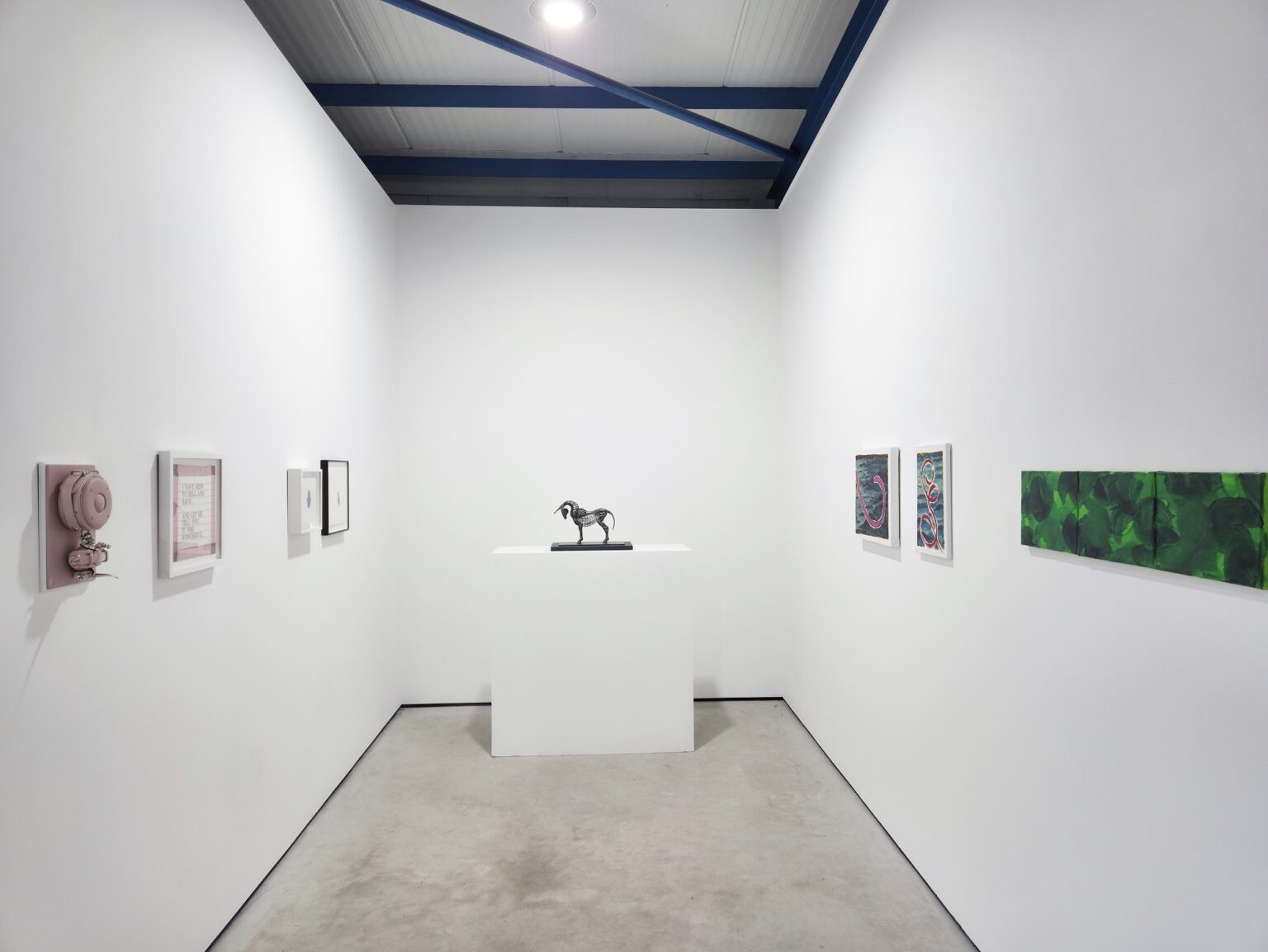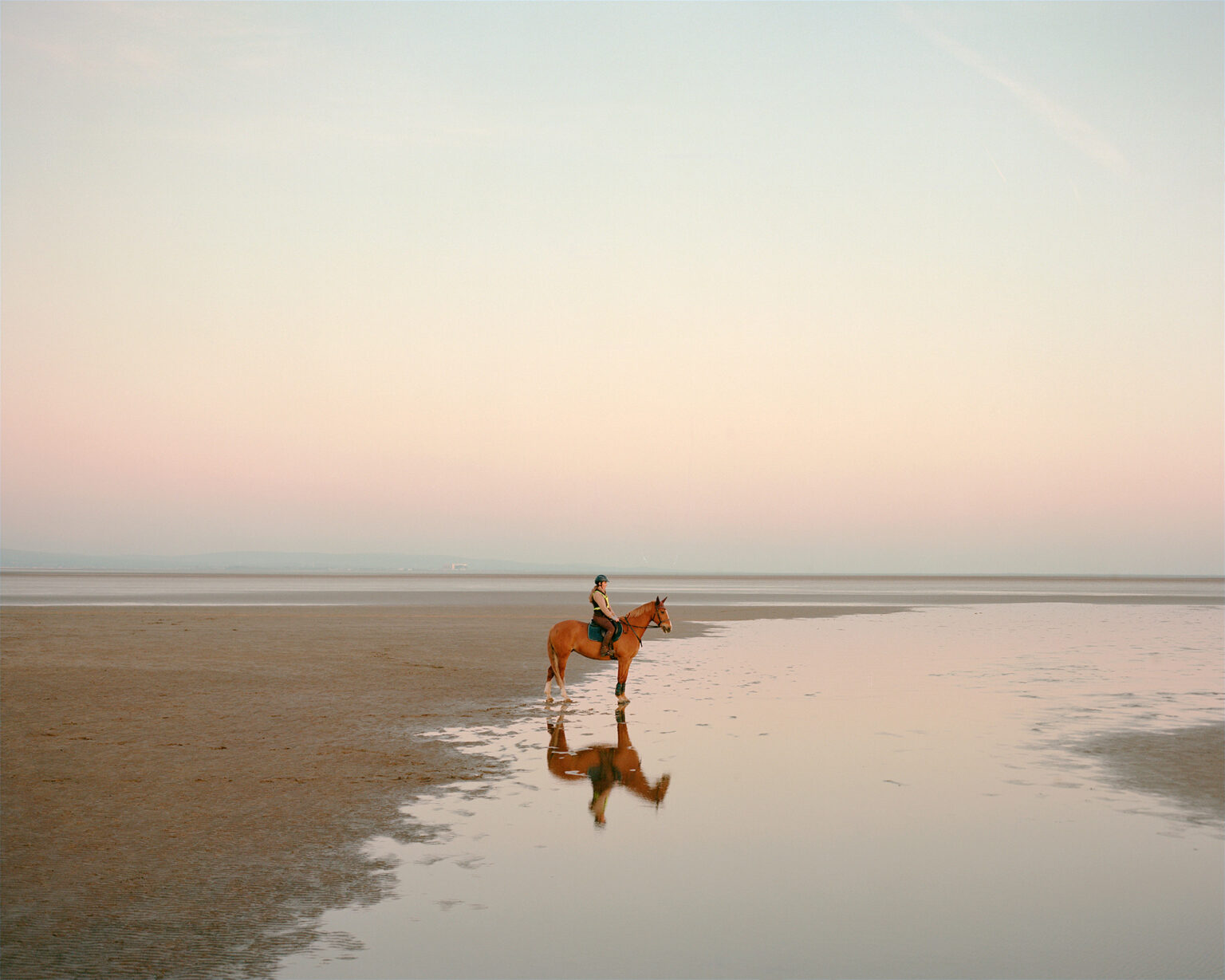
It is a stormy day when I visit Manchester-based Cumbrian artist Anna Clough’s exhibition Inter/Extra Terrestrial at the concert, film and sound art venue Full of Noises in Barrow. I am tense against the buffeting winds while I wait for the lights to change on the main road outside the train station, where orange traffic barriers have collapsed onto the pavement in defeat. At one point during my time in the gallery space, a hailstorm drums on the roof for a good ten minutes, then stops as abruptly as it arrived. This heightened awareness of the elements is appropriate for experiencing Clough’s multi-media installation of sculpture and moving image, held in an intimate space in Piel View House within Barrow Park and bound up with explorations of humanity’s entanglements with the natural world.
Clough is present in the gallery during my visit and talks me through the interrelationships between the works. My attention is first drawn to the three sculptures, which look a little like the remains of abandoned agricultural machinery. This is entirely intentional, as Clough is interested in testing the boundaries between art objects and machines by making her works seem ambiguous in terms of their age and potential function. Grouped under the title ‘Tools for Looking’ (2025), they are made of organic and inorganic materials like sand, steel, wool, hay, paper pulp, plastics, soil and iron pigment and stand directly on the floor. ‘Sand bopper’ (2025) is like a spined and rusted arch, crowned by prongs coated with a mixture of iron pigment and glue. The red pigment is from Florence Mine in West Cumbria, a closed iron ore mine that is now an arts centre, where Clough undertook residencies in 2022 and 2023 and previously exhibited in 2024. Two funnels attached by a plastic tube are held to the structure by strands of yarn. As Clough explains, when the sculptures’ materials are ‘reactivated’ by movement, they become an apparatus for mark-making with sand and water, shown in the nearby film ‘Beep.. tap, tap.. beep’ (2025).

‘Beep.. tap, tap.. beep’ presents the sculptures now in the gallery sited among the surroundings of nearby Roanhead beach and Sandscale Haws Nature Reserve across one day, accompanied by a score of strings by harpist Ada Francis. Stationed on the beach, ‘Sand bopper’ layers drips of wet sand onto the shore. ‘Hey Hoverer’, a rope of plaited hay now arranged like tinsel around a steel frame, is positioned in the film coiled in the waters of the estuary. Inspired by lighthouses, ‘Light Drifter’ is a beacon-like form on spindly legs. In the film, it is situated among the grassy dunes of the nature reserve, some of which are over four hundred years old. Clough describes the sculptures to me as ‘witnesses’, in a liminal landscape between built and natural ecologies.
During her week-long residency at Full of Noises, Clough held community workshops, advertised to the public. She describes the resulting group as made up of ‘the general public, especially those with an interest in art and nature’. The workshops initiated free writing and drawing exercises with discussions around human intervention and responsibility for the land. Such themes are particularly resonant for the area encompassing Barrow, which is home to the rare natterjack toad and dune helleborine plant as well as the brutalist fort of BAE Systems’ nuclear submarine shipyard. Sellafield nuclear decommissioning and storage site also lies further up the coast.

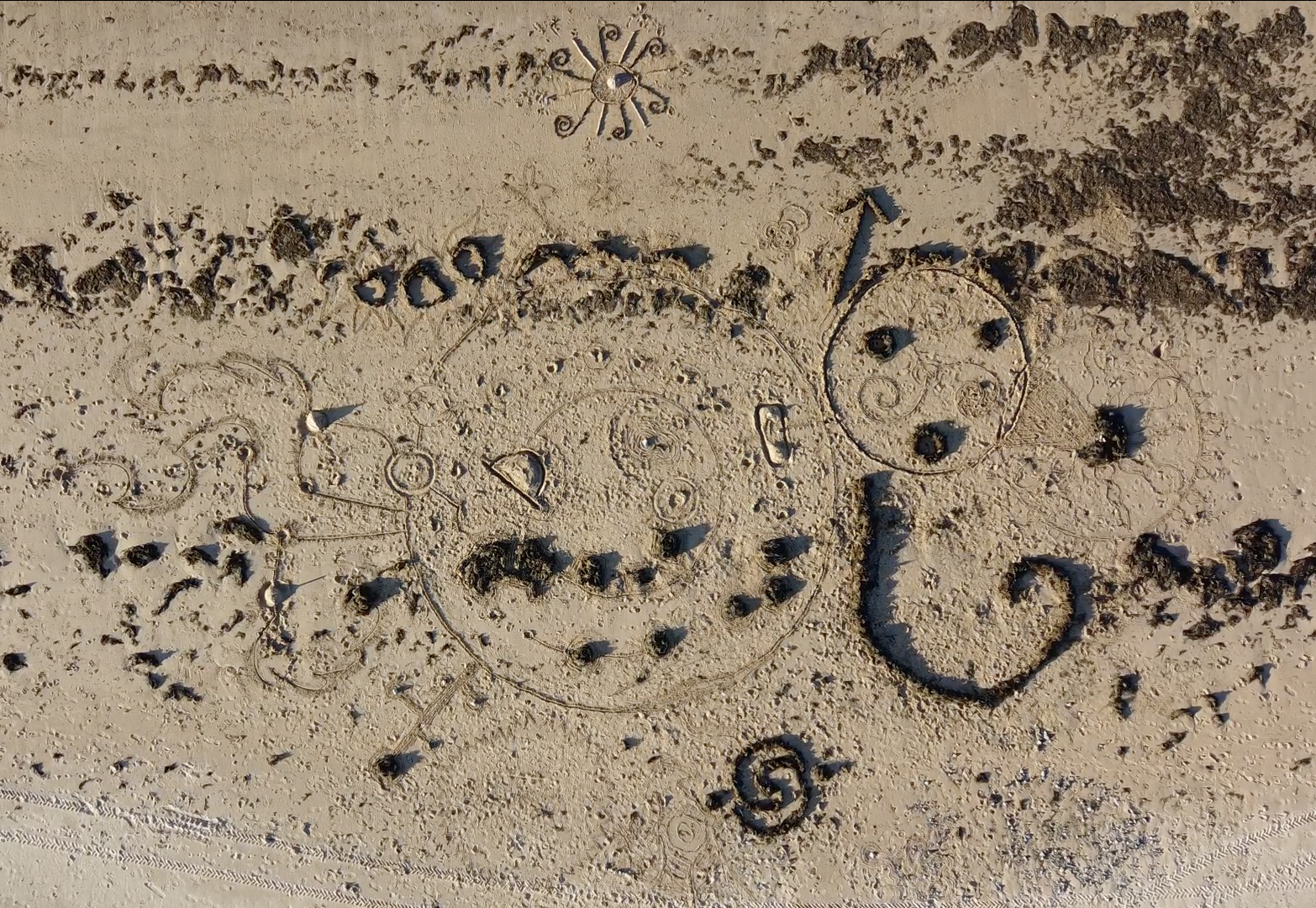
Some of the workshop materials are on display on a low plinth as ‘Crop Circle Responses’ (2025), including some of the group members’ handwritten notes that recall childhood memories alongside thoughts about the unintended consequences of conservation and the costs of non-intervention. These sessions culminated in a collective large-scale drawing of crop circles in the sand on Roanhead beach, the process recorded in the film ‘Can you feel us?’ (2025). Inspired by values of celebration, love, care and responsibility, the participants – some of whom had grown up visiting the beach while others were experiencing it for the first time – carved symbols into the sand using tools like sticks and trowels. The symbols were personal to what each participant wanted to communicate about nature and industry: one contributor created a stencil to trace the outline of a pyramid orchid, while another marked angular lines to suggest the radioactive hazard symbol. Once the incoming tide washed away these designs, their messages were delivered to the sea, swept into the coastal marine ecosystem.
In relation to this work, Clough conceptualises an image as a form of communication that can evade the hierarchies of narrative inevitable in the sequencing of text and verbal language. Such an approach allows for a sense of expansive intimacy in these shapes and symbols: they possess a private meaning for the sender but are elliptical enough to allow space for imagining how they might be received. The impermanence of the crop circles, existing only between high and low tide, are a refreshing counterbalance to iterations of land art that brashly stake a claim to specific sites. Yet their documentation in ‘Can you feel us?’ still allows for these symbols to be tattooed into the shorelines, constantly revealed through repeated moving image.

Describing the beach-drawings as ‘crop circles’ extends their pictorial messages into the cosmos and the realm of science fiction through the potential of extra-terrestrial recipients. Possibilities of interplanetary relationships are further expressed in ‘Micro to Macro’ (2025), a ninety-second film interspersing space pictures from the NASA archives with scans of pressed plants and dried seaweed collected locally on Walney Island in the mid-twentieth century by William Rollinson and Hilda Jane Bryden, now held in Barrow Archive Centre. Earth is connected to Jupiter’s moon Europa and Mars through similar patterns and textures. The rills of the seaweed specimens are echoed by the wheel-tracks of the Mars rover robot moving over the red planet’s surface. Martian rocks evoke the layered forms of the Peak district. The effect is oddly moving, as if I’m being shown an astronaut’s holiday snaps on a slide-projector. Clough notes during our conversation that these space images are ‘not alien-looking to us’. Affinities of texture and form weave familiarity across the solar system. I am reminded that it is the moon’s gravitational pull that creates the tides that absorbed the crop circles and helped to form the landscape that inspired Clough’s sculptural works.
Clough tells me that she is fascinated by the spiral as a shape that expands ever outwards, revolving but never returning exactly to the same position. In an earlier crop circle creation last year, participants intuitively drew into the sand and rearranged seaweed into the same curved forms. Inter/Extra Terrestrial explores this spiralling of deep time and history, expanding from the local to the cosmic. I leave the exhibition impressed by the varieties of scale Clough uses to express the longing to communicate with the more-than-human, from Barrow to Mars, shifting from film to sculpture to land art and manifesting in community collaboration. The installation is imbued with a poetic ambiguity in the sculptural forms of ‘Tools for looking’ and the open-ended crop-circle messages to the sea, collapsing distinctions between nature and humanity to communicate a sense of personal commitment and collective responsibility for the coastline and its complex and elemental landscape.
Anna Clough: Inter/Extra Terrestrial, 3-5 October, Full of Noises, Barrow-in-Furness.
Iona Glen is a writer and researcher currently based in Cardiff. Her mother’s family has lived in West Cumbria since the 1970s.
This review is supported by Arts Council England.
Published 03.11.2025 by Jazmine Linklater in Reviews
1,282 words