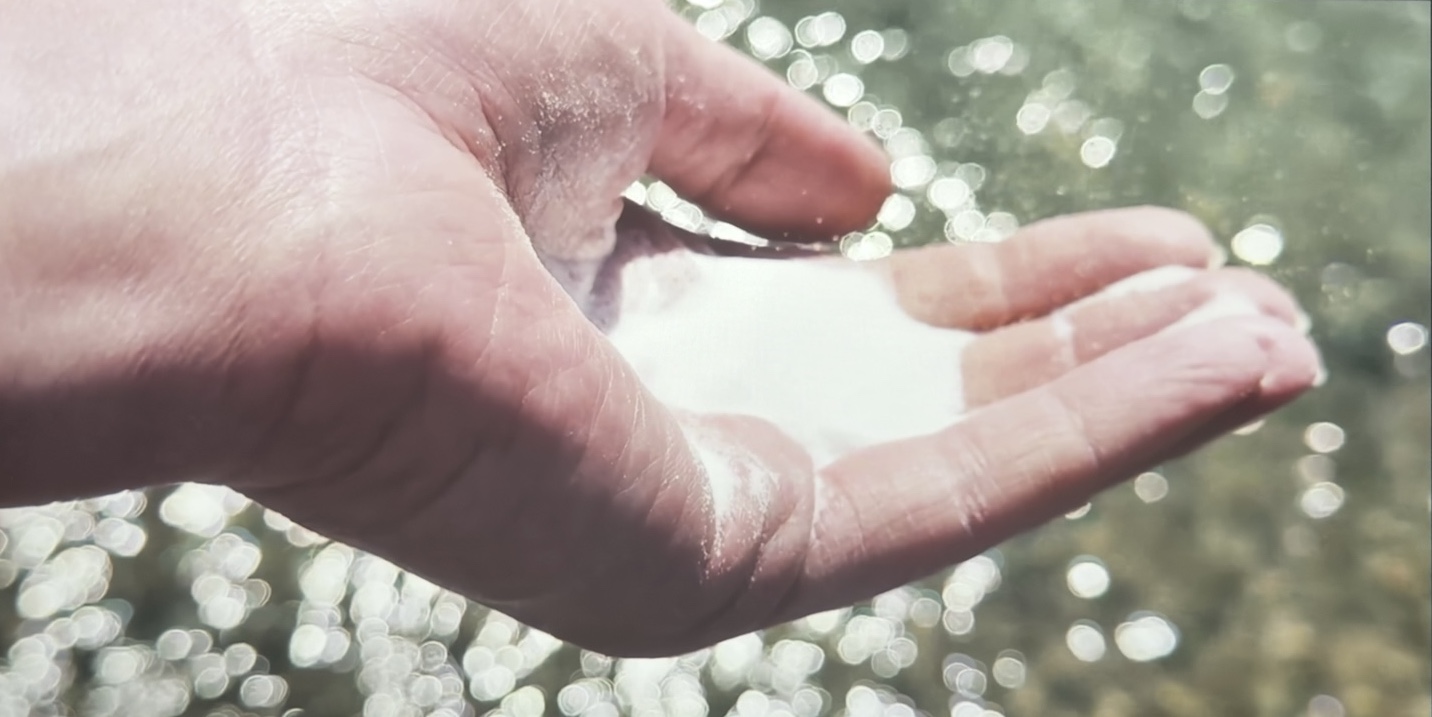
Angela Davies is an artist who allows ideas and materiality to dictate the medium she will work in at any particular point. She has a tendency to work with organic materials, making works that span across sculpture and installation, sound, film and performance.
At Plas Glyn Y Weddw, on the southern coast of Cymru’s Llyn Peninsula, salt is the protagonist in Davies’ recent solo exhibition, (To the) Heart of the Matter. The title itself reads like the title of a Motown song, soft yet anthemic. The exhibition brings together themes of ecofeminism and smugglers’ communication as acts of resistance and self-preservation.
Salt is a material that has long been a recurring feature in Davies’ practice. Salt is at once organic and symbolic; it holds the power to preserve. We salt food to keep it longer, workers are maintained by a ‘salary’ – a word derived from the Latin for salt (sal), and humans need salt to function, no salt or too little causes headaches, cramps and nausea. The exhibition at Plas Glyn y Weddw looks at the cycles of the sea, at bodily cycles and it deals with environmental loss. The work on display in the galleries is a new body of work that is five years in the making.
Immediately prior to visiting the gallery and meeting with the artist, I took advantage of the proximity to the sea and treated myself to some open water swimming from Llanbedrog Beach. I cannot think of a time where I have been to an exhibition that is so rooted in its surroundings that before visiting the gallery I have already been able to completely, physically immerse myself in its subject.
This part of Cymru, like lots of UK coastal regions, has a history of salt farming. The exhibition explores in part how the Salt Tax, introduced in the 17th Century by William III, resulted in a rise of salt being smuggled into the country from Ireland and Brittany. Men and women who had previously worked as salt makers had turned to smuggling in a quiet act of resistance against a suppressive system.
As we begin to walk through the gallery, Davies explains: ‘I really like thinking about these hidden networks and routes, the signals and signs that echo the way you navigate the exhibition. It translates or suggests the way that the community worked together; codifying through fire and smoke to hide goods in caves before disseminating to the community. I really enjoy thinking about how the community transgressed the law to make this work for them…It carries an interrogation of the income systems we have, its sharing and carrying within us… Within the work, I reflected upon the notion of the cave acting as a metaphor for a gestational space; a holding space for nurturing and growing.’
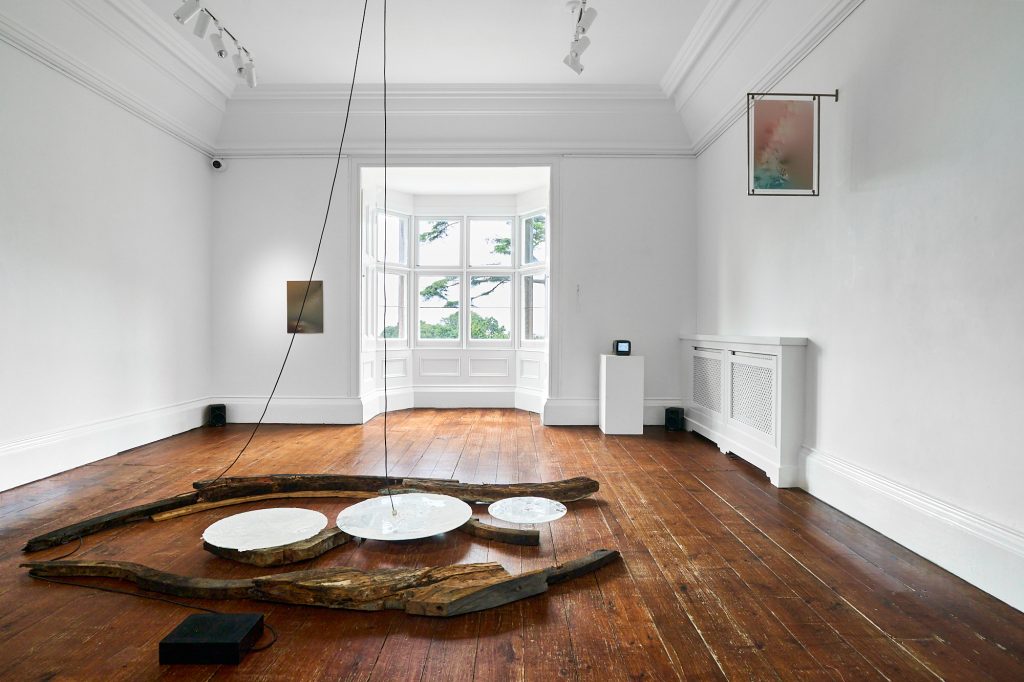
At the centre of the main gallery space is a floorbased installation, ‘The Rhythmalites and the Tides of You’ (2025). The installation comprises three glass discs each containing a unique pattern of salt crystals. Originally cultivated in Davies’ studio, these disks of salt crystals now rotate on turntables as a microphone translates their surface into a soundscape that envelopes you. The origins of this work come from casting old vinyl records with salt.
‘Early experiments back in 2020 involved casting from my father’s old 12 inch motown records using salt and customising the RPM on an old record player. I’m interested in ideas of long play. The work emits white noise due to the combination of the slow rotation and the stylus scratching across the surface of the salt terrain. I’d been thinking about the call and response structure present within soul music and extending this idea through notions of crossing boundaries and communication across cosmological space.’
On close inspection, the surfaces of the discs seem like a barren lunar landscape and are reminiscent of the salt flats of Uyuni salt flats in Bolivia. The accompanying soundscape is cold and hypnotic like the white noise Davies describes, but comforting like the empty sound of a record’s end when you’re relaxed enough to have forgotten the music has stopped, and the needle is playing what is known as ‘dead wax’.
The physical use of Motown Records for casting, combined with the reference to call and response style vocal arrangements, suggests a style of communication which is universally recognised and understood. Davies has taken soul music and reduced it down to some of its core elements to develop hidden signals.
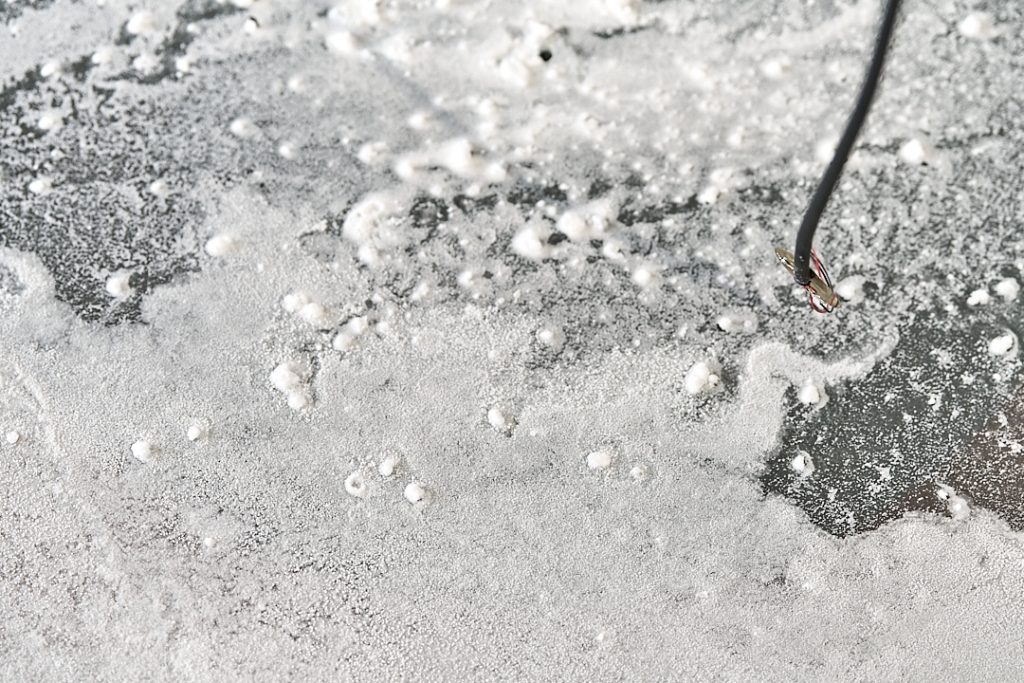
‘Nurture’ or ‘nurturing’ has been frequently mentioned by Davies as she discusses her processes of creation. The work considers human rhythms, hidden signals and communication and the natural rhythms of our planet. Davies has been working with scientists who have found a way to identify what tide patterns were like 300 million years ago by examining sediment deposits on strata in a geological stress in Pembrokeshire. This information is used to programme the turntable and consolidates almost a month’s worth of tidal data from 300 million years ago which is relayed in RPM. Only one of the three ‘salt records’ on display is programmed and played with the data. The other two records seem to be emitting sound but are actually spinning in silence. Here, a further reference to hidden communication, which relates back to salt farming and invisible or subversive labour.
In her essay Culture and Nature: The Roots of Ecopoetics, Grace Wells describes how ‘our culture is treating individuals much as it treats the earth. We are under enormous stress. These stresses are both the visible challenges of a hectic, urbanized, bureaucratic, technological world, and the invisible stresses of electromagnetic radiation, toxins and pollutants, pesticides and chemicals in our food and built environment. Our culture is not protecting and revering the human body[…]’ (Wells, 2018)
Davies’ recent entry into parenthood might explain the multiple references to nurturing and gestation. Broadcast as part of ‘The Rhythmalites and the Tides of You’ soundscape is the rhythm of an unborn baby’s heartbeat, which plays for a block of six minutes each hour. This element of the soundscape further connects the viewer/listener to Davies’ playful lines of inquiry into hidden signals and communication and the relationship between the human and the more-than-human.
‘When I was pregnant and carrying my child, I had a device to listen and monitor the heartbeat’’ explains Davies. ‘Due to the frequency of the BPM from an unborn child, the heartbeat is reminiscent of an alarm. Within the kinetic sound sculpture, there is an interplay with a recording of this alongside the evolving paleotidal soundscape data. I was interested in forming a relationship between human and more-than-human rhythms and cycles.’
An unborn baby’s heart rate ranges from 110-160 BPM, which is double that of an adult human resting heart rate. The sound of that racing heartbeat can certainly be alarming, even causing one’s own to race. At the same time, for anybody who has experienced pregnancy and understands the communication between baby and mother during gestation, the sounds can also be calming and reassuring.
In (To the) Heart of the Matter, salt can be seen as a metaphor for nurturing, owing to its preserving properties. Furthermore, if we consider the artist studio as a site for nurturing and developing a practice, salt can therefore also act as a metaphor for the studio. Davies’ own studio is particularly representative of her practice, and vice versa.
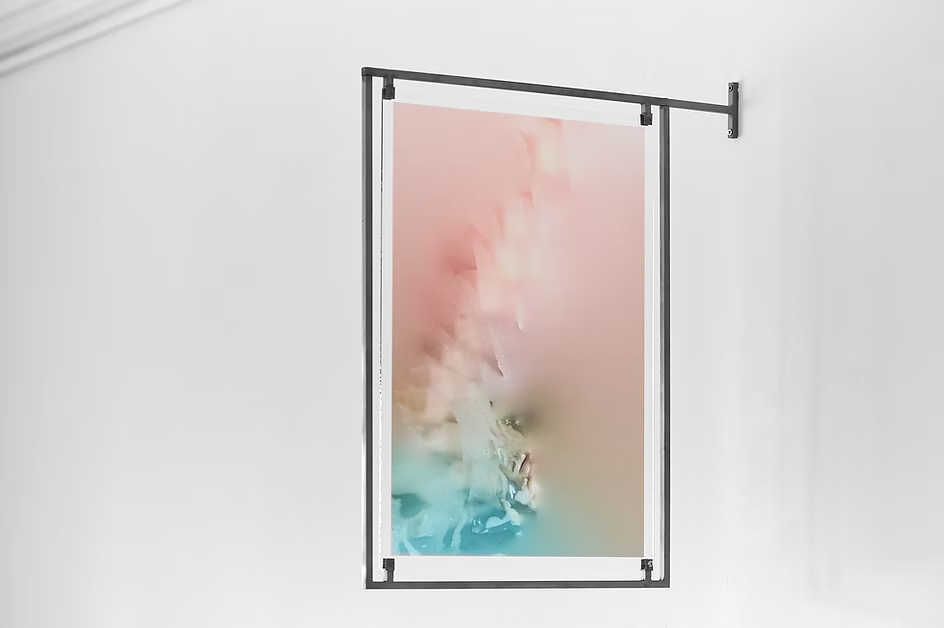
Davies established studioMADE in Denbigh 10 years ago with her partner Mark Eaglen. The former carriageworks now functions as a studio/project space for Davies and her young family to live, with a large, open plan studio area and further studios at street level. They host a programme of events, exhibitions and residencies Davies drew comparison between studioMADE and the acclaimed artist-led project of the late 1980s and 1990s, HOUSEWATCH.
HOUSEWATCH was a collective based in East London made up of artists Ian Bourn, Lulu Quinn, George Saxon, Tony Sinden, Stanford Steele, Chris White and Alison Winckle. Together they sought to engage the public in new and immersive ways, such as through innovative use of back projection, allowing passers-by the chance to view moving images from the pavement, shown on the windows of a terraced house.
The semi-rural location of a North Wales market town is a marked difference to an East London terrace. It encourages an acceptance of isolation, but with an intent to connect people and build communities. This is what encouraged Davies and Eaglen to set up the organisation, to establish a network of people that would become a mutually beneficial community. This is something that they see as important not just for sustaining a practice, but also to sustain and nurture a life.
The invisible, often unpaid, labour associated with running an artist-led spaces has been relegated to a minor role in proceedings recently as both Davies and Eaglen focus on their family and their respective artistic practices. Writing funding applications, for example, or building the necessary administrative framework to enable a visiting artist to get the most out of a residency, can be more than a full-time role and a drain on physical, mental and financial resources. The aspirations and expectations for studioMADE, however, remain for it to grow into something that will preserve artistic activity in Denbigh and across the north of Cymru.
Cycles of activity are as important in Davies’s practice as anyone’s. The body of work displayed at Plas Glyn y Weddw might be the culmination of five years of research and constant, meticulous experimentation in the studio, but there are other projects under development. Each project has a cycle that enables Davies to return refreshed.
James Harper is a writer and curator based in Liverpool
(To the) Heart of the Matter was on at Plas Glyn Y Weddw 20 July – 5 October 2025.
Davies recent work has been made possible with support from Arts Council Wales, Bangor University and Plas Glyn Y Weddw.
This article was supported with funding from Art Council Wales.
Published 24.11.2025 by Natalie Hughes in Feature
1,722 words