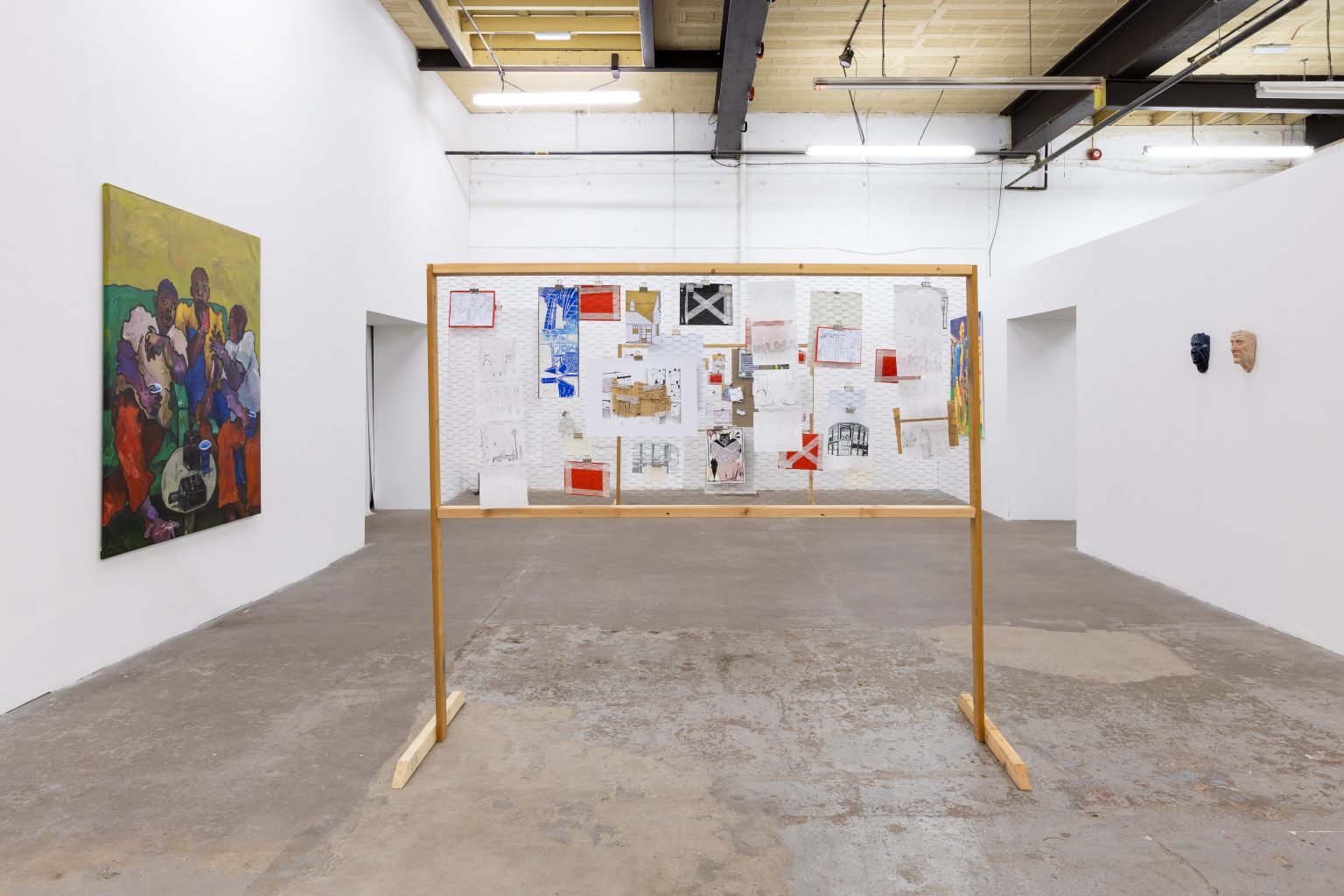
Over the past ten years, Attenborough Arts Centre in Leicester has positioned itself around principles of access and inclusion, shaping a programme that has sought to engage in dialogue with audiences through interaction and reflective engagement, as well as building long-term relationships with artists and communities. A Decade of Exhibitions collects together selected artworks and documentation from significant moments in the Centre’s exhibition programme since the opening of their purpose-built galleries in 2016. However, it goes beyond presenting a linear institutional history; it also foregrounds some of Attenborough Arts Centre’s important recurring commitments: to the visibility of disabled experience, the redistribution of authorship, and the sustained involvement of artists and audiences over time.
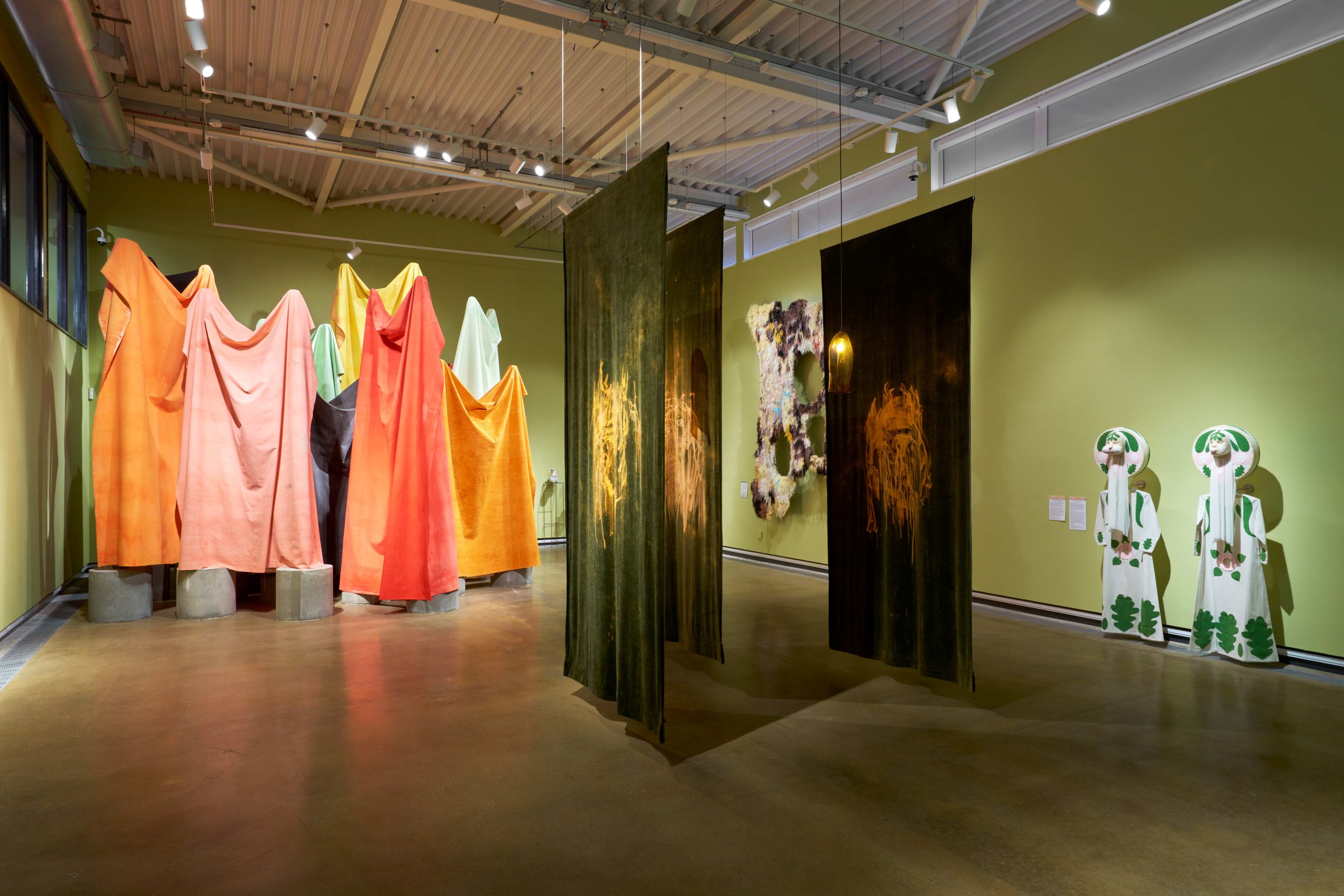
A Decade of Exhibitions unfolds as a layered display of objects, documentation, and material traces. Archival photographs, interpretive texts, videos, and selected artworks are presented in the Salmon Gallery, accompanied in Galleries One and Two by Material Worlds: Contemporary Artists and Textiles, a major exhibition developed by Hayward Touring. Spanning both of the lower ground floor galleries, Material Worlds brings together thirteen UK-based artists who work with textiles, including Jonathan Baldock, Phyllida Barlow, Yelena Popova, Yinka Shonibare and Zadie Xa. Although distinct from each other, the two exhibitions operate in dialogue, allowing visitors to move between institutional memory and present practice.
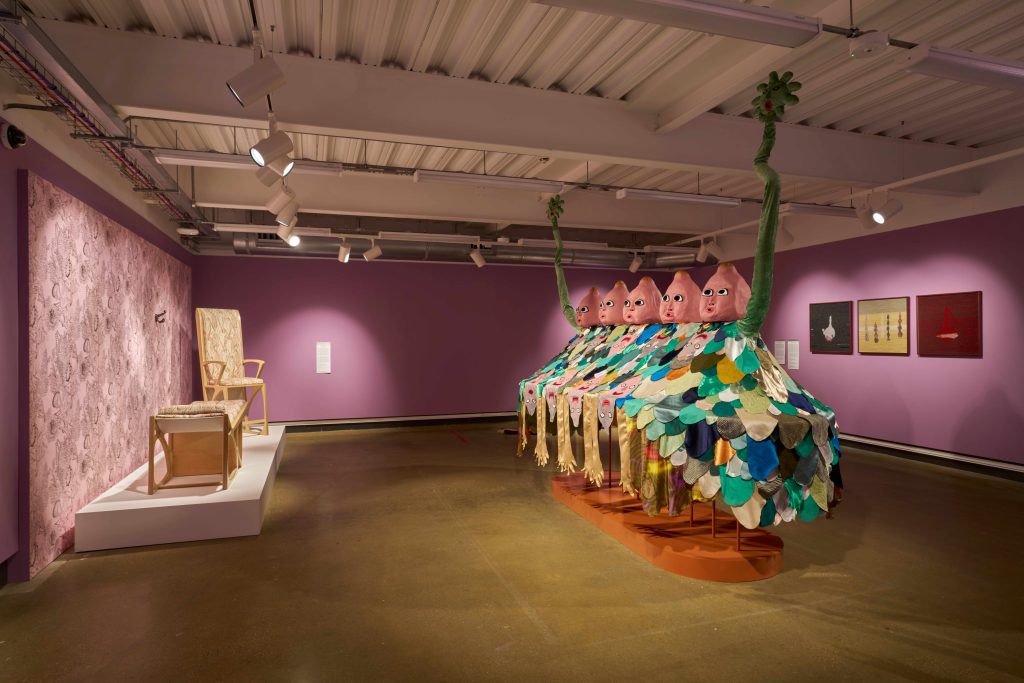
In Leicester the exhibition, which explores textile as a carrier of memory, ritual, labour, and politics, is inseparable from social history, in a city historically shaped by the textile industry, hosiery factories, and migrant labour. Here, craft emerges as a mode of resistance and continuity, foregrounding textile and craft practices as sites of sensory knowledge, labour, and access. Material Worlds proposes a renewed interest in an analogue labour of textile making as a way out of the digital swamp that we are in, and a return to slowness, touch, and repetition. This resonated strongly with my own practice, including crochet and lace-based making, where care is embedded in the process and the outcome. Baldock’s works stand out in particular: his ceremonial costumes and sculptural forms inhabit an uneasy space between folk ritual, surgery, and the body as a site of transformation. The stitched surfaces, swollen forms, and vegetal motifs suggest both healing and harm, protection and exposure. Shonibare’s works, meanwhile, expose the colonial histories embedded in fabric itself, using Dutch wax textiles to unravel questions of power, identity and cultural inheritance.
Guided by Attenborough Arts Centre’s principle that “Art is for All” my experience of the Centre’s programme as a visitor and participant over several years has consistently revealed an inclusive curatorial approach that supports artists from a wide range of marginalised communities, including Black, queer and disabled practitioners. This commitment is evident in Material Worlds too, where a quietly radical inclusivity emerges through the gathering of diverse materials, scales, and artistic perspectives. Across the exhibition, the artworks coexist, inviting different bodies, histories, and modes of making into shared visibility. Seen in this context, earlier exhibitions at Attenborough Arts Centre are better understood not as isolated projects but as part of a broader curatorial continuity and intent.
My first encounter with Attenborough Arts Centre took place two years ago, in spring 2024, through the exhibition Traces; a polyphonic exploration of embodiment, control, and the digital future. Large-scale wheelchair prints made by disabled children were exhibited alongside works by five contemporary artists: Sue Austin, Daryl Beeton, Laura Dajao, Aminder Virdee, and Joseph Wilk. Working across performance, sculpture, installation and digital drawing, these practices collectively expanded speculative thinking around disabled experience and the creative possibilities of emerging technologies to explore motion and embodiment.
The breadth of expressive forms combined with a deeply inclusive curatorial approach that foregrounded disabled voices across generations affected me profoundly. Joseph Wilk’s installation ‘Traces’ in particular captured my attention: an invisible wheelchair appears to move through the gallery leaving luminous traces on the floor, the artist’s projected trajectories inscribed into space as temporary imprints of the body.
What struck me most about Traces was how seamlessly traditional artistic media could coexist with advanced digital technologies within a shared conceptual framework. Established contemporary artists’ works unfolded alongside DIY wheelchair prints made by children as equal forms of expression, without hierarchy. Different generations, skill levels and modes of making were held together through a single question and aesthetic logic.
Material Worlds reflects a similar breadth of approach through its engagement with textile and fabric-based practices, ranging from small-scale, intimate works to large installations that occupy entire rooms. This spectrum is exemplified by installations such as those by Phyllida Barlow, whose anti-monumental yet physically overwhelming structures constructed from modest materials like cardboard and fabric demonstrate how scale, fragility and material simplicity recur as sustained curatorial interests.
My own experiences of growing up in Ukraine as a disabled woman with a rare genetic condition, later fleeing the war and trying to build a life in a new country from scratch, revealed how precious and essential mutual care really is. What makes life bearable in the hardest moments is the capacity of those around us to look beyond the lens of ‘otherness’: to recognise a shared humanity beneath visible differences. This recognition is the beginning of any genuine willingness for peaceful and supportive coexistence, and it is this ethos that has quietly run through the programming at Attenborough Arts Centre.

Crucially, inclusion does not mean making everyone the same. As Lennard J. Davis argues, ideas of normality are produced through hierarchy and exclusion rather than neutral description, generating “otherness” in the very act of defining the norm1. Within A Decade of Exhibitions and the wider programme at Attenborough Arts Centre, this dynamic becomes materially visible: works are not organised around a singular aesthetic standard but around coexistence, where different bodies, communication methods and artistic languages occupy the gallery without being flattened into uniformity.
Another key occasion in the gallery’s history was the presentation of Crip Arte Spazio, first shown at the Venice Biennale in 2024, later travelling to Attenborough Arts Centre in 2025. This landmark exhibition brought disabled artists into the international art world at an unprecedented scale, presenting a selection of works by disabled contemporary artists in dialogue with a major retrospective of the UK Disability Arts movement from the 1980s and 1990s. Installation, photographic archives and paintings rarely exhibited in mainstream contemporary art contexts traced the movement’s artistic and political urgency.
Over the past decade, Attenborough Arts Centre has also supported exhibitions that give a platform to artists from other marginalised communities, foregrounding the multiplicity of artistic voices in the UK and exploring experiences of intersectionality that can compound the barriers that people face. While not exhaustive, a few key moments stand out: SEE ME AS ME (2021) brought together film, sculpture, writing and music created and curated by young adults interested in social justice and LGBTQIA+ identity, highlighting lived perspectives that are often excluded from mainstream narratives; and Save the World (2025–26), an exhibition by BrightSparks: Arts in Mental Health Group and Leicestershire Partnership NHS Trust that featured work by artists addressing mental health, community and identity across diverse positions.
Through its sustained relationships with artists, Attenborough Arts Centre has repeatedly supported practices that challenge who is permitted visibility within mainstream cultural institutions. Christopher Samuel’s The Archive of An Unseen (2023) exemplified this approach. First presented at the Wellcome Collection (2022), the exhibition centred on Samuel’s reconstruction of a microform reader as an interactive sculptural interface, exposing how experiences of growing up Black, disabled, and working class in 1980s Britain remain systematically excluded from medical and cultural archives and are thus rendered invisible. Rather than symbolically “filling a gap,” the work re-authored the archive itself, insisting that lives like his must no longer remain unseen.

Within the Centre’s broader programme, such practices raise a fundamental question: who is allowed to produce cultural value, and whose experiences become legible as knowledge? In his book ‘The Field of Cultural Production’ (1993) Pierre Bourdieu argues that the artistic field does not exist outside the social2. One way to understand this dynamic is that what we recognise as art depends on collective belief in its value, a belief that has been historically unevenly distributed. Bodies and communities excluded from economies of desire and production have often been pushed not only beyond institutional visibility but beyond the realm of what can be perceived at all.
In our present political moment in the UK, shaped by austerity, pressure on Arts Council funding and ongoing debate around disability support, the importance of spaces like Attenborough Arts Centre becomes clear. Jacques Rancière reminds us in The Politics of Aesthetics (2004), ‘politics is organised around what can be seen and said, and by whom.’ Across the UK, reductions in local authority social care budgets, tightening disability benefit assessments, and limited funding for community arts have exposed inequalities that extend beyond mere physical accessibility to questions of dignity, belonging and cultural recognition. In this context, a centre guided by the principle of “Art for All” operates not merely as an exhibition venue but as a form of civic infrastructure: a space where access provision, community programmes, and artistic production intersect. The work that Attenborough Arts Centre does through its programmes insists that inclusion is not something to be achieved by erasing difference into a single ‘norm’, but rather through nurturing conditions where marginalised voices of many kinds, whether disabled, Black, queer or otherwise, are not token gestures but directly shape the cultural agenda.
This commitment was powerfully articulated during the launch event for A Decade of Exhibitions and Material Worlds: Contemporary Artists and Textiles. Attending the celebration I felt not only a visitor but more like a participant: someone who has been closely engaged with the Centre’s programmes for the past two years, sharing in a collective sense of pride in a decade shaped by access, experimentation and sustained care.
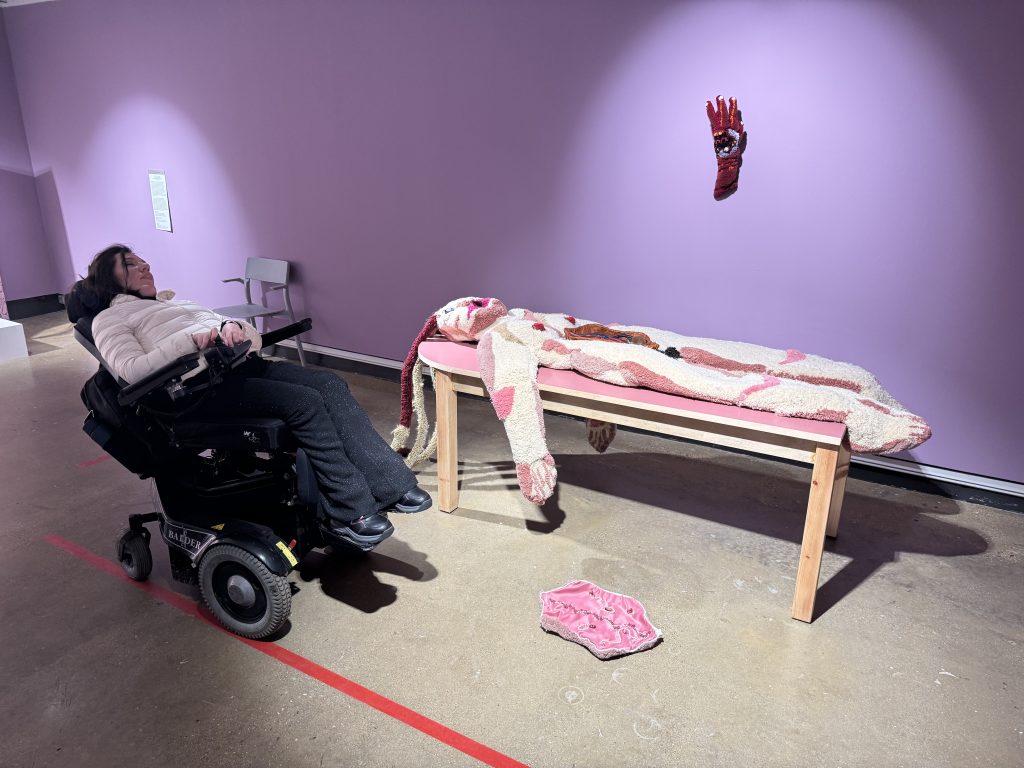
One moment during the evening I unexpectedly found myself doing an impromptu performance. Standing beside ‘Venus’ (2023), a sculpture by Anna Perach, I felt compelled to position my body in dialogue with the work. Perach’s sculpture of a goddess-like figure, crafted using a tufting method traditionally used in the fabrication of carpets, was laid out on a table in the largest gallery, her inner organs exposed like a ritualistic offering or surgical scene and drawing a mix of curiosity and nervous laughter from the audience. As I reclined my wheelchair next to her, sharing her horizontal vulnerability, someone exclaimed: ‘Oh, you’re lying just like her!’ In that instant the goddess and I, the disabled woman, became interchangeable objects of spectatorship, bodies stripped of subjectivity and opened for viewing, judgment or perhaps even sacrifice. Later, learning that Perach is also Ukrainian, and that we even share the same first name, I felt my gesture deepened into something uncanny and collective: a shared burden of the female, the migrant and vulnerable embodiment carried across different lives.
Encounters of this kind feel possible not just because of the artwork itself, but because of the conditions of the space in which our meeting took place. Attenborough Arts Centre’s access-led approach allows for a kind of proximity and response that is often restricted in large art institutions. In other galleries I have often been asked to step back, to stop filming or to limit how my body occupies the space, shutting down potential creative encounters into moments of self-regulation. Here, by contrast, I felt free to move, record, and let the gesture emerge, in an environment where embodied response is anticipated and encouraged rather than contained.
As Attenborough Arts Centre approaches another milestone: its 30th anniversary in 2027, exhibitions like ‘Material Worlds’ affirm why spaces like this remain vital. At a time when cultural value is increasingly measured through speed, productivity and visibility, Attenborough Arts Centre continues to work against the current, creating spaces where slowness and care is foregrounded, and real difference is made. Its future holds the promise of a broad range of exhibitions that cultivate conditions for shared vulnerability and for imagining other ways of being together. That, perhaps, is the most necessary material world we can build.
1. Davis L. J. Enforcing Normalcy: Disability, Deafness, and the Body. London; New York: Verso, 1995. Р. 49.
2. Bourdieu P. Les règles de l’art. Paris: Editions du Seuil, 1992; Bourdieu P. The Field of Cultural Production. New York: Columbia University Press, 1993.
3. Rancière, J. (2004) The Politics of Aesthetics: The Distribution of the Sensible. Translated by Gabriel Rockhill. London: Continuum, p. 13.
Anna Li is a writer and artist based in Nottingham, exploring the intersections of disability, identity, and contemporary art.
A Decade of Exhibitions and Material Worlds: Contemporary Artists and Textiles are on at Attenborough Arts Centre, University of Leicester, 30th January – 3rd May 2026.
This review is supported by Attenborough Arts Centre.
Published 02.03.2026 by Rachel Graves in Reviews
2,203 words