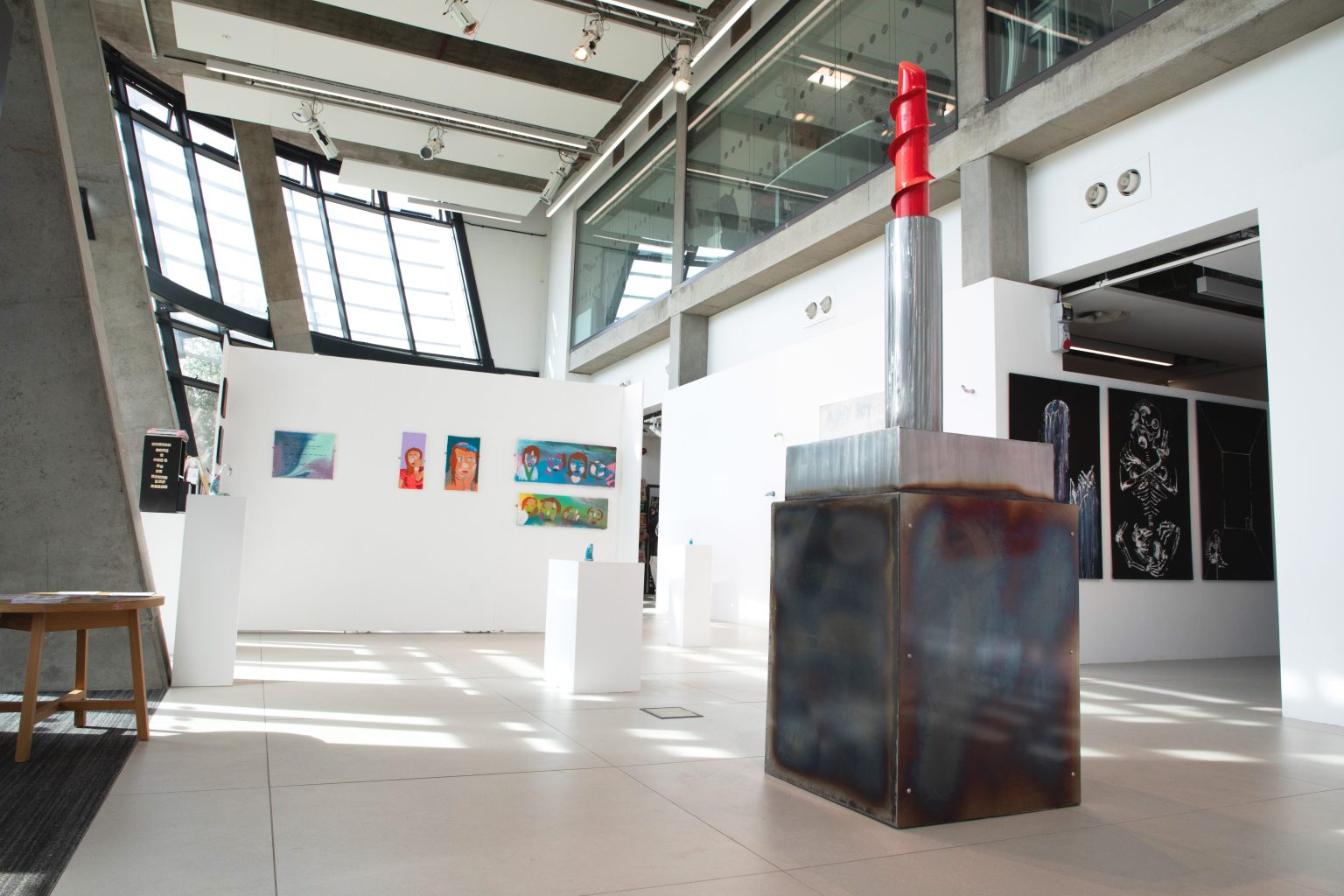
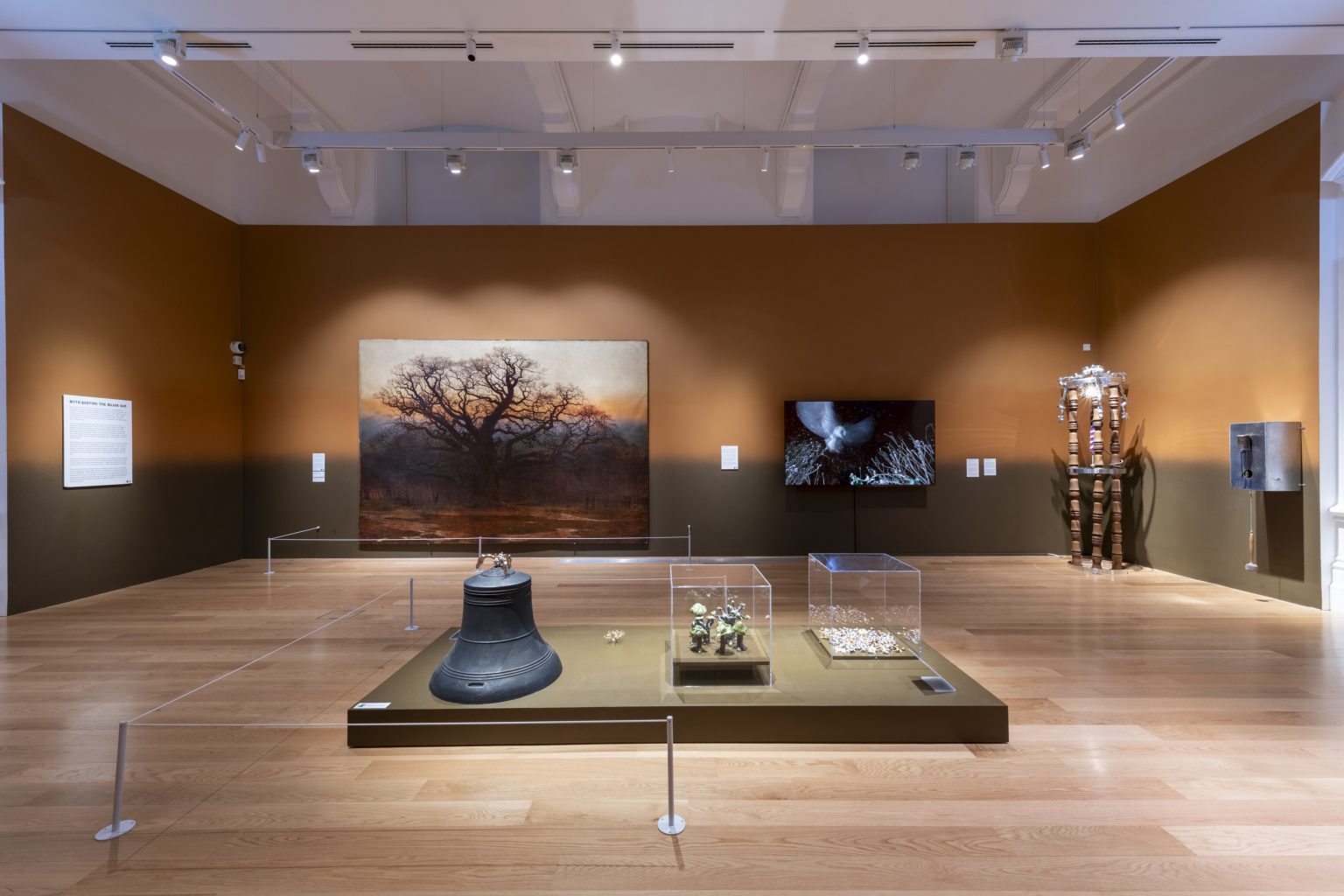
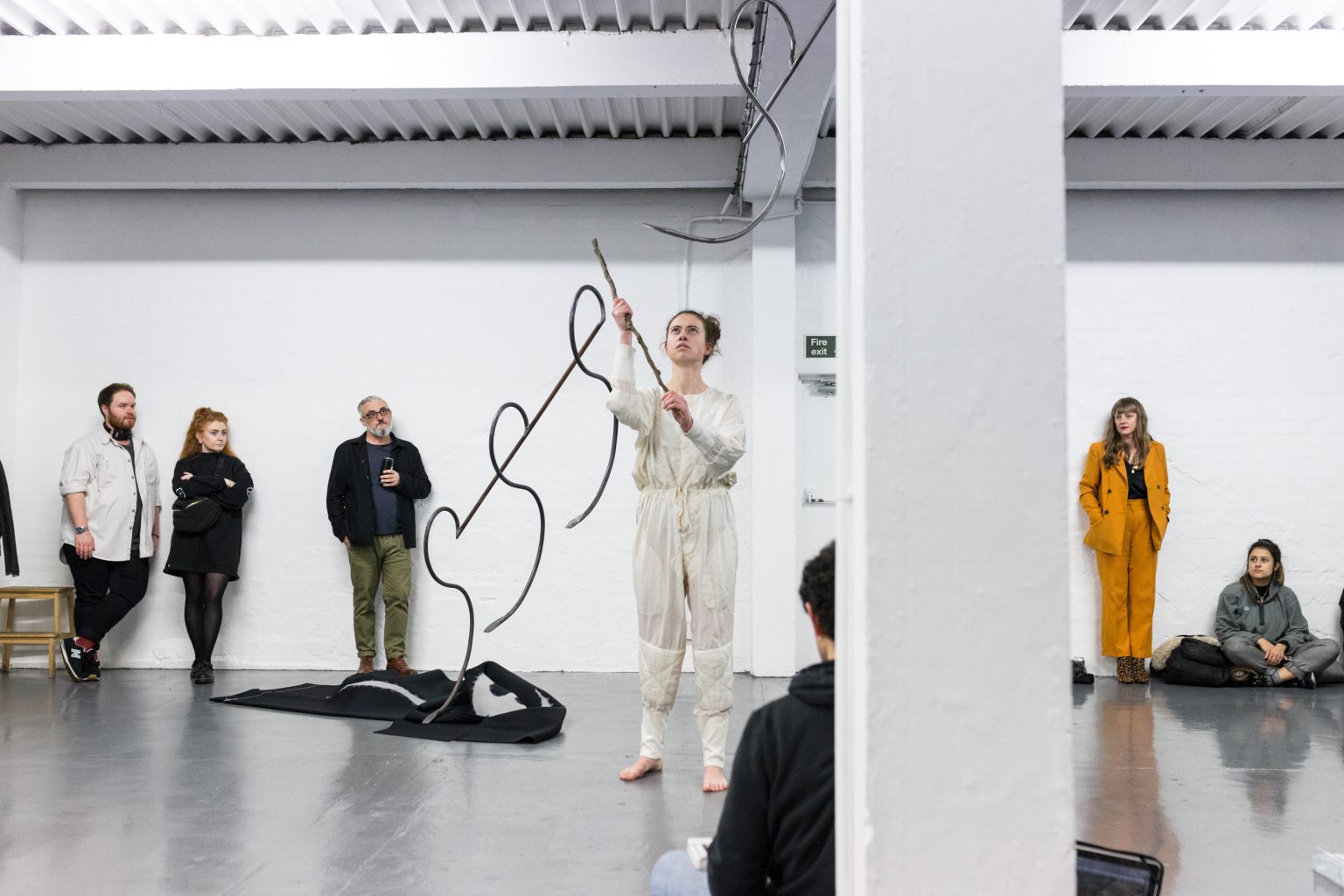
Cities are strange places. Not least because they seem to exist in a liminal state. Distinct, specific, and yet constantly in flux. They accelerate, transform, and beckon us back with a promise of change. But what kind of change? Up Town Again, titled after a common local expression, is a group exhibition at Two Queens in the city of Leicester that explores this tension. The cyclical pull of urban life, the ritual of returning to your home city again and again, adolescent rites of passage and the elusive possibility of belonging to a place defined by the transience of modernity.
Up Town Again has been curated by a recently formed team of local curators, Nam Huh, Lyddie Mac, Yusuf Mahmood and Bijal Manoj Daialal, who were recruited by Two Queens through an open call aimed at finding fresh, local perspectives. The exhibition marks a turning point for the now community-owned gallery seeking to connect and collaborate with the community, gathering six Leicester-based artists: Miriam Bean, Evie Cook, Alison Dunne, Oshorenoya David Francis, Jamie Seymour, and Francis Underwater. Collectively, their work presents fragmentary reflections on the city, forming a psychogeographic landscape of Leicester that is as much emotional and sensory as it is spatial and political.
Strangeness and strangers dominate every city, and the work of Francis Underwater perfectly illustrates the intimate loneliness that this close proximity to others can manifest. Fabricated entirely from memory, the painted clay busts ‘Statue of a man on the 158’ (2024) and ‘Statue of a man selling eight clementines for a pound’ (2024) are quietly captivating exactly because they retain the uncanny potency of a face in the crowd that is at once familiar and unknowable. These works embody a material form of memory: slightly caricatured, heightened, and painted in partially oversaturated tones, they hover between reality and dream-world.

The uncanniness of Underwater’s works continues in the next room where two terracotta masks hang, knowingly resembling ancient death masks. ‘Mask of a pensioner at a Sainsbury’s self-service’ (2025) evokes the same eerie intimacy of a stranger immortalised, yet still distant. Historically objects such as these: busts and masks, were reserved for the elite. Underwater undoes this by elevating the everyday, the man on the bus, the woman in the queue. These works aren’t exactly portraits: the real people that inspired these works are not being depicted, we don’t even know their names, and that’s precisely the point. Rather, what Underwater is capturing is the very distance that separates us. The indefinable gap between us becomes palpable, the masks we wear that never seem to fall.
If the city itself is the engine of this societal atomisation, what is a person to do in such circumstances? Perhaps the answer can be found in Oshorenoya David Francis’ lively hyperchromatic paintings in which individuals attempt, perhaps naively or clumsily, to alleviate their alienation. Adolescent men find awkward solace in the company of others in ‘MEN’S TALK’ (2024). Whereas the diptych, ‘MAN AMONGST WINGS, I & II’ (2025) is more concerned with connection to local nature, featuring dissonant colours and bold erratic line work that implies a certain kind of anxiety or intensity. Men interact with pigeons, grinning wildly. In one, a man is feeding the birds, while another features a pigeon landing tentatively on an outstretched hand. Although pigeons are often thought of as vermin, here the artist has rendered them in fluorescent tones that elevate them from this lowly status. They become transcendent beings, caught somewhere between high and low, nature and the city, natural and artificial.
This tension between the stark highs and lows of city life seems to haunt Leicester in particular, a city with a history of radical class-struggle and political unrest touched upon in Jamie Seymour’s video work, ‘James Towle’s Sorrowful Lamentation whilst in prison, 1816’ (2025). A ruminating voice reverberates through the gallery like an unwanted echo. A pale white face dominates the screen, the dramatic depiction of a ghoul or a ghost. Seymour channels the largely forgotten working-class voices of Leicestershire’s past, particularly the Luddite movement that sought to challenge the introduction of automated machinery at the start of the 19th Century. Memories of this industrial trauma seem to dominate the city and find expression in Seymour’s work. Here and there echoes of resistance perforate the surface, rupturing forth to expose and critique the inner workings of industrial capitalism.

Cities like Leicester are best felt and seen directly, innocently and without preconception. Evie Cook’s installation of diagrams, illustrations, doodles, comics and architectural sketches are held together tentatively by small clips on chicken wire, and the freestanding wooden panels invite close inspection. Her works echo the feeling of a deconstructed zine or the remnants of a community workshop, documenting the everyday in Leicester: places like churches, buses, streets, derelict factories. Carefully observed, over-the-shoulder perspectives and half-heard conversations hint at the lives ever present in the city, fragments of existence and experience that are caught by the artist and held up for consideration. Cook’s analytical attention to detail transforms these mundane moments into something quietly poetic. The city observed, overheard, and gently archived.
In contrast, Alison Dunne’s sculptural interventions present a tactile, provocative and deeply embodied understanding of navigating the city with a female body. Large leather breasts hang from wooden pegs on the wall, with visitors encouraged to try them on, to feel their weight. This invitation is both playful and political, presenting femininity as a laborious act, a burden, and a form with a very present and imposing material reality. Dunne’s work asks us to reflect on the interaction between gender, endurance, and the physicality of identity, turning the gallery space into an environment of bodily negotiation.
Sound becomes architecture in Miriam Bean’s sonic installation, ‘Eharmonic’ (2019), with discordant reverberations and electronic hums, high-pitched echoes and metallic ringing that fill the gallery with a disquieting presence. Oddly, the tones evoke tinnitus, electrical feedback, or perhaps even the ambient hum of a city in motion. Bean’s work captures the grinding rhythm of urban life, its endless movement and elusive peace. It’s a soundscape of searching; for connection, for stillness, for each other, and all the while we’re left to wonder: is what we’re looking for really going to be found Up Town Again?
Up Town Again was on at Two Queens, Leicester, 27 September – 1 November 2025.
Alexander Mobbs-Iles is a writer based in Nottingham.
This review is an independent commission from Corridor8, funded by Substack subscriptions and donations.
Published 13.11.2025 by Rachel Graves in Reviews
1,145 words