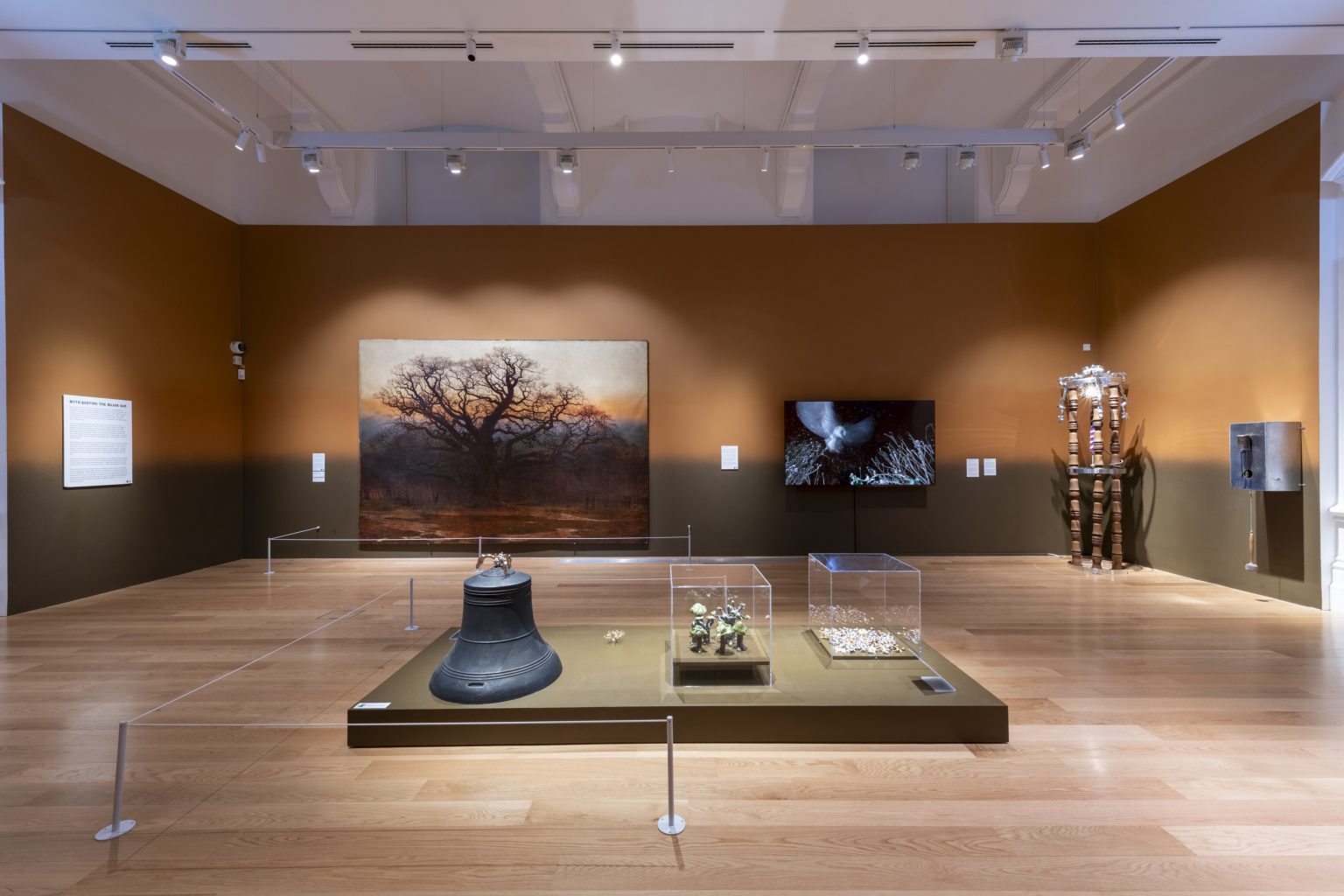
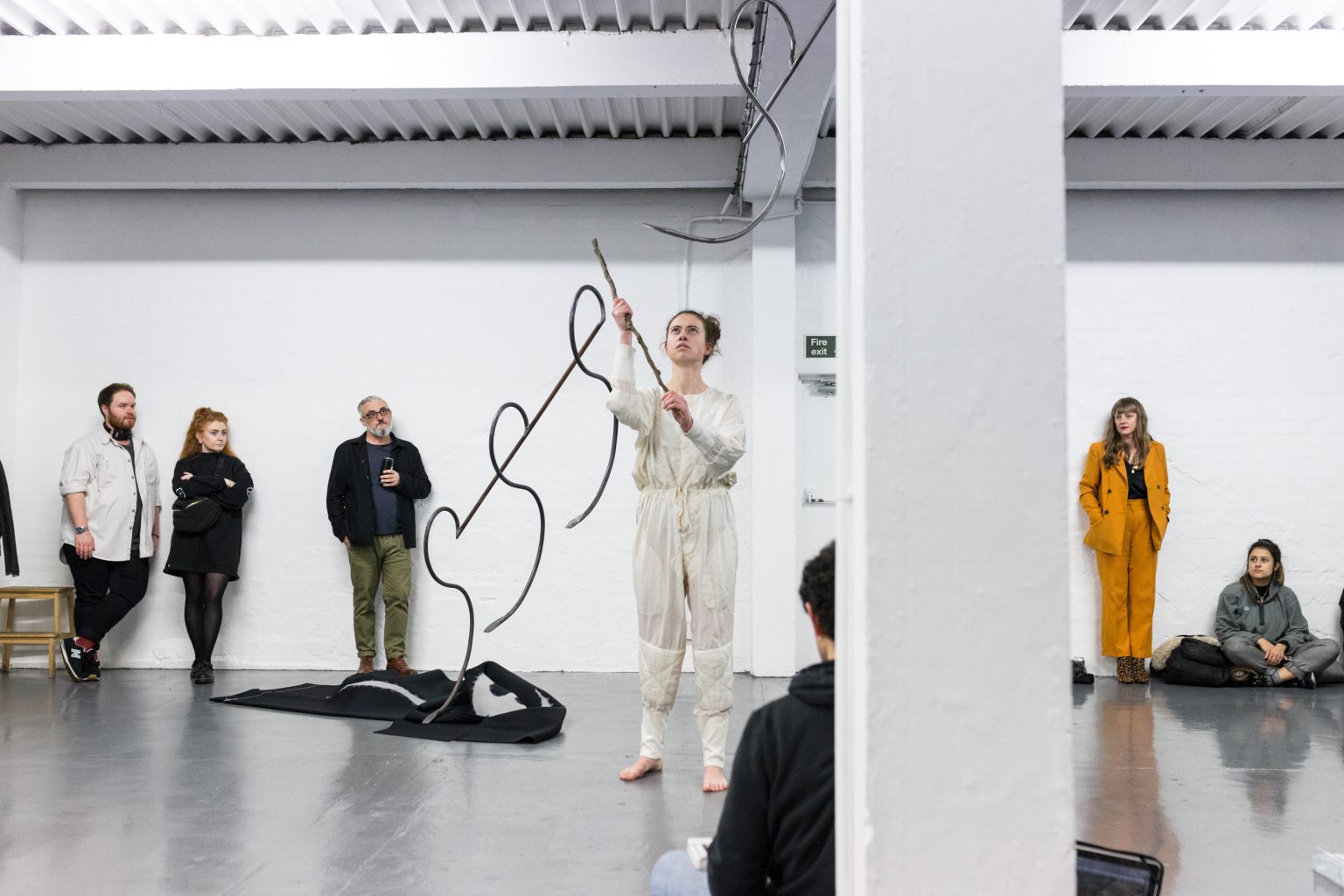
Nestled within De Montfort University campus is a building with a shining glass wall that offers passers-by a glimpse into other worlds. Leicester Gallery is renowned for a varied programme of exhibitions that usually presents work by established artists, but occasionally work by lesser-known artists and those who are just starting out appear in its programme too. 13 Beautiful Horses is one such example, an exhibition bringing together a variety of multi-disciplinary artists from the MA Contemporary Art Practice programme at DMU.
Immediately upon stepping into the gallery, I am confronted by a provocative collection of clay crystalised phalluses displayed on mixed-height platforms. Some are at eye-level, whilst others can be gazed at from above, presenting a display of glittering, textured surfaces which command attention. Max Hammond has taken an object of traditional masculine symbolism, usually associated with dominance, and upended it by making use of materials associated with camp aesthetics. Through embellishing the sculptures with hundreds of glittering crystals, Hammond strips them of their aggressive associations and reframes them as something of a spectacle. However, there are also hints at darker associations with narratives surrounding the expression of gender identity. A single canvas nearby is adorned with language relating to Hammond’s own lived experiences: words such as ‘Abandonment’ and ‘Scarred’ are stitched into the fabric of the canvas, which is particularly striking in the vulnerability it embodies.
Set behind Hammond’s sculptures are a series of expressionistic paintings by Harmony Bonner. Bonner works with poured backgrounds, oil pastel, and acrylic paint to create vibrant pieces that, perhaps at first, could be mistaken as joyful. However, as I linger in front of the paintings, undertones of isolation and disassociation become more apparent. In her own words, Bonner seeks to ‘document the struggle of late-diagnosed autistic girls to communicate in a world that often misunderstands them’. This is particularly direct in two paintings, ‘Masking’ and ‘Unmasking’ (both 2025), in which incomplete self-portraits, some missing facial features and others only partially painted, express the frustration of feeling misunderstood.
Positioned centrally in the gallery is a gigantic steel lipstick sculpture, bright red and about three metres in height. As with many of the artworks in this exhibition, all is not as it first appears: there is a mechanical element to it, the body of the lipstick emulating a screw thread. ‘What’s Your Thread Length’ (2025) by Emma Peers challenges assumptions and stereotypes about gender that are found embodied in everyday objects. She combines masculine and feminine forms to question binary societal structures. This is juxtaposed with Sophia Hussein’s ‘Origin’ (2025), a collection of small ceramic sculptures with porous structures in beige and black. The textures presented are very distinctive and varied, some representing coral whilst others seem reminiscent of fossils. Housed within a glass case, these little forms give the impression of scientific discoveries presented in a museum display. Despite the physical barrier of the display case between myself and the objects, Hussein’s work evoked a physical reaction within me as if I could feel the abrasiveness of the texture.
Moving towards a wide makeshift corridor, I find myself surrounded by the macabre and uncanny. Kane Hartley utilises the Surrealist technique of Automatism to tap into ‘the realm of the subconscious’ and access the dark parts of his psyche. The effect is harrowing, forcing the spectator to confront distorted, robotic forms on black and white canvases. Within these works, glimpses of colour act to further highlight the unsettling nature of the subjects presented. One painting within Hartley’s six-piece collection stands out to me: a figure holding a pulsating heart in its hand, painted in thick brushstrokes of crimson.
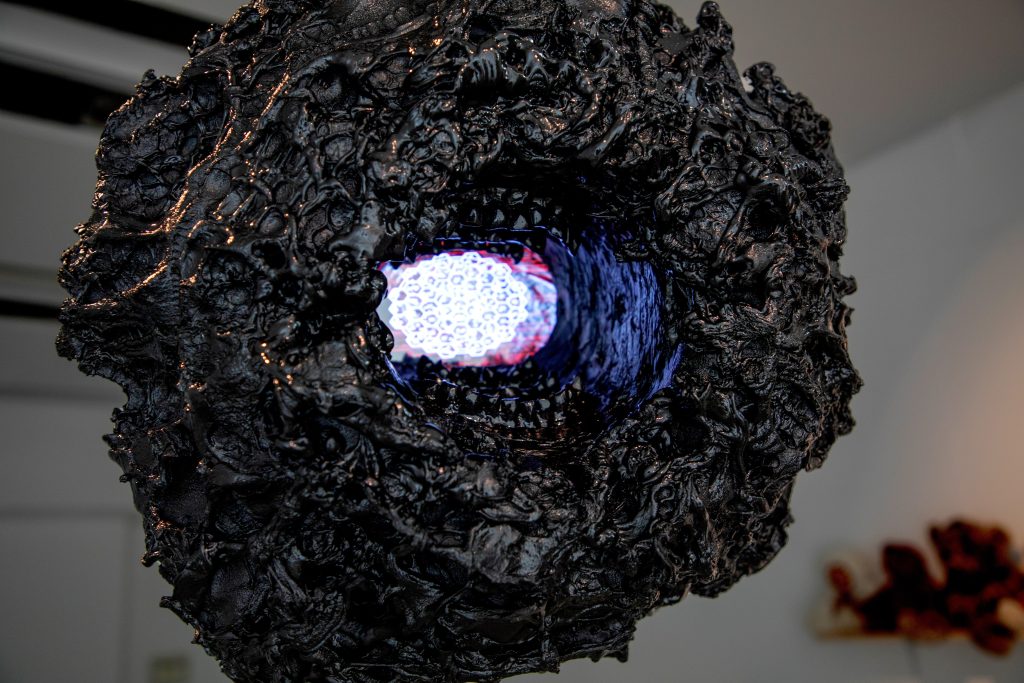
Further down the corridor, I enter a darkened room in which Ollie Scoble’s disturbing installation ‘Domination’ (2025) appears. A spherical sculpture hangs before me, its surface like molten rock, rough and uninviting. A long and narrow opening, punctuated by three sets of teeth, leads into the core of the sphere, within which a small video has been hidden. Scoble’s work explores the connection between technology and power structures, and the societal impact of its ever-increasing presence in our lives. From surveillance to social media, the video is deliberately disjointed and unsettling, leaving me to question the many different ways that technology has been used historically to control and manipulate. Nearby, Paula Uljanica’s ‘Nightmare Bears’ (2025) explores her recurring dreams and nightmares through the alteration of teddy bears, transforming the soft, cuddly toys into grotesque versions of themselves ‘through cutting, stitching, clay work and mixed media additions.’ Each represents a specific nightmare: from spider infestation to drowning, confronting me with some of my own deeply rooted fears.
Moving towards the corner of the space, I am greeted by Natasha Virli’s ‘The House and I’ (2025). A solitary door, detached from its hinges, features a series of digital images in cool blue, white, and black projected onto its white, glossy surface. Virli’s work spans writing, scanned materials, digital collage and drawing to explore memory, selfhood and the domestic space. There is a liminal quality to the work, the door acting as a portal into our deeper subconscious.
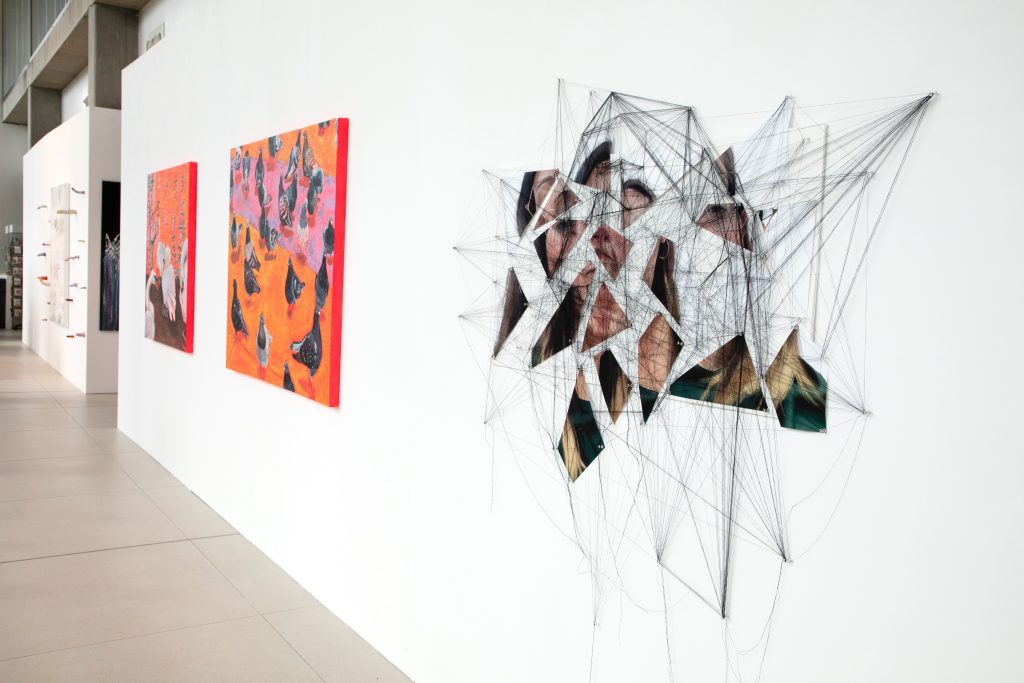
Returning back to the main gallery, I am drawn to two paintings by Olivia Clarke. ‘City Centre’ and ‘The Canal’ (both 2025) provide intimate snapshots of Leicester and highlight the hidden beauty that can be found within overlooked urban spaces. Alongside, Maria Pasinato’s ‘Sense of Self’ (2025) is an exploration of the ‘link between the mind and the face’; how what we think and feel translates to our outward expression. Pasinato’s two-dimensional painted self-portrait is fragmented into sharp geometric shapes and held together by delicate pieces of thread, which overlap and create a web connecting the different fragments of the painting. The empty spaces between the threads feel lonely and desolate but also strangely peaceful.
Lisa McNicoll explores relationality through installations which incorporate sound, video and performance. As I immersed myself in her series of short films exploring how ‘we interact with our environment’, I was drawn in by the layering of moving bodies paired with the sound of vibrant, funky beats. I was particularly moved by an older couple dancing across the screen, happiness and love in their eyes.
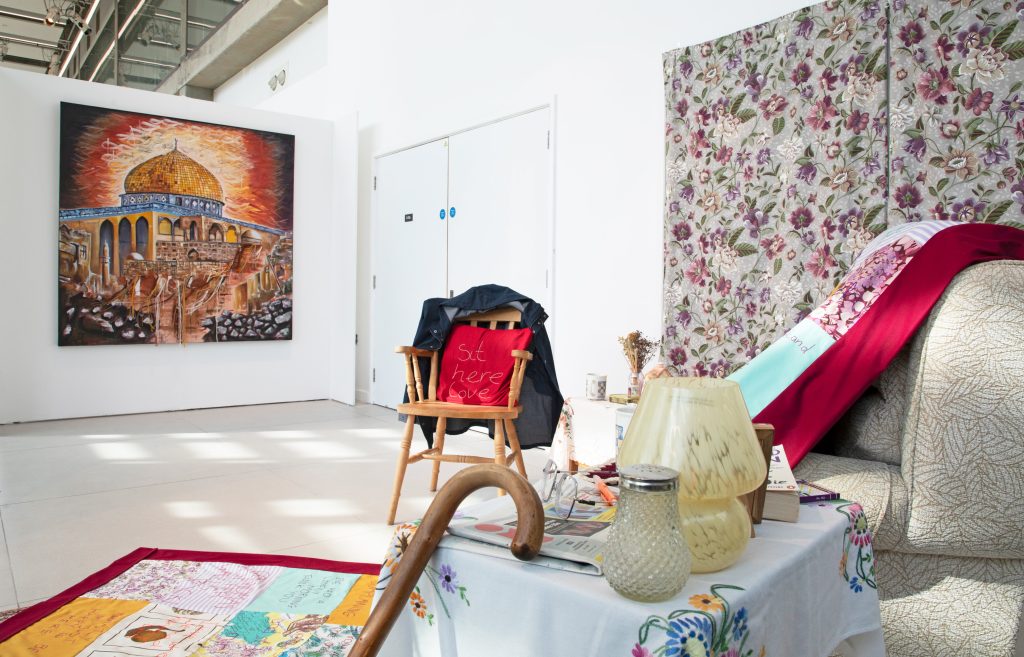
At the far end of the gallery, a huge canvas has been painted and woven in a Post-Impressionistic style with a depiction of the famous Islamic landmark the Dome of the Rock in Jerusalem. Umer Iqbal’s work consists of two opposing halves; the top half features the historic building’s distinctive golden dome and blue tiling reaching into a fiery sky, whilst the lower half depicts the building in a ruined, crumbling state. Iqbal’s choice of a subject matter that is a focus of religious debate and political controversy is poignant and brave, working not only to call attention to the current tensions in Jerusalem but also the questions that arise over individual human identities and values when they are called into question by such conflict. Positioned next to this painting is Chloe Green’s installation ‘They Said What?!’ (2025), a cosy and inviting corner where viewers can sit down and absorb the snippets of conversation that have been embroidered into the patchwork quilt, the main focal point of the display. Some phrases are humorous, whilst others are contemplative. I took my time absorbing the moments that Green had collected from her shared interactions or overheard whilst out and about, reminding myself to be more appreciative of interactions with those closest to me.
The bringing together of these thirteen artists results in an exhibition that is bold and daring. Three very distinct themes emerge, the first being representation and visibility. The works of Hammond, Bonner and Peers explore feminist and queer narratives, subjects that until recently have been largely ignored and sidelined. By foregrounding these stories, they reclaim space for marginalised voices. The second grouping of artworks deals with wider discourse through the uncanny and surreal. Hartley, Scoble, Uljanica and Virli create dreamlike worlds using the subconscious to explore collective anxieties about wider society. The works of Clarke, Hussein, Pasinato, McNicoll, Iqbal and Green explore the human experience, exploring issues of belonging, conflict and identity. This exhibition is provoking and challenging, highlighting the importance of art as a platform to engage audiences with social, political and cultural discourse.
13 Beautiful Horses was on at Leicester Gallery, Leicester, 13 September 2025 – 26 September 2025.
This review is supported by the artists and their sponsors StudionAme, Churchgate Artist Studios and The Unloved.
Paige Costinescu is a museum professional and writer based in Leicester.
Published 02.10.2025 by Rachel Graves in Reviews
1,481 words